Kalaushin
RUEN
Menu

The family history

Fourteen chapters, from the origin of the name and the Khoper Cossacks to the present day. Each chapter rests on documents, published sources and family testimony, and every reference is marked with its source class.

◆ documented◈ published source◇ family testimony△ hypothesisMore about the method

  1. Chapter 1 · 17th century – present

    The Name

    Kalaushin: a travelling bag, an earflap hat and the Kalaus River

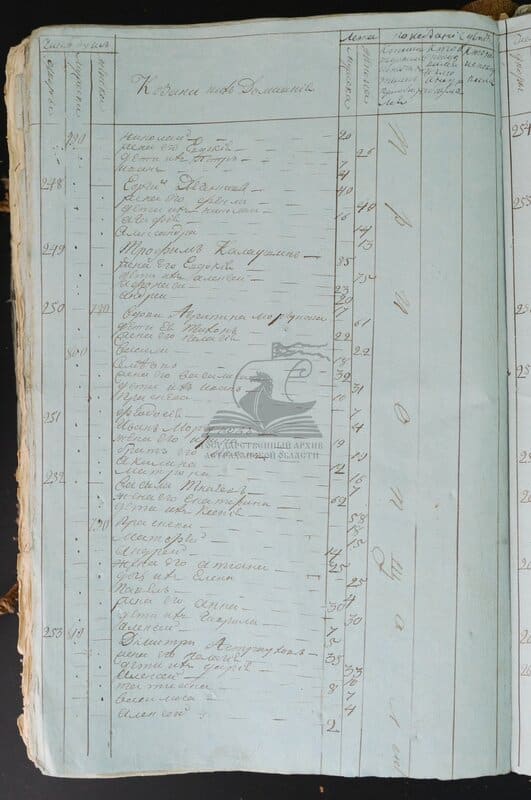
    Where the rare surname Kalaushin came from, and how clerks wrote it down — from “Trofim Pakhomov Kalaushin” in the census return of 1815 to “Koloushin”, “Kaloushin” and “Kelaushin the 1st”. The chapter brings together the dialect words *kalaush* (a travelling bag) and *kalaushka* (an earflap hat), the history of the Kalaus River and the family’s account of Yuliya Matveyevna and S.S. Goloushev, and ranks the explanations of the name by likelihood.
    Read the chapter →

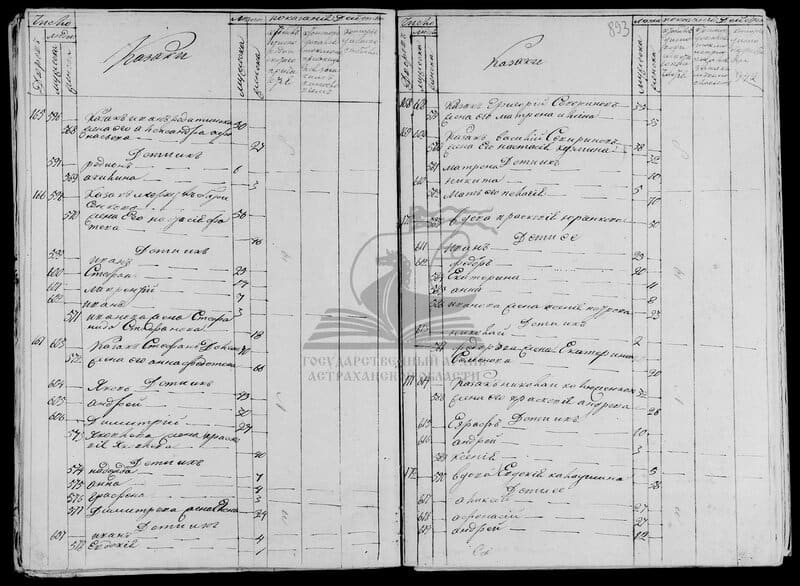
    Confession lists, 1822–25: Trofim Kalaushin with his wife Evdokia and sons
    ◆ Confession lists of Stavropol district, 1822–25: "Trofim Kalaushin, his wife Evdokia, their children Aleksei, Afanasy, Andrei". Trofim Pakhomovich is the earliest documented ancestor of the family; the compiler of the roster, before these records were known, rightly placed the founder "around 1740" [State Archive of Astrakhan Region, f. 599, op. 2, d. 3684, scan 1287; Roster of A. B. Kalaushin, no. 1].State Archive of Astrakhan Region, f. 599, op. 2, d. 3684; scan: Yandex "Search in archives"
  2. Chapter 2 · c. 1737 – 1827

    The Khoper

    The founder, Trofim Pakhomovich, and half a century of the Khoper Cossacks on the Azov–Mozdok Line

    The earliest Kalaushin named in the documents is Trofim Pakhomovich, a Khoper Cossack of Stavropolskaya stanitsa, born about 1737. This chapter follows the Khoper Cossacks from their river to the Caucasus in 1777–1781, describes life at the headwaters of the Kalaus, and tells how Trofim’s family moved on to the Kuban, to Batalpashinskaya stanitsa, in 1825–1827.

    Read the chapter →

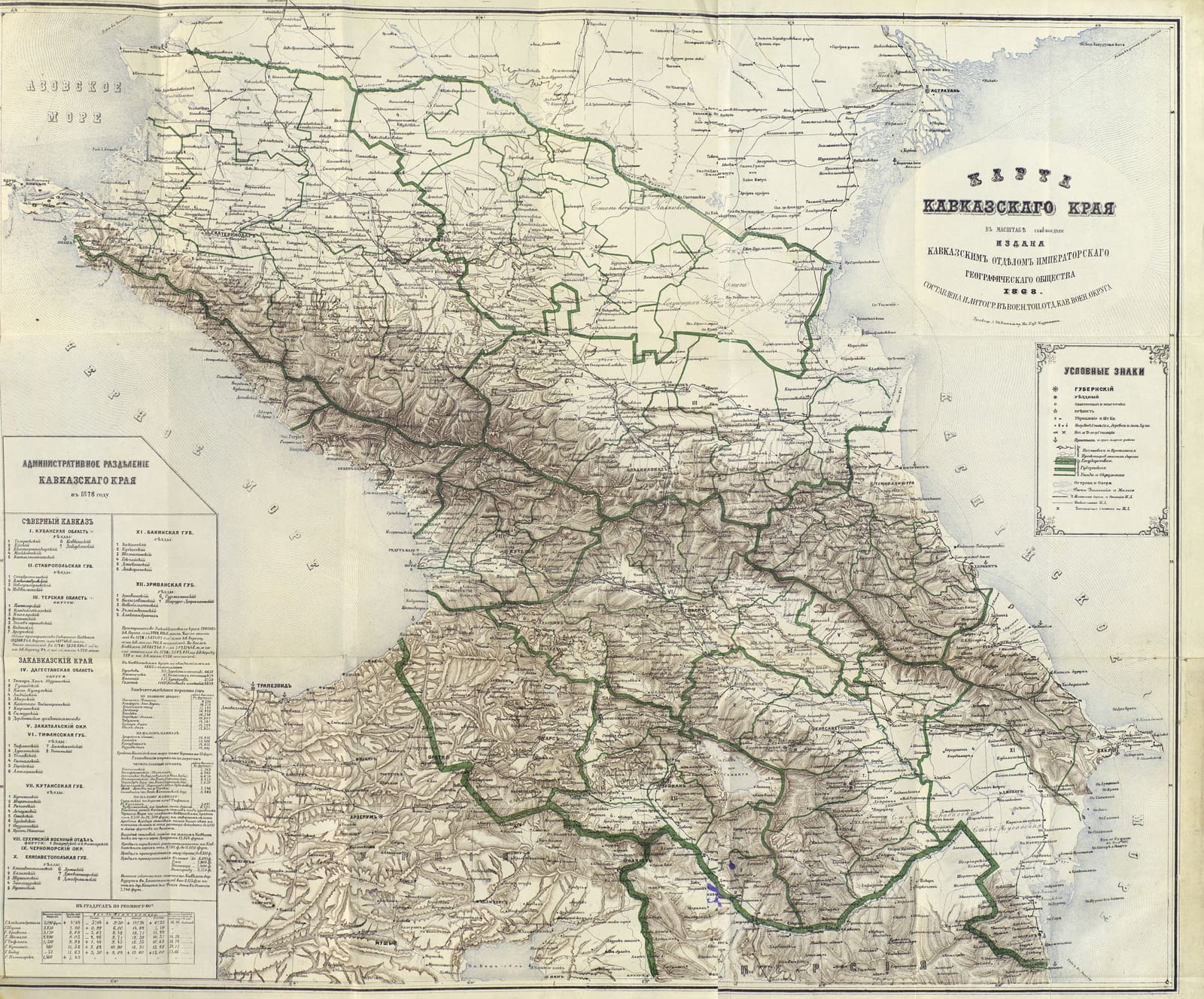
    Map of the Caucasus Region, 1868
    Map of the Caucasus Region published by the Caucasian Branch of the Imperial Russian Geographical Society in 1868 [Wikimedia Commons].Wikimedia Commons (public domain)
  3. Chapter 3 · 1815–1860

    The Caucasian Line

    Trofim Kalaushin, his sons and the stanitsa of Batalpashinskaya (1815–1860)

    The earliest Kalaushins named in the records are Trofim Pakhomovich, a Khoper Cossack of Stavropolskaya, and his sons Ivan, Aleksey, Afanasy and Andrey, who moved in 1826–1827 to the new stanitsa of Batalpashinskaya on the Kuban. The chapter follows their households through the lists of 1815, 1827, 1848 and 1860, tells the story of the chamber Cossack Andrey Ivanovich and the family’s first decorations, and gently refines A.B. Kalaushin’s family roster in the light of the documents.

    Read the chapter →

    Confession lists, 1822–25: Trofim Kalaushin with his wife Evdokia and sons
    ◆ Confession lists of Stavropol district, 1822–25: "Trofim Kalaushin, his wife Evdokia, their children Aleksei, Afanasy, Andrei". Trofim Pakhomovich is the earliest documented ancestor of the family; the compiler of the roster, before these records were known, rightly placed the founder "around 1740" [State Archive of Astrakhan Region, f. 599, op. 2, d. 3684, scan 1287; Roster of A. B. Kalaushin, no. 1].State Archive of Astrakhan Region, f. 599, op. 2, d. 3684; scan: Yandex "Search in archives"
  4. Chapter 4 · 1810–1917

    Service and Crosses

    Khoper Cossacks, Convoy men and officers: the Kalaushins in service, 1810–1917

    For more than a century the Kalaushins served in the Khoper regiments, in His Majesty’s Own Convoy and in the units of the Kuban Cossack Host — from a Cossack who joined in 1810 to a lieutenant colonel of 1916. This chapter follows that service through the regimental history, imperial orders, directories and newspapers, together with the family’s own memory, including the farewell review of 1900 and the saddle for the Shah of Persia.

    Read the chapter →

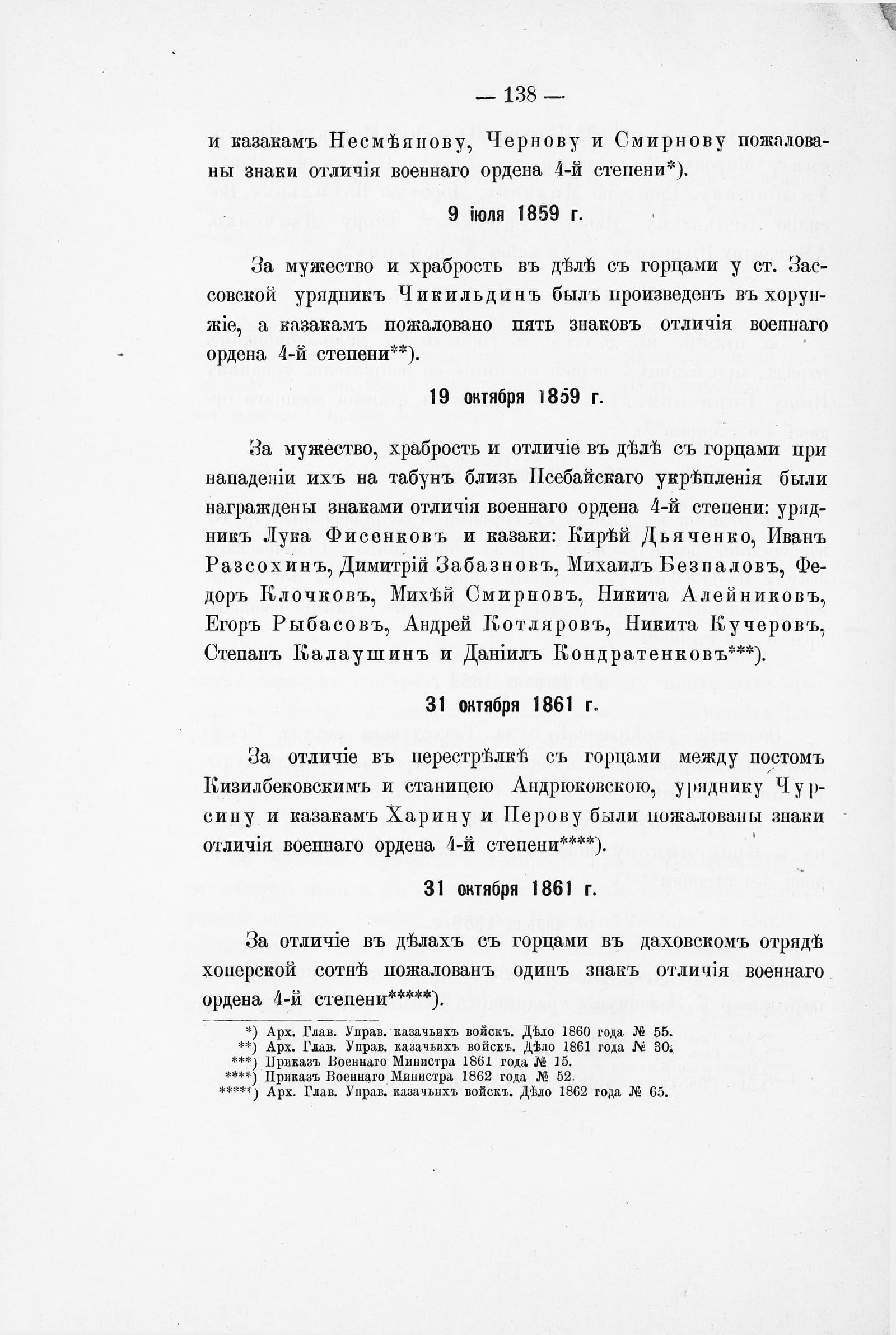
    Tolstov, History of the Khoper Regiment, App. 65, p. 138: Cossack Stepan Kalaushin, Psebai, 1859
    ◆ "For courage, bravery and distinction in the action with the Highlanders when they attacked the horse herd near the Psebai fort" on 19 October 1859, several Cossacks received the St George insignia, 4th class, among them "Stepan Kalaushin". The roster assigns this award to Stefan Nikolaevich [Tolstov 1901, App. 65, p. 138; Roster of A. B. Kalaushin, no. 30].Scan: State Public Historical Library of Russia (elib.shpl.ru)
  5. Chapter 5 · 1853–1911

    At Court

    The Kalaushins in His Majesty’s Own Convoy, 1853–1911

    For half a century Kalaushins from Batalpashinskaya served at the Imperial Court — from Andrey Ivanovich, chamber Cossack to the Tsesarevna in 1853, to the Convoy uryadniks Fedot, Mikhail and Aleksandr Alekseyevich and to Ivan Stepanovich, who came to the Convoy’s centenary in 1911. At the heart of the chapter is the family’s account, confirmed by relatives, of the saddle made in Fedot Alekseyevich’s workshop for the Shah of Persia, and its most consistent dating: spring to early summer 1900, for the visit of Mozaffar ad-Din Shah.

    Read the chapter →

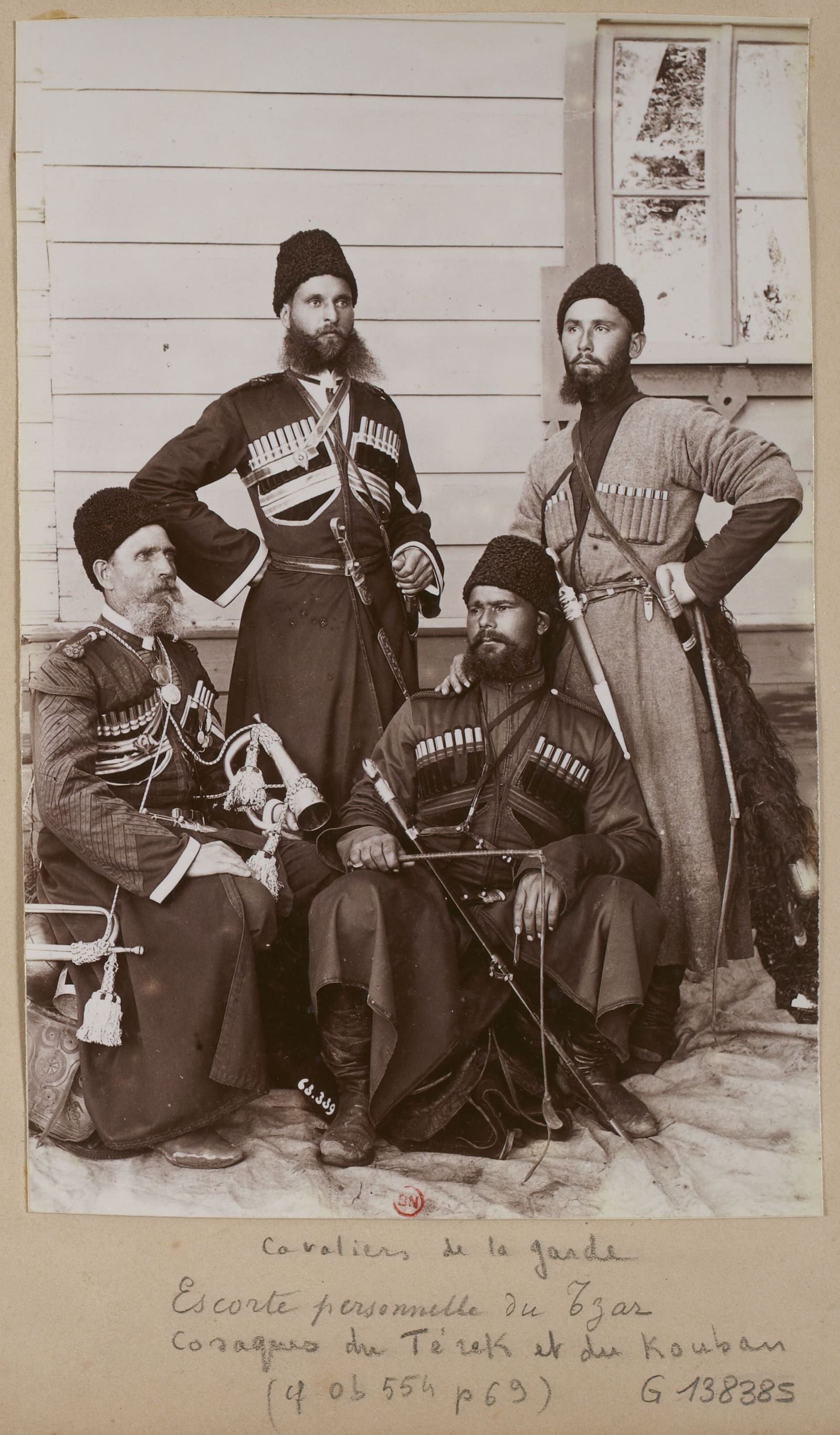
    Kuban and Terek Cossacks of His Imperial Majesty's Own Convoy, 1892
    "Escorte personnelle du Tzar. Cosaques du Térek et du Kouban" — lower ranks of the Convoy in full dress with kinjals and shashkas. Album "Armée russe, 1892", photographs by E. and F. de Jongh; BnF, sheet G 138385. The sitters are not named; 1892 was the year Fedot Alekseevich Kalaushin began his Convoy service.Source gallica.bnf.fr / BnF
  6. Chapter 6 · 1840s–1931

    The Workshop

    The Kalaushin saddlers: from a stanitsa workshop to the Imperial Court

    For several generations the Kalaushins of Batalpashinskaya were saddlers: their saddles and harness won awards at exhibitions from Tiflis to Nizhny Novgorod, officers of the Emperor’s Convoy bought their saddles, and Fedot Alekseyevich appears in the 1915 List of Purveyors to the Imperial Court. This chapter follows the masters and their workshops in Batalpashinskaya and Labinskaya, and tells two family accounts confirmed by relatives — the saddle for the Shah of Persia, which, set against the records, falls in the spring and early summer of 1900, and the parade commission for Archduke Franz Ferdinand.

    Read the chapter →

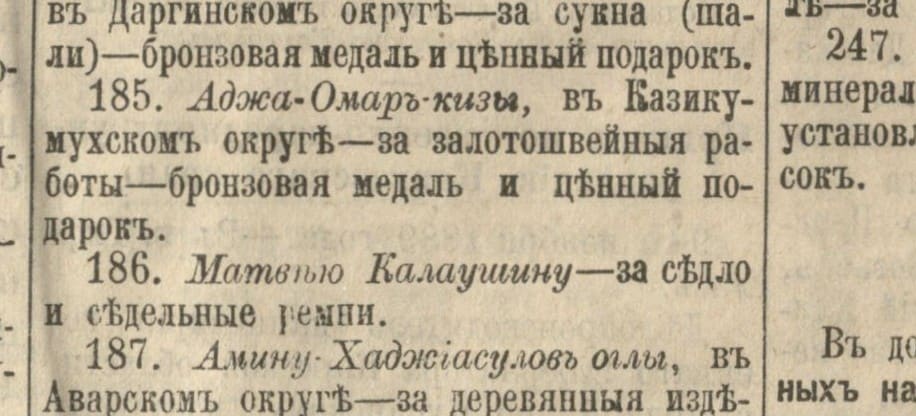
    "186. To Matvei Kalaushin — for a saddle and saddle straps" (Tiflis, 1889)
    ◆ Bronze medal or 3rd-class honorary diploma of the 1889 Caucasian Exhibition in Tiflis: "186. To Matvei Kalaushin — for a saddle and saddle straps". The earliest exhibition award found that names a Kalaushin, and specifically for a saddle. The notice gives no stanitsa; almost certainly this is Matvei Alekseevich, then 22 ["Kavkaz", No. 305, 17 Nov 1889, p. 2; Roster of A. B. Kalaushin, no. 71].Scan: National Parliamentary Library of Georgia, Iverieli digital library
  7. Chapter 7 · 1917–1931

    The Upheaval

    The Kalaushins in the Revolution, the Civil War and the first Soviet years (1917–1931)

    The Revolution found the Kalaushins on the Persian front and in their home stanitsas; the Civil War divided the family, took the lives of Pavel Aleksandrovich and of Fedot Alekseyevich, shot as a hostage in 1920, while Pavel’s wife and their three children — among them the author’s great-grandfather — escaped from a burning barn. This chapter tells those years in the family’s own words and from the documents, from the Khoper Cossacks’ return from Persia in the spring of 1918 to the disenfranchisement lists of 1930–1934, an execution in 1931 and the rehabilitations that came decades later.

    Read the chapter →

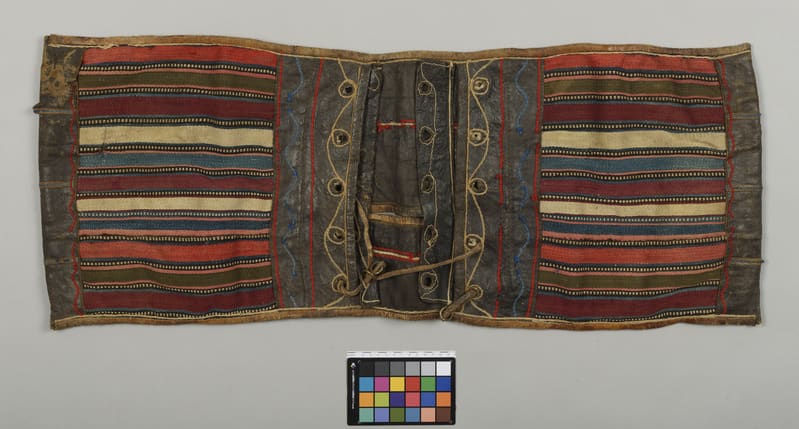
    Saddle bag brought from Persia by the doctor of a Kuban Cossack regiment, 1918
    Saddle bag of striped linen and leather. The museum record states: "brought from Persia during the First World War, to Estonia in 1918, by the Estonian doctor Edgar Hansen, who served in a Kuban Cossack regiment". Persian work; shown as a reminder of the Kuban regiments' service in Persia during the First World War. Haapsalu and Läänemaa Museums, HM 410 E.Haapsalu and Läänemaa Museums (MuIS), CC0
  8. Chapter 8 · 1918–1976

    Exile

    The Kalaushins abroad: Manchuria, Constantinople, Lemnos, Serbia and France, 1918–1976

    After the Civil War three sons of the Labinskaya master saddler Matvey Alekseyevich Kalaushin, and the Cossack infantry colonel Nikita Ilyich, ended up outside Russia — in Manchuria, Constantinople, on Lemnos, in Serbia and in France. This chapter follows their paths through General Staff lists, evacuation lists, émigré journals, reference works and the family’s own memory.

    Read the chapter →

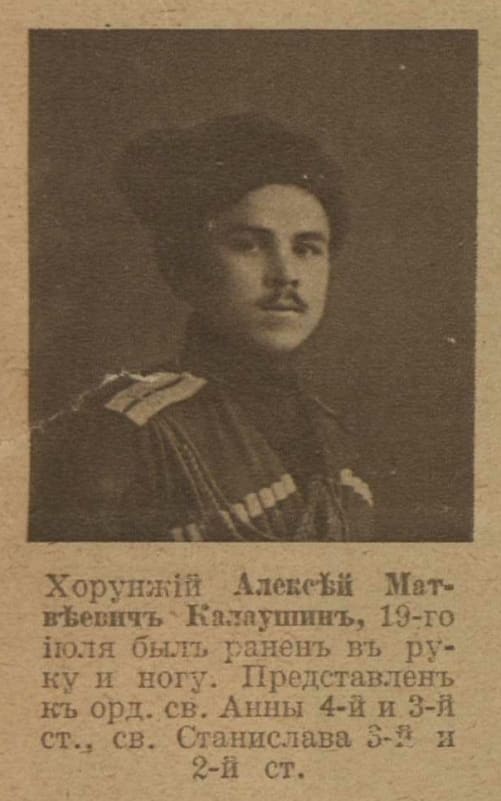
    Khorunzhy Aleksei Matveevich Kalaushin in a cherkeska with gazyri, 1915 (magazine clipping)
    Magazine clipping, 1915: "Khorunzhy Aleksei Matveevich Kalaushin, wounded in the arm and leg on 19 July. Recommended for the Orders of St Anna, 4th and 3rd class, and St Stanislaus, 3rd and 2nd class." The best known portrait of Aleksei Matveevich, later a colonel and an émigré in Manchuria [ria1914.info; Roster of A. B. Kalaushin, no. 122].1915 publication; copy from the site "Officers of the Russian Imperial Army" (ria1914.info)
  9. Chapter 9 · 1941–1945

    The Great Patriotic War

    The Kalaushins at the front, in besieged Leningrad and on the home front, 1941–1945

    Between 1941 and 1945 Kalaushins from Cherkessk, Bekeshevskaya, Zelenchukskaya, Vladikavkaz and Leningrad served as drivers, carters, sappers, anti-aircraft gunners and officers, from Novgorod and Myskhako to Berlin and the Far East, and the Book of Memory of Karachay-Cherkessia alone lists nine men of the name killed or missing. This chapter follows them through casualty reports, award sheets and the family roster, and also tells of besieged Leningrad, where Matvey Matveyevich Kalaushin served as acting commandant of Pushkin House, and of the spring of 1945 in ruined Mikhailovskoye.

    Read the chapter →

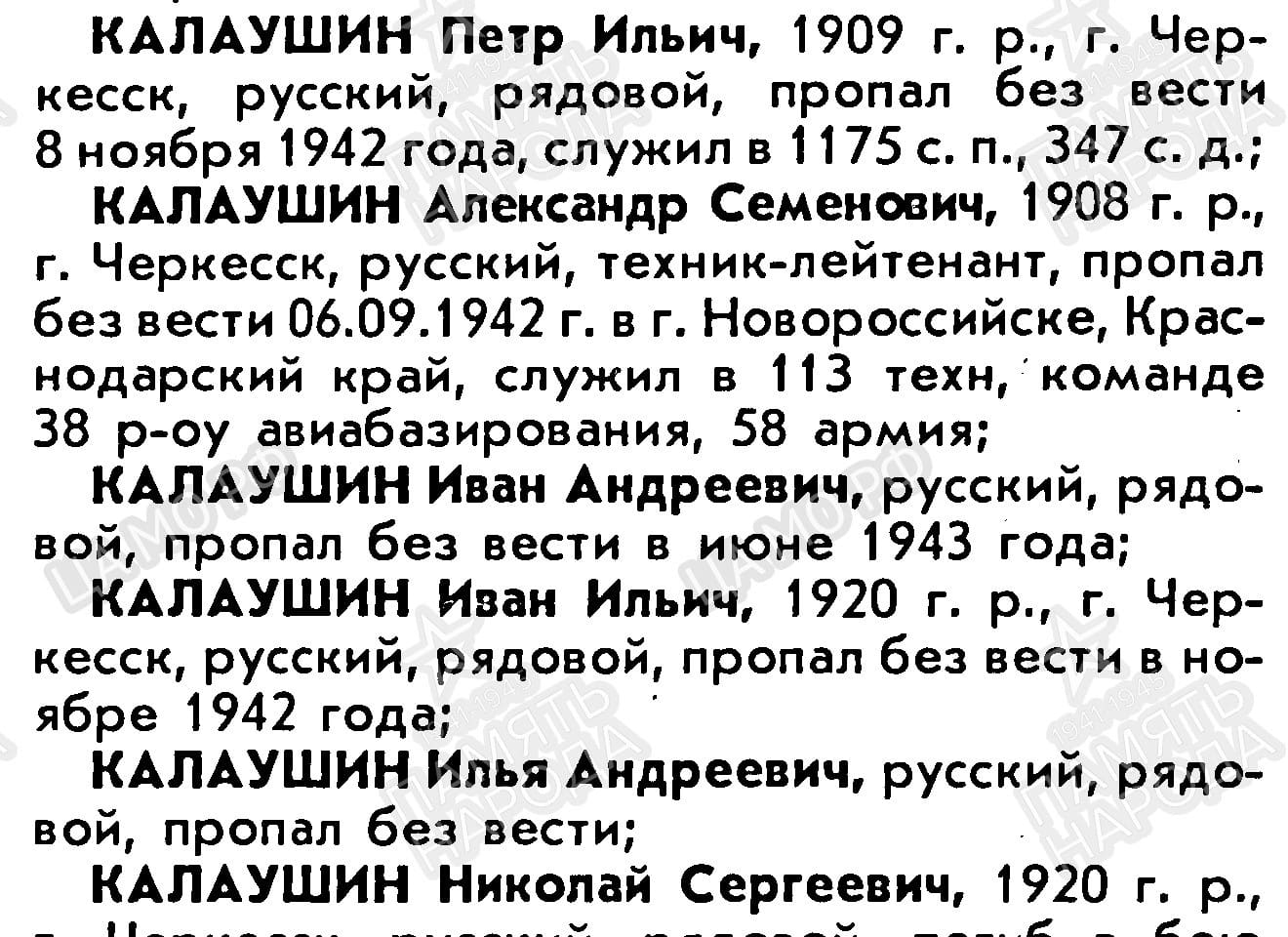
    Book of Memory of Karachay-Cherkessia: entries "Kalaushin" (KChR, p. 59, part 1)
    ◆ Page of the Book of Memory of Karachay-Cherkessia with entries on the Kalaushins killed or missing in the war: Pyotr Ilyich, Aleksandr Semyonovich, Ivan Andreevich, Ivan Ilyich, Ilya Andreevich, Nikolai Sergeevich, Nikolai Fyodorovich, Pavel Ilyich, Pyotr Ivanovich. Nikolai Sergeevich, Ilya Andreevich and Ivan Andreevich appear in the roster [OBD Memorial, Book of Memory of KChR].OBD "Memorial" database (Russian Ministry of Defence)
  10. Chapter 10 · 1904–1968

    Pushkin House

    Matvey Matveyevich Kalaushin (1904–1968), Pushkin scholar and museum-maker

    The youngest son of a Labinskaya saddler and a pupil of Boris Eikhenbaum, Matvey Matveyevich Kalaushin spent more than twenty years building the literary museums of Pushkin House in Leningrad, lived through the blockade winter there, looked after the ruined Pushkin Reserve at Mikhailovskoye after its liberation — where Semyon Geychenko was made director in 1945 on his recommendation — and in 1953–1965 was the first director of the All-Union Pushkin Museum. This chapter follows his museum work from the act of 1934 to the opening of the Pushkin exhibition in the Alexander Palace in 1949, the attacks on him in 1946 and 1951, his letters in RGALI, the ways he has been remembered — from the centenary exhibition at Mikhailovskoye (2005) to the plaque in Labinsk — and the double marriage that joined the Kalaushins and the Chirskovs.

    Read the chapter →

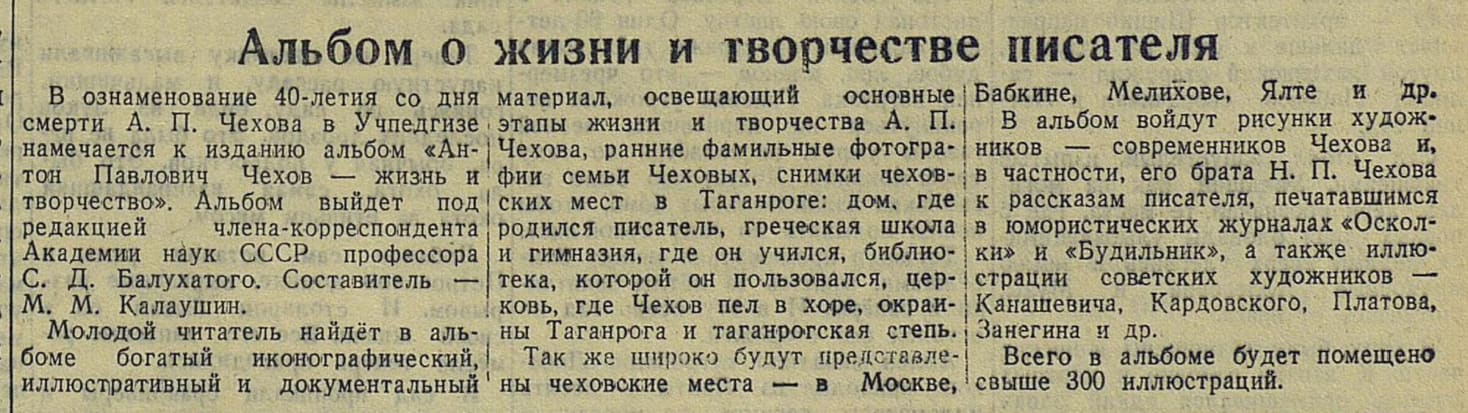
    Leningradskaya Pravda, 15 July 1944: a Chekhov album compiled by M. M. Kalaushin
    ◆ Note "An album on the writer's life and work", for the 40th anniversary of Chekhov's death: "The album will be edited by Professor S. D. Balukhaty, corresponding member of the USSR Academy of Sciences. Compiler — M. M. Kalaushin." The album appeared in 1957 as "A. P. Chekhov in Portraits, Illustrations and Documents" [Leningradskaya Pravda, 15 Jul 1944, No. 168, p. 3].National Library of Russia, Vivaldi digital library
  11. Chapter 11 · 1929–1999

    The Artist

    Boris Matveyevich Kalaushin (1929–1999): Siege booklets, Mikhailovskoye, a hundred children’s books, painting and the Apollon society

    Grandson of a Labinskaya master saddler and son of a Pushkin scholar, Boris Matveyevich Kalaushin made hand-written booklets as a boy in besieged Leningrad, drew war-ravaged Mikhailovskoye at fifteen, and went on to illustrate more than a hundred children’s books while painting, for decades, pictures that almost no one saw before 1987. This chapter follows his path from the Academy of Arts to the Apollon society and his books on the Russian avant-garde, his family, the stories of the clan he passed on, and where his work is kept today — some 120 originals in nine museums.

    Read the chapter →

    "186. To Matvei Kalaushin — for a saddle and saddle straps" (Tiflis, 1889)
    ◆ Bronze medal or 3rd-class honorary diploma of the 1889 Caucasian Exhibition in Tiflis: "186. To Matvei Kalaushin — for a saddle and saddle straps". The earliest exhibition award found that names a Kalaushin, and specifically for a saddle. The notice gives no stanitsa; almost certainly this is Matvei Alekseevich, then 22 ["Kavkaz", No. 305, 17 Nov 1889, p. 2; Roster of A. B. Kalaushin, no. 71].Scan: National Parliamentary Library of Georgia, Iverieli digital library
  12. Chapter 12 · late 20th century – 2026

    The Chroniclers

    Who kept and wrote down the Kalaushin family’s memory — from family stories to the 2026 review

    The Kalaushins’ memory was kept by its storytellers — Boris Matveyevich, Olga Savvichna, Emiliya Fyodorovna, Mariya Aleksandrovna and many others — and by two family chroniclers: Aleksandr Borisovich Kalaushin, who spent more than forty years assembling the family roster, and Yury Romanovich Kalaushin, who compiled a family tree of 363 people. This chapter tells how their records became the roster published on the Philippov website, which family accounts relatives confirm — among them the saddle for the Shah of Persia, most consistently dated to spring and early summer 1900 — and how the roster was checked against the documents in 2026.

    Read the chapter →

    Confession book, 1827, Batalpashinskaya: the widow Evdokia Kalaushina with her sons
    ◆ Confession book, 1827: "the widow Evdokia Kalaushina, her children Aleksei, Afanasy, Andrei". By now Trofim had died; the family was settled in its new home, Batalpashinskaya stanitsa [State Archive of Astrakhan Region, f. 599, op. 2, d. 7148, scan 161].State Archive of Astrakhan Region, f. 599, op. 2, d. 7148; scan: Yandex "Search in archives"
  13. Chapter 13 · c. 1737 – the present

    Vyacheslav’s Line

    Nine generations of the author’s direct line, from the Khoper Cossack Trofim Pakhomovich to the present day

    This chapter follows a single line of the family — from Trofim Pakhomovich, a Khoper Cossack of Stavropolskaya stanitsa, through the saddler Nikolay Ivanovich, Uryadnik Aleksandr Nikolayevich, Pavel Aleksandrovich, whose wife and children escaped from a burning barn, the engineer Mikhail Pavlovich and Lieutenant Colonel Vyacheslav Mikhailovich, born in Chimkent, to the motoring journalist Oleg Vyacheslavovich and the author of this chronicle, Vyacheslav Olegovich, founder of Data Nexus. Along the way it tells how the name Vyacheslav returned to the family a generation later and how Kalaushin Convoy Cossacks, the Pushkin scholar Matvey Matveyevich and the author’s father each found their way to Tsarskoye Selo, and it matches the years in the family account of the saddle for the Shah of Persia, most consistently dated to spring and early summer 1900.

    Read the chapter →

    Confession lists, 1822–25: Trofim Kalaushin with his wife Evdokia and sons
    ◆ Confession lists of Stavropol district, 1822–25: "Trofim Kalaushin, his wife Evdokia, their children Aleksei, Afanasy, Andrei". Trofim Pakhomovich is the earliest documented ancestor of the family; the compiler of the roster, before these records were known, rightly placed the founder "around 1740" [State Archive of Astrakhan Region, f. 599, op. 2, d. 3684, scan 1287; Roster of A. B. Kalaushin, no. 1].State Archive of Astrakhan Region, f. 599, op. 2, d. 3684; scan: Yandex "Search in archives"
  14. Chapter 14 · 1737–2026

    Sources and Further Research

    How the chronicle was put together, where the documents on the Kalaushins are kept, and how relatives can help

    The Kalaushin chronicle rests on three layers — family memory as recorded in A.B. Kalaushin’s family roster, the documents of each period, and the work of historians; this chapter explains how they were brought together, how to search for the family name in old records, and which archives, from Stavropol, Krasnodar and St Petersburg to Vienna and Tehran, hold or may hold papers on the family. It also sets out where to look for papers on the two accounts that relatives confirm — the saddle for the Shah of Persia (most consistently dated to spring and early summer 1900) and the commission for Archduke Franz Ferdinand — lists the enquiries prepared for museums, and invites relatives to add their photographs, documents and stories.

    Read the chapter →

    Confession lists, 1822–25: Trofim Kalaushin with his wife Evdokia and sons
    ◆ Confession lists of Stavropol district, 1822–25: "Trofim Kalaushin, his wife Evdokia, their children Aleksei, Afanasy, Andrei". Trofim Pakhomovich is the earliest documented ancestor of the family; the compiler of the roster, before these records were known, rightly placed the founder "around 1740" [State Archive of Astrakhan Region, f. 599, op. 2, d. 3684, scan 1287; Roster of A. B. Kalaushin, no. 1].State Archive of Astrakhan Region, f. 599, op. 2, d. 3684; scan: Yandex "Search in archives"