Chapter 11 of 14 · 1929–1999
The Artist
Boris Matveyevich Kalaushin (1929–1999): Siege booklets, Mikhailovskoye, a hundred children’s books, painting and the Apollon society
In brief
Grandson of a Labinskaya master saddler and son of a Pushkin scholar, Boris Matveyevich Kalaushin made hand-written booklets as a boy in besieged Leningrad, drew war-ravaged Mikhailovskoye at fifteen, and went on to illustrate more than a hundred children’s books while painting, for decades, pictures that almost no one saw before 1987. This chapter follows his path from the Academy of Arts to the Apollon society and his books on the Russian avant-garde, his family, the stories of the clan he passed on, and where his work is kept today — some 120 originals in nine museums.
◆ documented◈ published source◇ family testimony△ hypothesisMore about the method
The thread· Quality· System
Here quality is measured by museums: some 120 of Boris Matveyevich’s originals are held by nine collections, the Russian Museum among them, and the Museum of Fine Arts of Karelia calls his works the pride of its collection for that period [◈ S165; ◈ S171]. System lies in Apollon: two volumes on Kulbin, Search and Documents, about five hundred pages each, which he paid for himself when the sponsor ran into difficulties [◈ S178; ◈ S115].
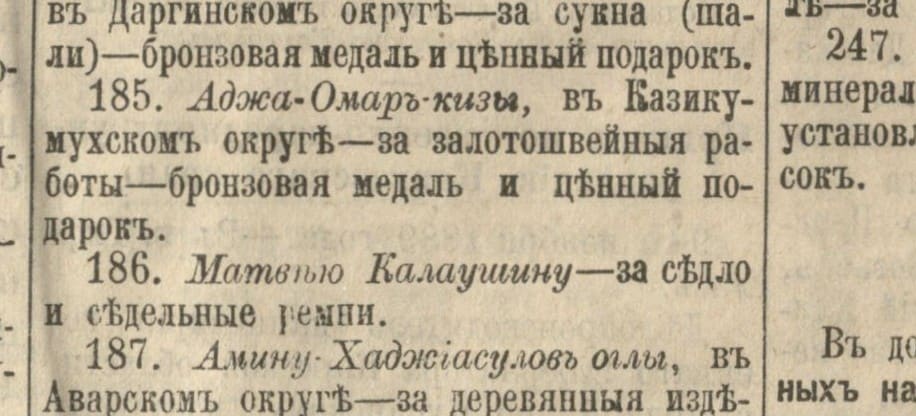
In the autumn of 1889, at the Caucasus Exhibition in Tiflis (now Tbilisi), a bronze medal “for a saddle and saddle straps” went to Matvey Kalaushin [◆ S036, no. 305, 17.11.1889, p. 2]. The award list does not name his stanitsa (Cossack village), but △ he was almost certainly Matvey Alekseyevich Kalaushin [S001, No. 71], a twenty-two-year-old Cossack of Batalpashinskaya from a family of saddlers: the surname is rare, and in 1896, at the All-Russian Exhibition in Nizhny Novgorod, he was honoured again, with an honourable mention for leather goods [◆ S044, no. 1, pp. 33, 36].
◇ family testimony · confirmed by relatives
The family also remembers the proudest commissions of the workshops run by the artist’s grandfather and his brothers. The saddle for the Shah of Persia (Iran), ordered by Emperor Nicholas II, was made over two months in the workshop of Fedot Alekseyevich Kalaushin [S001, No. 73], Matvey Alekseyevich’s brother; Fedot Alekseyevich took it to St Petersburg himself, and the Emperor praised the work and there and then congratulated the master on the title of Purveyor to the Court of His Imperial Majesty. The last commission that Matvey Alekseyevich carried out together with Fedot Alekseyevich was a full set of parade equipment — harness, saddles, sabres, kinzhals (Caucasian daggers) — for Archduke Franz Ferdinand: a “political” order meant to help improve relations with Austria-Hungary [◇ S001, Nos. 71, 73]. Relatives confirm both accounts — the saddle for the Shah, and that the commission for the Archduke was completed; both are recorded in the family history [◇ S003].
△ The years point to 1900. Fedot Alekseyevich served in His Majesty’s Own Convoy from 1892 and was discharged by Order No. 60 of the Kuban Cossack Host of 17 June 1900 [◈ S001, No. 73], and the only state visit of a Persian shah to St Petersburg in those years was that of Mozaffar ad-Din Shah, 4–10 July 1900 Old Style (17–23 July New Style) [◆ S052, 20.07.1900, p. 5]. The most consistent dating is spring to early summer 1900: the saddle was made for that visit. The dates are examined in detail in the chapter “At Court”, and the Archduke’s commission in “The Workshop”.
Matvey Alekseyevich’s grandson chose a different craft. Boris Matveyevich Kalaushin [S001, No. 213], son of the Pushkin scholar Matvey Matveyevich [S001, No. 127], became a book artist and a painter: he illustrated more than a hundred children’s books, painted all his life — pictures that were not exhibited before 1987 — and studied and published the history of the Russian avant-garde [◈ S204, “Kalaushin B.M.”; ◈ S163]. By our count of museum records, some 120 of his original works are held today in nine Russian museums [◈ S165; ◈ S171; ◈ S167; ◈ S166].
Leningrad and Mikhailovskoye
Boris was born in Leningrad on 6 August 1929 [◈ S001, No. 213; ◈ S005]. His father, the son of the Labinskaya saddler, worked from 1931 at Pushkin House — the Institute of Literature of the Academy of Sciences — where he headed the Literary Museum and, on the institute’s behalf, oversaw the Pushkin Reserve at Mikhailovskoye; in 1949 he opened the All-Union Pushkin Museum in the Alexander Palace at Pushkin, and when in 1953 the museum was separated from Pushkin House as an institution in its own right, he became its first director, serving until 1965 [◈ S004; ◈ S086, no. 19, p. 196; ◈ S086, no. 26, p. 36; ◈ S086, no. 102, p. 61; ◈ S150]. His mother, Emiliya Fyodorovna (née Chirskova) [◈ S001, No. 127], had studied at a music college under the well-known musician Sergey Alpers, a friend of Sergey Prokofiev. Artists, writers, musicians and philologists came to the house, and it was in this circle, the staff of the All-Russian Pushkin Museum write, that the future artist was formed [◈ S163].
Note on the roster. The roster gives 1947 as the year of Emiliya Fyodorovna’s death. Letters show that she was alive in May 1955 and on 30 December 1968, when she wrote to Yu.G. Oksman [◆ S086, no. 51, p. 185; ◆ S028, f. 2567, op. 1, ed. khr. 541]; the roster itself repeatedly cites her recollections.
◇ family testimony
His father encouraged the boy’s gifts in every way, and at the age of six Borya was already going out to paint from nature at Trigorskoye with the artists N.E. Radlov and L.S. Khizhinsky [◇ S001, No. 213].
In the summer of 1935 Radlov, N.K. Shvede-Radlova and Khizhinsky were indeed working in the Reserve, and on 29 and 30 August the district saw its first exhibition of the pictures on Pushkin themes they had painted there that summer; in 1936 paintings by Shvede-Radlova and watercolours by Khizhinsky were bought and commissioned for the Reserve’s museum. Matvey Matveyevich himself wrote about this [◆ S071, p. 392]. Boris turned six that summer. His father knew many artists, Radlov and Khizhinsky among them, and more than once drew them into museum work [◈ S004].
The Siege booklets
The family spent the first years of the war in besieged Leningrad [◈ S163]. In the Siege winter of 1941–42 Matvey Matveyevich, head of the Pushkin House museum, served as the institute’s commandant; in July 1942 he was sent to Tashkent, escorting a train with the most valuable museum material [◈ S129]. Boris, too, was evacuated to Tashkent [◈ S115].
Between the ages of twelve and fourteen, first in the besieged city and then in Tashkent, the boy made more than a hundred and fifty hand-written booklets, in most of which he was at once author, illustrator and “publisher” [◈ S163; ◈ S115]. He invented “publishing houses” and series for them — “Literature and Children”, “The Green Lamp Library”, “Around the World”, “Tiny Books” — numbered the issues and volumes, and gave a place of publication: Leningrad, the North Caucasus, Tashkent. The art historian Nikolay Kononikhin, who saw the booklets, was struck above all by how finished they were, nothing like a child’s work; among the fairy tales and stories he singled out The Rotten Drum. New Futurists, No. 34 of the “Tiny Books Library”, 1945, with a Futurist drawing on the cover [◈ S115]. The cover of one of the early booklets, Two Notebooks from “The Green Lamp Library”, carries the imprint “Literature and Children”, MCMXLI, and the author’s name “Shan-Tyul” [◈ S142, p. 30, fig. 3]. Boris Matveyevich later said of the booklets that “for me it was an absorbing game” [◈ S001, No. 213; ◈ S115].
The Kalaushins’ home held lithographed books by the Russian Futurists, with drawings by Goncharova, Larionov, Burliuk and Malevich [◈ S115]. Recalling the Siege winter, Boris Matveyevich said that everything went into the little stove — books, journals, some of the furniture — but never the lithographed drawings of Larionov, Malevich and the Burliuks, nor the Futurists’ treatises and poems [◈ S122]. Half a century later he wrote that the Futurists’ hand-made books “radiated a wondrous energy that did not let us die” [◈ S121, quoting B. Kalaushin, “Frantsuzskaya kniga”, in Boris Kalaushin (1929–1999): booklet, St Petersburg: Apollon, 1999, pp. 9–10].
Copies of Boris’s home-made booklets from the Siege and the evacuation were given by his sister to the People’s Museum “And the Muses Were Not Silent…” at St Petersburg School No. 235 [◈ S142, pp. 29–30]; △ the originals appear to remain in the family.
Mikhailovskoye, 1945
In April 1945 Semyon Geychenko became director of the Pushkin Reserve; no one, he recalled, had argued harder for sending him there than Matvey Matveyevich [◈ S100, p. 176]. On the morning of 12 April Geychenko set out for Pskov with L.N. Nazarova of Pushkin House and the fifteen-year-old Boris, who was travelling “to sketch the ruined Pushkin monuments”. Every station along the line had been destroyed; the train took more than two days and reached Pskov late in the evening of 14 April [◈ S100, pp. 178–179]. The Reserve’s newspaper tells the story of that spring a little differently: Matvey Matveyevich came to Geychenko with his son, a budding artist, who was given the task of recording the post-war state of Petrovskoye, the Hannibal family estate [◈ S087, no. 3 (22), 2017, p. 6]. △ These may have been two separate journeys.
On 16 May 1945, at Geychenko’s request, Boris drew a rough plan of the park at Petrovskoye and marked on it the German fortifications of 1943–44: a minefield, dugouts, trenches, shell craters, destroyed trees. In a note he recorded that the orchard belonged to the Petrovskoye agricultural co-operative and the park to the Reserve. The plan is kept in the Reserve’s archive [◈ S086, no. 83, p. 177, n. 2]. Boris made a second version, in colour, in 1946, marking the foundations of the Hannibal house and the buildings that had been destroyed [◈ S087, no. 3 (22), 2017, p. 6]. His father, too, drew plans of the German fortifications in the village of Savkino and in the centre of Mikhailovskoye “while the traces were still fresh” [◈ S086, no. 64, p. 33]. △ It is possible that one of the two publications has confused the initials of father and son; the Reserve’s archive may settle the question.
The pencil drawing Nanny’s Cottage (Domik nyani), signed “BKalaushin 45”, dates from the same year; in 2015 the Reserve’s newspaper printed it for the 70th anniversary of Victory [◆ S087, no. 2 (13), 2015, p. 3]. The cottage itself no longer existed: on the site of the destroyed building the Germans had dug trenches and dugouts. Reconstruction began on 7 October 1945; in the autumn of 1946 the first log frame had to be taken down, and the exhibition in the new cottage opened on 6 June 1947. In the spring of that year Geychenko, together with Matvey Matveyevich as head of the Literary Museum of the Institute of Literature, had submitted its outline for approval [◈ S086, no. 68, pp. 31–34]. The newspaper does not say where the original drawing is kept.
In 1946 Boris was working in the Reserve again. His name also found its way into a report on the shortcomings of the Reserve, compiled in December 1946 by N.I. Aksenov, the assistant director for administration, who complained of public money spent on “drawings of scientific content” made by “our own people” coming from Leningrad on holiday — among them “Kalaushin, son of the director of the museum of the Institute of Literature” (see “Documents” at the end of this chapter) [◆ S025, ff. 46–51, publ. in S086, no. 96, p. 155]. His drawing Mikhailovskoye. View of the Estate. 1950 is in the Reserve’s collection; in 2022 it became the cover of Mikhailovskaya Pushkiniana 89, “The Pushkin Reserve in the 20th Century” [◈ S086, no. 89, 2022, imprint].
The Academy
Boris had been learning to draw since before the war: he attended the Secondary Art School of the Academy of Arts in 1939–1941 and 1944–1949 (from 1940, according to the roster) [◈ S005; ◈ S001, No. 213]. From 1950 to 1956 he studied in the graphic arts faculty of the Repin Institute of Painting, Sculpture and Architecture under M.G. Platunov, S.V. Priselkov and M.A. Taranov [◈ S001, No. 213; ◈ S204, “Kalaushin B.M.”; ◈ S163]. His diploma work — the design and illustrations for Yury Olesha’s Three Fat Men — was graded “excellent” [◈ S001, No. 213]. In June 1956 the Union of Artists opened a personal file on the young graphic artist [◆ S028, f. 2940, op. 7, ed. khr. 653]; he became a member of the Union of Artists of the USSR that year [◈ S001, No. 213].
He married while still a student. On 3 January 1952 the Peterhof historian N.I. Arkhipov wrote to Semyon Geychenko that he had been at Matvey Matveyevich’s on New Year’s Day, and that the evening before they had been “celebrating Boris’s wedding”: the father, Arkhipov added, had been stubborn at first, but “the children” had got their way [◆ S086, no. 51, p. 182]. The letter does not name the bride. The family website about the artist names his wife as Tamara Georgiyevna Kalaushina (d. 2004); the roster records a wife, Elionora (1931–1995), and a son, Sergey [◈ S005; ◈ S001, No. 213]. △ The two dates of death (1995 and 2004) do not contradict each other: Boris Matveyevich may have been married twice.
A hundred children’s books
For decades the children’s book was his main work. The first books with his drawings came out in 1956, among them Vitaly Gubarev’s fairy-tale novella The Kingdom of Crooked Mirrors (Moscow: Molodaya Gvardiya) and Andersen’s tales The Emperor’s New Clothes (Leningrad: Detgiz) [◈ S178, 07NLR_LMS007917448; ◈ S178, 07NLR_LMS007908826]. Then came Nina Gernet and Grigory Yagdfeld’s Katya and the Crocodile (1957), Beatrix Potter’s Ukhti-Tukhti in O. Obraztsova’s translation (1958), and in 1959 Three Fat Men — the very novel he had designed for his diploma [◈ S178, 07NLR_LMS008290344; ◈ S178, 07NLR_LMS008710822; ◈ S178, 07NLR_LMS008992181]. A letter from Boris Matveyevich to O.A. Obraztsova, now in S.V. Obraztsov’s papers, is dated the summer of 1958 [◆ S028, f. 2732, op. 1, ed. khr. 1485]; △ its addressee was probably the translator of Ukhti-Tukhti.
While still a student, in 1954, he made designs for Leo Tolstoy’s story The Two Mice: a cover mock-up, a title page and scenes — the town mouse going to visit the plain mouse, the field mouse inviting her guest to the table. Nine sheets are held by the State Leo Tolstoy Museum; the title page is hand-lettered “Detgiz / Leningrad / 1954”. The museum showed them in exhibitions on Tolstoy’s ABC and his teaching in 2023–2024 [◈ S165, GMT KP-18030/1–9; ◈ S167]. From the same year comes a design for a headpiece to Chekhov’s story The Bride, now in the Taganrog museum-reserve [◈ S165, TMCh KP-11874].
In his early work, his biographers note, the influence of his predecessors can still be seen, but he soon found a “decorative” style of his own [◈ S005]. Books with his illustrations were published not only in Russia but in Lithuania, Georgia, Germany, Romania and Japan [◈ S005]; in English, Olesha’s Three Fat Men (Foreign Languages Publishing House, Moscow) and Nosov’s Dunno stories (Raduga) appeared with his illustrations [◈ S178; ◈ S149]. The catalogue of the National Library of Russia lists almost a hundred editions with his drawings published in his lifetime, under some seventy different titles — among them Ivan Demyanov’s A Book for Little Ones (Rebyatishkina knizhka, 1964), Emma Moshkovskaya’s A Hundred Children — A Kindergarten and A.A. Milne’s Once I Was in a House (Ya byl odnazhdy v dome, 1987); the St Petersburg publisher Rech is still reissuing his books in 2026 [◈ S178].
He also drew filmstrips: A Visit to the Clown after Zoshchenko (1967), The Very First King, The War of the Crocodiles (1985) and others; in the online filmstrip archive of the Russian State Children’s Library, 21 records are linked to his name [◈ S173]. Sixty-five sheets of frame designs for two filmstrips — The Story of the Elephant, the Bonfire and the White Duckling after Donald Bisset (1982) and Merry Adventures, Not Only for Fun to verses by Ya. Kozlovsky (1987) — are held by the Film Museum [◈ S165, GTsMK KP-14164, KP-14155].
Painting
He also painted for himself — semi-abstract portraits of women and landscapes, which were not shown at exhibitions before 1987 [◈ S204, “Kalaushin B.M.”]. According to Kononikhin, from the late 1950s Boris’s former fellow students from the Academy — artists and art historians — would gather around the Futurist books in Matvey Matveyevich’s library and around Western books on Picasso and the Russian avant-garde; during the Thaw, Kalaushin and a few companions spoke out at the Union of Artists for creative freedom and for opening the museum storerooms that held Kandinsky, Malevich and Filonov. When the Thaw ended, he followed the advice of the artist N. Altman — to show one’s work not at exhibitions but to a friend one trusts — and for many years stopped exhibiting his painting [◈ S115].
By the mid-1960s he had found a language of his own. In 1966 came the series Hieroglyph of a Woman; in 1967, A Woman’s Head, which began the series Lit by the Sun: a sign, a “hieroglyph”, set against bands of bright, unmixed colour [◈ S115]. The painting Lit by the Sun (1966–1968) is in the Museum of Fine Arts of the Republic of Karelia; the museum record describes an abstract composition of bright geometric elements across which a woman’s face is drawn in black strokes [◈ S165, KMII KP-13293]. The art historian Lev Mochalov called Kalaushin “an aesthetic romantic, perhaps even an aesthetic hedonist”, and observed that even when “everything was allowed” he did not turn to pure abstraction: nature in his canvases “always shows through, can always be sensed” [◈ S121]; L.I. Novozhilova saw in his vertical colour constructions the order of St Petersburg itself — its embankments, straight avenues and canals [◈ S122].
His painting was first shown in 1987, at the exhibition Painting by Leningrad Graphic Artists in the “Hall on the Okhta”. He had solo exhibitions in 1972, 1975, 1990, 1991, 1997 and 1998 [◈ S005]; △ those of the 1970s were, it seems, of his graphic work. In 1987 and 1992 he took part in large exhibitions at the Manege [◈ S005].
Apollon
In the 1990s Boris Matveyevich and his sister, Yuliya Matveyevna Firtich, founded the Apollon Society of Lovers of Music and Art, and with Ye. Kovtun, A. Povelikhina, B. Solovyov, Yu. Firtich and G. Chugunov he set up a publishing house of the same name to issue studies of the history of the Russian avant-garde without censorship. The artists P. Kondratyev and V. Volkov were made honorary members of the society posthumously; between 1992 and 1999 Apollon held ten exhibitions and three conferences [◈ S115]. The society’s second exhibition, in 1993, took place at the Pushkin museum on the Moika, 12 — the very museum whose first director his father had been [◈ S005]. In 1996, on his initiative, the Apollon gallery opened at 13 Millionnaya Street and ran until early 2000 (the All-Russian Pushkin Museum dates his initiative to 1992 [◈ S163]); the city encyclopedia counts eight solo and ten group exhibitions, among them Futurist Drawings (1997) and Sources and Roots — the Russian Avant-Garde of the 20th Century (1998, 1999) [◈ S204, “Apollon (gallery)”]. In 1997–1999 he organised four international conferences, Sources and Roots: From the History of the Russian Avant-Garde of the 20th Century [◈ S005].
His principal work was the series of books in the Apollon almanac: two volumes on Nikolay Kulbin, Search (1994) and Documents (1995), each of about five hundred pages, and the eight-hundred-page Burliuk, Colour and Rhyme. Book 1: The Father of Russian Futurism (1995 or 1996) [◈ S178; ◈ S177]. When the publishing house’s sponsor ran into financial difficulties, he paid for the Kulbin volumes himself [◈ S115]. As early as 1980 he had persuaded an English student, Jeremy Howard, to write a book on the Union of Youth group, and for eight years he corresponded with him — gathering material, writing short chapters and posting them to England [◈ S115]. Kononikhin called his essay about him “A Devotee of the Russian Avant-Garde” [◈ S115].
From 1980 to the end of his life Boris Matveyevich chaired, without interruption, the Commission for the Protection of Monuments of Architecture, History and Culture of the Leningrad branch of the Union of Artists [◈ S005]. As the roster records, it was thanks to him that new life was given to the Nicholas Roerich House-Museum at Izvara, the Church of the Saviour Not Made by Hands on Konyushennaya Square, the Lutheran church of St Peter and St Paul on Nevsky Prospekt, the Vyazemsky estate, and the Benois house and its wing [◈ S001, No. 213].
His sister, the composer and the nephew
Yuliya Matveyevna Firtich (née Kalaushina) [S001, No. 214], the artist’s younger sister, founded the Apollon society with her brother and was among the founders of the Apollon publishing house [◈ S115]. She edited the website about her brother (2009) [◈ S005], compiled with him the collection Kotenka-kotok: Grandmother’s Songs, published with his drawings in 2011 [◈ S168; ◈ S188, “Kalaushin, Boris Matveyevich”, bibliography], and gave copies of his Siege booklets to the school museum [◈ S142, pp. 29–30].
Through Yuliya Matveyevna the composer Georgy Ivanovich Firtich (1938–2016) became part of the family [◈ S001, No. 214]. A jazz pianist and professor at the Herzen State Pedagogical University of Russia, he was named Honoured Art Worker of the Russian Federation in 1992 and wrote the music for David Cherkassky’s animated films The Adventures of Captain Vrungel and Doctor Aybolit; his symphonic works include the poem Memories of Mikhailovskoye (1999) [◈ S188, “Firtich, Georgy Ivanovich”].
Matvey Matveyevich’s grandson, Nikolay Georgiyevich Firtich, wrote a biographical essay about his grandfather for the 2005 exhibition at Mikhailovskoye [◈ S004]. A 1980 portrait of Boris Kalaushin on the family website is captioned as the work of the artist Nikolay Firtich [◈ S005], and an N. Firtich is also listed among the artists of the Apollon gallery [◈ S204, “Apollon (gallery)”]. △ They are probably one and the same.
Keeper of the family’s stories
Some of the stories of the family’s early history were written down in the roster from Boris Matveyevich’s words — and he, in turn, had heard them from his father.
◇ family testimony · Boris Matveyevich’s account, from his father
Citing words his father spoke before his death, Boris Matveyevich said that Aleksey Nikolayevich’s wife, Anna Nikitichna, was a Circassian: on one of the journeys for Damascus steel, which was then re-tempered for kinzhals (Caucasian daggers) and sabres, three brothers carried her off from a well in a Circassian aul (mountain village), and in church she was passed off as a Gypsy’s daughter. The family called her Annushka-cherkeshenka — Annushka the Circassian. Yevdokiya Fyodorovna, wife of Aleksandr Alekseyevich, remembered it differently: that Anna Nikitichna was the daughter of a Gypsy named Belavin; Aleksandr Borisovich, the compiler of the roster, believed she was an Adyghe [◇ S001, No. 32].
The roster records Anna Nikitichna as Bulavina; the Bulavinov family had lived in Batalpashinskaya since the first years of the stanitsa — the confessional register of 1827 lists a Cossack, Anton Bulavinov [◈ S001, No. 32; ◆ S009, no. 176, via S180, topic 25558].
◇ family testimony · from Boris Matveyevich
Nikolay — a master saddler, as the roster records — had, so Boris Matveyevich said, a second son named Ilya; in the roster he carries the nickname “Lagaga” [◇ S001, No. 7].
The records know two Ilyas in this family: a three-year-old Ilya in the family list of 1848, and an Ilya baptised in July 1857 by “the Cossack Nikolay Ivanov Kalaushin and Vassa Andreyeva” [◆ S012, no. 92, via S180, topic 25557; ◆ S013, f. 174v]. Note on the roster. The roster enters Nikolay as Alekseyevich; in the confessional registers and family lists he is Nikolay Ivanovich, son of Ivan Trofimovich [◆ S009, no. 181, via S180, topic 25558; ◆ S012, no. 92, via S180, topic 25557].
The last years
Boris Matveyevich died on 10 June 1999 [◈ S005]. ◇ As the roster records, he did not quite live to see his seventieth birthday or a planned solo exhibition; the last chapter of his monograph on Burliuk remained unfinished, and a hundred canvases, prepared and ready for work, were left behind [◇ S001, No. 213].
He is buried in the Kuzmolovo cemetery outside St Petersburg [◈ S204, “Kalaushin B.M.”]. Apollon’s tenth group exhibition, in 1999, was dedicated to his memory [◈ S204, “Apollon (gallery)”]. Exhibitions followed at the Union of Artists (December 1999), at the Manege (2000, 2001), at the Apollon gallery (2001, 2007), at the Museum of the Petersburg Avant-Garde in the Matyushin House (2008, The Living Organics of Form) and in the United States (November 2008) [◈ S005; ◈ S101; ◈ S001, No. 213]. From 17 September to 17 October 2015 the Green Hall of the All-Russian Pushkin Museum on the Moika, 12, showed Boris Kalaushin. From the Academy to Abstraction. Graphic Art and Painting of the 1950s–1970s: early works inspired by the landscape of the Pushkin Reserve, illustrations to Vsevolod Rozhdestvensky’s book Reading Pushkin (1962), and paintings, many of them exhibited for the first time [◈ S163].
Works in museums
Museum records name Boris Kalaushin as the artist of the following originals [◈ S165; ◈ S171; ◈ S167; ◈ S166]:
- State Russian Museum — The Flower Fairy, 1968, oil on canvas, 100×75 cm (GRM KP-180715, ZhS-1382).
- Museum of Fine Arts of the Republic of Karelia, Petrozavodsk — 20 works of 1966–1998: 11 paintings and 9 works on paper (KMII KP-13293…13305, 13316…13322), among them Lit by the Sun and Landscape, from the series “Dacha Cottages” (1998). The museum itself calls Kalaushin’s works the pride of its collection for that period [◈ S171].
- Museum of the Art of St Petersburg, 20th–21st Centuries (the former collection of the Manege Central Exhibition Hall) — 12 works of 1965–1996 (TsVZM 1606–1617), among them Portrait of Tamara (1970), Winter (1966) and Moist Earth (1996).
- Yaroslavl Art Museum — 9 drawings and lithographs of 1986–1991 (YaKhM-53292…53295, 55397…55401).
- State Leo Tolstoy Museum — 9 designs for The Two Mice, 1954 (GMT KP-18030/1–9).
- State Central Film Museum — 65 sheets of frame designs for two filmstrips, 1982 and 1987 (GTsMK KP-14164/1–31, KP-14155/1–34); the first sheet of each series is a printed title card.
- Tsarskoye Selo Collection museum, Pushkin — Autumn Landscape, from the series “Sister Earth” (1967) and Landscape. Dacha Cottage (1979) (GMTsK KP 1540, 1541).
- Pushkin Reserve, Mikhailovskoye — the drawing Mikhailovskoye. View of the Estate. 1950 (PZ-KP-415, G-190).
- Taganrog museum-reserve — design for a headpiece to Chekhov’s The Bride, 1954 (TMCh KP-11874).
Filmstrips and books illustrated or designed by him are also held in museums on Sakhalin, in the Krasnoyarsk region, in Moscow, Pskov and Pushkin [◈ S165]. Museums also keep things about the man himself: a caricature by N.E. Muratov, Kalaushin Boris Matveyevich (1964), in the Museum of the Defence and Siege of Leningrad; a portrait by A.Z. Davydov (1986) in the Pskov museum-reserve, where he is described as “the son of the founder of the All-Russian Pushkin Museum”; and two bookplates by V.V. Tambovtsev — “Bookplate of B. Kalaushin” and “From the Books of the Kalaushins” — in the Irbit State Museum of Fine Arts [◈ S165, GMMOBL KP 8108; MZI 1640/16; IGMII KP 6592, 6593]. Boris Matveyevich and Tambovtsev also worked together: in 1980 he and S. Zhavoronkova compiled the catalogue of Tambovtsev’s exhibition, and he wrote its introduction [◈ S178, 07NLR_LMS006409219].
The family biography of the artist also lists among the collections holding his work the Tretyakov Gallery, the Museum of the Academy of Arts, the All-Russian Pushkin Museum, the State Literary Museum, the Andersen Museum in Copenhagen, the Stedelijk Museum in Amsterdam, and the private collections of H. Neuhoff (USA) and J. Howard (UK) [◈ S005; ◈ S001, No. 213]; the All-Russian Pushkin Museum also names the Tretyakov Gallery and the Museum of the Academy of Arts [◈ S163]. We have not yet come across their records: only about forty per cent of the State Catalogue of the Museum Fund has been searched so far. In 2019 the State Literary Museum showed his illustrations to Three Fat Men at an exhibition about Yury Olesha [◈ S166].
Where the documents and works may be found
- RGALI: f. 2940, op. 7, ed. khr. 653 — B.M. Kalaushin’s personal file in the Union of Artists of the RSFSR (June 1956, 38 ff.); f. 2732, op. 1, ed. khr. 1485 — his letter to O.A. Obraztsova (4 July 1958).
- Archive of the Pushkin Reserve: PZ-KP-250 — plan of the Petrovskoye park (16 May 1945); its colour version of 1946 should be sought there too, and the Reserve asked where the drawing Nanny’s Cottage (1945) is kept.
- ODNILS GAPO (Pskov): f. 1219, op. 1, d. 352 — papers on the Reserve’s work in 1946.
- People’s Museum “And the Muses Were Not Silent…” (School No. 235, St Petersburg) — copies of the Siege booklets; O.G. Prutt’s article “Bukovki i bukvitsy Borisa Kalaushina” (Bibliofily Rossii, vol. 10, Moscow, 2013, pp. 499–524).
- The State Catalogue of the Museum Fund of Russia — the part not yet searched (records entered after 2019); enquiries to the Tretyakov Gallery, the Museum of the Academy of Arts, the All-Russian Pushkin Museum (including the 2015 exhibition) and the State Literary Museum.
- The book Boris Kalaushin (St Petersburg, 2001) and the booklet Boris Kalaushin (1929–1999) (St Petersburg: Apollon, 1999).
Documents
Translated from the Russian.
1946. “…scientific work, which takes various forms: photography, exhibitions, drawings of scientific content… A considerable part of the work is done by our own people who come from Leningrad on holiday: …Kalaushin, son of the director of the museum of the Institute of Literature…” — From a report on the shortcomings of the Pushkin Reserve compiled by N.I. Aksenov, assistant director for administration, December 1946 [◆ S025, ff. 46–51; publ.: S086, no. 96, p. 155]
1956. “Kalaushin Boris Matveyevich, born 1929, graphic artist.” — Title of the personal file in the inventory of the Union of Artists of the RSFSR records, 7–10 June 1956 [◆ S028, f. 2940, op. 7, ed. khr. 653]
1991. “B. Kalaushin. Lik II. 1991. Col. lith.” — The artist’s pencil inscription on the back of the lithograph Lik II (Face II) [◈ S165, Yaroslavl Art Museum, YaKhM-55397]
Documents and illustrations
Images held by rights holders
- Image held by the rights holder — permission requested
Work of art · 1945 ◈ published source
B. M. Kalaushin, "Nanny's Cottage", Mikhailovskoye, 1945
Boris Matveevich Kalaushin's pencil drawing "Nanny's Cottage", 1945: Mikhailovskoye soon after its liberation; the artist was 15 or 16, and the sheet is signed "BKalaushin 45". Published in the Pushkin Reserve's newspaper for the 70th anniversary of Victory [Pushkinsky Ugolok, 2015, No. 2 (13), p. 3].
Место хранения оригинала не указано (вероятно, ГМЗ «Михайловское»)
© heirs of B. M. Kalaushin; published by the Mikhailovskoye Museum Reserve
- Image held by the rights holder — permission requested
Work of art · 1950 ◆ documented
B. M. Kalaushin, "Mikhailovskoye. View of the estate", 1950 (cover of Mikhailovskaya Pushkiniana, issue 89)
Cover of Mikhailovskaya Pushkiniana, issue 89, "The Pushkin Reserve in the 20th Century" (2022), with Boris Matveevich Kalaushin's drawing "Mikhailovskoye. View of the estate. 1950" from the Pushkin Reserve collection [Mikhailovskaya Pushkiniana, issue 89].
ГМЗ «Михайловское», ПЗ-КП-415 Г-190
© heirs of B. M. Kalaushin; Mikhailovskoye Museum Reserve
- Image held by the rights holder — permission requested
Work of art · 1941 ◈ published source
Boris Kalaushin's home-made booklet "Two Notebooks", 1941
A home-made booklet Boris Kalaushin made as a boy: "The Green Lamp Library. Chant-Tulle. Two Notebooks", with the imprint "Literature and Children", MCMXLI (1941); on the left, the mark of his childhood "publishing house", "LI". Copies of Boris's home-made books from the years of the Siege and the evacuation were given to the People's Museum "And the Muses Were Not Silent…" [Khukhrina 2022, p. 30, fig. 3].
Семья Б.М. Калаушина (оригинал, по-видимому); копии — Народный музей «А музы не молчали…», СПб.
Family archive; published in O. V. Khukhrina, Kulturnaya zhizn Yuga Rossii, 2022, no. 3
- Image held by the rights holder — permission requested
Work of art · 1954 ◆ documented
B. M. Kalaushin, title page for Tolstoy's "The Two Mice", 1954
Boris Matveevich Kalaushin, illustration for L. N. Tolstoy's story "The Two Mice": two mice by a scroll inscribed "L. N. Tolstoy. The Two Mice. Detgiz. Leningrad. 1954" (hand-drawn lettering — an original drawing). State Leo Tolstoy Museum [GMT website, 2 Oct 2023; State Museum Catalogue, ID 13283148].
Государственный музей Л.Н. Толстого, Москва, ГМТ КП-18030/2, инв. АИГ-3056/2 (Госкаталог ID 13283148; сопоставление по сюжету)
© State Leo Tolstoy Museum; © heirs of B. M. Kalaushin
- Image held by the rights holder — permission requested
Work of art · 1954 ◆ documented
B. M. Kalaushin, "The plain field mouse invites her guest to the table", 1954
Boris Matveevich Kalaushin, "The plain field mouse invites her guest to the table" — illustration for L. N. Tolstoy's "The Two Mice", 1954. Pen, ink and gouache on paper; sheet 21.8 × 33.7 cm. State Leo Tolstoy Museum [State Museum Catalogue, ID 13283146].
Государственный музей Л.Н. Толстого, Москва, ГМТ КП-18030/5, инв. АИГ-3056/5 (Госкаталог ID 13283146)
© State Leo Tolstoy Museum; © heirs of B. M. Kalaushin
- Image held by the rights holder — permission requested
Work of art · 1954 ◆ documented
B. M. Kalaushin, "The field mouse visits the town mouse", 1954
Boris Matveevich Kalaushin, "The field mouse visits the town mouse" — illustration for L. N. Tolstoy's "The Two Mice", 1954. Pen, ink and gouache on paper; sheet 21.8 × 33.7 cm. State Leo Tolstoy Museum [State Museum Catalogue, ID 13283127].
Государственный музей Л.Н. Толстого, Москва, ГМТ КП-18030/6, инв. АИГ-3056/6 (Госкаталог ID 13283127)
© State Leo Tolstoy Museum; © heirs of B. M. Kalaushin
- Image held by the rights holder — permission requested
Work of art · 1998 ◆ documented
B. M. Kalaushin, "Landscape. From the series 'Dacha Houses'", 1998
Boris Matveevich Kalaushin, "Landscape. From the series 'Dacha Houses'", 1998. Tempera and oil on canvas, 54 × 65 cm. Museum of Fine Arts of the Republic of Karelia, Petrozavodsk [State Museum Catalogue, ID 15205397].
Музей изобразительных искусств Республики Карелия, Петрозаводск, КМИИ КП-13295, инв. Ж-853 (Госкаталог ID 15205397)
© Museum of Fine Arts of Karelia; © heirs of B. M. Kalaushin
- Image held by the rights holder — permission requested
Work of art · 1970 ◆ documented
B. M. Kalaushin, "Portrait of Tamara", 1970
Boris Matveevich Kalaushin (1929–1999), "Portrait of Tamara", 1970. Oil on canvas, 130 × 90 cm. Museum of Art of St Petersburg, 20th–21st centuries (MISP) [State Museum Catalogue, ID 12922892].
Музей искусства Санкт-Петербурга XX–XXI веков (СПб ГБУК ЦВЗ «Манеж»), КП ЦВЗМ 1606, инв. Ж 419 (Госкаталог ID 12922892)
© Museum of Art of St Petersburg, 20th–21st centuries (Manege Central Exhibition Hall); © heirs of B. M. Kalaushin
- Image held by the rights holder — permission requested
Work of art · 1965 ◆ documented
B. M. Kalaushin, "Reclining Figure 1", 1965
Boris Matveevich Kalaushin (1929–1999), "Reclining Figure 1", 1965. Gouache on paper, 61.5 × 86 cm. Museum of Art of St Petersburg, 20th–21st centuries (MISP) [State Museum Catalogue, ID 12923440].
Музей искусства Санкт-Петербурга XX–XXI веков (СПб ГБУК ЦВЗ «Манеж»), КП ЦВЗМ 1612, инв. Г 1213 (Госкаталог ID 12923440)
© Museum of Art of St Petersburg, 20th–21st centuries (Manege Central Exhibition Hall); © heirs of B. M. Kalaushin
- Image held by the rights holder — permission requested
Work of art · 1966 ◆ documented
B. M. Kalaushin, "Winter", 1966
Boris Matveevich Kalaushin (1929–1999), "Winter", 1966. Tempera on paper, 86 × 61 cm. Museum of Art of St Petersburg, 20th–21st centuries (MISP) [State Museum Catalogue, ID 12923591].
Музей искусства Санкт-Петербурга XX–XXI веков (СПб ГБУК ЦВЗ «Манеж»), КП ЦВЗМ 1613, инв. Г 1214 (Госкаталог ID 12923591)
© Museum of Art of St Petersburg, 20th–21st centuries (Manege Central Exhibition Hall); © heirs of B. M. Kalaushin
- Image held by the rights holder — permission requested
Work of art · 1993 ◆ documented
B. M. Kalaushin, "Dacha Motif", 1993
Boris Matveevich Kalaushin (1929–1999), "Dacha Motif", 1993. Oil and tempera on canvas, 81 × 63 cm. Museum of Art of St Petersburg, 20th–21st centuries (MISP) [State Museum Catalogue, ID 12923223].
Музей искусства Санкт-Петербурга XX–XXI веков (СПб ГБУК ЦВЗ «Манеж»), КП ЦВЗМ 1609, инв. Ж 422 (Госкаталог ID 12923223)
© Museum of Art of St Petersburg, 20th–21st centuries (Manege Central Exhibition Hall); © heirs of B. M. Kalaushin
- Image held by the rights holder — permission requested
Work of art · 1996 ◆ documented
B. M. Kalaushin, "Spring No. 66", 1996
Boris Matveevich Kalaushin (1929–1999), "Spring No. 66", 1996. Oil on canvas, 65 × 80 cm. Museum of Art of St Petersburg, 20th–21st centuries (MISP) [State Museum Catalogue, ID 12923126].
Музей искусства Санкт-Петербурга XX–XXI веков (СПб ГБУК ЦВЗ «Манеж»), КП ЦВЗМ 1607, инв. Ж 420 (Госкаталог ID 12923126)
© Museum of Art of St Petersburg, 20th–21st centuries (Manege Central Exhibition Hall); © heirs of B. M. Kalaushin
- Image held by the rights holder — permission requested
Work of art · 1996 ◆ documented
B. M. Kalaushin, "Damp Mother Earth", 1996
Boris Matveevich Kalaushin (1929–1999), "Damp Mother Earth", 1996. Oil on canvas, 63 × 81 cm. Museum of Art of St Petersburg, 20th–21st centuries (MISP) [State Museum Catalogue, ID 12923178].
Музей искусства Санкт-Петербурга XX–XXI веков (СПб ГБУК ЦВЗ «Манеж»), КП ЦВЗМ 1608, инв. Ж 421 (Госкаталог ID 12923178)
© Museum of Art of St Petersburg, 20th–21st centuries (Manege Central Exhibition Hall); © heirs of B. M. Kalaushin
- Image held by the rights holder — permission requested
Work of art · 1979 ◆ documented
B. M. Kalaushin, "Landscape", 1979
Boris Matveevich Kalaushin (1929–1999), "Landscape", 1979. Tempera on grey paper, 48 × 49.5 cm. Museum of Art of St Petersburg, 20th–21st centuries (MISP) [State Museum Catalogue, ID 12923314].
Музей искусства Санкт-Петербурга XX–XXI веков (СПб ГБУК ЦВЗ «Манеж»), КП ЦВЗМ 1611, инв. Г 1212 (Госкаталог ID 12923314)
© Museum of Art of St Petersburg, 20th–21st centuries (Manege Central Exhibition Hall); © heirs of B. M. Kalaushin
- Image held by the rights holder — permission requested
Work of art · 1996 ◆ documented
B. M. Kalaushin, "Landscape. Early Spring", 1996
Boris Matveevich Kalaushin (1929–1999), "Landscape. Early Spring", 1996. Oil on canvas, 63 × 79.5 cm. Museum of Art of St Petersburg, 20th–21st centuries (MISP) [State Museum Catalogue, ID 12923288].
Музей искусства Санкт-Петербурга XX–XXI веков (СПб ГБУК ЦВЗ «Манеж»), КП ЦВЗМ 1610, инв. Ж 423 (Госкаталог ID 12923288)
© Museum of Art of St Petersburg, 20th–21st centuries (Manege Central Exhibition Hall); © heirs of B. M. Kalaushin
- Image held by the rights holder — permission requested
Work of art · 1995 ◆ documented
B. M. Kalaushin, "Portrait of a Woman 1", 1995
Boris Matveevich Kalaushin (1929–1999), "Portrait of a Woman 1", 1995. Gouache on grey paper, 63 × 49 cm. Museum of Art of St Petersburg, 20th–21st centuries (MISP) [State Museum Catalogue, ID 12923877].
Музей искусства Санкт-Петербурга XX–XXI веков (СПб ГБУК ЦВЗ «Манеж»), КП ЦВЗМ 1614, инв. Г 1215 (Госкаталог ID 12923877)
© Museum of Art of St Petersburg, 20th–21st centuries (Manege Central Exhibition Hall); © heirs of B. M. Kalaushin
- Image held by the rights holder — permission requested
Work of art · 1968–1971 ◆ documented
B. M. Kalaushin, "Nude Maiden", 1968–71
Boris Matveevich Kalaushin, "Nude Maiden", 1968–71. Tempera and oil on canvas, 60 × 40 cm. Museum of Fine Arts of the Republic of Karelia; shown at "Night of Museums" 2020 [State Museum Catalogue, ID 15205444].
Музей изобразительных искусств Республики Карелия, Петрозаводск, КМИИ КП-13297, инв. Ж-855 (Госкаталог ID 15205444)
© Museum of Fine Arts of Karelia; © heirs of B. M. Kalaushin
- Image held by the rights holder — permission requested
Photograph · 1990–1999 ◈ published source
Boris Matveevich Kalaushin in his study, 1990s
Boris Matveevich Kalaushin (1929–1999) among the books in his study, holding a frame with one of his abstract works; 1990s. Photograph from the page of the exhibition "Boris Kalaushin: From Academy to Abstraction" at the All-Russian Pushkin Museum (2015) [museumpushkin.ru].
Всероссийский музей А.С. Пушкина (публикация); семейный архив
© All-Russian Pushkin Museum; © heirs of B. M. Kalaushin
- Image held by the rights holder — permission requested
Work of art · 1968? ◈ published source
B. M. Kalaushin, geranium on a window (probably "Window with Geranium", 1968)
A potted flower on a window amid cubist planes of colour; a work by Boris Matveevich Kalaushin from the 2015 exhibition. The museum page gives no title; from L. I. Novozhilova's description it is probably "Window with Geranium", 1968 (our identification) [museumpushkin.ru].
Всероссийский музей А.С. Пушкина (публикация); местонахождение работы не указано
© All-Russian Pushkin Museum; © heirs of B. M. Kalaushin
- Image held by the rights holder — permission requested
Photograph ◈ published source
B. M. Kalaushin, small portrait (middle age)
B. M. Kalaushin, small portrait (middle age). Photograph from the family archive, published on the website about the artist (ed. Yu. M. Firtich, 2009); photographer not named [kalaushinboris.webs.com, Internet Archive copy].
Семейный архив (публикация сайта kalaushinboris.webs.com)
Family archive; published on the site "Boris Kalaushin, The Artist" (kalaushinboris.webs.com)
- Image held by the rights holder — permission requested
Photograph · 1990–1999 ◈ published source
B. M. Kalaushin at an exhibition in front of his abstract works, 1990s
B. M. Kalaushin at an exhibition in front of his abstract works, 1990s. Photograph from the family archive, published on the website about the artist (ed. Yu. M. Firtich, 2009); photographer not named [kalaushinboris.webs.com, Internet Archive copy].
Семейный архив (публикация сайта kalaushinboris.webs.com)
Family archive; published on the site "Boris Kalaushin, The Artist" (kalaushinboris.webs.com)
- Image held by the rights holder — permission requested
Photograph · 1990–1999 ◈ published source
B. M. Kalaushin at an exhibition opening, 1990s
B. M. Kalaushin at an exhibition opening, 1990s. Photograph from the family archive, published on the website about the artist (ed. Yu. M. Firtich, 2009); photographer not named [kalaushinboris.webs.com, Internet Archive copy].
Семейный архив (публикация сайта kalaushinboris.webs.com)
Family archive; published on the site "Boris Kalaushin, The Artist" (kalaushinboris.webs.com)
- Image held by the rights holder — permission requested
Work of art · 1980 ◈ published source
Portrait of Boris Kalaushin by Nikolai Firtich, 1980
"Portrait of B. Kalaushin by Nikolai Firtich, St Petersburg, 1980" (caption on the family website about the artist) [kalaushinboris.webs.com, 2009, Internet Archive copy].
Семья Фиртич / Калаушиных (публикация семейного сайта)
© N. G. Firtich; published on "Boris Kalaushin, The Artist"
- Image held by the rights holder — permission requested
Document · 22.01.1994 ◆ documented
Boris Kalaushin's dedication in the almanac "Apollon", 1994
Boris Matveevich Kalaushin's autograph on the endpaper of volume 1 of the almanac "Apollon" (St Petersburg, 1994): a dedication "from the author of this book, Boris Kalaushin, in kind remembrance", 22 January 1994. Lot at the Litfond auction (27 Apr 2023) [Litfond, auction 481, lot 286].
Частное владение (продано на аукционе «Литфонд», 2023)
Photo: Litfond auction house; © heirs of B. M. Kalaushin
- Image held by the rights holder — permission requested
Photograph · 1949 ◈ published source
M. M. Kalaushin with his family at Mikhailovskoye, 1949
"M. M. Kalaushin with his family at Mikhailovskoye, 1949" (source caption). The other people are not named [museum.ru, N20942; exhibition "Matvei Matveevich Kalaushin: centenary", Mikhailovskoye Museum Reserve, 2005].
Семейный архив / ГМЗ «Михайловское» (выставка 2005, museum.ru)
"Museums of Russia" (museum.ru), Mikhailovskoye Museum exhibition, 2005


Sources for this chapter
- S001 — A.B. Kalaushin’s roster Kalaushiny (philippov.spb.ru, version 03.02 of 13 July 2025)
- S003 — Family testimony: V.O. Kalaushin, 8–9 Oct 2026
- S004 — N.G. Firtich, “Matvey Matveyevich Kalaushin: on the centenary of his birth” (museum.ru, N20942, 2005)
- S005 — “Boris Kalaushin, The Artist” (kalaushinboris.webs.com, 2009)
- S009 — Batalpashinskaya confessional register, 1827 (GAAO, f. 599, d. 7148)
- S012 — Batalpashinskaya confessional register (family list), 1848 (GASK, f. 135, d. 806)
- S013 — Batalpashinskaya parish register, 1857 (RGVIA, f. 14877, d. 2716)
- S025 — ODNILS GAPO, f. 1219, op. 1, d. 352
- S028 — RGALI (online catalogue and inventories)
- S036 — Kavkaz newspaper (Tiflis)
- S044 — Illyustrirovanny vestnik… progressa Rossii, no. 1 (1898)
- S052 — Neues Wiener Journal, 1900 (ANNO)
- S071 — M.M. Kalaushin, “Pushkinskiye mesta” (Vremennik Pushkinskoy komissii 1, 1936)
- S086 — Mikhailovskaya Pushkiniana, the Mikhailovskoye Museum Reserve series
- S087 — Pushkinsky Ugolok, newspaper of the Pushkin Reserve
- S100 — S.S. Geychenko, U Lukomorya (Leningrad, 1986)
- S101 — A. Dmitrenko, “Dobraya traditsiya, traditsiya dobroty i masterstva” (2001)
- S115 — N. Kononikhin, “Podvizhnik russkogo avangarda” (1999)
- S121 — L. Mochalov, “Khudozhnik Boris Kalaushin. Zhivopis” (2000)
- S122 — L.I. Novozhilova, “O zhivopisi Borisa Kalaushina”
- S129 — A.G. Rabinyants, “Tikhy podvig” (All-Russian Pushkin Museum library website)
- S142 — O.V. Khukhrina, “Risunki leningradskikh detey 1930-kh – 1940-kh godov v kontekste voyny” (2022)
- S149 — Internet Archive (archive.org): editions illustrated by B.M. Kalaushin
- S150 — museumpushkin.ru: “140 years of the first Pushkin museum”
- S163 — All-Russian Pushkin Museum: exhibition “Boris Kalaushin: From the Academy to Abstraction” (2015)
- S165 — State Catalogue of the Museum Fund of the Russian Federation (Goskatalog)
- S166 — State Literary Museum (goslitmuz.ru)
- S167 — State Leo Tolstoy Museum (tolstoymuseum.ru)
- S168 — Melik-Pashayev publishers: artist page for B. Kalaushin
- S171 — Museum of Fine Arts of the Republic of Karelia (artmuseum.karelia.ru)
- S173 — NEB.Deti (RGDB), filmstrip archive
- S177 — Russian State Library (RSL), online catalogue
- S178 — National Library of Russia (RNB/NLR), online catalogue
- S180 — Kubanskiye kazaki forum (kubancossack.0pk.me)
- S188 — Russian Wikipedia — for general historical context
- S204 — Encyclopaedia of St Petersburg (encspb.ru)
This page uses material from the Kalaushin family roster published on the Philippov website: https://philippov.spb.ru/?q=Kalaushiny (version 03.02 of 13 July 2025).