Chapter 8 of 14 · 1918–1976
Exile
The Kalaushins abroad: Manchuria, Constantinople, Lemnos, Serbia and France, 1918–1976
In brief
After the Civil War three sons of the Labinskaya master saddler Matvey Alekseyevich Kalaushin, and the Cossack infantry colonel Nikita Ilyich, ended up outside Russia — in Manchuria, Constantinople, on Lemnos, in Serbia and in France. This chapter follows their paths through General Staff lists, evacuation lists, émigré journals, reference works and the family’s own memory.
◆ documented◈ published source◇ family testimony△ hypothesisMore about the method
The thread· Quality· Exclusivity
Of the three sons of the Labinskaya saddler who ended in exile, Aleksey Matveyevich was a General Staff officer. Podyesaul Kalaushin — △ almost certainly he — completed the preparatory course of the Academy with an average of 10.68 on a twelve-point scale on which 10–11 meant “very good” [◆ S099, Doc. 6, p. 512; ◈ S099, p. 8]; in 1922 Colonel A.M. Kalaushin was chief of staff of the border guard of the Zemskaya Rat [◈ S098, vol. 2, p. 677].
As his great-grandson N.G. Firtich writes, Matvey Alekseyevich Kalaushin [S001, No. 71], a master saddler of Labinskaya stanitsa (a Cossack village; now the town of Labinsk), had nine children, and the family motto was “No feeling is holier than friendship” (Svyateye druzhby chuvstva net) [◇ S004]. The Civil War divided the brothers by a frontier. “Three of his sons, Aleksey, Aleksandr and Nikolay, emigrated abroad with the Whites,” the family history records [◇ S001, No. 71]. The youngest, Matvey Matveyevich [S001, No. 127], stayed: from 1920, while still at the gymnasium (grammar school), he worked as secretary of the revolutionary committee in the aul (village) of Khodz, and later became a museum curator and Pushkin scholar in Leningrad [◈ S004].
Also abroad was Nikita Ilyich Kalaushin [S001, No. 85] of Batalpashinskaya stanitsa (now Cherkessk), an officer of the Cossack infantry and, according to the roster, a first cousin of Matvey Alekseyevich [◈ S001, Nos. 32, 34, 85]. This chapter follows their paths — from the Volga and Primorye to Harbin, from the Crimea to Constantinople, Lemnos, Serbia and France — through General Staff lists and evacuation lists, émigré journals and reference works, and then through the family’s own memory.
Aleksey Matveyevich: from the Volga to Harbin
A General Staff officer
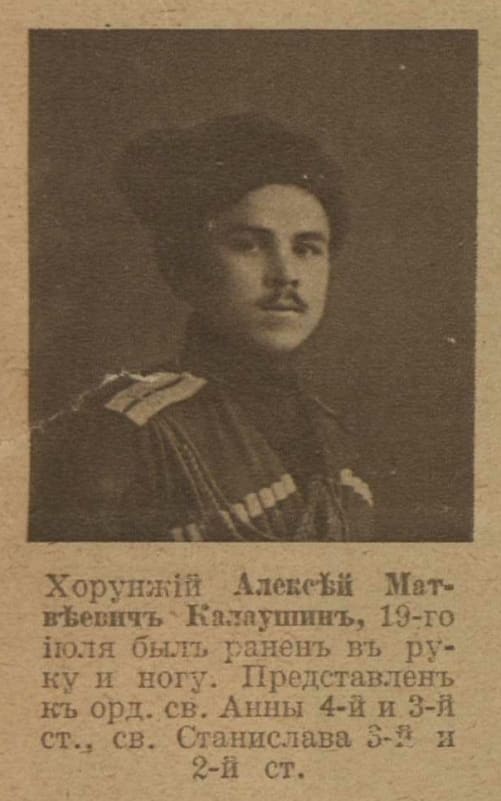
Aleksey Matveyevich [S001, No. 122] was born, according to the roster, in 1894 at Kutais (Kutaisi) [◈ S001, No. 122]. He finished the Labinskaya gymnasium and the Yelisavetgrad Cavalry School, from which an Imperial Order of 1 October 1914 commissioned him khorunzhy (cornet) in the 3rd Khoper Regiment [◆ S045, 1.10.1914, via S152]. A wartime magazine clipping — probably of 1915, though the caption gives no year — preserves his portrait in a papakha (fur hat) and a cherkeska (Circassian coat) with cartridge pockets, and the caption: “Khorunzhy Aleksey Matveyevich Kalaushin, wounded in the arm and leg on 19 July” [◆ magazine clipping, via S152]. In October 1916 Sotnik (Lieutenant) Kalaushin was regimental adjutant of the 3rd Khoper Regiment; he became podyesaul (staff captain) with seniority from 30 October 1916 [◈ S066, 10.1916, via S152; ◆ S099, Doc. 14, p. 571]. His war service is described in the chapter “Service and Crosses”.
Note on the roster. The roster dates his graduation from the cavalry school to 12 June 1912; by the Imperial Order he was commissioned in 1914, with seniority from 12 July [◆ S045, 1.10.1914, via S152]. The year given in the same entry for his leaving the gymnasium, 1906, probably needs checking as well: if he was born in 1894, he would then have been twelve.
From November 1917, according to the roster, he attended the accelerated courses of the third intake of the Academy of the General Staff, and in the summer and autumn of 1918 its senior course [◈ S001, No. 122]. A single line in A.V. Ganin’s reference book captures the turning point of that year: “Courses, 3rd intake, 1918. Col., podyesaul. 1918, Red Army; 1918–1920, Eastern Front” [◈ S099, p. 235]. On 7 August 1918 Kazan was taken by the People’s Army; the head of the Academy, A.I. Andogsky, went over to the Whites together with the Academy’s entire staff, and on that same day in Kazan Lieutenant Colonel V.O. Kappel of the General Staff issued Andogsky with his identity papers [◈ S099, p. 36; p. 136, n. 10]. The list of third-intake students as of 18 November 1918 reads: “Podyesaul Kalaushin of the 3rd Khoper Cossack Regiment, 10.68 (at the disposal of Colonel Kappel)” [◆ S099, Doc. 6, p. 512 (compiled from RGVA, f. 33892, and RGVIA, f. 544)]. The figure 10.68 is his average mark on completing the preparatory course; the Academy marked on a twelve-point scale, on which 10–11 meant “very good” [◆ S099, Doc. 14, p. 571; ◈ S099, p. 8]. △ These lists give no first name or patronymic, but the man is almost certainly Aleksey Matveyevich: the officer lists of the 3rd Khoper Regiment for 1916–1917 show only two Kalaushins — him and Semyon Ilyich, a praporshchik (ensign) [◈ S066, 10.1916 and 14.06.1917, via S152].
The Eastern Front
His further path is known from the roster. In August 1918 he was kept in Samara at the headquarters of the People’s Army, and from October to December he was assistant chief of staff of the Samara Brigade [◈ S001, No. 122]. The same post appears in the list of General Staff officers on the Eastern Front as of 24 February 1919: “Podyesaul Kalaushin — asst. chief of staff, Samara bde.” [◆ S099, Doc. 14, p. 571]. From March 1919 he was a voyskovoy starshina (lieutenant colonel) and chief of staff of Colonel Nechayev’s Volga Cavalry Brigade; then came the Siberian Ice March, on the staff of the Ural Detachment of the 3rd Army. On 16 February 1920, at Verkhneudinsk, Order No. 24 of the 3rd Army gave him the rank of colonel. From March 1920 he served at Chita, in the Quartermaster General’s department of the Far Eastern Army headquarters, and by October as assistant head of a department of the Field Headquarters and adjutant to Ataman Semyonov [◈ S001, No. 122]. △ His brigade commander of 1919 was probably Konstantin Petrovich Nechayev, who commanded the cavalry brigade of the 3rd Corps, went through the Siberian Ice March and in emigration led the Russian Group of troops in China [◈ S133, p. 139, n. 6].
Primorye, 1922
The last White forces on Russian soil — General M.K. Diterikhs’ Zemskaya Rat (Zemstvo Host) — stood in Primorye, the Russian Pacific province [◈ S133, p. 8]. By A.V. Ganin’s count, as of 1 October 1922 at least eighteen General Staff officers were serving in it, among them: “The chief of staff of the border guard was Colonel A.M. Kalaushin” [◈ S098, vol. 2, p. 677]. S.V. Volkov’s entry gives the same post more briefly: “Oct. 1922 chief of staff of the Border Regiment” [◈ S162, vol. “K”]; according to the roster, Aleksey Matveyevich had served with the border units since February 1922 [◈ S001, No. 122]. In October and early November 1922 the Zemskaya Rat crossed the frontier into China and Korea in three columns, while some units left Vladivostok by sea with Rear Admiral Yu.K. Stark’s squadron [◈ S133, p. 8]. △ Aleksey Matveyevich most likely left Russia at that time.
China and Manchuria
Volkov’s entry continues: “In emigration in China, served in the forces of Zhang Zuolin; by 1927 in the Combined Russian Detachment (lieutenant colonel); by 1938 in the Far East” [◈ S162, vol. “K”]. Manchuria was then ruled by Marshal Zhang Zuolin, head of the Mukden faction. After his unsuccessful war of 1922 he began to bring Russian officers into his army as instructors, and in 1924 a Russian Group of troops under Lieutenant General K.P. Nechayev was formed in the army of his ally General Zhang Zongchang, which was fighting in northern China. Russian units existed in the Chinese army until the end of 1928, and several thousand émigrés passed through them [◈ S133, pp. 10–11]. According to the roster, Aleksey Matveyevich served in the Russian Group in 1924–1927 [◈ S001, No. 122]. △ He seems, then, to have found himself once more under his commander of 1919.
The roster also tells of the 1930s. In 1931 Aleksey Matveyevich worked for the “Asiatic Film Company” and offered the Soviet consulate his services in organising film work in China; in the early 1930s he was on Ataman Semyonov’s staff at Kakahashi near Dairen; in the late 1930s he worked “on the commercial side” in Inner Mongolia, “carrying out commissions for the Japanese”; by 1938 he headed a newsreel department. He was Orthodox, a monarchist by conviction, a member of the “Far Eastern Cossack Union of members of the former Far Eastern Army”, and unmarried. Aleksey Matveyevich died in Harbin in April 1941 “in unexplained circumstances” and was buried in the New Uspensky Cemetery [◈ S001, No. 122].
Kakahashi was a place near Dairen where the Japanese had given Ataman G.M. Semyonov a large estate. At the end of 1934, under Japanese direction, the Bureau of Russian Émigrés in Manchuria (BREM) was set up, and Semyonov was formally proclaimed leader of the emigration in the Far East [◈ S133, p. 20]. △ The sequence “religion — nationality — political convictions — marital status” in the roster’s entry on Aleksey Matveyevich looks like a BREM questionnaire. The roster’s list of sources includes the reference “GAKhK, f. R-830, op. 3, d. 18923” [◈ S001, source 29] (in the entry itself the questionnaire details carry the neighbouring number, 30; the footnote numbers in this part of the roster seem to have shifted); fond R-830 of the State Archive of Khabarovsk Krai is the BREM archive, and inventory 3 holds émigrés’ personal files [◈ S181, topic 138302; ◈ S141]. This is most likely Aleksey Matveyevich’s own file.
Nikita Ilyich: the Ice March, Constantinople, Serbia
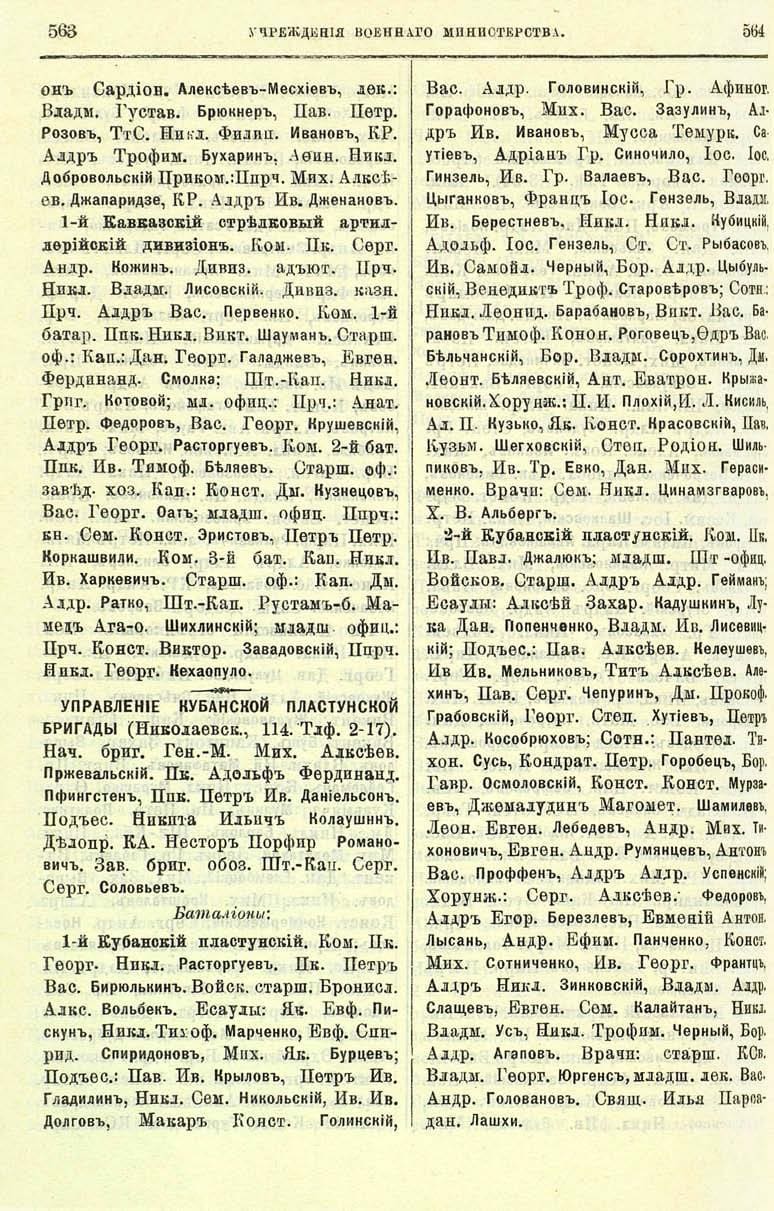
Nikita Ilyich, son of Ilya Nikolayevich [S001, No. 34] of Batalpashinskaya, was born on 26 May 1878 [◈ S033, via S180, topic 855]. He began as a Cossack and an uryadnik (Cossack NCO) in the 5th Kuban Plastun (Cossack infantry) Battalion [◈ S033, via S180, topic 855; ◈ S001, No. 85], was commissioned khorunzhy in the 3rd Kuban Plastun Battalion in 1900, by 1909 was senior adjutant of the headquarters of the Kuban Plastun Brigade in Tiflis (Tbilisi), and in the Great War was senior adjutant on the staff of the 1st Kuban Plastun Brigade on the Caucasian front; in February 1916, as a yesaul (captain), he received the Order of St Vladimir, 4th class [◆ S045, 21.06.1900 and 6.05.1909, via S152; ◆ S058, 1914; ◈ S119, p. 52; ◆ S045, 14.02.1916].
In the Civil War, according to S.V. Volkov’s entry, Nikita Ilyich — a voyskovoy starshina of the Kuban Cossack Host — served in the Volunteer Army and took part in the First Kuban (Ice) March with the Kuban Druzhina (detachment). He then headed the chancellery of the Kuban Krai Intendant (quartermaster), and from 9 November 1919 was acting assistant to the Intendant of the Kuban Krai. He remained in the Russian Army until the evacuation of the Crimea and rose to colonel [◈ S162, vol. “K”].
Constantinople, December 1920
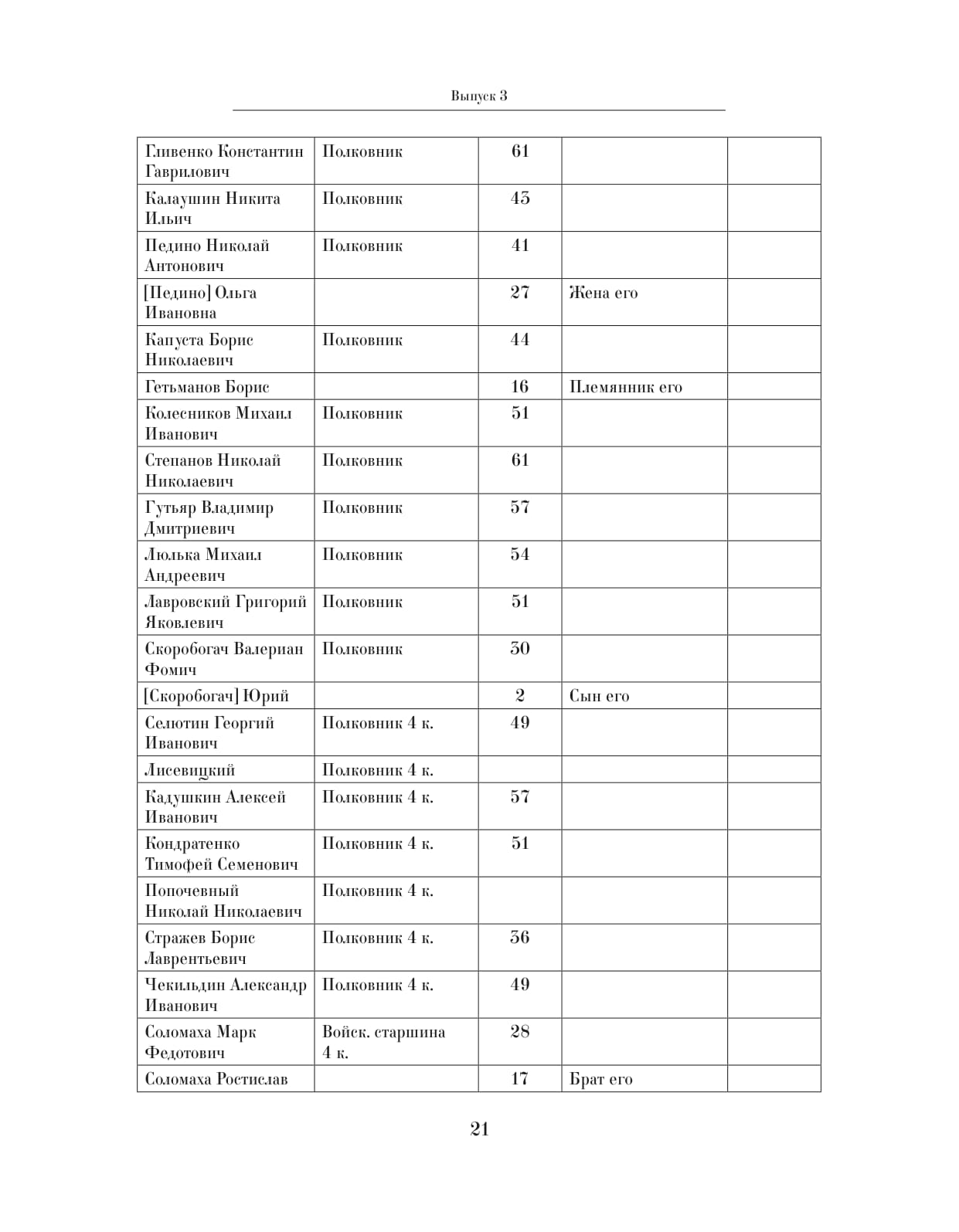
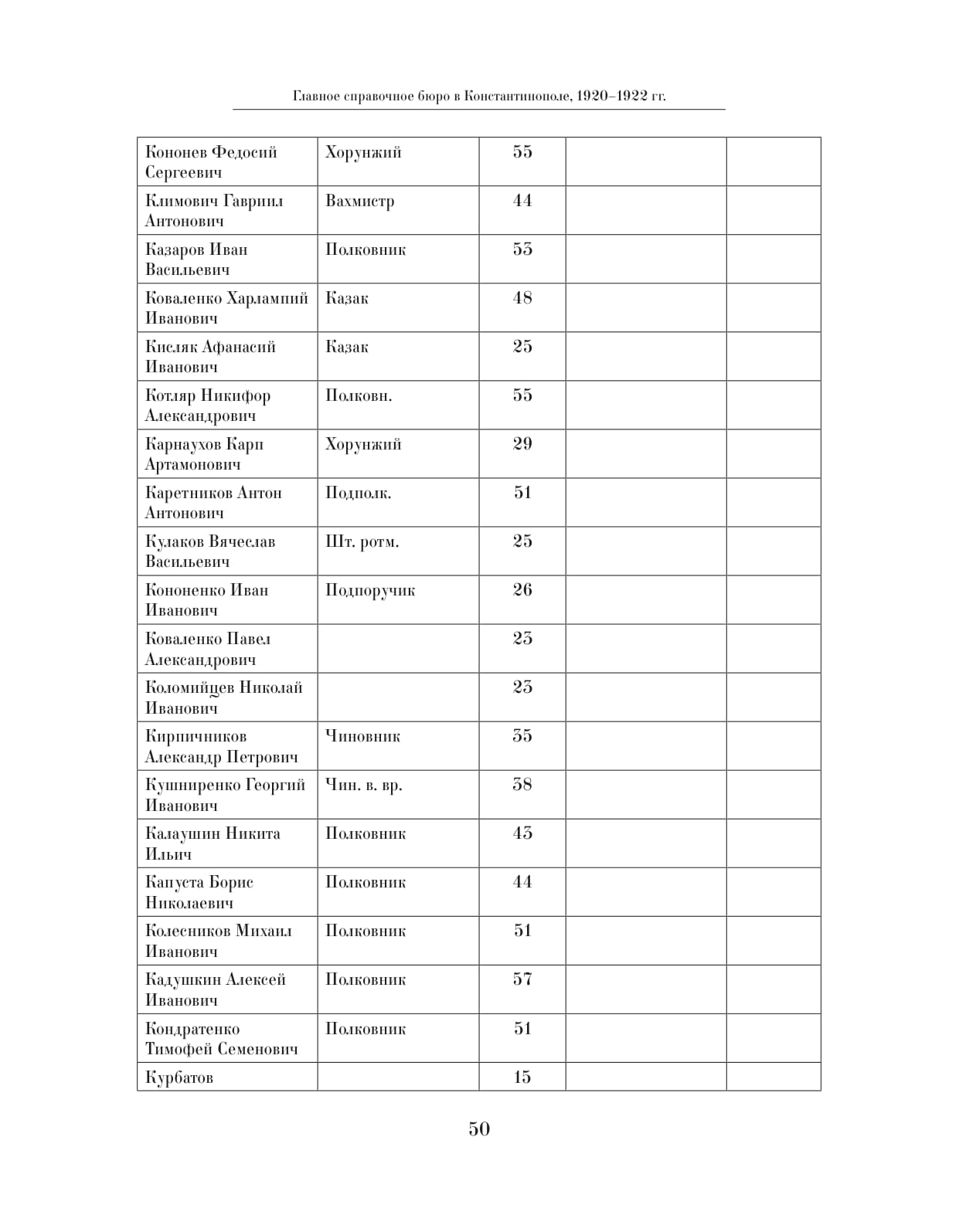
The State Archive of the Russian Federation (GARF) holds the papers of the Chief Information Bureau in Constantinople, among them name lists of refugees and members of the Russian Army who had left their homeland [◈ S082, no. 3, p. 2]. One of these is a typed “Name list of refugees to be sent on the steamer Kherson, 18 December 1920 (if places become available)”. In it, next to Colonels Glivenko, Pedino and Kapusta, stands “Kalaushin Nikita Ilyich — Colonel — 43”; he appears in the same way in a second version of the list [◆ S019, ff. 1–11 and 12–22; publ.: S082, no. 3, pp. 21, 50]. A month earlier, on 15–16 November 1920, the same Kherson had arrived in Constantinople from the Crimea with Red Cross personnel and staff of the Volunteer Fleet and their families [◈ S082, no. 3, p. 5, contents]. The list was drawn up in case “places become available”; it does not say where the steamer was bound, and whether Nikita Ilyich sailed on it is not yet known.
Note on the roster. The roster states: “Colonel from 18 December 1920” [◈ S001, No. 85]. Volkov’s entry, on which this rests, reads: “Colonel. On 18 Dec. 1920 was to be evacuated on the ship Kherson” [◈ S162, vol. “K”]. The date belongs to the list for the steamer; the date of his promotion to colonel is not yet known. The name index to the Kuban Host orders gives his year of birth as 1878, Volkov as 1877; the age of 43 in the December 1920 list is closer to the latter.
The Šabac stanitsa
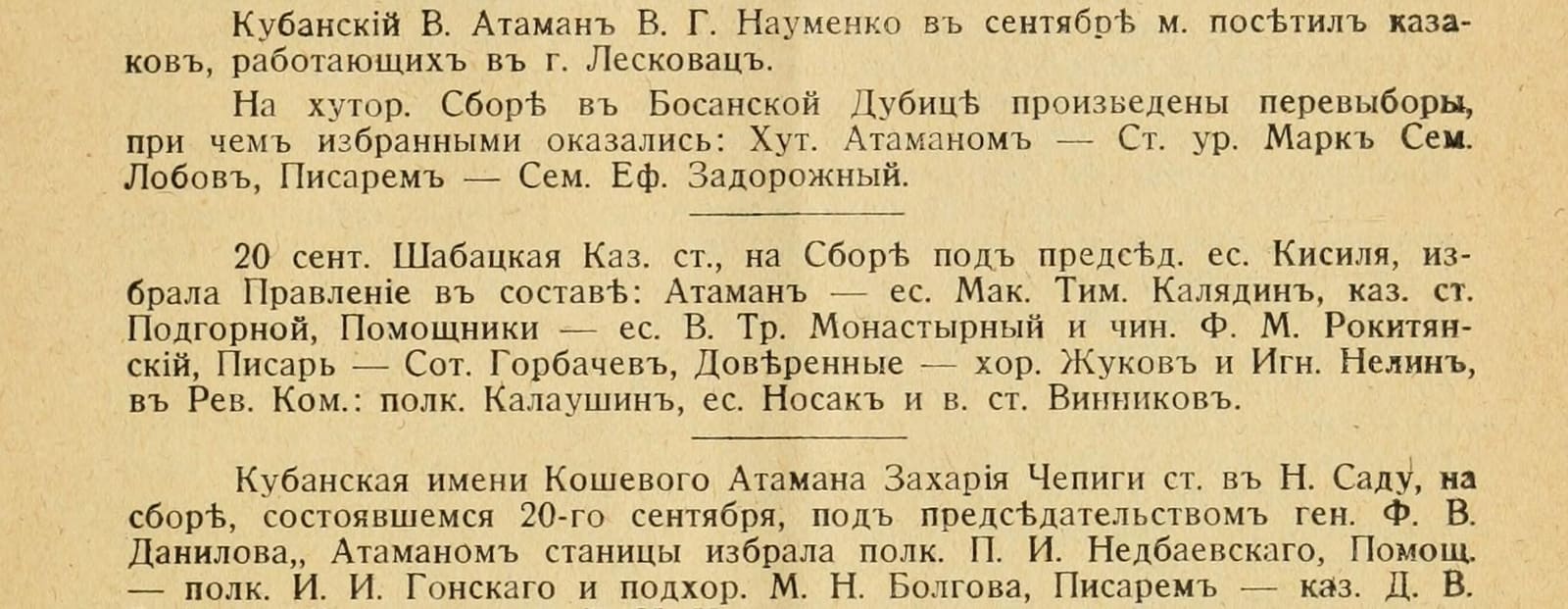
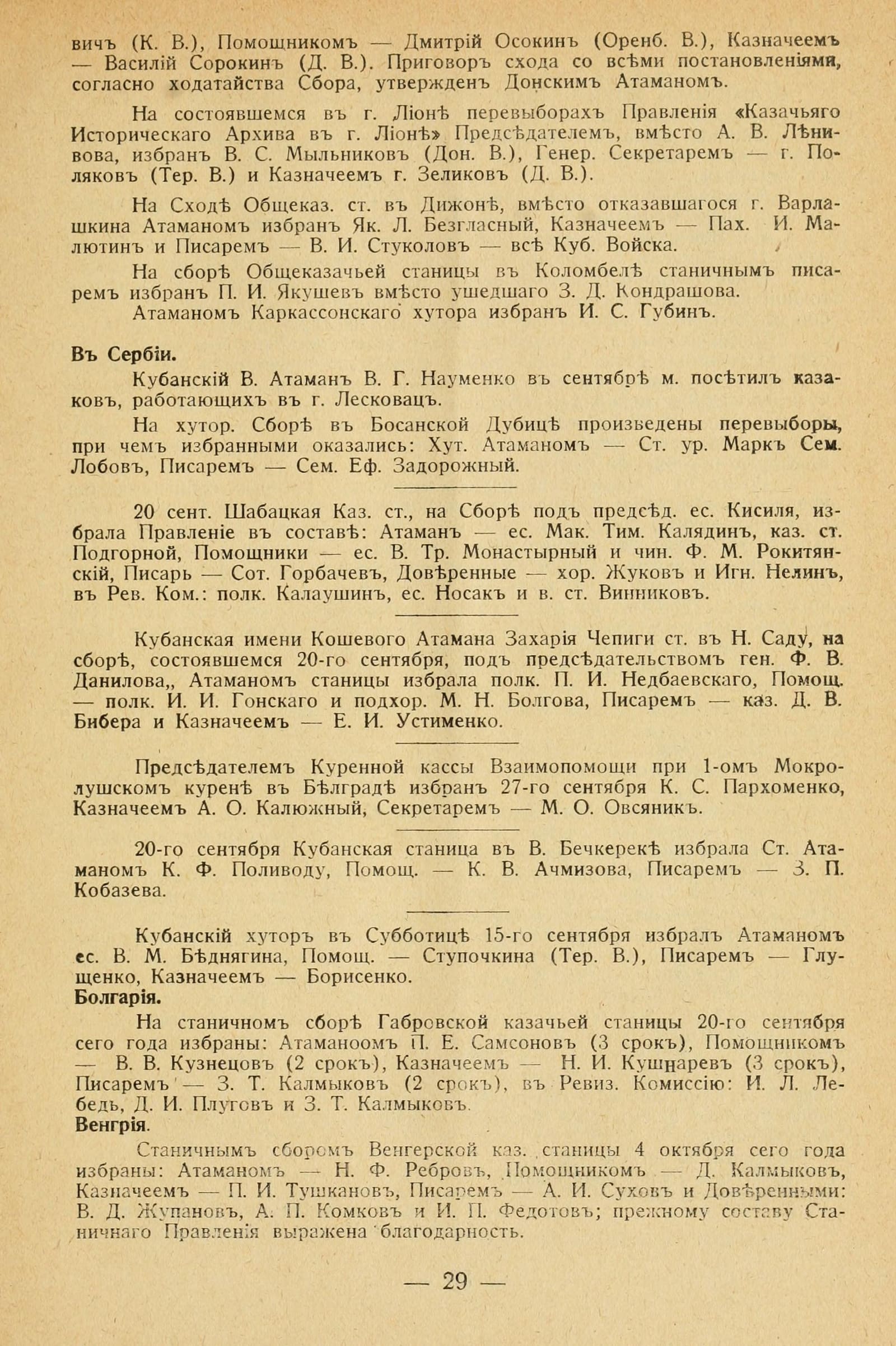
Eleven years later the Kalaushin name appears again in the émigré press. Rodimy Kray (“Native Land”), a monthly Cossack journal published in Paris by the Board of the Cossack Union, carried a report from Serbia in its October–November 1931 chronicle “Around the stanitsas and khutors”: on 20 September the Šabac Cossack stanitsa, at its assembly, elected an ataman, his assistants, a clerk and trustees, and an audit committee consisting of “Col. Kalaushin, Yesaul Nosak and Voyskovoy Starshina Vinnikov” [◆ S068, 1931, no. 10–11]. Even abroad, Cossacks lived in stanitsas and khutors (farmstead communities) with their own atamans and assemblies: the same chronicle reports new elections at the khutor in Bosanska Dubica and a visit in September by the Kuban Host Ataman, V.G. Naumenko, to the Cossacks working in Leskovac [◆ S068, 1931, no. 10–11]. Kuban Cossacks lived in Šabac itself and in Belgrade: in its issue of 15 June 1931 the journal reported that Khorunzhy Ivan Karpovich Kulichkovsky of Abinskaya stanitsa had died in Šabac on 30 May, and that on 15 May Major General Tit Ivanovich Ostroukhov — a fellow countryman of the Kalaushins, a Cossack of Batalpashinskaya — had died in Belgrade [◆ S068, 15.06.1931].
The Šabac report gives no initials. △ It is most likely Nikita Ilyich: of the Kalaushins known to us in the European emigration, he alone was a colonel; Aleksey Matveyevich lived in China, and Nikolay Matveyevich was a sotnik in 1925 [◈ S162, vol. “K”]; in 1933 General Maslovsky calls Nikita Ilyich “yesaul, later colonel” (see below).
Serbia was also where Vasily Grigoryevich Tolstov, historian of the Khoper Regiment, on whose book the early chapters of this chronicle rest, spent his last years. At the Russian monastery in the village of Petkovica he reconstructed from memory a “Historical Note on the Khoper Regiment”; he died on 25 November 1935 and was buried at the monastery of Hopovo [◈ S138].
Information for General Maslovsky
In 1933 General E.V. Maslovsky’s book The World War on the Caucasian Front was published in Paris. Describing the advance of the 1st Kuban Plastun Brigade towards Karakilise in October 1914, the general cited in a footnote “the information of the senior adjutant for line affairs on the staff of the 1st Kuban Plastun Brigade, Yesaul, later Colonel N.I. Kalaushin. E.V. Maslovsky’s archive” [◈ S119, p. 52, n.]. △ When this information reached Maslovsky — during the war or in emigration — is not known. Maslovsky himself served in the Caucasus in the First World War and the Civil War, and in emigration lived in Nice, where he ran the library of the Russian Orthodox Cathedral; his papers — correspondence, manuscripts and material for his book on the Caucasian front — are held in the Bakhmeteff Archive at Columbia University, and his correspondents there are described as including “many former Russian officers” [◈ S026].
“One of the few Cossack publicists”
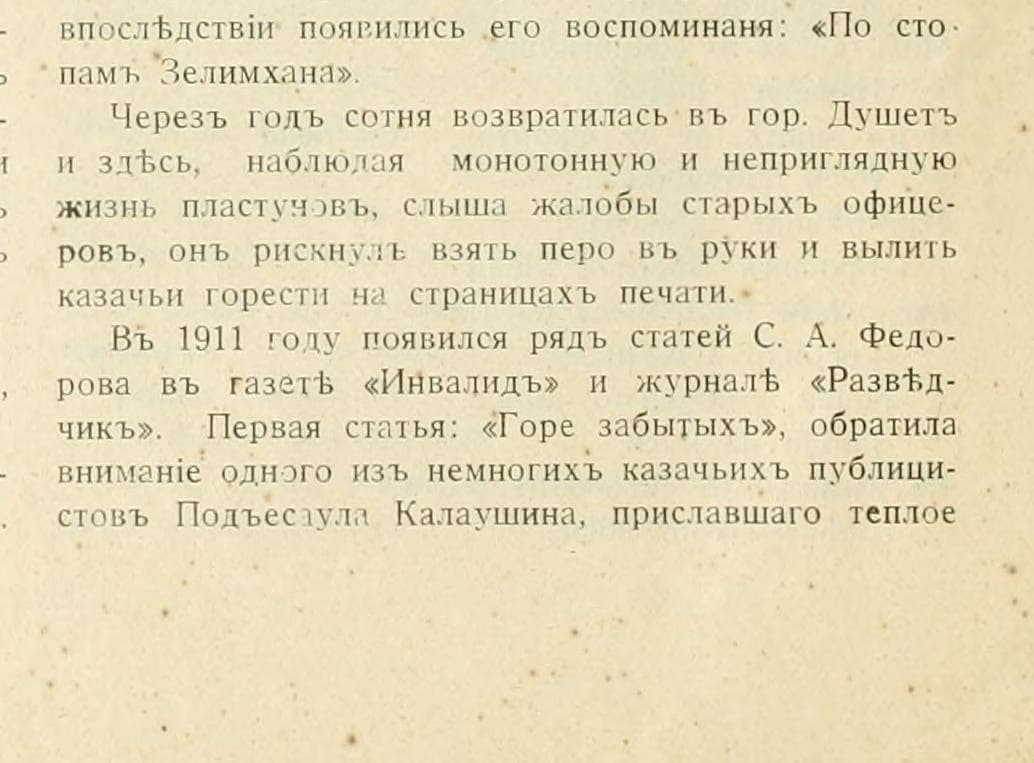
In May 1932 the Paris collection Kubanskoye Kazachestvo (“The Kuban Cossacks”), published by the Society of Devotees of the Kuban, printed an article marking twenty years of journalism by Colonel S.A. Fedorov (Lantukh). Sergey Alekseyevich Fedorov was born on 13 January 1891 in Labinskaya stanitsa, served as a khorunzhy in the 2nd Kuban Plastun Battalion and in 1911 began to write for the newspaper Invalid and the journal Razvedchik. His first article, “The Sorrow of the Forgotten”, “caught the attention of one of the few Cossack publicists, Podyesaul Kalaushin, who sent a warm letter” [◆ S069, 1932, no. 3, pp. 20–21].
The article gives no first name. △ It may have been Nikita Ilyich: at that time he was a podyesaul and senior adjutant of the Kuban Plastun Brigade headquarters [◆ S045, 6.05.1909, via S152; ◆ S058, 1914], and Fedorov was writing precisely about the life of the plastuns. But Stepan Yegorovich (Georgiyevich) [S001, No. 93] and Yefim (Yevfimy) Mikhailovich [S001, No. 131] Kalaushin were also podyesauls then [◆ S058, 1910, pt 2, col. 497; 1912, p. 496], so the question remains open.
The same issue names another officer with a similar surname, in Fedorov’s recollections “Plastuns at Sevastopol”, about the Emperor’s review in April 1915. The Emperor walks along the ranks and calls out the men put forward for awards; among them the narrator sees, to his right, “old Podyesaul Kalaushev, trembling” [◆ S069, 1932, no. 3]. The account concerns the 6th Kuban Plastun Battalion, commanded by Colonel Zinkovsky [◆ S069, 1932, no. 3]. Whether this is a misprint of our surname or a different man is not known: Nikita Ilyich was then serving on the staff of the 1st Kuban Plastun Brigade on the Caucasian front, and by February 1916 he is listed as a yesaul [◈ S119, p. 52; ◆ S045, 14.02.1916].
Nikolay Matveyevich: Lemnos, Yugoslavia, France
Nikolay Matveyevich [S001, No. 125] was born, according to the roster, in about 1894 in Labinskaya stanitsa [◈ S001, No. 125]. His entry in S.V. Volkov’s database Participants of the White Movement in Russia is brief: “Cossack of the Kuban Oblast. In the Armed Forces of South Russia and the Russian Army until the evacuation of the Crimea. Was on the island of Lemnos. In autumn 1925 in the 1st Combined Kuban Cossack Regiment in Yugoslavia. Sotnik” [◈ S162, vol. “K”].
Behind these lines lies the common road of the Kuban Cossacks. On 11 November 1920 (New Style) General P.N. Wrangel ordered the evacuation of the Crimea; some 18,000 Kuban Cossacks left, and about 15,000 of them, under Lieutenant General M.A. Fostikov, ended up on Lemnos in the Aegean [◈ S138]. Fostikov was himself a native of Batalpashinskaya, the son of a stanitsa vakhmistr (sergeant major) [◈ S188, “Fostikov, Mikhail Arkhipovich”]. Rocky and almost bare, Lemnos was called “the island of death”: officers lived three or four to a tent, food and fuel were short, and disease followed. The Cossacks spent more than a year on the island; in November 1921 some of them were moved to Yugoslavia, Bulgaria and Czechoslovakia. About five hundred graves remained on Lemnos [◈ S138]. In the Balkans large Russian units served in the forces of the national governments, and in 1924 the Russian All-Military Union (ROVS) was founded to hold former soldiers of the White armies together [◈ S133, p. 8].
△ hypothesis · identification
Nikolay Matveyevich may be the Nikolay Kalaushin who on 1 January 1916 left the Tiflis Military School as a praporshchik for the 4th Reserve Plastun Sotnia, and who in May 1917 was promoted from khorunzhy of the 10th Kuban Plastun Battalion to sotnik, with seniority from 15 November 1916 [◆ S064, 1.01.1916, via S152; ◆ S067, 24–31.05.1917, via S152]: in emigration Nikolay Matveyevich is also listed as a sotnik. The orders give no patronymic, and there were other Nikolays of the same generation in the family [S001, Nos. 103, 134], so the identification remains a suggestion.
◇ family testimony · from A.B. Kalaushin’s manuscript
From here the family’s memory takes up Nikolay Matveyevich’s story. In the 1920s he went to France with his brother Aleksandr and worked there at the Renault works. In France he married again — Mariya Nikitichna Bugayeva, who died there in 1976. In Russia he had left his wife Gertruda and their children: a daughter, Taisiya [S001, No. 210], born in 1919, and a son, Anatoly [S001, No. 211] (1920–1971) [◇ S001, Nos. 125, 210, 211].
Aleksandr Matveyevich
◇ family testimony · from A.B. Kalaushin’s manuscript
The family remembers little of Aleksandr Matveyevich [S001, No. 126]. He was born in 1896, went abroad with the Whites and left for France with his brother Nikolay. He died in 1953; he had one child [S001, No. 212], of whom the roster says nothing more [◇ S001, Nos. 125, 126, 212].
Note on the roster. The rest of the roster entry on Aleksandr Matveyevich — the Labinskaya gymnasium, the Yelisavetgrad school, the General Staff Academy, the 3rd Khoper Regiment, the Eastern Front, chief of staff of the Border Regiment in 1922, service under Zhang Zuolin and “by 1938 in the Far East” — corresponds almost word for word to S.V. Volkov’s entry on Aleksey Matveyevich [◈ S001, No. 126; ◈ S162, vol. “K”]. Aleksandr Matveyevich is not among the seven Kalaushins in Volkov’s database. △ The entry on the elder brother seems to have passed into the younger brother’s entry when the roster was compiled. The initials “A.M.” in Ganin’s 1922 data would fit either brother, but the accelerated General Staff courses and the 3rd Khoper Regiment point to Aleksey Matveyevich [◈ S099, pp. 235, 512; ◈ S098, vol. 2, p. 677].
Descendants abroad
According to the compiler of the roster, descendants of the Kalaushins now live in Vladikavkaz, Yessentuki, Maykop, Nalchik, Nevinnomyssk, Omsk, St Petersburg, Tbilisi, Tolyatti, in Bekeshevskaya stanitsa “and even in the USA” [◈ S001, introduction]. By its own rules, this chronicle gives only the name and relationship of relatives who are living today. If descendants of Nikolay and Aleksandr Matveyevich remained in France, their traces are worth looking for in the papers of the French offices that dealt with Russian refugees (see “Where the documents may be found”).
Documents
18 November 1918. “Podyesaul Kalaushin of the 3rd Khoper Cossack Regiment, 10.68 (at the disposal of Colonel Kappel).” — List of officers of the preparatory courses and senior class of the third intake of the Nicholas Military Academy as of 18 November 1918. Compiled by A.V. Ganin from RGVA (f. 33892, op. 1, d. 14, 20, 37) and RGVIA (f. 544, op. 1, d. 1642, 1644); publ.: A.V. Ganin, Korpus ofitserov Generalnogo shtaba…, Moscow, 2009, p. 512.
18 December 1920. “Name list of refugees to be sent on the steamer Kherson, 18 December 1920 (if places become available)”: “Kalaushin Nikita Ilyich — Colonel — 43.” — GARF, f. R-5982, op. 1, d. 57, ff. 1–11; publ.: Glavnoye spravochnoye byuro v Konstantinopole, no. 3, Moscow, 2022, p. 21.
20 September 1931, Šabac. “The Šabac Cossack stanitsa, at an assembly chaired by Yesaul Kisil, elected a Board as follows: Ataman — Yesaul Mak. Tim. Kalyadin… audit committee: Col. Kalaushin, Yesaul Nosak and Voyskovoy Starshina Vinnikov.” — Rodimy Kray, Paris, 1931, no. 10–11, chronicle “Around the stanitsas and khutors: In Serbia”.
Where the documents may be found
- GAKhK (State Archive of Khabarovsk Krai), f. R-830 (BREM), op. 3, d. 18923 — the file in the roster’s list of sources, probably A.M. Kalaushin’s personal file; the Harbin newspapers Kharbinskoye Vremya and Zarya for April–May 1941 — a possible obituary of A.M. Kalaushin; A.A. Khisamutdinov, Rossiyskaya emigratsiya v Kitaye: opyt entsiklopedii (2002).
- RGVA, ff. 33892 and 40215; RGVIA, f. 544 — lists of students of the Academy’s accelerated courses, 1918–1919; I.L. Ryzhov, Posledny pokhod (Vladivostok, 2020), pp. 160–165 — on the staffs of the Zemskaya Rat.
- GARF, f. R-5982 (Chief Information Bureau in Constantinople) — any registration records on N.I. Kalaushin; GARF — unit lists of the Russian Army as of autumn 1925 (1st Combined Kuban Regiment, Sotnik N.M. Kalaushin).
- Archives of Yugoslavia, Belgrade — records of the State Commission for Russian Refugees; the Belgrade émigré newspapers Tsarsky Vestnik and Novoye Vremya — obituaries; the Russian section of the town cemetery in Šabac; A.B. Arsenyev’s reference book Russkaya emigratsiya v Serbii.
- Bakhmeteff Archive, Columbia University, New York: Evgenii Vasil’evich Maslovskii Papers (BAR Ms Coll/Maslovskiĭ) — the general’s correspondence with former officers and material for his 1933 book.
- Hoover Institution, Stanford: Kuban Cossack Association records (2020C39), 12 boxes, not yet described.
- France: the OFPRA archives (Office central des réfugiés russes, 1924–1952) — personal files of Russian refugees (including under the spellings Kalaouchine and Bougaeva); the Paris Préfecture de police — files on foreigners; the Archives nationales — naturalisation files; the Renault company archives (Société d’histoire du groupe Renault); the cemeteries of Boulogne-Billancourt and Sainte-Geneviève-des-Bois; the dictionary Rossiyskoye zarubezhye vo Frantsii 1919–2000 (L. Mnukhin, M. Avril, V. Losskaya).
- Razvedchik and Invalid for 1911 — articles by S.A. Fedorov and perhaps by the “Cossack publicist” Kalaushin; officer lists of the 6th Kuban Plastun Battalion for 1915 — “Podyesaul Kalaushev”.
Documents and illustrations

Images held by rights holders
- Image held by the rights holder — permission requested
Document · 1933 ◈ published source
E. V. Maslovsky, The World War on the Caucasian Front (Paris, 1933), p. 52
Page of General E. V. Maslovsky's history of the Caucasian front with the footnote: "Data of the senior adjutant (line section) of the staff of the 1st Kuban Plastun Brigade, Esaul, later Colonel N. I. Kalaushin. Archive of E. V. Maslovsky". It concerns the order for the brigade's advance into Turkish territory (towards Karakilise), October 1914 [Maslovsky 1933, p. 52].
Internet Archive (цифровая копия) (экз. UNC Chapel Hill)
E. V. Maslovsky, 1933 (scan: Internet Archive)
- Image held by the rights holder — permission requested
Document · 05.1932 ◈ published source
Kubanskoe Kazachestvo (Paris, 1932), No. 3, p. 21 (full page)
Page of the émigré collection Kubanskoe Kazachestvo (Society of Zealots of the Kuban, Paris, May 1932) with the article on Colonel S. A. Fedorov that mentions Podesaul Kalaushin [Kubanskoe Kazachestvo, 1932, No. 3, pp. 20–21].
Internet Archive (экз. André Savine Collection, UNC Chapel Hill)
Kubanskoe Kazachestvo, Paris, 1932 (scan: Internet Archive, UNC Chapel Hill)
Sources for this chapter
- S001 — A.B. Kalaushin’s roster Kalaushiny (philippov.spb.ru, version 03.02 of 13 July 2025)
- S004 — N.G. Firtich, “Matvey Matveyevich Kalaushin: on the centenary of his birth” (museum.ru, N20942, 2005)
- S019 — GARF, f. R-5982, op. 1, d. 57
- S026 — Evgenii Vasil’evich Maslovskii Papers (Columbia University)
- S033 — Name index to the Orders of the Kuban Host, 1880–1899
- S045 — Imperial Orders (Vysochayshiye prikazy)
- S058 — Kavkazsky kalendar (Tiflis), 1910–1914
- S064 — Supplement to the Imperial Order of 1.01.1916
- S066 — Officer lists of the 3rd Khoper Regiment (10.1916 and 14.06.1917)
- S067 — Order to the Army and Navy on military ranks, May 1917
- S068 — Rodimy Kray (Paris), 1931
- S069 — Kubanskoye Kazachestvo (Paris), no. 3, 1932
- S082 — Glavnoye spravochnoye byuro v Konstantinopole, 1920–1922 gg., no. 3 (Moscow, 2022)
- S098 — A.V. Ganin, Kadry Generalnogo shtaba v period Grazhdanskoy voyny v Rossii 1917–1922 gg., vol. 2 (Moscow, 2023)
- S099 — A.V. Ganin, Korpus ofitserov Generalnogo shtaba v gody Grazhdanskoy voyny 1917–1922 gg. (Moscow, 2009)
- S119 — E.V. Maslovsky, Mirovaya voyna na Kavkazskom fronte, 1914–1917 g. (Paris, 1933)
- S133 — S.V. Smirnov, Otryad Asano (Yekaterinburg, 2012)
- S138 — V.S. Fedosov, “General-mayor Vasily Grigoryevich Tolstov” (2021)
- S141 — A.A. Khisamutdinov, “Russkiye obshchestvenno-voyennye organizatsii v Kharbine” (SibScript, 2015)
- S152 — ria1914.info
- S162 — S.V. Volkov, database Uchastniki Belogo dvizheniya v Rossii, vol. “K”
- S180 — Kubanskiye kazaki forum (kubancossack.0pk.me)
- S181 — VGD genealogy forum (forum.vgd.ru)
- S188 — Russian Wikipedia — for general historical context
This page uses material from the Kalaushin family roster published on the Philippov website: https://philippov.spb.ru/?q=Kalaushiny (version 03.02 of 13 July 2025).