Chapter 12 of 14 · late 20th century – 2026
The Chroniclers
Who kept and wrote down the Kalaushin family’s memory — from family stories to the 2026 review
In brief
The Kalaushins’ memory was kept by its storytellers — Boris Matveyevich, Olga Savvichna, Emiliya Fyodorovna, Mariya Aleksandrovna and many others — and by two family chroniclers: Aleksandr Borisovich Kalaushin, who spent more than forty years assembling the family roster, and Yury Romanovich Kalaushin, who compiled a family tree of 363 people. This chapter tells how their records became the roster published on the Philippov website, which family accounts relatives confirm — among them the saddle for the Shah of Persia, most consistently dated to spring and early summer 1900 — and how the roster was checked against the documents in 2026.
◆ documented◈ published source◇ family testimony△ hypothesisMore about the method
The thread· System
The family’s most visible system is its memory. Aleksandr Borisovich spent “more than 40 years, crumb by crumb” on a roster of 265 entries, and Yury Romanovich compiled a tree of 363 people [◈ S001, dedication; ◈ S001, introduction; ◈ S084, “Kalaushin Yury Romanovich”]. In 2026 the chronicle checked the roster against the documents in seven passes — and gave every discrepancy as a note, with respect for the compiler.
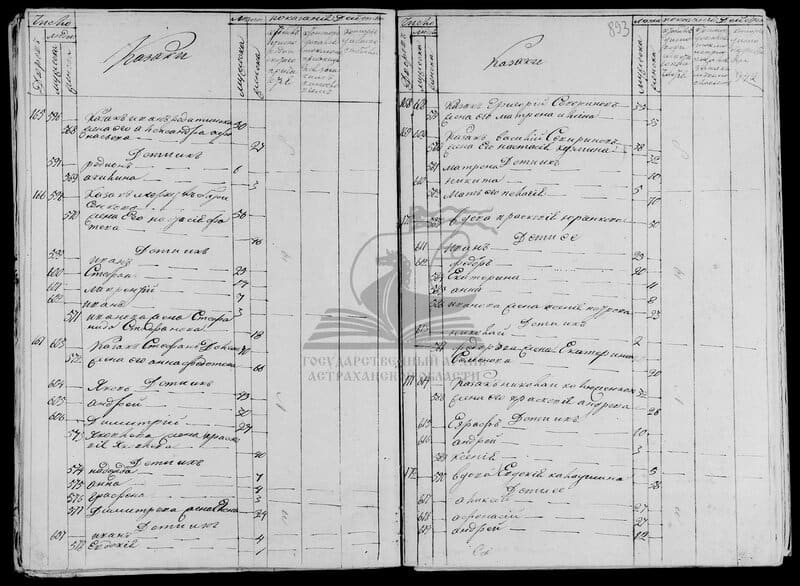
Everything in this chronicle has reached us because someone remembered it, retold it and wrote it down. Not every Kalaushin Cossack could read: the service record of Stepan Alekseyevich, an uryadnik (a Cossack non-commissioned officer), notes that he “cannot read or write Russian” [◈ S001, No. 9]. Their lives passed to their children in stories told at the table, in letters, in deeds of sale and in photographs. Two descendants took on the work of gathering and recording those stories — Aleksandr Borisovich Kalaushin and Yury Romanovich Kalaushin, the family’s chroniclers. Their records became the basis of the family roster “Kalaushiny”, published in 2025 on the Philippov genealogy website, and in 2026, while this chronicle was being prepared, the roster was checked against the documents. This chapter is about the storytellers and the compilers, about the roster itself, about what relatives confirm, and about how we went about our work.
The family’s voices
The roster often says whose words a story was taken down from, and these notes show how many people had a hand in the common work. Boris Matveyevich Kalaushin [S001, No. 213] was an artist, the son of the Pushkin scholar Matvey Matveyevich. Olga Savvichna — Olga Savelyevna Veber, née Kalaushina (b. 1897) — was the daughter of the schoolteacher Savva Alekseyevich and a teacher herself; she lived in Pyatigorsk with her daughter [◈ S001, No. 145], Iraida Yevgenyevna Sitnikova [S001, No. 230], who also contributed. Then there were Emiliya Fyodorovna, wife of Matvey Matveyevich; Yevdokiya Fyodorovna, wife of Aleksandr Alekseyevich, an uryadnik of His Majesty’s Own Convoy (the Emperor’s Cossack bodyguard; hereafter the Convoy), and her daughters Mariya and Lyudmila Aleksandrovna [S001, Nos. 74, 140, 142]; Nikolay Fedotovich, son of Fedot Alekseyevich [S001, No. 134]; and Lev Petrovich [S001, No. 108], whose stories came down through the letters of his daughter, Galina Leontyevna Dolzhikova [S001, No. 195], a great-granddaughter of Gavriil Ivanovich — the roster mentions her letters of 1986 [◈ S001, Nos. 7, 19, 92, 193].
◇ family testimony · Olga Savvichna’s letters
Olga Savvichna remembered her grandfather, Aleksey Nikolayevich [S001, No. 32]. On Sundays he rode into the stanitsa (the Cossack village) to church with his saddlebags full of apples, and a crowd of children ran after him: along the way he scattered apples for them — “it had become the rule”. Once he left his horse outside the tavern and came out to find that Gypsies (Roma) had led it away. He went to his son Fedot with his head bowed, and met neither anger nor resentment: “Never mind, father, there’ll be another horse.” She remembered the summers on the khutor (the family farmstead), when all the uncles gathered there: “The feasting went on and on. That was when the cousins all met” — while the children, unwatched, took the hunting guns and shot at sparrows and empty bottles. Of Fedot Alekseyevich’s orchard she wrote briefly: “The garden was immaculate. Irisha worked hard” [◇ S001, Nos. 32, 73, 75].
◇ family testimony · accounts of Anna Nikitichna
The family called Anna Nikitichna, wife of Aleksey Nikolayevich, Annushka-cherkeshenka — “Annushka the Circassian” — and about her, as the compiler of the roster puts it, “two versions are handed down”. His grandmother, Yevdokiya Fyodorovna, said that Anna Nikitichna was the daughter of a Gypsy called Belavin. Boris Matveyevich, citing words his father spoke before he died, said that she was a Circassian: three brothers carried her off from a well in a Circassian aul (mountain village) during one of their journeys for Damascus steel, and had her entered in the church register as a Gypsy’s daughter. Olga Savvichna remembered that Anna Nikitichna wore her hair in many small plaits, and thought the family owed its “Gypsy temperament” to her. “But our temperament is Circassian!” Aleksandr Borisovich answers her in the pages of the roster. He himself believed his great-grandmother to be an Adyghe (Circassian): “From her comes the eye colour of our line” — Aleksey Nikolayevich had light eyes, but all his children, grandchildren and great-grandchildren whom the compiler knew were dark-eyed [◇ S001, No. 32]. Their daughter, Anna Alekseyevna, was named after her mother [◇ S001, No. 76].
Context. The roster records Anna Nikitichna as née Bulavina. The Bulavinov family of Cossacks lived in Batalpashinskaya from the stanitsa’s first years: the confessional register of 1827 lists a Cossack Anton Bulavinov [◈ S001, No. 32; ◆ S009, no. 176, via S180, topic 25558].
◇ family testimony · Boris Matveyevich’s account
Boris Matveyevich remembered that Nikolay Ivanovich (entered in the roster as Nikolay Alekseyevich) had two sons named Ilya, and that the second was called “Ilya the Second, Lagaga”. He also remembered Anton Nikolayevich, whose three sons — Dmitry, Semyon and Nikita — were killed in the Civil War [◇ S001, Nos. 7, 33, 37].
Context. The compiler cautiously allowed that the second Ilya might have entered the story by way of a grandson of the same name — the son of the first Ilya. Documents found later agree with the account: the confessional register of 1848 lists a three-year-old Ilya in Nikolay’s household, and in July 1857 “the Cossack Nikolay Ivanov Kalaushin and Vassa Andreyeva” christened another son, Ilya [◆ S012, household No. 92, via S180, topic 25557; ◆ S013, f. 174v, via S181, topic 20012]. Family memory had kept what the archive would bring back to light more than a century and a half later.
Emiliya Fyodorovna, wife of Matvey Matveyevich, told the compiler that Aleksey Nikolayevich came to Batalpashinskaya stanitsa as a young man, and that Aleksandr Alekseyevich served as an uryadnik of the Convoy in St Petersburg in 1904–1908 [◇ S001, Nos. 32, 74]. Note on the roster. The entry for Matvey Matveyevich gives 1947 as the year of her death, but in May 1955 N.I. Arkhipov mentions her in a letter, and on 30 December 1968 she herself wrote to Yu.G. Oksman [◆ S086, no. 51, p. 185; ◆ S028, f. 2567, op. 1, item 541]; the roster itself cites her stories more than once. Mariya Aleksandrovna gave the compiler the deeds of sale for the houses where the Kalaushins had lived in the Caucasus — one of them is quoted below, under “Documents” — and recalled the children playing in the house at Labinskaya, bought in 1916, rolling gold coins across the floor until they slipped into the cracks under the window [◇ S001, Nos. 32, 142].
Not every branch managed to stay in touch. Nikolay Nikolayevich Koloushin of the Vladikavkaz branch [S001, No. 184] wrote to Aleksey Yefimovich Kalaushin [S001, No. 215] in December 1983: “Our childhood was very hard; we were cut off from our relatives, and so we know little of our distant kin.” The compiler attributes such ruptures to the Revolution, the Civil War, de-Cossackisation, prisons and the war of 1941–1945 [◇ S001, No. 184].
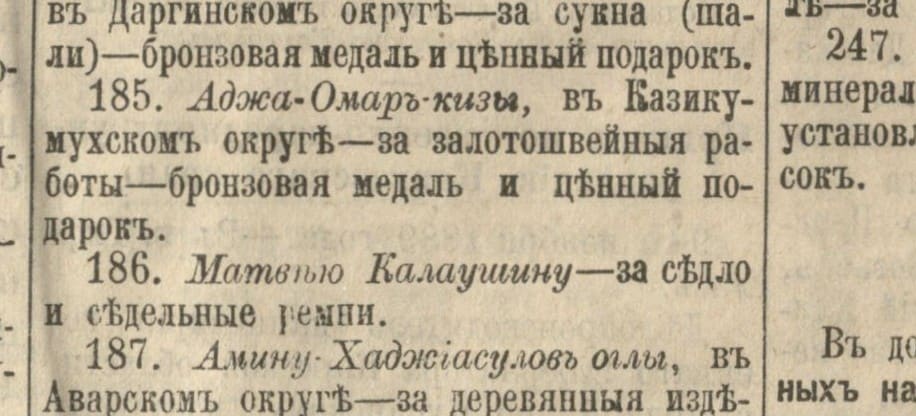
From these voices come stories the reader will meet in other chapters. ◇ The barn fire: during the Revolution Pavel Aleksandrovich Kalaushin was killed with pitchforks, and his wife, Pelageya Alekseyevna, and their three small children were locked in a barn with other hostages and the barn was set alight; they escaped only by a miracle [◇ S001, No. 70]. The stanitsa changed hands more than once in those years (see the chapter “The Upheaval”). ◇ Kalausskaya stal, “Kalaus steel”, is the family’s own name for the steel of the Kalaushin masters: Matvey Alekseyevich obtained Damascus steel and re-tempered it himself, and kinzhals (Caucasian daggers) “with Kalaus steel” were highly prized in the Caucasus [◇ S001, No. 71]. △ Most likely it means kalaushinskaya, “the Kalaushins’ steel”: in the Caucasus steel was named after the master who re-tempered an imported blade — “Bazalay steel”, “Chilli buolat” [◈ S091, PDF p. 58] — and the word also echoes the Kalaus River, near whose headwaters the Khoper Cossacks lived from 1777 to 1825 (see the chapter “The Workshop”). ◇ The family remembered that the workshop’s pieces more than once won prizes and gold medals at the world exhibitions in Paris and London [◇ S001, No. 71; ◇ S004]. Among the award lists found so far are four exhibitions with awards to Kalaushin masters: Tiflis (1889), Nizhny Novgorod (1896), the Voznesenskaya exhibition (1899) and Yekaterinodar (1902) [◆ S036, no. 305, 17.11.1889, p. 2; ◆ S044, no. 1, pp. 33, 36; ◆ S035, 1899, no. 203, 24.09.1899, p. 2; ◆ S035, 1902, no. 255, 28.11.1902, p. 1].
Aleksandr Borisovich: “more than 40 years, crumb by crumb”
Aleksandr Borisovich Kalaushin [S001, No. 221] was born in 1932. He is a great-grandson of Aleksey Nikolayevich and a grandson of the Convoy uryadnik Aleksandr Alekseyevich. His father, Boris Aleksandrovich [S001, No. 138], a cinema technician, was mobilised on 22 June 1941 and in August that year, during the retreat from Novgorod, was reported missing [◈ S001, No. 138]. His eight-year-old son remembered the men gathering on the veranda that evening, his father saying he would rather die than be taken prisoner, and their farewell by the well [◇ S001, No. 138]. The family kept his father’s letter of 30 July 1941: “War is terrible, and whoever stays alive will be a happy man” [◈ S001, No. 138].
Aleksandr Borisovich himself chose the sea: he graduated from a naval college and from 1954 to 1958 served as a naval officer, a lieutenant commander [◈ S001, No. 221]. But his life’s work became the family’s history. The online roster is dedicated to him — to Aleksandr Borisovich, “who for more than 40 years gathered, crumb by crumb, the facts about the Kalaushins and the families related to them” [◈ S001, dedication]; the early draft of January 2025 said “more than 30 years” [◈ S002].
The roster is written in his voice — “my great-grandfather”, “my mother”, “grandmother”: the narrative, as the introduction says, is “told in the voice of Aleksandr Borisovich Kalaushin” [◈ S001, introduction]. He corresponded with relatives: the roster mentions letters from Olga Savvichna and Iraida Yevgenyevna and from Galina Dolzhikova, a letter by Nikolay Nikolayevich Koloushin, the deeds received from Mariya Aleksandrovna, and a photograph of Vasily Afanasyevich’s family of 1904–1905 from his archive [◈ S001, Nos. 32, 43, 75, 184, 193; source 17]. The roster that grew out of his manuscript contains extracts from files of the Central State Military History Archive (now RGVIA), from V.G. Tolstov’s History of the Khoper Regiment, and from the Caucasian and Kuban directories [◈ S001, sources nos. 5, 8–16, 22–25]. He also created three family websites on MyHeritage — “Veb-sayt kazachyego roda Kalaushinykh” (“Website of the Kalaushin Cossack family”), “Kalaushin Web Site” and “Zhenskiye linii Kalaushinykh” (“The female lines of the Kalaushins”); access to them, the roster notes, is now closed [◈ S001, introduction].
The compiler did not hide his doubts. Time and again the roster itself warns that its information is incomplete or needs checking: on the kinship of two branches — “a purely speculative assumption”; on the nickname “Lagaga” — “this still needs to be checked”; on the two Ilyas — “none of this is firm or exact” [◈ S001, Nos. 8, 92]. It was precisely these caveats that showed where to look for documents. And on the main point he was right: the founder, who according to the roster “was born about 1740”, appears in the documents as Trofim Pakhomovich, born about 1737 (see the chapters “The Khoper” and “The Caucasian Line”) [◈ S001, No. 1; ◆ S007, household no. 321, via S181, topic 84017].
Yury Romanovich: a tree of 363 names
Yury Romanovich Kalaushin [S001, No. 182] was born in 1937. He is a grandson of Vasily Afanasyevich [S001, No. 43] and the son of Roman Vasilyevich (1895–1983) [S001, No. 100], a Khoper Cossack who was dispossessed as a “kulak” in the 1930s and ended the Second World War as a Red Army soldier in Berlin [◈ S001, No. 100]. Of the dekulakisation, the family remembers: “all they gave back was a sewing machine and an empty chest” [◇ S001, No. 100]. An article on the local history website Istorichesky Cherkessk (“Historical Cherkessk”) is devoted to Yury Romanovich himself; its author had known him for some forty-five years [◈ S084, “Kalaushin Yury Romanovich”, via the bruk.by/79076 mirror]. According to the author, Yury Romanovich “sings rare old Cossack songs beautifully”, and in his spare time “writes a chronicle of his family and studies the history of his ancestors and relatives”. The family tree he compiled contains 363 people, 110 of them direct descendants “in the male line” [◈ S084, “Kalaushin Yury Romanovich”, via the bruk.by/79076 mirror; ◈ S001, No. 182].
Note on the roster. Both the article and the roster begin the family with “the Khoper Cossack Aleksey Kalaushin (1791–1862)”. According to the documents of 1815–1827, the founder was Trofim Pakhomovich, and Aleksey was one of his sons — as was Afanasy, from whom, according to the roster, Yury Romanovich’s line descends [◆ S007, household no. 321; ◆ S009, no. 172, via S180, topic 25558; ◈ S001, Nos. 8, 43].
◇ family testimony · Yury Romanovich’s account
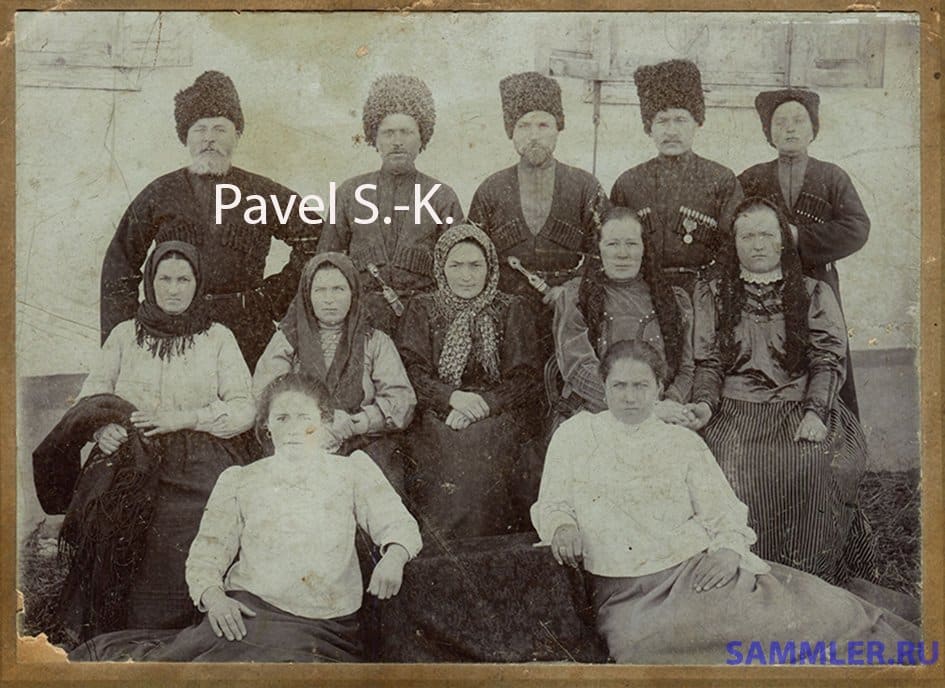
The roster quotes Yury Romanovich’s own words about his grandfather: “…When my grandfather already had three grown-up sons, his wife died. He married Fedosya Petrovna, who already had three grown-up daughters. My father, Roman, was the only son of their marriage.” He also described a family photograph of 1904–1905: Vasily Afanasyevich with his second wife, Fedosya Petrovna, his sons Pyotr, Nikolay and Grigory with their wives, and Roman [◇ S001, No. 43, source 17]. The family also remembered that Vasily Afanasyevich grew up in another family, the Afanasyevs, never knew his parents, and after the death of the old couple who had taken him in took up his family surname — the Cossacks who lived nearby remembered it [◇ S001, No. 43].
Context. In 2024 the collector P.N. Strelyanov published a similar photograph captioned “Kalaushin Vasily Afanasyevich with his family; to his right, his sons Pyotr, Nikolay, Grigory, Roman” and dated “1914” [◈ S153, 03.11.2024]. △ It is probably the same photograph; the original should settle the year it was taken.
The early, short draft of the online roster (January 2025) was based above all on the Istorichesky Cherkessk article and on A.B. Kalaushin’s MyHeritage sites [◈ S002]. The Istorichesky Cherkessk article also records the story of the saddle for the Shah of Persia (see below).
The roster on the Philippov website
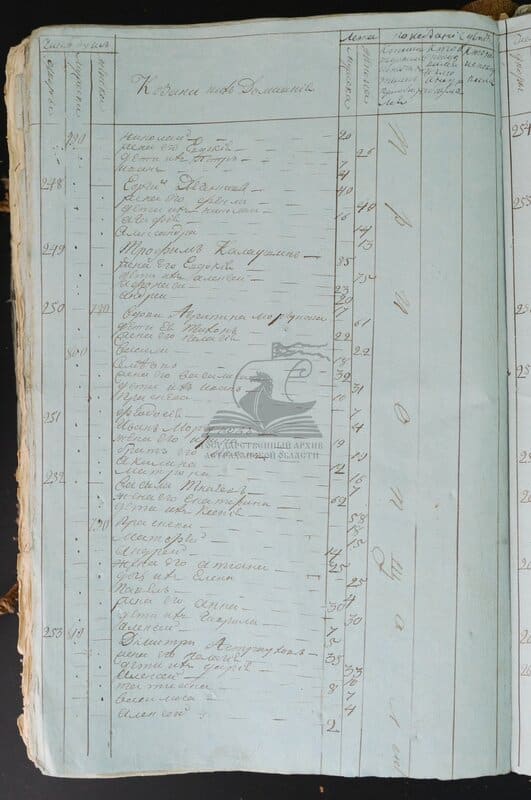
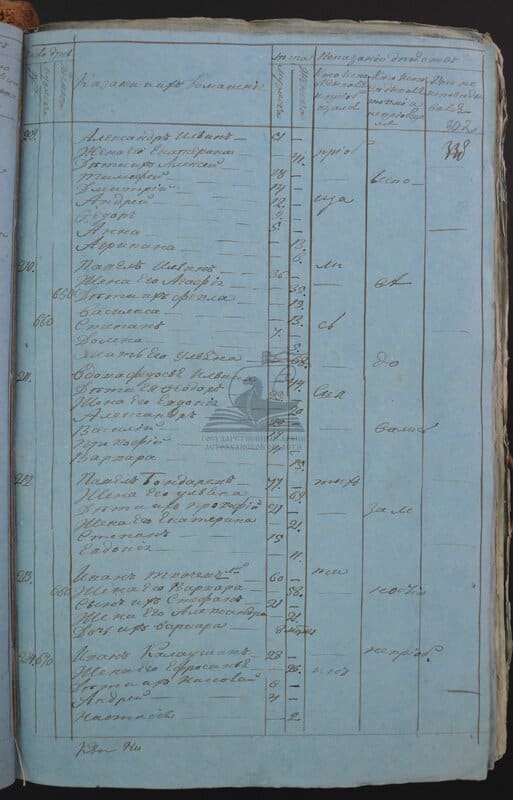
The roster “Kalaushiny” is published in the section “Cossack families” of the Philippov genealogy website. A short draft was there as early as January 2025; the full version 03.02 is dated 13 July 2025 [◈ S002]. As the introduction explains, it is based on Aleksandr Borisovich’s manuscript roster, supplemented with material from Istorichesky Cherkessk and the MyHeritage sites [◈ S001, introduction]. It contains 265 entries in seven generations; the introduction lists 37 families continued by the women of the line, from the Belousovs to the Shcherbins [◈ S001, introduction]. The page does not say who prepared the online publication. The website sets one condition: “When using these materials, a link to the site is required” [◈ S001]. This chronicle is built on the roster, and every one of its pages ends with that link.
We keep the roster’s numbering: the number in square brackets at a person’s first mention refers to his or her entry. Where the documents say otherwise, we give notes on the roster without changing the numbers. The main ones: the founder is Trofim Pakhomovich, not “Aleksey, c. 1791” [◆ S007, household no. 321]; the website author’s ancestor Nikolay was the son of Ivan — Nikolay Ivanovich — and entries Nos. 7 and 15 describe one and the same man [◆ S013, f. 174v]; Pavel Aleksandrovich’s father is No. 31, Aleksandr Nikolayevich, not No. 30 (△ the parent numbers in this part of the roster appear to have shifted when the manuscript was retyped); and Matvey Matveyevich was not the director of the Pushkin Reserve — he supervised the Reserve on behalf of Pushkin House, it was on his recommendation that S.S. Geychenko became its director in 1945, and on 10 June 1949 Matvey Matveyevich opened the All-Union Pushkin Museum in the Alexander Palace [◈ S001, Nos. 1, 7, 15, 31, 70, 71, 127; ◈ S086, no. 19, p. 196; ◈ S086, no. 26, p. 36; ◈ S100, p. 176].
Two accounts confirmed by relatives
On 8 October 2026 the author of this website, Vyacheslav Olegovich Kalaushin, reported that two family accounts are confirmed by relatives and recorded in the family history [◇ S003].
The commission for Archduke Franz Ferdinand
◇ family testimony · confirmed by relatives
The family remembers the last commission that Matvey Alekseyevich Kalaushin [S001, No. 71] carried out together with Fedot Alekseyevich [S001, No. 73] as a complete set of parade equipment for Archduke Franz Ferdinand — “full parade harness, saddles, sabres, kinzhals, etc.” The family history records that it was a “political” commission, meant to help improve relations with Austria-Hungary; war came all the same in 1914, after the Archduke’s assassination [◇ S001, No. 71]. Relatives confirm that the commission was completed [◇ S003].
Matvey Alekseyevich died in 1912 [◇ S001, No. 71], so the work was finished before then. From 1891 the Archduke was honorary chief of the Russian 26th Bug Dragoon Regiment, and in February 1902 he came to St Petersburg to present himself to Nicholas II as a General of Cavalry of the Russian army [◈ S189, “Bugsky 9th Uhlan…”; ◆ S055, 01.02.1902, p. 3]. More on this in the chapter “The Workshop”.
The saddle for the Shah of Persia
◇ family testimony · confirmed by relatives
The saddle for the Shah of Persia was made in Fedot Alekseyevich’s workshop on the order of Emperor Nicholas II; the work took two months. Fedot Alekseyevich took the saddle to St Petersburg himself. There, “at a review of the Guards, on the last day before going home (after the end of service)”, Prince Trubetskoy reported to the Emperor that the saddle had arrived. Nicholas II examined it, said it was very well made, and there and then congratulated Kalaushin on the title of Purveyor to the Court of His Imperial Majesty; a gold watch was granted with the title. Talking with the master, the Emperor asked how long he had been in St Petersburg and, learning that Trubetskoy had kept the saddle waiting so long, showed his displeasure; after the Emperor had gone, Trubetskoy sent Fedot to the guardhouse for two days for an incautious answer. The promised gold watch never reached Fedot Alekseyevich [◇ S001, No. 73; ◇ S084, “Kalaushin Yury Romanovich”]. Relatives confirm the account; it is recorded in the family history [◇ S003].
The story has come down to us in two records — the Istorichesky Cherkessk article and the roster, which repeats it almost word for word [◈ S084, “Kalaushin Yury Romanovich”; ◈ S001, No. 73]. The task the family set was not to test it but to match the years.
△ hypothesis · dating
The years point to 1900. Fedot Alekseyevich took the oath in 1891, served in the Convoy from 1892 and was discharged by Order No. 60 of the Kuban Cossack Host of 17 June 1900, “retaining the Guards uniform and awarded the badge for service in the Convoy” [◈ S001, No. 73]. Note on the roster. The same entry gives the years “1892–1911”; the number and date of the order are more precise, and his years in the Convoy are 1892–1900; △ “1911” probably refers to his whole term of Cossack service, or echoes the Convoy’s centenary.
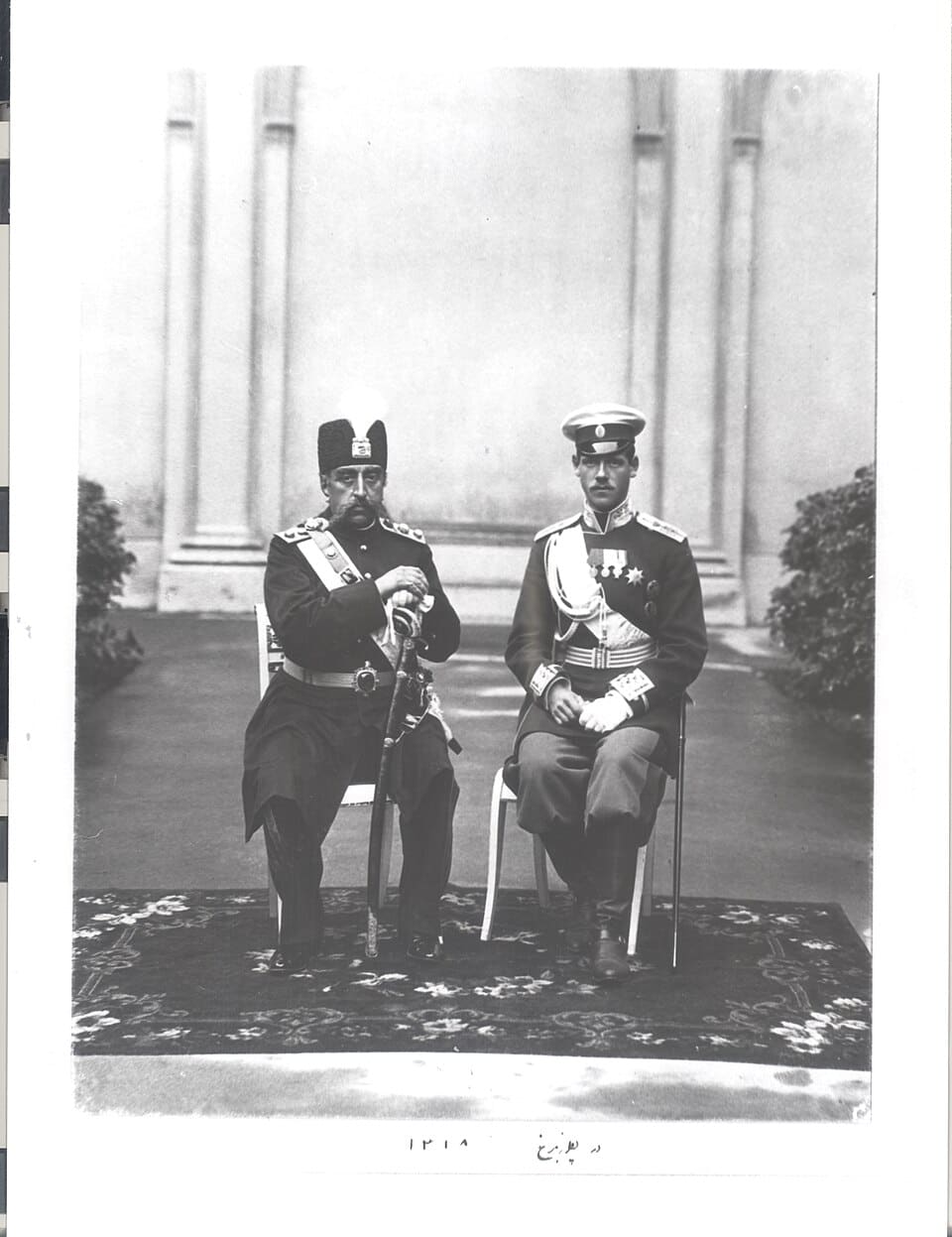
The only state visit of a Persian shah to St Petersburg in those years was that of Mozaffar ad-Din Shah, 4–10 July 1900 Old Style (17–23 July New Style) [◆ S037, 4–10.07.1900; ◆ S036, no. 181, 11.07.1900, p. 3]. It was known about well in advance: on 2 (15) February 1900 St Petersburg reported the invitation Nicholas II had sent to the Shah; in March came news of the preparations and that the Shah was expected at the end of May; in April, that he would cross Russia incognito and pay the official visit on his way back — and that visit fell in July [◆ S048, 15.02.1900, p. 7; ◆ S049, 03.03.1900, p. 33; ◆ S050, 10.03.1900, p. 23; ◆ S051, 25.04.1900, p. 3]. The two months’ work on the saddle therefore falls roughly in March–May 1900.
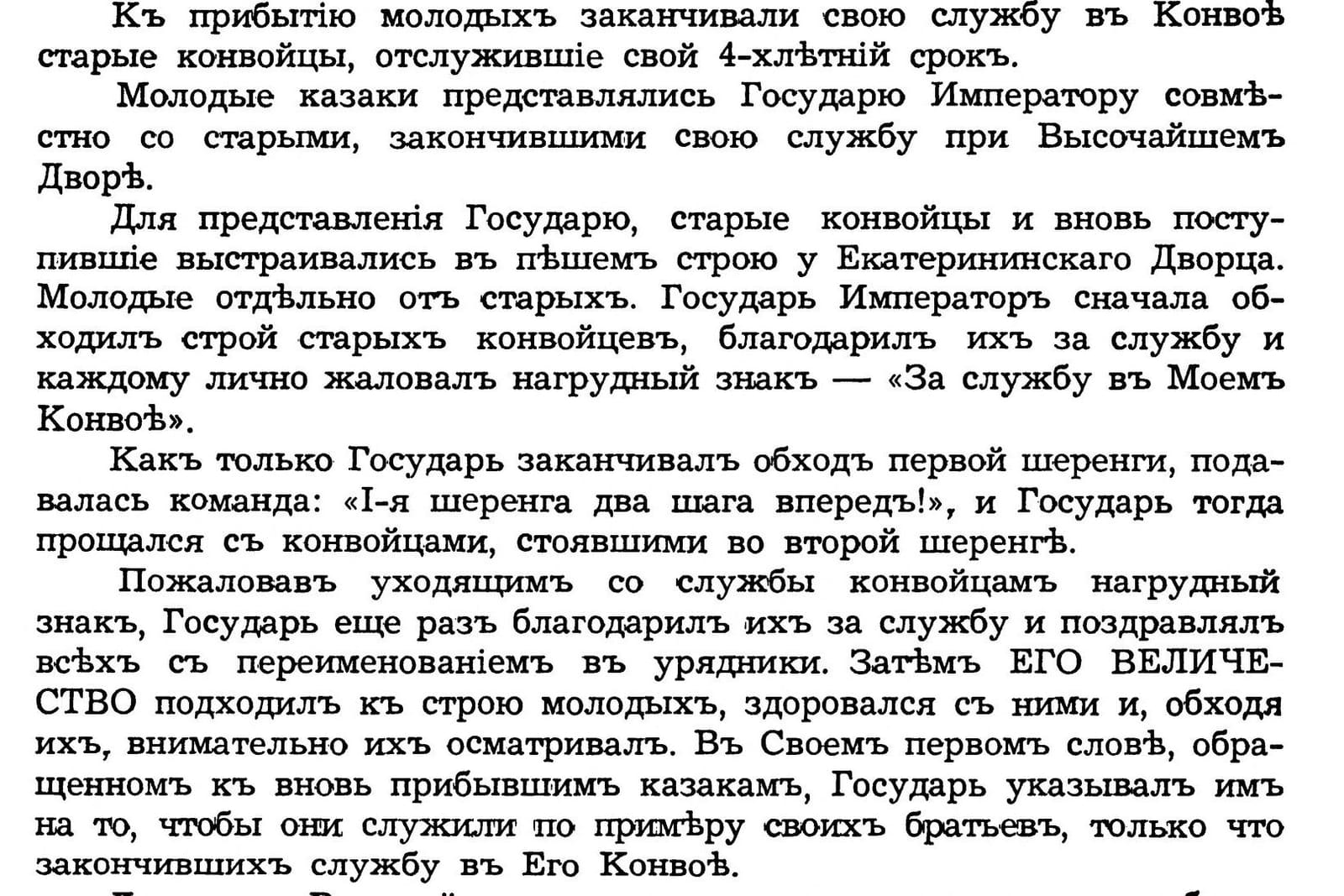
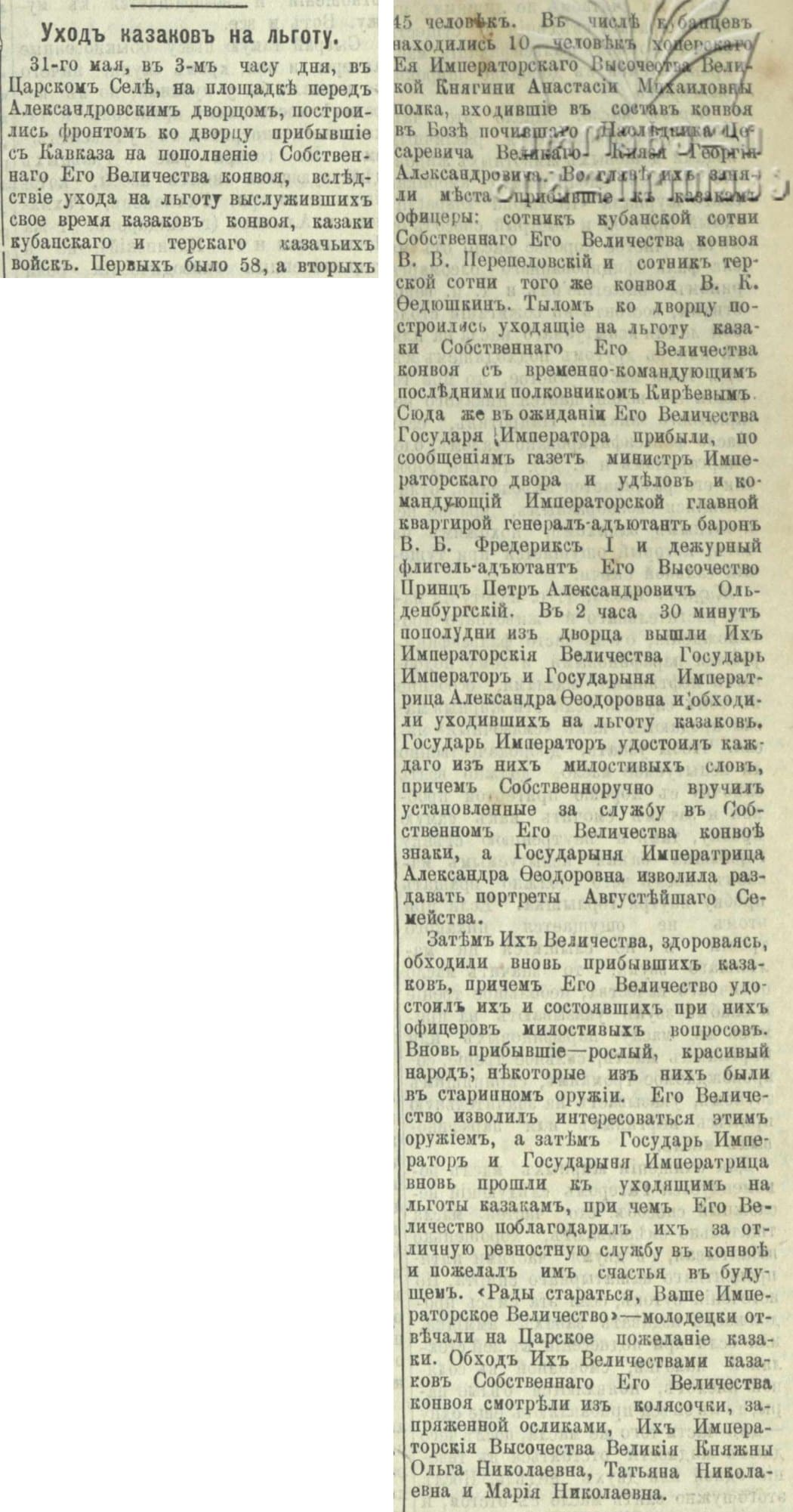
The “review on the last day before going home” was the farewell presentation of the Convoy Cossacks leaving on reserve leave. By Convoy custom, at the end of May the men who had completed their service paraded before the Emperor together with the young Cossacks who had come to replace them, and he thanked the departing men and handed each one personally the badge “For Service in My Convoy” [◈ S097, pp. 144–145]. In 1900 that presentation took place on Wednesday 31 May (13 June) in front of the Alexander Palace at Tsarskoye Selo: the Emperor spoke “gracious words” to every departing man and handed each the Convoy service badge with his own hand [◆ S036, no. 150, 10.06.1900, p. 3; ◆ S037, 31.05.1900]. Seventeen days later came Order No. 60 — with that very badge. After 1900 the documents find Fedot Alekseyevich back in the Kuban: in 1902 he won a silver medal at the Yekaterinodar exhibition, and in 1907–1909 he was ataman of Batalpashinskaya stanitsa [◆ S035, 1902, no. 255, 28.11.1902, p. 1; ◈ S156, database of stanitsa atamans, after KOV, 1907, no. 214; ◆ S035, 1909, no. 256, 03.12.1909, p. 1]. The Emperor’s question about how long the master had been in St Petersburg, and his displeasure at the delay, make sense if the saddle arrived at the end of May, when the Shah was still expected, and the visit was then put off until July.
The most consistent dating is spring to early summer 1900: the saddle was made roughly in March–May, the Emperor most probably inspected it at the farewell review on 31 May, and it was intended for Mozaffar ad-Din Shah’s visit of 4–10 July 1900. Other meetings between Russian emperors and shahs fit the account less well: Naser al-Din Shah was in St Petersburg in May 1889, in the reign of Alexander III, before Fedot Alekseyevich had taken the oath (1891); Mozaffar ad-Din Shah met Nicholas II at the manoeuvres near Kursk in 1902 and at Peterhof in August 1905, by which time Fedot Alekseyevich had left the Convoy; and for Ahmad Shah’s coronation in Tehran in 1914 Russia sent a special envoy, so there could be no review in St Petersburg [◈ S127; ◈ S033, via S180, topic 855; ◆ S054, 19.09.1902, p. 2; ◆ S037, 20–24.08.1905; ◆ S049, 21.07.1914].
A note on names. In the family account the report is made by “Prince Trubetskoy”. In 1900 the Convoy was commanded by Baron Alexander Meyendorff (1893–1906); on the day of the review, 31 May, the departing men were led by the acting commander, Colonel Kireyev, and the aide-de-camp on duty beside the Emperor was Prince Peter of Oldenburg [◈ S097, p. 170; ◆ S036, no. 150, 10.06.1900, p. 3]. Prince Georgy (Yury) Ivanovich Trubetskoy, Meyendorff’s nephew, commanded the Convoy in 1906–1914, and according to the family Fedot’s younger brother, Aleksandr Alekseyevich, served under him [◈ S097, p. 170; ◈ S188, “Trubetskoy, Georgy Ivanovich”; ◇ S001, No. 74]. △ For Kuban families his was the best-remembered commander’s name of those years, and in the story it most likely took the place of his uncle’s. This is an ordinary feature of family memory, not a contradiction of the account.
The title and the watch. The official List of Purveyors to the Imperial Court, compiled at the beginning of 1915, names “the saddle-maker Fedot Kalaushin of Batalpashinskaya stanitsa” [◈ S108]. Watches were a customary imperial reward in the Convoy: newly promoted uryadniks received silver ones, and a gold watch bearing the State arms went, for example, to the uryadnik who served as the Emperor’s orderly, at the end of his six-month term [◈ S097, p. 151]. The full discussion is in the chapter “At Court”.
Memory beyond the family
For the Kalaushins, keeping memory was not only a family matter. Matvey Matveyevich Kalaushin [S001, No. 127] devoted his life to literary museums. He supervised the Pushkin Reserve on behalf of Pushkin House, and in 1945 recommended S.S. Geychenko as its director — “No one argued harder for sending me to the Reserve than Matvey Matveyevich Kalaushin,” Geychenko recalled. On 10 June 1949 Matvey Matveyevich opened the All-Union Pushkin Museum in the Alexander Palace, and from 1953 to 1965 he was its first director [◈ S100, p. 176; ◈ S086, no. 26, p. 36; ◈ S150]. His son Boris Matveyevich, a graphic artist who illustrated more than a hundred children’s books and a scholar of the Russian avant-garde, was the first and, until his death in 1999, the only chairman of the Commission for the Protection of Historical and Cultural Monuments of the Leningrad branch of the Union of Artists [◈ S001, No. 213; ◈ S172, “Kalaushin Boris Matveyevich”].
Others, in turn, remember them. In 2004 the exhibition “Our First Director” marked Matvey Matveyevich’s centenary, and in 2005 there was an exhibition at the Mikhailovskoye Museum Reserve [◈ S001, No. 127; ◈ S004]. For it his grandson, N.G. Firtich, wrote a biographical essay, which also records the motto of Matvey Alekseyevich’s family of nine children: “There is no feeling holier than friendship” [◇ S004]. The artist’s sister, Yuliya Matveyevna Firtich [S001, No. 214], edited a website devoted to him in 2009 [◈ S005], and in 2015 the All-Russian Pushkin Museum mounted the exhibition “Boris Kalaushin: From the Academy to Abstraction” [◈ S163].
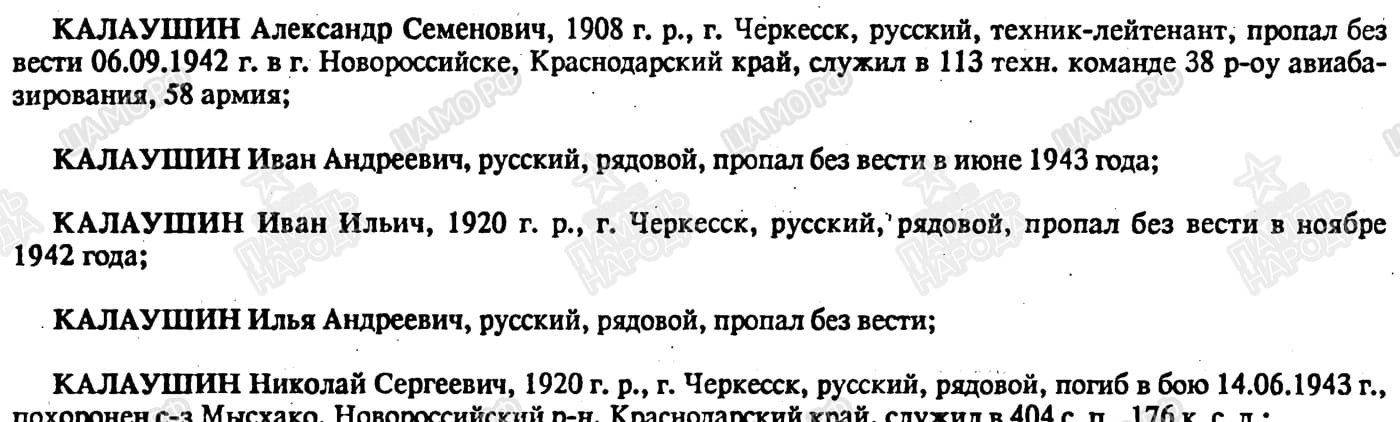
In Labinsk a memorial plaque to Matvey Matveyevich was placed on No. 1, Khalturina Street, on the initiative of the local historian G.A. Vinogradova [◈ S170, “Labinskiye krayevedy. G.A. Vinogradova”, 27.04.2025]. The Labinsk Museum takes visitors to a building it calls “the house and shop of the Kalaushin brothers, Purveyors to the Imperial Court”, and descendants of the Firsovs, among the first settlers of Labinskaya, told the museum that their father made harness and supplied it to the Kalaushins’ saddlery workshop [◈ S170, “Aleksandrovsky prospekt, 5 sentyabrya”; “Vstrecha s potomkami pervoposelentsev Firsovykh”]. In Cherkessk, according to Istorichesky Cherkessk, Kalaushin names appear among the holders of the St George Cross on the banner of the 2nd Khoper Regiment in the Church of the Intercession, and on a pennant listing the men of Batalpashinskaya killed in the First World War [◈ S084, “Kalaushin Yury Romanovich”]; the Book of Memory of the Karachay-Cherkess Republic preserves the names of Kalaushins who did not come back from the Second World War [◆ S110, p. 59; S110, vol. “Cherkessk”, p. 101]. And the historian of the Convoy, N.V. Galushkin, preserved the line that the Convoy officers’ saddles were supplied by “the Cossack Kalaushin of Batalpashinskaya stanitsa, famous throughout the Caucasus for the work of his workshop” [◈ S097, p. 143, n. 24].
“With the passage of time many historical realities fade,” Matvey Matveyevich’s grandson wrote in 2005 [◈ S004]. This chronicle is an attempt to hold on to them.
The 2026 review
While preparing this chronicle in 2026 we broke the roster down entry by entry — 265 people — and tried to check each of its statements against primary sources. The review was done in seven passes: the early generations; 19th-century service and the Convoy; the masters and officers of 1860–1917; the 20th century; Pushkin House and the St Petersburg branch; the surname; and the historical context. The rule was strict: for every statement in the roster, look first for the document that might correct it, and only then for confirmation. The family’s own accounts were not put to this test: we give them in the family’s words and add the documents alongside.
Where we looked. Confessional registers, revision tales and parish registers from the archives of Stavropol, Astrakhan, Cherkessk, Maykop and Vladikavkaz — in researchers’ transcriptions on the VGD and “Kuban Cossacks” forums and in scans on Yandex’s “Search the Archives” (some three hundred hits for the surname and its variants). Newspapers: Kavkaz of Tiflis (National Parliamentary Library of Georgia), Kubanskiye Oblastnye Vedomosti, Russky Invalid, and Austrian newspapers in the ANNO collection. The Caucasian and Kuban directories, Imperial Orders, the award lists and reports of the exhibitions of 1889, 1896, 1899, 1900 and 1902, V.G. Tolstov’s history of the Khoper Regiment and N.V. Galushkin’s book on the Convoy. The databases of the Central Archive of the Ministry of Defence (TsAMO), of Kuban Genealogy and of S.V. Volkov. Mikhailovskaya Pushkiniana, the holdings of RGALI, the State Catalogue of the Museum Fund of Russia, and museum catalogues in Russia and abroad. In all, more than 120 collections of sources were gathered — copies of pages, scans, recognised texts — together with some 450 images, 398 of which are described in the website’s catalogue of illustrations.
What we found. The earliest document of the family — the revision tale of Stavropolskaya stanitsa of 1815 — named the founder, Trofim Pakhomovich, and showed that the family came to Batalpashinskaya from Stavropolskaya in 1826–1827 [◆ S007, household no. 321; ◆ S008]. The chamber Cossack (kamer-kazak) of the Tsesarevna in 1853 proved to be Andrey Ivanovich, son of Ivan Trofimovich (entered in the roster as Andrey Alekseyevich, No. 6): a service record of 1854 names him outright as “chamber Cossack” [◆ S012, household No. 92; ◆ S013, ff. 178v–179v; ◈ S156, database of service records, service record of 1854]. We found the masters’ exhibition awards — the first of them “for a saddle and saddle straps”, Tiflis, 1889 [◆ S036, no. 305, 17.11.1889, p. 2] — and the exact days of 1900 to which the story of the Shah’s saddle belongs. The family’s words “the Cossacks elected him ataman” were borne out by the orders of 1907–1909 concerning Fedot Alekseyevich [◈ S156, database of stanitsa atamans, after KOV, 1907, no. 214; ◆ S035, 1909, no. 256, 03.12.1909, p. 1], and S.S. Geychenko’s memoirs confirmed Matvey Matveyevich’s part in the events of 1945 [◈ S100, p. 176]. Many of these finds do not argue with the roster but add to it; every difference from it is given as a note on the roster, with respect for its compiler.
What is still closed to us. The Istorichesky Cherkessk page on cherkessk.su currently opens blank — we read the article in a mirror copy; the MyHeritage sites are closed; and we have not yet seen the text of Order No. 60 of 17 June 1900, the Chamber-Fourier Journal for 1900 or the Shah’s Persian travel diary. All of these are listed under “Where the documents may be found”.
How we write. Every fact carries a reference marked with the class of its source: ◆ documented — a primary source of the period that we have seen in a scan or transcription; ◈ published source — a book, article or database, and the roster where it passes on archival information; ◇ family testimony — the stories and confirmations of relatives; △ hypothesis — our own inference. We tell the family’s account first and in its own words, and give the documents afterwards — as an addition, not a test.
Documents
Revision tale of Stavropolskaya stanitsa, 18 November 1815, household no. 321 — the earliest known document of the family, found during the 2026 review: “Trofim Pakhomov Kalaushin, 78. His wife Avdotya, 70. Their children: Ivan, 22; Aleksey, 16; Afanasy, 12; Andrey, 9; Anna, 19” [◆ S007, household no. 321, via S181, topic 84017].
Confessional register of Batalpashinskaya stanitsa, 1827, no. 172 — the entry the compiler of the roster started from: “The widow Yevdokiya Kalaushina, 58. Her children: Aleksey, 27; Afanasy, 27; Andrey, 12” [◆ S009, no. 172, via S180, topic 25558; ◆ S009, scan 161].
Deed of sale of Aleksey Nikolayevich Kalaushin’s house and orchard in Batalpashinskaya stanitsa, 1902 — one of the deeds given to the compiler by Mariya Aleksandrovna: “I, Aleksey Kalaushin, have made this sale on condition that until my death and the death of my wife Anna Nikitichna, my wife and I shall own and enjoy the whole of this property…” [◈ S001, No. 32, from the 1902 deed in the family archive]. “So Aleksey Nikolayevich loved Anna Nikitichna,” the compiler concludes.
Where the documents may be found
- A.B. Kalaushin’s family archive (whereabouts to be confirmed with relatives): the manuscript roster (source [10] of the roster); the deed of 1902 and Aleksandr Alekseyevich’s deeds (before 1916); letters from Olga Savvichna and Iraida Yevgenyevna, Galina Dolzhikova (1986) and Nikolay Nikolayevich Koloushin (1983); the photograph of Vasily Afanasyevich’s family, 1904–1905 (source [17]); B.A. Kalaushin’s letter of 30.07.1941.
- MyHeritage sites “Veb-sayt kazachyego roda Kalaushinykh”, “Kalaushin Web Site”, “Zhenskiye linii Kalaushinykh”, “Kalaushins Web Site” — access through their owners.
- Istorichesky Cherkessk (cherkessk.su): the original page of the article “Kalaushin Yury Romanovich” and the printed edition the article refers to (“vol. 1 of this book”, p. 502); Yu.R. Kalaushin’s chronicle of the family.
- The Shah’s saddle. Chamber-Fourier Journal for 1900: RGIA, f. 516, op. 1 (219/2728), d. 10 (the review of 31 May) and d. 11 or the end of d. 10 (the Shah’s visit). Diary of Nicholas II, original: GA RF, f. 601, op. 1. His Imperial Majesty’s Cabinet (RGIA, f. 468): gifts to the Shah in 1900; a watch for Uryadnik Kalaushin. Chancellery of the Ministry of the Imperial Court (RGIA, f. 472): the file on F.A. Kalaushin’s purveyor title. Court Stables Office (RGIA; fond number to be confirmed). AVPRI, Persian Desk (fond number to be confirmed). Convoy orders for May–June 1900 (RGVIA; fond number to be confirmed). GAKK, Krasnodar: the text of Kuban Host Order No. 60 of 17.06.1900. In Iran: the Safarnameh of the Shah’s first European journey (AH 1318); the archive of the Golestan Palace.
- The Archduke’s commission. Haus-, Hof- und Staatsarchiv, Vienna: HA OMaA 505; Franz Ferdinand’s papers, cartons 35–40 “Ehrenpreise und Geschenke” (1892–1914). Czech National Heritage Institute (NPÚ), Konopiště Castle. RGIA, f. 468.
- The early generations. Confessional registers of Batalpashinskaya for 1854–1860 (RGVIA, f. 14877, op. 1, d. 2050, 2470, 2717, 3501); the confessional registers of 1828 and 1830 (RGVIA, f. 14877, op. 1, d. 5159, ff. 178–214 and 501–518); the service record of 1854 (GAKK, via the Kuban Genealogy database); the original file “On the appointment of Uryadnik Kalaushin as chamber Cossack” (reference to be confirmed); the parish register of 1848 (GASK, f. 135, op. 6, d. 809).
- The 20th century. Parish registers of the Kuban regiments and plastun battalions, 1886–1913 (TsGIA SPb, f. 19, op. 128); papers of the exhibition “Our First Director” (2004) at the All-Russian Pushkin Museum; the date the Labinsk memorial plaque was unveiled (Labinsk Museum).
Documents and illustrations

Images held by rights holders
- Image held by the rights holder — permission requested
Photograph · 1990–1999 ◈ published source
Boris Matveevich Kalaushin in his study, 1990s
Boris Matveevich Kalaushin (1929–1999) among the books in his study, holding a frame with one of his abstract works; 1990s. Photograph from the page of the exhibition "Boris Kalaushin: From Academy to Abstraction" at the All-Russian Pushkin Museum (2015) [museumpushkin.ru].
Всероссийский музей А.С. Пушкина (публикация); семейный архив
© All-Russian Pushkin Museum; © heirs of B. M. Kalaushin
- Image held by the rights holder — permission requested
Work of art · 1980 ◈ published source
Portrait of Boris Kalaushin by Nikolai Firtich, 1980
"Portrait of B. Kalaushin by Nikolai Firtich, St Petersburg, 1980" (caption on the family website about the artist) [kalaushinboris.webs.com, 2009, Internet Archive copy].
Семья Фиртич / Калаушиных (публикация семейного сайта)
© N. G. Firtich; published on "Boris Kalaushin, The Artist"
- Image held by the rights holder — permission requested
Photograph · 1940–1960 ◈ published source
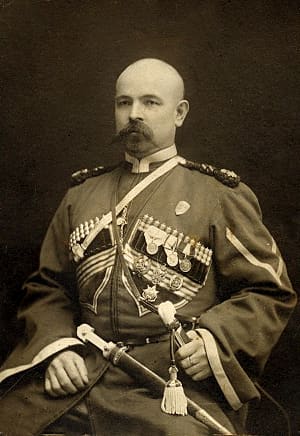
Matvei Matveevich Kalaushin (1904–1968), portrait
Matvei Matveevich Kalaushin (1904–1968) — staff member and director of the Literary Museum of Pushkin House, curator of the Pushkin Reserve on behalf of the Institute of Literature; on his recommendation S. S. Geichenko was appointed director of the Reserve in 1945; in 1949 he opened the All-Union A. S. Pushkin Museum in the Alexander Palace. Portrait from the centenary exhibition [museum.ru, N20942; Mikhailovskaya Pushkiniana, issues 19, 26, 51].
Семейный архив / ГМЗ «Михайловское» (выставка 2005, museum.ru)
"Museums of Russia" (museum.ru), Mikhailovskoye Museum exhibition, 2005

Sources for this chapter
- S001 — A.B. Kalaushin’s roster Kalaushiny (philippov.spb.ru, version 03.02 of 13 July 2025)
- S002 — A.B. Kalaushin’s roster, early draft (January 2025)
- S003 — Family testimony: V.O. Kalaushin, 8–9 Oct 2026
- S004 — N.G. Firtich, “Matvey Matveyevich Kalaushin: on the centenary of his birth” (museum.ru, N20942, 2005)
- S005 — “Boris Kalaushin, The Artist” (kalaushinboris.webs.com, 2009)
- S007 — Revision tale of Stavropolskaya stanitsa, 18.11.1815 (GASK, f. 748)
- S008 — Confessional registers of Stavropol district, 1822–1825 (GAAO, f. 599, d. 3684)
- S009 — Batalpashinskaya confessional register, 1827 (GAAO, f. 599, d. 7148)
- S012 — Batalpashinskaya confessional register (family list), 1848 (GASK, f. 135, d. 806)
- S013 — Batalpashinskaya parish register, 1857 (RGVIA, f. 14877, d. 2716)
- S028 — RGALI (online catalogue and inventories)
- S033 — Name index to the Orders of the Kuban Host, 1880–1899
- S035 — Kubanskiye Oblastnye Vedomosti (KOV)
- S036 — Kavkaz newspaper (Tiflis)
- S037 — Dnevniki imperatora Nikolaya II, vol. 1 (Moscow: ROSSPEN, 2011)
- S044 — Illyustrirovanny vestnik… progressa Rossii, no. 1 (1898)
- S048 — Wiener Zeitung, 1900 (ANNO)
- S049 — Prager Tagblatt, 1900, 1914 (ANNO)
- S050 — Neue Freie Presse, 1900 (ANNO)
- S051 — Vorarlberger Volksblatt, 1900 (ANNO)
- S054 — Ostdeutsche Rundschau, 1902 (ANNO)
- S055 — Sport und Salon, 1902 (ANNO)
- S084 — Istorichesky Cherkessk: “Kalaushin Yury Romanovich”
- S086 — Mikhailovskaya Pushkiniana, the Mikhailovskoye Museum Reserve series
- S091 — E.G. Astvatsaturyan, Oruzhiye narodov Kavkaza (1995)
- S097 — N.V. Galushkin, Sobstvenny Yego Imperatorskogo Velichestva Konvoy (San Francisco, 1961)
- S100 — S.S. Geychenko, U Lukomorya (Leningrad, 1986)
- S108 — I.V. Zimin et al., Yuvelirnye sokrovishcha Rossiyskogo imperatorskogo dvora (Moscow, 2013)
- S110 — Book of Memory of the Karachay-Cherkess Republic
- S127 — Ye. Preobrazhenskaya, “Vizity shakha Persii v Rossiyu” (Naslediye Imperii)
- S150 — museumpushkin.ru: “140 years of the first Pushkin museum”
- S153 — sammler.ru: collectors’ forum (P.N. Strelyanov)
- S156 — Kubanskaya genealogiya (kubangenealogy.ucoz.ru)
- S160 — Yandex Archive Search (yandex.ru/archive)
- S163 — All-Russian Pushkin Museum: exhibition “Boris Kalaushin: From the Academy to Abstraction” (2015)
- S170 — F.I. Moiseyenko Labinsk Museum of History and Local Lore (labinskiymuzey.ru)
- S172 — Museum of Art of St Petersburg, 20th–21st Centuries (MISP): “Kalaushin Boris Matveyevich”
- S180 — Kubanskiye kazaki forum (kubancossack.0pk.me)
- S181 — VGD genealogy forum (forum.vgd.ru)
- S188 — Russian Wikipedia — for general historical context
- S189 — Voennaya entsiklopediya, vol. 5 (St Petersburg: I.D. Sytin, 1911)
This page uses material from the Kalaushin family roster published on the Philippov website: https://philippov.spb.ru/?q=Kalaushiny (version 03.02 of 13 July 2025).