Chapter 13 of 14 · c. 1737 – the present
Vyacheslav’s Line
Nine generations of the author’s direct line, from the Khoper Cossack Trofim Pakhomovich to the present day
In brief
This chapter follows a single line of the family — from Trofim Pakhomovich, a Khoper Cossack of Stavropolskaya stanitsa, through the saddler Nikolay Ivanovich, Uryadnik Aleksandr Nikolayevich, Pavel Aleksandrovich, whose wife and children escaped from a burning barn, the engineer Mikhail Pavlovich and Lieutenant Colonel Vyacheslav Mikhailovich, born in Chimkent, to the motoring journalist Oleg Vyacheslavovich and the author of this chronicle, Vyacheslav Olegovich, founder of Data Nexus. Along the way it tells how the name Vyacheslav returned to the family a generation later and how Kalaushin Convoy Cossacks, the Pushkin scholar Matvey Matveyevich and the author’s father each found their way to Tsarskoye Selo, and it matches the years in the family account of the saddle for the Shah of Persia, most consistently dated to spring and early summer 1900.
◆ documented◈ published source◇ family testimony△ hypothesisMore about the method
The thread· Quality· Exclusivity· System
The chapter tests the thesis on a single line — and shows plainly where a trait can be seen and where there is no document. Nikolay Ivanovich the saddler, Aleksandr Nikolayevich the uryadnik with the Insignia of the Military Order, Mikhail Pavlovich the engineer with his 1965 brochure on introducing defect-free production, Oleg Vyacheslavovich the test-driving journalist [◇ S001, No. 7; ◈ S001, No. 31; ◈ S177, record 01006288313; ◆ S080] — and today Vyacheslav Olegovich, founder of Data Nexus: a Tagline Awards bronze for his EdCAS, an accelerator for EdWay, rules written into the system itself [◆ S209; ◆ S205; ◆ S210]. Of Vyacheslav Mikhailovich only his birthplace, his place of service and his rank are known [◇ S003; ◈ S001, No. 202], and the chronicle does not write traits in for him.
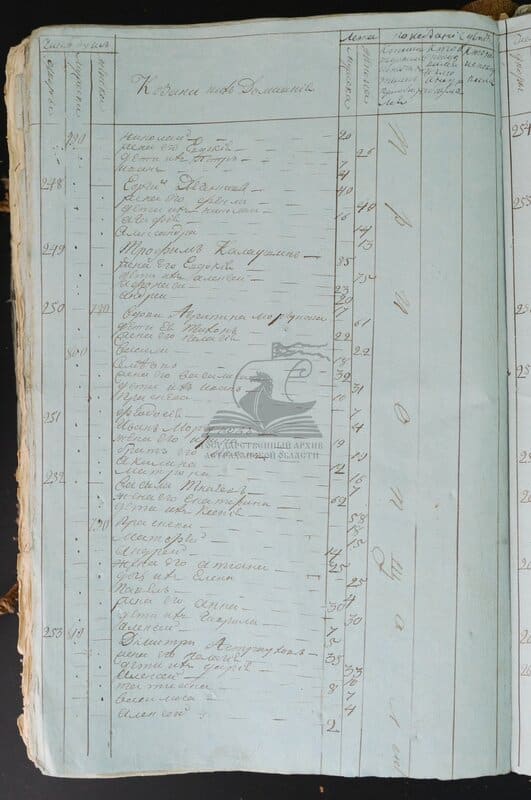
This chapter follows a single thread of the family, from the first Kalaushin named in the documents to the author of this chronicle. Many of these people appear in other chapters; here they stand side by side, father and son. The line begins in Stavropolskaya stanitsa (a Cossack village) at the end of the 18th century, keeps to Batalpashinskaya for more than a century, lives through the Revolution and the Civil War there, then in the 20th century moves by way of Chimkent to Leningrad — St Petersburg, and in the 21st to Moscow and the Emirates. Along it one can trace how the family’s work changed: Cossack service, saddlery, engineering, the army, journalism, data systems.
Nine generations
- Trofim Pakhomovich Kalaushin (b. c. 1737, d. before 1827) — a Khoper Cossack of Stavropolskaya stanitsa [S001, No. 1; ◆ S007, household no. 321].
- Ivan Trofimovich (b. 1793, d. between 1849 and 1860) — a Cossack of the Khoper Regiment from 1810 [S001, Nos. 3, 5].
- Nikolay Ivanovich (b. c. 1816) — a Cossack of Batalpashinskaya and a master saddler [S001, Nos. 7, 15].
- Aleksandr Nikolayevich (b. 1837) — an uryadnik (a Cossack non-commissioned officer), holder of the Insignia of the Military Order [S001, No. 31].
- Pavel Aleksandrovich — a householder and beekeeper in Batalpashinskaya; killed in the years of the Revolution [S001, No. 70].
- Mikhail Pavlovich (1908–1980) — an engineer in the food industry [S001, No. 117].
- Vyacheslav Mikhailovich (1943–1990) — a lieutenant colonel [S001, No. 202].
- Oleg Vyacheslavovich — a motoring journalist.
- Vyacheslav Olegovich — author and owner of the website kalaushin.com; founder of Data Nexus.
Trofim’s patronymic, “Pakhomov”, preserves a tenth and most distant generation: his father was called Pakhom, and nothing more is known of him [◆ S007, household no. 321, via S181, topic 84017].
Note on the roster. In the roster the direct line runs from the founder (No. 1: “born about 1740”) through Aleksey (No. 2: “born about 1791”) to Nikolay Alekseyevich (No. 7) [◈ S001, Nos. 1, 2, 7]. Documents published by researchers after Aleksandr Borisovich Kalaushin [S001, No. 221] compiled the roster refine this point. The husband of the widow Yevdokiya was Trofim Pakhomovich, and Aleksey was her son. Nikolay, for his part, was the son of the eldest brother, Ivan: the parish register of 1857 calls him outright “Nikolay Ivanov Kalaushin” [◆ S013, f. 174v, via S181 transcription, topic 20012]. Entries No. 7, “Nikolay Alekseyevich”, and No. 15, “Nikolay Ivanovich”, describe the same man; so do No. 3, “Ivan” (b. 1793), and No. 5, “Ivan Alekseyevich”, to whom the roster gives a second wife, Yefrosinya Pavlova, and the children Nikolay, Andrey, Irina and Marina [◈ S001, Nos. 3, 5]. The number of generations from the founder to the author is unchanged, and the compiler was right about the essentials: the founder was born about 1740, and he had sons “Ivan and Aleksey” [◈ S001, No. 1].
Khoper roots: Trofim and Ivan
The revision tale (census return) of Stavropolskaya stanitsa, drawn up on 18 November 1815, records under No. 321: “Trofim Pakhomov Kalaushin, 78. His wife Avdotya, 70. Their children: Ivan, 22; Aleksey, 16; Afanasy, 12; Andrey, 9; Anna, 19” [◆ S007, household no. 321, via S181, topic 84017]. In the confessional registers of Stavropol district for 1822–1825 Trofim is 85, and his eldest son already has a household of his own: “Ivan Kalaushin, 28; his wife Yefrosiniya, 26; their children Nikolay, 6, Andrey, 4, Nastasya, 2” [◆ S008, scans 597, 1287]. This is the first document to name Nikolay, the author’s direct ancestor.
The compiler of the roster thought the founder was “most likely a Don Cossack” [◈ S001, No. 1]; where the Kalaushins came from before they joined the Khoper Regiment is not yet known, as the chapter “The Name” explains. What is known is this: Batalpashinskaya stanitsa was founded on 1 October 1825, its southern part and centre were settled by people from Stavropolskaya [◈ S135, p. 535], and by late autumn 1827 the Khoper Cossacks had “finally hauled themselves” to their new homes [◆ S047, pt 1, p. 179]; Trofim’s family moved from Stavropolskaya with them. By 1827 Trofim Pakhomovich was no longer alive: the confessional register of the new stanitsa lists “the widow Yevdokiya Kalaushina” with her sons [◆ S009, no. 172, via S180, topic 25558]. Yet a valuation of 1830 of the establishments of the Cossacks of the former Stavropolskaya stanitsa still listed a garden “formerly belonging to the retired Cossack Trofim Kaloushin” [◆ S010, no. 155, via S181, topic 39076].
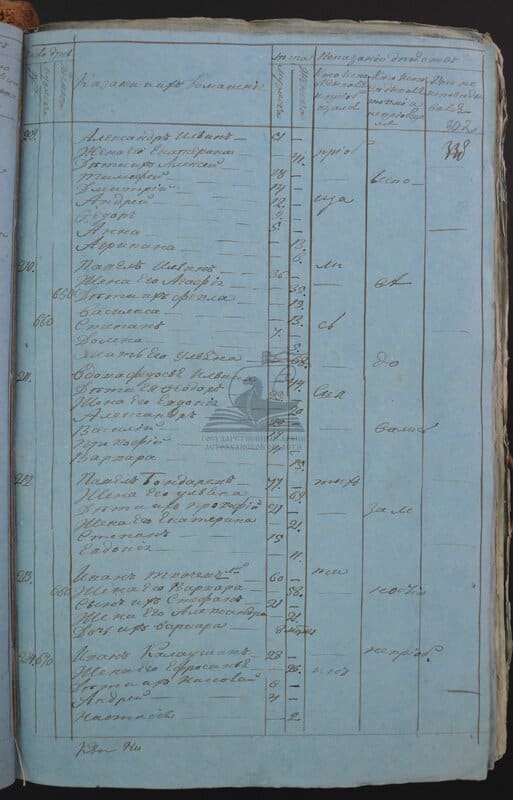
Ivan Trofimovich was born in 1793 — the year given both by the revision tale of 1815 and by the service record cited in the roster. In October 1810, at seventeen, he began his service in the Khoper Regiment; in January 1839 he was discharged “into full retirement”, and in 1849, aged fifty-six, he was listed as a retired Cossack [◈ S001, No. 3, citing TsGVIA, f. 1058, op. 2, d. 143a]. In Batalpashinskaya he had his own household from 1827: “Cossack Ivan Kalaushin, 38. His wife Yefrosinya Pavlova, 35. Their children: Nikolay, 11; Andrey, 10; Irina, 4; Marina, 3” [◆ S009, no. 181, via S180, topic 25558]. By 1860 his large household was headed by “the widow Yefrosinya Kalaushina”, aged 68, with seventeen souls in her care [◆ S014, no. 101, via S181 transcription, topic 20012]: Ivan Trofimovich had died between 1849 and 1860. The first generations are described in detail in the chapters “The Khoper” and “The Caucasian Line”.
Nikolay Ivanovich, saddler
Nikolay Ivanovich was born about 1816. In 1848 he and his family were still living in his father’s household: “Nikolay’s wife Vasilisa, 29. Their children Stefan, 13; Aleksey, 9; Yelizaveta, 7; Agafya, 5; Ilya, 3” [◆ S012, household no. 92, via S180, topic 25557]. In July 1857 “Cossack Nikolay Ivanov Kalaushin and Vassa Andreyeva” had another son baptised, also named Ilya [◆ S013, f. 174v].
◇ family testimony
The family history records Nikolay Ivanovich as a Khoper Cossack and a master saddler [◇ S001, No. 7]. With him begins the craft for which the Kalaushins would become known in the generations that followed. According to Boris Matveyevich Kalaushin [S001, No. 213], Nikolay had two sons named Ilya: there was, as the roster puts it, “a second Ilya as well, nicknamed ‘Lagaga’” [◇ S001, No. 7].
Context. The documents know two Ilyas as well: one was three years old in 1848, and the other was baptised in July 1857 [◆ S012, household no. 92; ◆ S013, f. 174v].
From Nikolay Ivanovich the family divides into two branches. His son Aleksey Nikolayevich (b. c. 1839) was the father of the master craftsmen Matvey, Mikhail, Fedot and Aleksandr, of the teacher Savva and of their sister Anna; his grandson was the Pushkin scholar Matvey Matveyevich Kalaushin [◈ S001, Nos. 32, 71–76, 127]. The author’s line runs through another son, Aleksandr Nikolayevich.
Aleksandr Nikolayevich, uryadnik
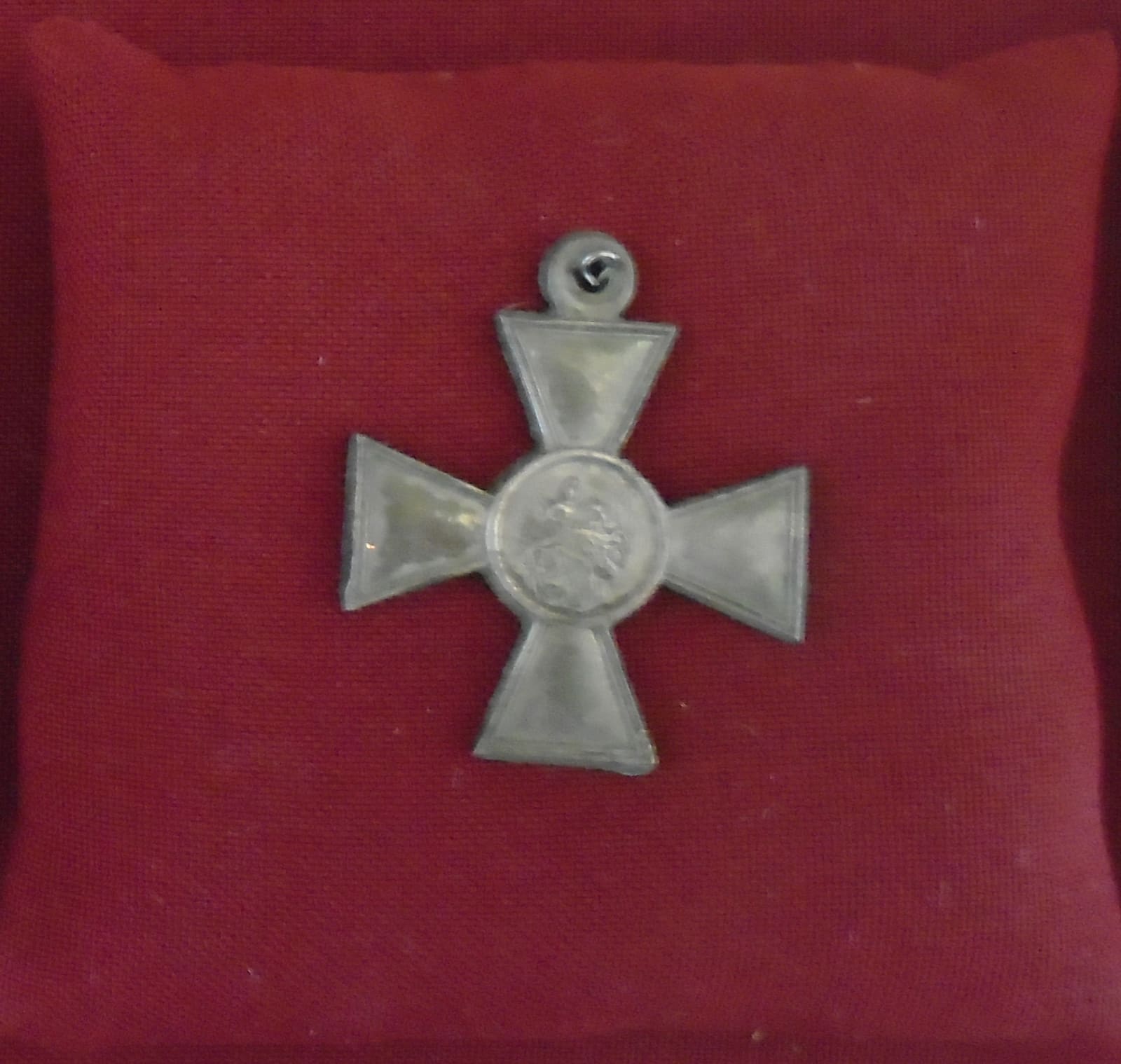
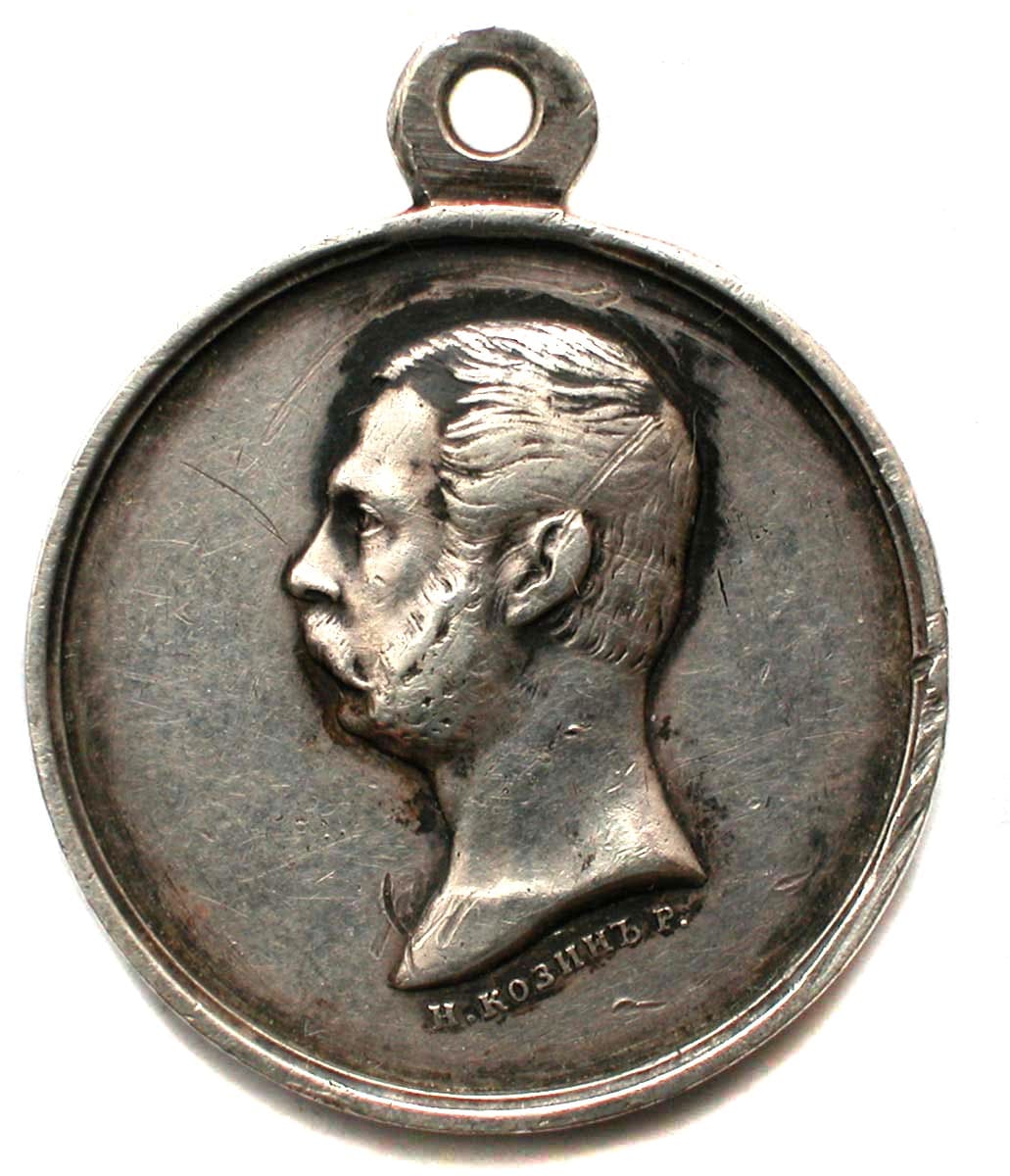
According to the roster, Aleksandr Nikolayevich was born in 1837, entered service in January 1855, was “listed as an uryadnik from as early as December 1855”, and held the Insignia of the Military Order (“the soldier’s St George Cross”) No. 19441, the silver Medal “For the Conquest of the Western Caucasus” and the Cross “For Service in the Caucasus”. In the list of uryadniks on internal service in the Batalpashinsk Department cited by the roster, the column “where he is” reads “at home”. “He has a son Pavel,” the compiler adds [◈ S001, No. 31, citing TsGVIA, f. 330, op. 56, d. 452]. △ The medal and the cross indicate that his service fell in the last years of the Caucasian War.
Note on the roster. The roster gives the same insignia number, 19441, for his brother Aleksey Nikolayevich [◈ S001, No. 32]; one number cannot have belonged to two men, and it can be checked against the RGVIA database Georgiyevskiye kavalery (Knights of St George). In the confessional register of 1848 there is no Aleksandr in Nikolay’s household, although he would then have been about eleven [◆ S012, household no. 92]. △ The boy may have been entered in another household, or the year 1837 may be approximate; the stanitsa’s confessional registers for 1854–1860 should settle the question (see “Where the documents may be found”).
Pavel Aleksandrovich: Kutais, the beehives, the barn
Note on the roster. The roster enters Pavel Aleksandrovich as No. 70.30, a son of Stefan Nikolayevich. His patronymic and the entry for Aleksandr Nikolayevich (“He has a son Pavel”) show that his father is No. 31, Aleksandr Nikolayevich [◈ S001, Nos. 31, 70]. △ The parent numbers in this part of the roster appear to have shifted when the manuscript was retyped.
△ He is probably the Pavel Kalaushin of Batalpashinskaya who was called up in 1903 and discharged in 1907 [◈ S156, Kuban Cossack Host conscript database], which would place his birth about 1882. And he is probably the man of whom Russky Invalid wrote in the summer of 1906. On the evening of 16 May 1906, in Kutais (now Kutaisi), five Cossacks of the 2nd Sotnia of the 1st Khoper Regiment were escorting General Alikhanov’s carriage; the Cossacks Pavel Kalaushin and Ivan Melnikov rode in front. As the carriage drew level with the former Hotel Marseille, two bombs were thrown: one Cossack was killed outright, two were seriously wounded, “and Pavel Kalaushin lightly”. The three wounded men, thrown from their horses, returned fire into the darkness [◆ S056, no. 147, 07.07.1906, p. 6, letter from the acting commander of the 1st Khoper Regiment, Voyskovoy Starshina Rychkov]. There is no other Pavel of the right age in the roster.
◇ family testimony
Pavel Aleksandrovich lived in Batalpashinskaya; the family had a large and prosperous farm and kept bees. His wife’s name was Pelageya Alekseyevna. “During the Revolution” Pavel Aleksandrovich was killed with pitchforks. Pelageya Alekseyevna and their three small children were locked in a barn with other hostages, and the barn was set on fire. “Only by a miracle did they escape.” Afterwards the family lived in Cherkessk [◇ S001, No. 70].
△ These three children were most likely the three sons named in the roster: Mikhail (b. 1908), Nikolay (b. 1911) and Vyacheslav (b. 1915) [◈ S001, Nos. 70, 117–119].
From the history of the stanitsa. The Civil War passed through Batalpashinskaya more than once. Soviet power was established there in February–March 1918; at dawn on 5 September 1918 the stanitsa was taken by the forces of A.G. Shkuro; on 22–23 March 1920 the Red Army returned; in the summer of 1920 General M.A. Fostikov’s insurgents rose in the mountains; and only from mid-September 1920 did the stanitsa remain in Soviet hands for good [◈ S117, pp. 56–64, 104, 134, 162; ◈ S143, ch. 15; ◈ S096]. In the spring of 1918, in the words of a local officer quoted by Shkuro, the new authorities were arresting and shooting “the most prominent Cossacks” [◈ S143, ch. 7]; in July 1920 whole families, children included, were taken hostage in the stanitsa [◈ S139]. In 1920 Pavel Aleksandrovich’s first cousin, Fedot Alekseyevich, was shot as a hostage in Batalpashinskaya [◈ S001, No. 73]. △ The family account is undated (“during the Revolution”) and fits either period of Soviet rule, 1918 or 1920; when the barn burned has still to be established from the documents. More is told in the chapter “The Upheaval”.
Mikhail Pavlovich, engineer
Mikhail Pavlovich was born in 1908 [◈ S001, No. 117]. His brother Nikolay Pavlovich (1911–1987), a driver, was called up in Kustanay in July 1941; in August 1945 he fought in the Far East as a driver in the guard company of the 15th Army headquarters and received the Medal “For Combat Service” [◆ S022, f. 33, op. 686196, d. 6291, via S175, record 29982103; ◈ S001, No. 118] — his story is told in the chapter “The Great Patriotic War”. The youngest, Vyacheslav, “died in the Civil War” [◇ S001, No. 119].
◇ family testimony
Mikhail Pavlovich was a very serious man, strict, punctual and principled. His son used to say that whoever was visiting, when bedtime came his father would not depart from his settled routine. He lived independently and brought up his only son, Vyacheslav, in the same way [◇ S001, No. 117]. The family remembers him as an engineer in the food industry [◇ S003].
The roster also records a printed work by Mikhail Pavlovich, and it has been found in two national libraries: Vnedreniye sistemy bezdefektnogo izgotovleniya produktsii na Ryazanskom khlebozavode No. 3 (“Introducing the system of defect-free production at Ryazan Bakery No. 3”, Moscow, 1965; 16 pp.), published by the Central Institute for Scientific and Technical Information of the Food Industry of the State Committee for the Food Industry under the USSR State Planning Committee (Gosplan). Both catalogues give the author as “Kalaushin, M. P.”; the Russian State Library notes that the author is not named on the cover [◈ S177, record 01006288313, shelfmark FB Br 98/895; ◈ S178, record 07NLR_LMS008617471, shelfmark 65-6/2867; ◈ S001, No. 117]. Mikhail Pavlovich thus has a printed trace of his own, confirmed by a library catalogue and not by the roster alone. △ The subject of the brochure suggests that in the mid-1960s his work was connected with that bakery; the roster does not say where he was employed.
Mikhail Pavlovich died in 1980 [◈ S001, No. 117].
Vyacheslav Mikhailovich, lieutenant colonel
Vyacheslav Mikhailovich was born in 1943 in Chimkent (now Shymkent) in the Kazakh SSR [◈ S001, No. 202; ◇ S003] and was named after his father’s younger brother, Vyacheslav Pavlovich [◇ S001, Nos. 119, 202]. He served, in the roster’s words, “at the Military Transport Academy of the Army and the Rear” [◈ S001, No. 202]; the family calls it the Military Transport Academy of the Rear and Transport in Leningrad [◇ S003]. He left the service on grounds of ill health with the rank of lieutenant colonel [◈ S001, No. 202].
◇ family testimony
The compiler of the roster, Aleksandr Borisovich Kalaushin, noted that in looks Vyacheslav Mikhailovich closely resembled the compiler’s own brother, Dmitry Borisovich Kalaushin (1938–2011), “only shorter, and with light eyes” [◇ S001, Nos. 202, 222].
Vyacheslav Mikhailovich’s wife was called Galina; they had a son, Oleg [◈ S001, No. 202]. According to the family, he met Galina there, in Chimkent [◇ S003]. Vyacheslav Mikhailovich died in 1990 [◈ S001, No. 202].
Oleg Vyacheslavovich, motoring journalist
The author’s father, Oleg Vyacheslavovich Kalaushin, is a motoring journalist. According to the family, he worked for the St Petersburg magazine Pyatoye Koleso (“The Fifth Wheel”, also styled 5 Koleso) from 1995 to 2019 [◇ S003]. The earliest pieces under his name that could be traced date from 2000: the printed issues of the 1990s have not been digitised, and the magazine’s website survives in the web archive only from August 2000. Among the first are a road test, “Nissan Almera. A Good Sort”, and a piece on a car-repair shop in the weekly newspaper 5 Koleso (no. 41, 2000); by the spring of 2001 he was writing for the magazine and for its supplement Populyarnaya mekhanika, where his instalments of the used-car series Po vintiku (“Screw by Screw”) appeared [◆ S078, 22.08.2000, 5koleso.ru/?p=3971; ◆ S078, no. 41, 2000; ◆ S079, supplement, no. 4, 2001 — 5koleso.spb.ru archive, via the Wayback Machine]. From 2003 to 2006 the magazine’s staff page lists him in its Testing Department [◆ S078, “Editorial staff”, 03.09.2003, 27.10.2005, 18.10.2006, via the Wayback Machine].
The magazine’s website credits “Oleg Kalaushin” with 290 pieces from 2000 to 2019, 243 of them road tests; Russian Wikipedia cites five of his articles [◆ S078, publication metadata; ◈ S188, “Kharkovchanka”, “Chery Tiggo” and others]. They include a winter run in the magazine’s Lada Vesta from St Petersburg to Murmansk to visit the nuclear icebreaker Lenin — some 3,200 km in five days in February 2016 — and essays on Antarctic snow vehicles, from the Soviet Kharkovchanka to the American Snow Cruiser [◆ S078, 22.02.2016, ?p=12993; 21.01.2016, ?p=7377; 03.02.2016, ?p=7393]. The last piece found is a long-term test of the Lada Vesta Cross, dated 15 April 2019 [◆ S078, 15.04.2019, ?p=5605].
On 25 March 2005, in the Throne Hall of the Catherine Palace in Pushkin, the awards were presented for the tenth professional competition of journalists of St Petersburg and Leningrad Oblast, the Golden Pen (results for 2004). The special prize “Best Test-Driving Journalist” went to “Oleg Kalaushin (Pyatoye Koleso magazine)” [◆ S080; ◆ S081].
Vyacheslav Olegovich
Vyacheslav Olegovich Kalaushin is the author and owner of kalaushin.com, where this chronicle is published. It was through him that the relatives’ confirmation reached the chronicle: two family accounts — of the parade commission for Archduke Franz Ferdinand and of the saddle for the Shah of Persia — are recorded in the family history and confirmed by relatives. He also set the task to which part of this chapter is devoted: for the saddle, not to test the account but to match the years [◇ S003].
Vyacheslav Olegovich was born in St Petersburg. He was into IT from childhood, finished school and afterwards, in his own words, “decided to try himself in the craft”. Early in 2018 he moved to Moscow, from there to Dubai, and then to Abu Dhabi, where he lives today [◇ S003].
He began in education, while still in St Petersburg: EdWay, which he founded, was launched there in December 2017 as an adaptive-learning platform for the EGE, Russia’s school-leaving exam [◆ S207; ◆ S205]. In autumn 2018 EdWay was one of six projects at the Startup Exchange of the business daily Delovoy Peterburg, and in February 2019 the paper named Vyacheslav Olegovich as co-owner of the startup, which was then in the accelerator of the pre-seed fund Startup Lab [◆ S206; ◆ S205]. The same year EdCAS, the corporate-learning platform he founded, won Bronze at the Tagline Awards [◆ S208; ◆ S209]. Today his work is Data Nexus Technologies Services FZ-LLC (UAE), the company he founded, a marketing, product-architecture and data-systems practice [◇ S003; ◆ S210, /blog/author/viacheslav-kalaushin]. Its products — CyberEGE, a preparation platform for Russia’s EGE and OGE school exams; NeuroFrame, a behavioural assessment platform; and Carfleet, a system for car-rental firms — he calls “ours”: he and the Data Nexus team created them [◇ S003; ◆ S210, /products; ◆ S211; ◆ S212; ◆ S213]. For Drive Your Dream, a Dubai company, the team built a quoting website, a CRM and an AI sales agent [◆ S210, /case-studies/drive-your-dream-quoting-site; ◆ S214]. Data Nexus’s working rule is “Define what must remain true before deciding what should change” [◆ S210]. His father road-tested cars [◆ S078] and his great-grandfather wrote a brochure on a system of defect-free production [◈ S177, record 01006288313]; △ the chronicle notes this echo as it notes the Tsarskoye Selo one — not as cause and effect but as a recurring motif. With Vyacheslav Olegovich the line begun by Trofim Pakhomovich reaches the present day.
A name that came back
Pavel Aleksandrovich’s youngest son, Vyacheslav, was born in 1915 and died as a child during the Civil War. In 1943 his elder brother Mikhail gave his only son the name in his memory [◇ S001, No. 119]. Vyacheslav Mikhailovich’s grandson, the author of this chronicle, bears the same name. So one name has passed through three generations of the line — from a boy who did not live to grow up in the years of upheaval to the man who has gathered this history together.
The Tsarskoye Selo thread
There is also a resonance in this line worth naming — not as cause and effect, but as a recurring motif. Several times over a century and a half the Kalaushins’ paths led to the court and to the imperial residences outside St Petersburg.
In 1853 Nikolay Ivanovich’s brother Andrey Ivanovich (in the roster, Andrey Alekseyevich), an uryadnik of the 2nd Khoper Regiment serving in the Heir’s Convoy, was appointed chamber Cossack (kamer-kazak) to the Tsesarevna, the future Empress Maria Alexandrovna, and sent to St Petersburg with his wife and daughters [◈ S001, Nos. 6, 16, citing the file “On the appointment of Uryadnik Kalaushin as chamber Cossack”; ◆ S013, ff. 178v–179v].
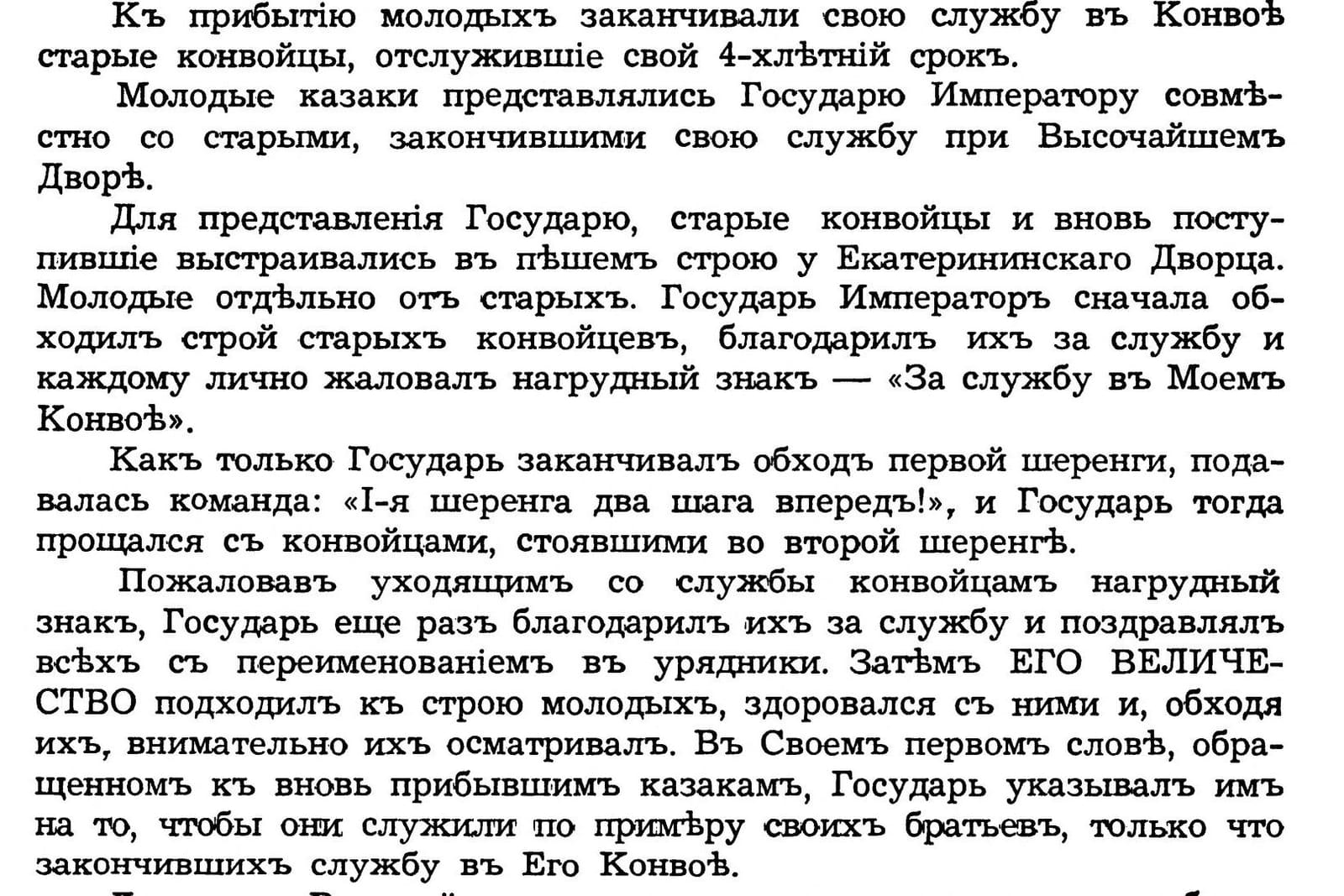
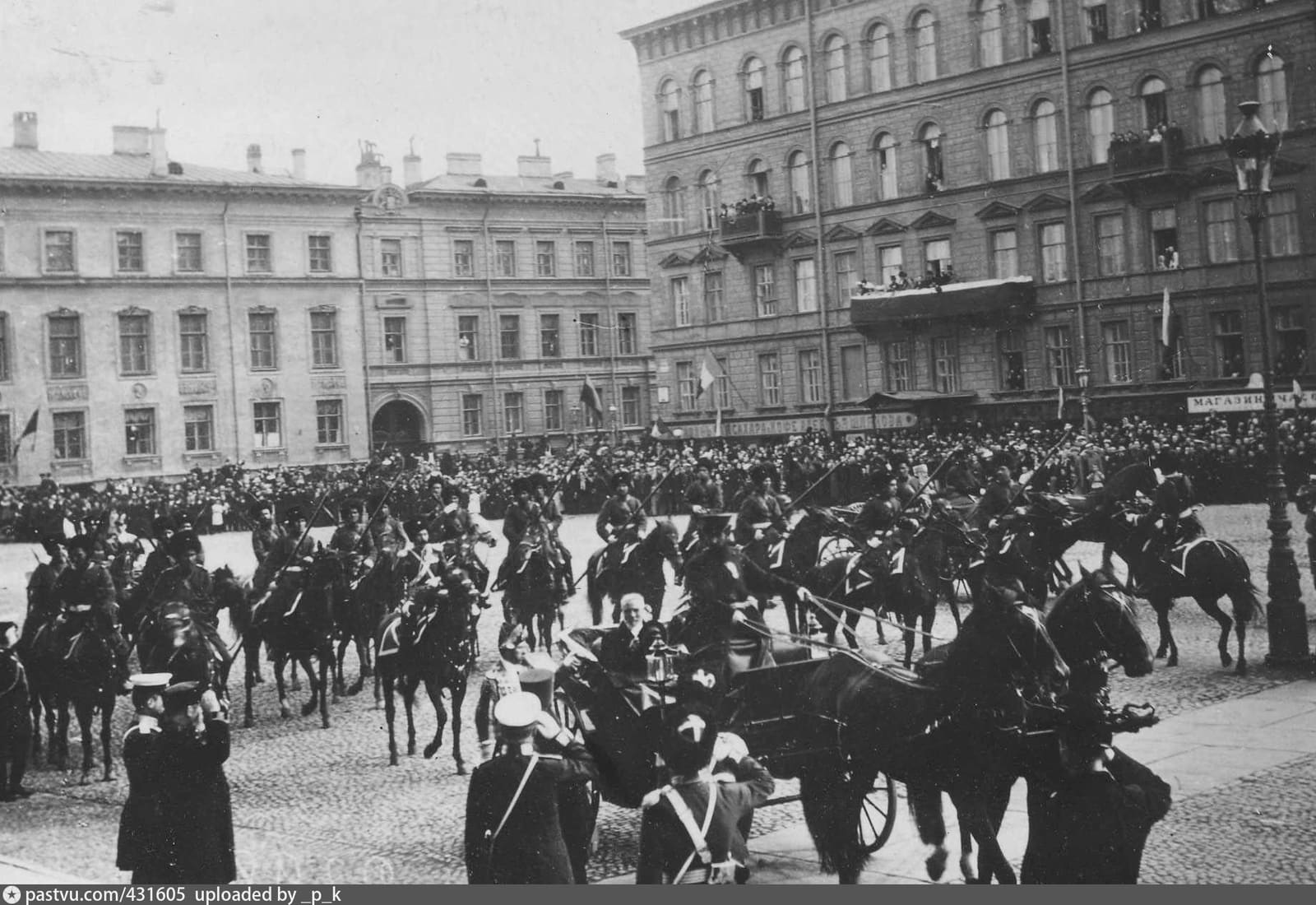
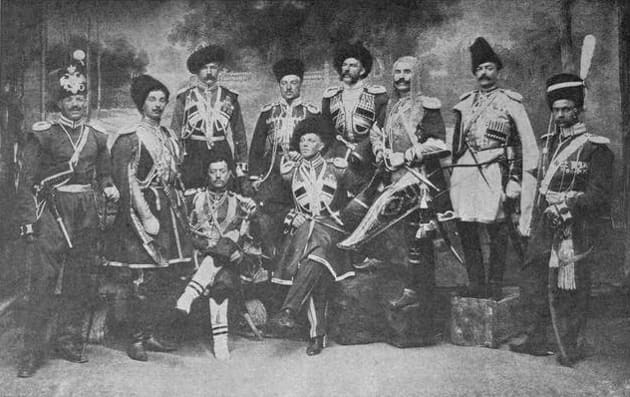
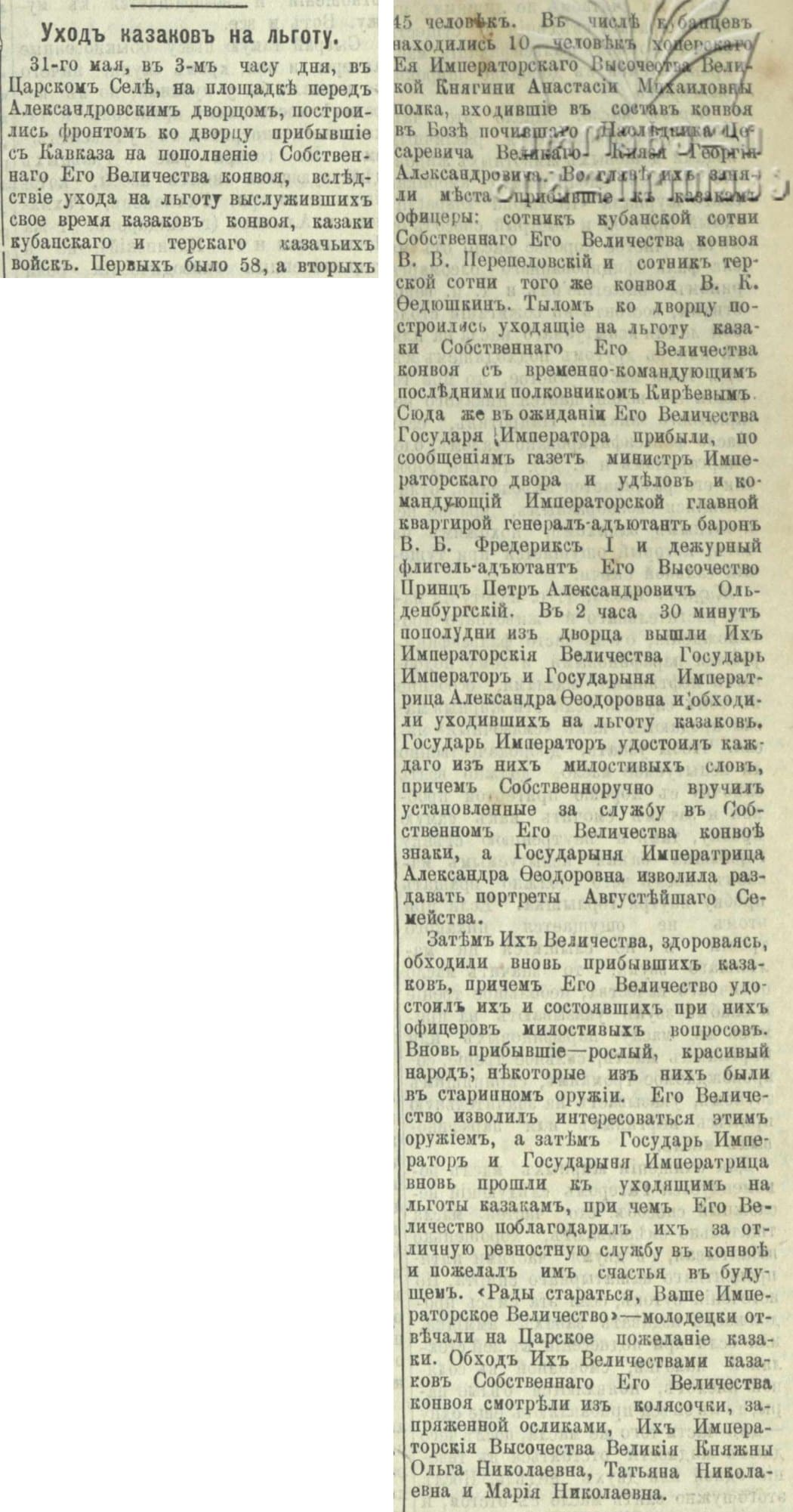
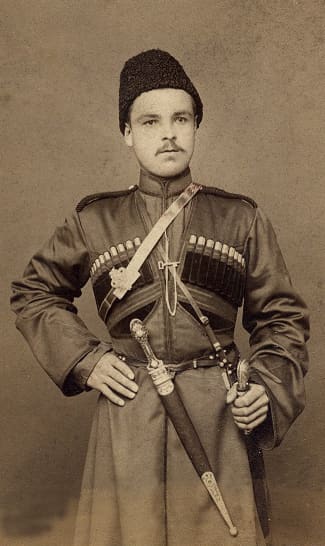
Pavel Aleksandrovich’s first cousin, Fedot Alekseyevich Kalaushin [S001, No. 73], served from 1892 to 1900 in His Majesty’s Own Convoy (the Cossack bodyguard of the Emperor; hereafter the Convoy). In 1900 the farewell presentation of the departing Convoy men took place on Wednesday, 31 May Old Style (13 June New Style), in front of the Alexander Palace at Tsarskoye Selo: the Emperor honoured each man who was leaving with “gracious words” and handed out the Convoy service badges with his own hand [◆ S036, no. 150, 10.06.1900, p. 3; ◆ S037, 31.05.1900]. Galushkin places this custom at the Catherine Palace [◈ S097, pp. 144–145]; in 1900 the review was held at the Alexander Palace, where the Imperial Family was then living. The family account of the saddle for the Shah of Persia is bound up with this review.
The saddle for the Shah of Persia: matching the years
◇ family testimony · confirmed by relatives
The saddle for the Shah of Persia (Iran) was made in Fedot Alekseyevich’s workshop on the order of Emperor Nicholas II; the work took two months. Fedot Alekseyevich took the saddle to St Petersburg himself. There, “at a review of the Guards, on the last day before going home (after the end of service)”, Prince Trubetskoy reported to the Emperor that the saddle had arrived. Nicholas II examined it, said it was very well made, and there and then congratulated Kalaushin on the title of Purveyor to the Court of His Imperial Majesty; a gold watch was granted with the title. Talking with the master, the Emperor asked how long he had been in St Petersburg and, learning that Trubetskoy had put off presenting the saddle for so long, showed his displeasure. Once the Emperor had gone, Trubetskoy turned his anger on Fedot and sent him to the guardhouse for two days for an incautious answer. The promised gold watch never reached Fedot Alekseyevich. The family also remembers the signboard of his workshop in Batalpashinskaya, which announced that it belonged to a Purveyor to the Court of His Imperial Majesty — a title granted to him after the saddle for the Shah [◇ S001, No. 73]. Relatives confirm this account; it is recorded in the family history [◇ S003].
△ hypothesis · dating
The years point to 1900. Fedot Alekseyevich served in the Convoy from 1892 and was discharged by Order No. 60 of the Kuban Cossack Host of 17 June 1900, “retaining the Guards uniform and awarded the badge for service in the Convoy” [◈ S001, No. 73]. Note on the roster. The same entry also gives the years “from 1892 to 1911”; the 1900 order, with its number and date, is the most precise date for the end of his service in the Convoy itself, while 1911 △ probably marks the end of his Cossack service as a whole rather than of his service at Court. The only state visit of a Persian shah to St Petersburg during his years in the Convoy was that of Mozaffar ad-Din Shah, 4–10 July 1900 (17–23 July New Style) [◆ S037, 4–10.07.1900; ◆ S036, no. 181, 11.07.1900, p. 3]. It was known about well in advance: in February 1900 St Petersburg reported the invitation Nicholas II had sent to the Shah; in March, the preparations for his reception and that he was expected in St Petersburg at the end of May; in April, that his route had changed — he would cross Russia incognito, and the state reception in the capital would take place on his way back [◆ S048, 15.02.1900, p. 7; ◆ S049, 03.03.1900, p. 33; ◆ S050, 10.03.1900, p. 23; ◆ S051, 25.04.1900, p. 3]. That reception duly came in July. If the saddle was ordered when the visit was first announced, two months’ work falls roughly in March–May 1900. The “review on the last day before going home” is the farewell presentation of 31 May, the only one in 1900: seventeen days later came Order No. 60 — with the very badge the Emperor had handed out at the review — and two and a half weeks after that the Shah arrived in St Petersburg. The Emperor’s question about how long the master had been in the capital, and his displeasure at the delay, also find their place in this picture: the saddle was being made for the date set in March, the end of May; once the reception had been moved to the Shah’s return journey there was no longer any hurry to present it, and the master and his saddle waited for the farewell review. The most consistent dating is spring to early summer 1900, for Mozaffar ad-Din Shah’s visit of 4–10 July 1900.
Other meetings between Russian emperors and shahs fit the account less well. Naser al-Din Shah was in St Petersburg in May 1889, in the reign of Alexander III, before Fedot Alekseyevich had taken the oath of service (1891). In 1902 Mozaffar ad-Din Shah met Nicholas II at the manoeuvres near Kursk, and in August 1905 at Peterhof; by then Fedot Alekseyevich had left the Convoy, and August was not the time of the farewell review. For Ahmad Shah’s coronation in Tehran in 1914, Russia sent a special envoy — a gift would then have travelled to Tehran rather than been shown at a review at Tsarskoye Selo [◈ S127; ◈ S033, via S180, topic 855; ◆ S054, 19.09.1902, p. 2; ◆ S037, 20–24.08.1905; ◆ S049, 21.07.1914].
A note on names. In the family account the report is made by “Prince Trubetskoy”. In 1900 the Convoy was commanded by Baron Alexander Meyendorff (1893–1906); on the day of the review, 31 May, the departing men were led by the acting commander, Colonel Kireyev, and the aide-de-camp on duty beside the Emperor was Prince Peter Alexandrovich of Oldenburg [◈ S097, p. 170; ◆ S036, no. 150, 10.06.1900, p. 3]. Prince Georgy (Yury) Ivanovich Trubetskoy, Meyendorff’s nephew, commanded the Convoy from 1906 to 1914 [◈ S097, p. 170; ◈ S188, “Meyendorff, Aleksandr Yegorovich”, “Trubetskoy, Georgy Ivanovich”]; according to the family, Fedot’s younger brother, Aleksandr Alekseyevich, served in the Convoy in 1904–1908, his last years there falling under Trubetskoy’s command [◇ S001, No. 74]. △ For Kuban families his was the best-remembered commander’s name of those years, and in the account it most likely took the place of his uncle’s. Another possibility is that the titled “prince” who stood beside the Emperor that day merged, in the retelling, with the well-remembered “Prince Trubetskoy”. This is how names often travel in family memory; it does not contradict the account.
The title and the watch. The official List of Purveyors to the Imperial Court, compiled at the beginning of 1915, names “the saddle-maker Fedot Kalaushin of Batalpashinskaya stanitsa” [◈ S108]. Watches were a familiar reward in the Convoy: the Emperor gave a gold watch bearing the State arms to his uryadnik-orderly, for example, at the end of a six-month term of duty with him, while silver watches went to Cossacks who completed the Convoy training course and to the best marksmen [◈ S097, pp. 151–152]. The full discussion is in the chapters “At Court” and “The Chroniclers”.
1911, 1949, 2005
In May 1911 the Convoy celebrated its centenary at Tsarskoye Selo: on 18 May, in front of the Catherine Palace, a service was held to consecrate the new standard, followed by a parade of the Convoy [◈ S097, pp. 173–175]. Among the Kuban delegation at the jubilee was Podkhorunzhy (senior NCO) Ivan Stepanovich Kalaushin [◈ S132, pp. 104–105, citing GAKK] — according to the roster a former Convoy man and a nephew of Aleksey Nikolayevich, and so another first cousin of Pavel Aleksandrovich [◈ S001, No. 77].
Mikhail Pavlovich’s second cousin, Matvey Matveyevich Kalaushin [S001, No. 127], looked after the Pushkin Reserve on behalf of Pushkin House from 1934; on his recommendation Semyon Geychenko was appointed director of the Reserve in 1945 [◈ S100, p. 176; ◈ S086, no. 19, p. 196]. Note on the roster. The roster says that Geychenko was “handed this post by Matvey Matveyevich Kalaushin” [◇ S001, No. 71]; according to the documents and memoirs, Matvey Matveyevich was not himself styled director of the Reserve — he oversaw it for Pushkin House and recommended Geychenko as director. △ The family’s phrase is easy to understand: in the late autumn of 1944 it was he who came to the newly liberated Mikhailovskoye, paid the staff their wages for the months gone by and took them to Leningrad for the winter; in February they were told that Geychenko had been appointed director [◈ S144, no. 5 (8), 2014, p. 12]. On 10 June 1949 the first exhibition of the All-Union Pushkin Museum opened in the Alexander Palace at Tsarskoye Selo (then the town of Pushkin); the ribbon was cut by the President of the Academy of Sciences, Sergey Vavilov [◈ S204, Tsarskoye Selo chronicle, 10.06.1949]. Matvey Matveyevich, then “head of the literary museum of the Institute of Literature” [◆ S075, no. 20, 15.05.1949], opened the museum: Mikhailovskaya Pushkiniana has published a photograph captioned “On the day of the opening of the All-Union Pushkin Museum in the Alexander Palace”, showing, from right to left, Sergey Vavilov, Semyon Geychenko and M.M. Kalaushin [◈ S086, no. 26, p. 36]. From 1953 to 1965 he was the first director of the All-Union Pushkin Museum [◈ S150]. His story is told in the chapter “Pushkin House”.
And on 25 March 2005, almost a hundred and five years after the review at the Alexander Palace, the author’s father received his prize in the Throne Hall of the Catherine Palace. Nothing links these days except the family itself; the chronicle can only note the echo.
Documents
Confessional registers of Stavropol district, 1822–1825 — the first document to name Nikolay, the author’s direct ancestor: “Ivan Kalaushin, 28; his wife Yefrosiniya, 26; their children Nikolay, 6, Andrey, 4, Nastasya, 2” [◆ S008, scan 597; scan: S160].
Parish register of Batalpashinskaya stanitsa, July 1857 — the entry that gives Nikolay’s patronymic: at the baptism of his son Ilya the parents are “Cossack Nikolay Ivanov Kalaushin and Vassa Andreyeva” [◆ S013, f. 174v, via S181 transcription, topic 20012].
Russky Invalid, no. 147, 7 July 1906 — Kutais, 16 May 1906: “The carriage was escorted by 5 mounted Cossacks of the 2nd Sotnia of the 1st Khoper Regiment, the escort being disposed as follows: in front rode the Cossacks Pavel Kalaushin and Ivan Melnikov… two bombs were thrown, whereupon Cossack Mitrofan Zaichenko was killed outright, Uryadnik Ivan Pomazanov and Cossack Nikita Kiktenko were seriously wounded, and Pavel Kalaushin lightly” [◆ S056, no. 147, 07.07.1906, p. 6].
Where the documents may be found
- Ivan Trofimovich and Nikolay Ivanovich. GASK (Stavropol), f. 748, op. 1, d. 1 — the original revision tale of Stavropolskaya stanitsa, 1815; GAAO (Astrakhan), f. 599, op. 2, d. 3684 and 7148 — confessional registers of 1822–1827; TsGVIA/RGVIA, f. 1058, op. 2, d. 143a — the service record of Ivan Trofimovich cited in the roster.
- Aleksandr Nikolayevich. The confessional registers of Batalpashinskaya for 1854, 1856, 1857 and 1860, with full household lists (RGVIA, f. 14877, op. 1, d. 2050, 2470, 2717, 3501) — whose son he was; the 1887 list of uryadniks on internal service in the Batalpashinsk Department (TsGVIA, f. 330, op. 56, d. 452); the RGVIA database Georgiyevskiye kavalery — Insignia of the Military Order No. 19441.
- Pavel Aleksandrovich. The parish registers of the Kuban regiments, 1886–1913 (TsGIA SPb, f. 19, op. 128), and his service record (GAKK) — service in the 1st Khoper Regiment in 1903–1907, Kutais 1906. The State Archive of the Karachay-Cherkess Republic (Cherkessk): records of the Batalpashinsk Department revolutionary committee and executive committee, 1918–1921 — minutes, orders, lists of hostages. GARF, f. R-470 (the Special Commission for the Investigation of Bolshevik Atrocities, 1918–1920), if the fire took place in 1918. The FSB directorate for the Karachay-Cherkess Republic and the Karachay-Cherkess prosecutor’s office: an enquiry about Pavel Aleksandrovich’s fate and rehabilitation, which under the law of 1991 a relative may submit.
- Mikhail Pavlovich. RSL, FB Br 98/895, and NLR, 65-6/2867 — copies of the 1965 brochure: order scans of the cover and title page (the author’s name may appear on the title page or in the imprint).
- Vyacheslav Mikhailovich. Family papers on his service; possibly in-house publications of the Academy. His 1943 birth record — in the civil registry books of Chimkent (now Shymkent, Kazakhstan).
- Vyacheslav Olegovich. The public pages of his projects: datanexus.ae, cyberege.ru, neuroframe.ae, carfleet.ae, driveyourdream.club [◆ S210; ◆ S211; ◆ S212; ◆ S213; ◆ S214]; the Delovoy Peterburg articles of 2018 and 2019 [◆ S206; ◆ S205] and the Wayback Machine snapshots of the EdWay site from 2018 [◆ S207]; the EdCAS case on tagline.ru [◆ S208; ◆ S209]; his appearance on the 10X AI with Julius Neil podcast, 7 January 2026 [◆ S215].
- Oleg Vyacheslavovich. The mastheads of the printed issues of 1995–2000: RSL — the magazine 5 Koleso from 1998 (FB 43 51/22) and its weekly supplement from 1997 (OG NP 22-g/21); NLR — periodicals collection; the editorial archive (formerly the Shans publishing house); family papers.
- The saddle for the Shah. The Chamber-Fourier Journal for 1900: RGIA, f. 516, op. 1 (219/2728), d. 10 (the review of 31 May) and d. 11 or the end of d. 10 (the Shah’s visit). The original diary of Nicholas II: GA RF, f. 601, op. 1. His Imperial Majesty’s Cabinet (RGIA, f. 468): gifts to the Shah in 1900, registers of items received and issued for 1900–1901, a watch for Uryadnik Kalaushin. The Chancellery of the Ministry of the Imperial Court (RGIA, f. 472): the file on F.A. Kalaushin’s purveyor title. The Court Stables Office (RGIA; fond number to be confirmed): presentation saddles. AVPRI, Persian Desk (fond number to be confirmed): the ceremonial of the 1900 visit and the exchange of gifts. Convoy orders for May–June 1900 (RGVIA; fond number to be confirmed): the list of men leaving at the review of 31 May. GAKK, Krasnodar: the text of Kuban Host Order No. 60 of 17.06.1900; Kubanskiye Oblastnye Vedomosti, summer 1900. The St Petersburg press: Pravitelstvenny Vestnik and Novoye Vremya, 1–3 June 1900, for the first report of the review. In Iran: the Safarnameh of the Shah’s first European journey (AH 1318), entries on St Petersburg; the treasury and archive of the Golestan Palace.
Documents and illustrations
Images held by rights holders
- Image held by the rights holder — permission requested
Photograph · 25.03.2005 ◈ published source
"Golden Pen 2004" ceremony, 25 March 2005: general view of the Throne Room
Ceremony of the 10th "Golden Pen" professional competition for journalists of St Petersburg and Leningrad Region (2004 results), 25 March 2005, Throne Room of the Catherine Palace at Pushkin. At this ceremony Oleg Vyacheslavovich Kalaushin ("Pyatoe Koleso" magazine) received the special prize "To the best test-driver journalist". A photograph from the competition archive; the source does not name the people shown [St Petersburg Union of Journalists, "From the Golden Pen archives"].
Союз журналистов Санкт-Петербурга и Ленинградской области (фотоархив конкурса)
St Petersburg and Leningrad Region Union of Journalists (spbsj.ru); photographer not named
- Image held by the rights holder — permission requested
Photograph · 2008 ◈ published source
Oleg Vyacheslavovich Kalaushin, motoring journalist of "5 Koleso" magazine, 2008
Oleg Vyacheslavovich Kalaushin, the author's father — motoring journalist of the magazine "5 Koleso" ("Fifth Wheel"), where he worked from 1995 to 2019; portrait accompanying an editorial comparison test, 2008. In 2005 he received the special prize "To the best test-driver journalist" of the "Golden Pen" competition ["5 Koleso", 25 Mar 2008; St Petersburg Union of Journalists, "From the Golden Pen archives"].
Журнал «5 колесо», Санкт-Петербург (фото редакции)
Photo: 5 Koleso magazine
- Image held by the rights holder — permission requested
Photograph · 06.1949 ◈ published source
M. M. Kalaushin, S. S. Geichenko and S. I. Vavilov on the opening day of the All-Union Pushkin Museum, 1949
Caption in the publication: "On the opening day of the All-Union A. S. Pushkin Museum in the Alexander Palace. Right to left: President of the USSR Academy of Sciences Academician S. I. Vavilov, director of the Mikhailovskoye State Museum Reserve S. S. Geichenko, director of the All-Union A. S. Pushkin Museum M. M. Kalaushin." Matvei Matveevich is on the left. The opening took place on 10 June 1949; on museum.ru the same photograph is captioned as the opening of the house-museum at Mikhailovskoye [Mikhailovskaya Pushkiniana, issue 26, p. 36].
ГМЗ «Михайловское» (публикация); исходный снимок — архив ПЗ или ВМП (не установлено)
Publ.: Mikhailovskaya Pushkiniana, issue 26; Mikhailovskoye Museum Reserve
- Image held by the rights holder — permission requested
Photograph · 10.06.1949 ◈ published source
S. I. Vavilov at the opening of the Pushkin Museum in the Alexander Palace, 10 June 1949
"President of the USSR Academy of Sciences S. I. Vavilov at the opening of the first exhibition of the Pushkin Museum in the Alexander Palace, 1949" (source caption). The opening took place on 10 June 1949. The heavy-set man on the right behind the microphones resembles M. M. Kalaushin; this is our conjecture — he is not named in the caption [Encyclopaedia of St Petersburg, Tsarskoye Selo chronicle, 10 Jun 1949].
Энциклопедия Санкт-Петербурга (encspb.ru); автор снимка не указан
Encyclopaedia of St Petersburg (encspb.ru)
Sources for this chapter
- S001 — A.B. Kalaushin’s roster Kalaushiny (philippov.spb.ru, version 03.02 of 13 July 2025)
- S003 — Family testimony: V.O. Kalaushin, 8–9 Oct 2026
- S007 — Revision tale of Stavropolskaya stanitsa, 18.11.1815 (GASK, f. 748)
- S008 — Confessional registers of Stavropol district, 1822–1825 (GAAO, f. 599, d. 3684)
- S009 — Batalpashinskaya confessional register, 1827 (GAAO, f. 599, d. 7148)
- S010 — Valuation of the establishments of the Cossacks of the former Stavropolskaya stanitsa, July 1830 (RGIA, f. 383)
- S012 — Batalpashinskaya confessional register (family list), 1848 (GASK, f. 135, d. 806)
- S013 — Batalpashinskaya parish register, 1857 (RGVIA, f. 14877, d. 2716)
- S014 — Batalpashinskaya confessional register, 1860 (RGVIA, f. 14877, d. 3501)
- S022 — TsAMO (via OBD Memorial and Podvig Naroda)
- S033 — Name index to the Orders of the Kuban Host, 1880–1899
- S036 — Kavkaz newspaper (Tiflis)
- S037 — Dnevniki imperatora Nikolaya II, vol. 1 (Moscow: ROSSPEN, 2011)
- S047 — V.G. Tolstov, Istoriya Khopyorskogo polka Kubanskogo kazachyego voyska, pt 1 (Tiflis, 1900)
- S048 — Wiener Zeitung, 1900 (ANNO)
- S049 — Prager Tagblatt, 1900, 1914 (ANNO)
- S050 — Neue Freie Presse, 1900 (ANNO)
- S051 — Vorarlberger Volksblatt, 1900 (ANNO)
- S054 — Ostdeutsche Rundschau, 1902 (ANNO)
- S056 — Russky Invalid, 1906
- S075 — Ogonyok, 1949
- S078 — 5 Koleso (Pyatoye Koleso), 5koleso.ru
- S079 — Populyarnaya mekhanika, supplement, no. 4, 2001
- S080 — St Petersburg Union of Journalists: “From the Golden Pen archives” (spbsj.ru)
- S081 — spbsj.ru: “Special prizes – 2004”
- S086 — Mikhailovskaya Pushkiniana, the Mikhailovskoye Museum Reserve series
- S096 — A.Yu. Gaynulin, “Vosstaniye gortsev Verkhney Kubani osenyu 1920 g.” (2011)
- S097 — N.V. Galushkin, Sobstvenny Yego Imperatorskogo Velichestva Konvoy (San Francisco, 1961)
- S100 — S.S. Geychenko, U Lukomorya (Leningrad, 1986)
- S108 — I.V. Zimin et al., Yuvelirnye sokrovishcha Rossiyskogo imperatorskogo dvora (Moscow, 2013)
- S117 — K.T. Laypanov, Oktyabr v Karachayevo-Cherkesii (Cherkessk, 1971)
- S127 — Ye. Preobrazhenskaya, “Vizity shakha Persii v Rossiyu” (Naslediye Imperii)
- S132 — V.V. Slobodenyuk, “Prazdnovaniye stoletnego yubileya Kubanskoy kazachyey gvardii” (Krasnodar, 2011)
- S135 — GASK Handbook 2008: Administrativno-territorialnoye ustroystvo Stavropolya… (Stavropol, 2008)
- S139 — M.A. Fostikov, “Moyo vosstaniye na Kubani (mart — oktyabr 1920 goda)” (2004)
- S143 — A.G. Shkuro, Zapiski belogo partizana (Moscow, 2004)
- S144 — M.A. Shpinyova, “Vsya nasha semya zapovedniku sluzhila” (1994; repr. 2014)
- S150 — museumpushkin.ru: “140 years of the first Pushkin museum”
- S156 — Kubanskaya genealogiya (kubangenealogy.ucoz.ru)
- S160 — Yandex Archive Search (yandex.ru/archive)
- S175 — Podvig Naroda database (podvignaroda.ru)
- S177 — Russian State Library (RSL), online catalogue
- S178 — National Library of Russia (RNB/NLR), online catalogue
- S180 — Kubanskiye kazaki forum (kubancossack.0pk.me)
- S181 — VGD genealogy forum (forum.vgd.ru)
- S188 — Russian Wikipedia — for general historical context
- S204 — Encyclopaedia of St Petersburg (encspb.ru)
- S205 — Delovoy Peterburg, 27 Feb 2019: “EdWay project finds an investor”
- S206 — Delovoy Peterburg, 3 Oct 2018: Startup Exchange No. 43
- S207 — EdWay project site, edway.space (September 2018, Wayback Machine)
- S208 — Tagline: the EdCAS case (2019)
- S209 — Tagline Awards 2019: winners
- S210 — Data Nexus, datanexus.ae
- S211 — CyberEGE, cyberege.ru
- S212 — NeuroFrame, neuroframe.ae
- S213 — Carfleet, carfleet.ae
- S214 — Drive Your Dream, driveyourdream.club
- S215 — 10X AI with Julius Neil podcast, 7 Jan 2026 (YouTube)
This page uses material from the Kalaushin family roster published on the Philippov website: https://philippov.spb.ru/?q=Kalaushiny (version 03.02 of 13 July 2025).