Chapter 6 of 14 · 1840s–1931
The Workshop
The Kalaushin saddlers: from a stanitsa workshop to the Imperial Court
In brief
For several generations the Kalaushins of Batalpashinskaya were saddlers: their saddles and harness won awards at exhibitions from Tiflis to Nizhny Novgorod, officers of the Emperor’s Convoy bought their saddles, and Fedot Alekseyevich appears in the 1915 List of Purveyors to the Imperial Court. This chapter follows the masters and their workshops in Batalpashinskaya and Labinskaya, and tells two family accounts confirmed by relatives — the saddle for the Shah of Persia, which, set against the records, falls in the spring and early summer of 1900, and the parade commission for Archduke Franz Ferdinand.
◆ documented◈ published source◇ family testimony△ hypothesisMore about the method
The thread· Quality· Exclusivity· System
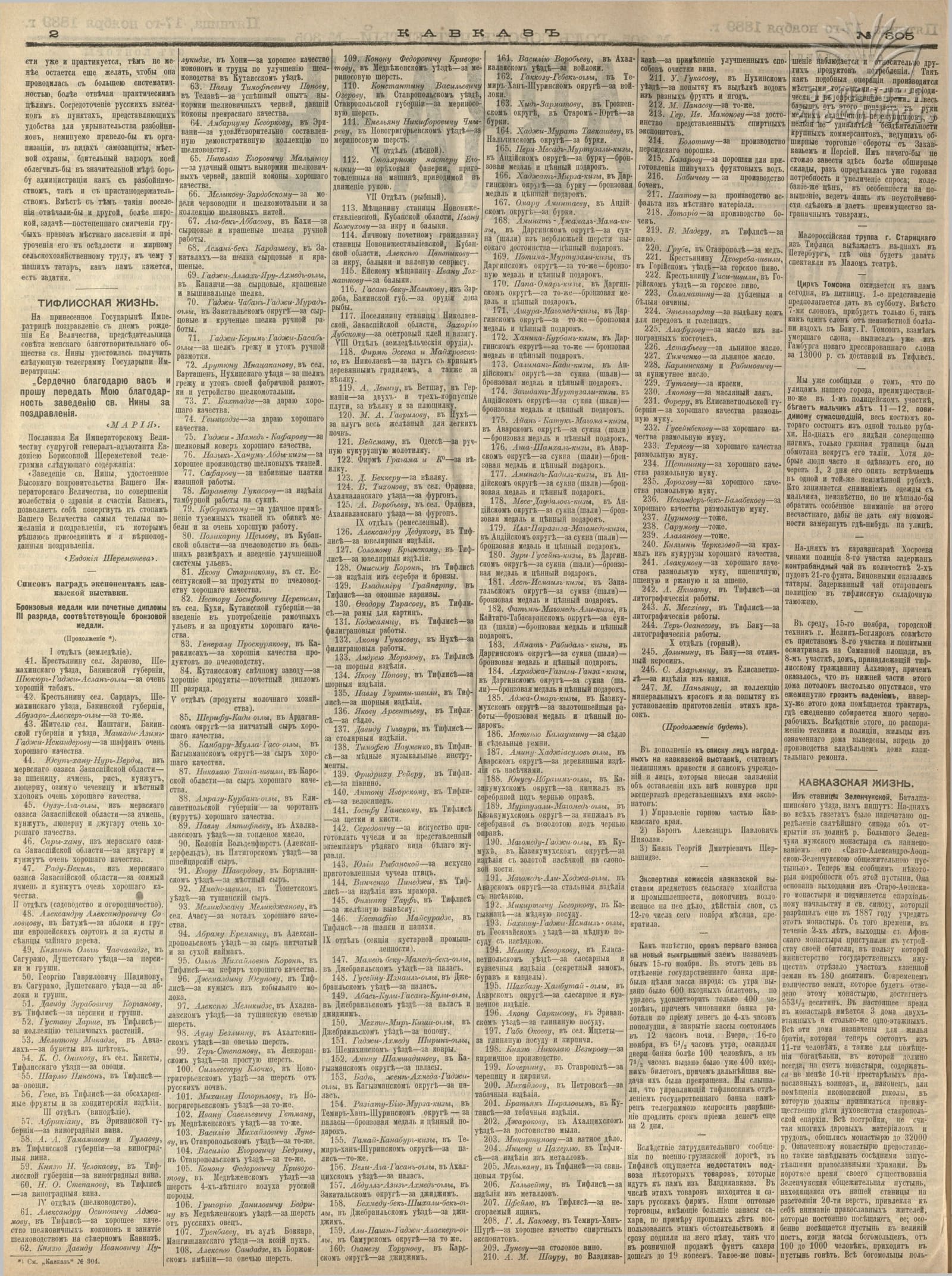
All three traits of the house meet here. Quality: awards at four exhibitions, the first “for a saddle and saddle straps” (1889) [◆ S036, no. 305, 17.11.1889, p. 2]; exclusivity: saddles for the Convoy’s officers and a name on the List of Purveyors to the Imperial Court [◈ S097, p. 143, n. 24; ◈ S108]; system: teachers of the craft, and Mikhail Kalaushin’s clamps, with which one master, or even a pupil, could glue a saddle tree [◆ S035, 1902, no. 204, 21.09.1902, p. 2].
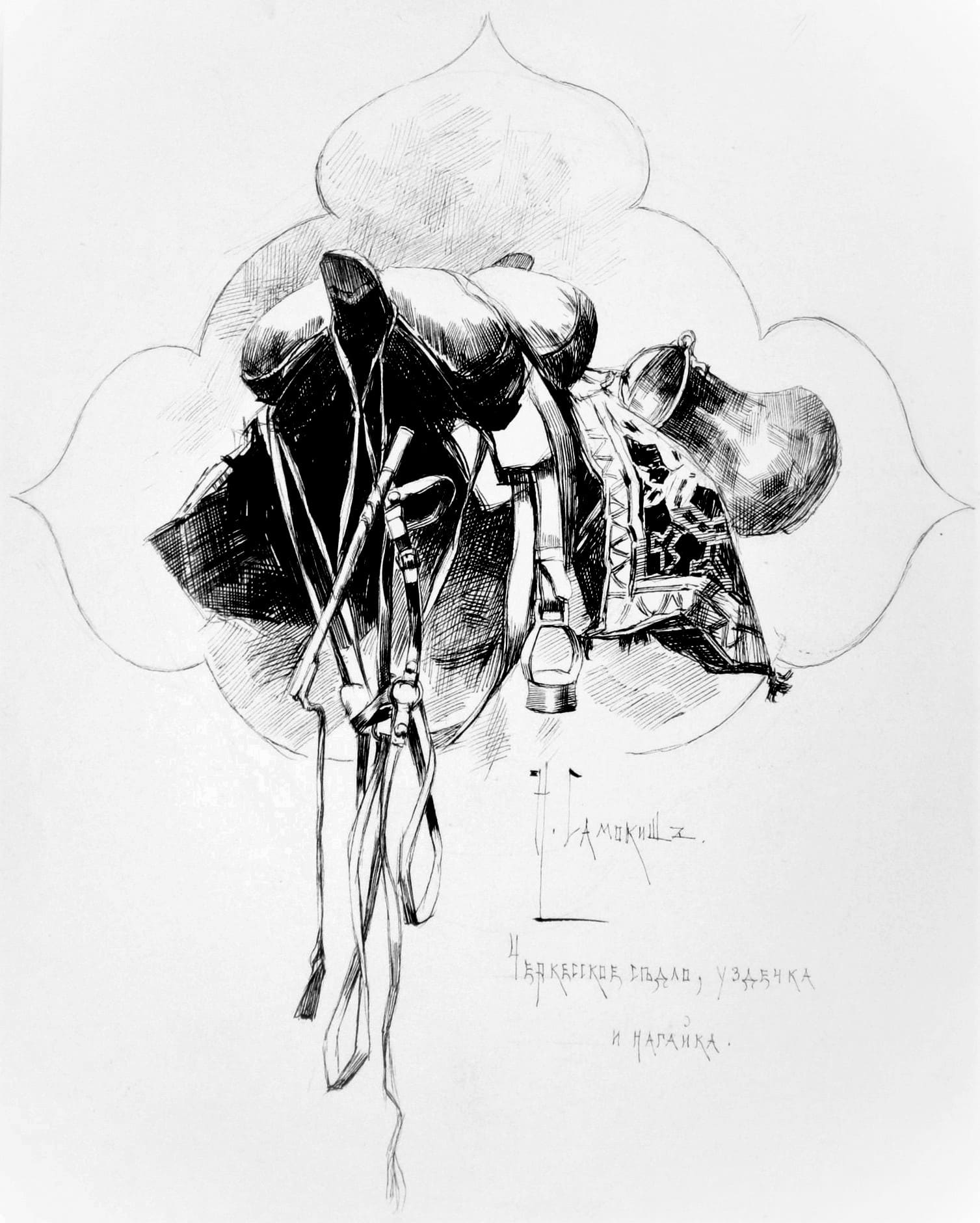
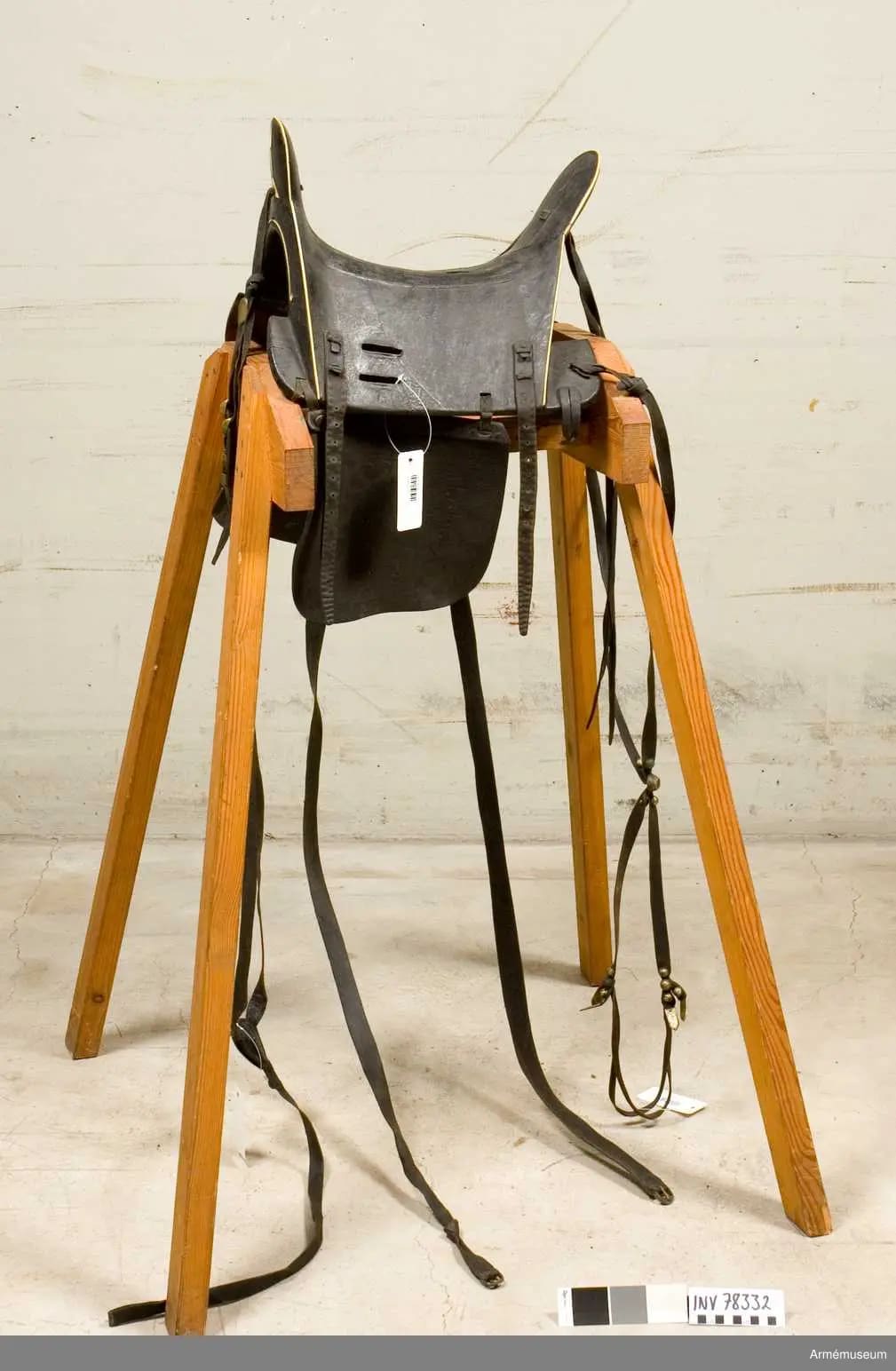
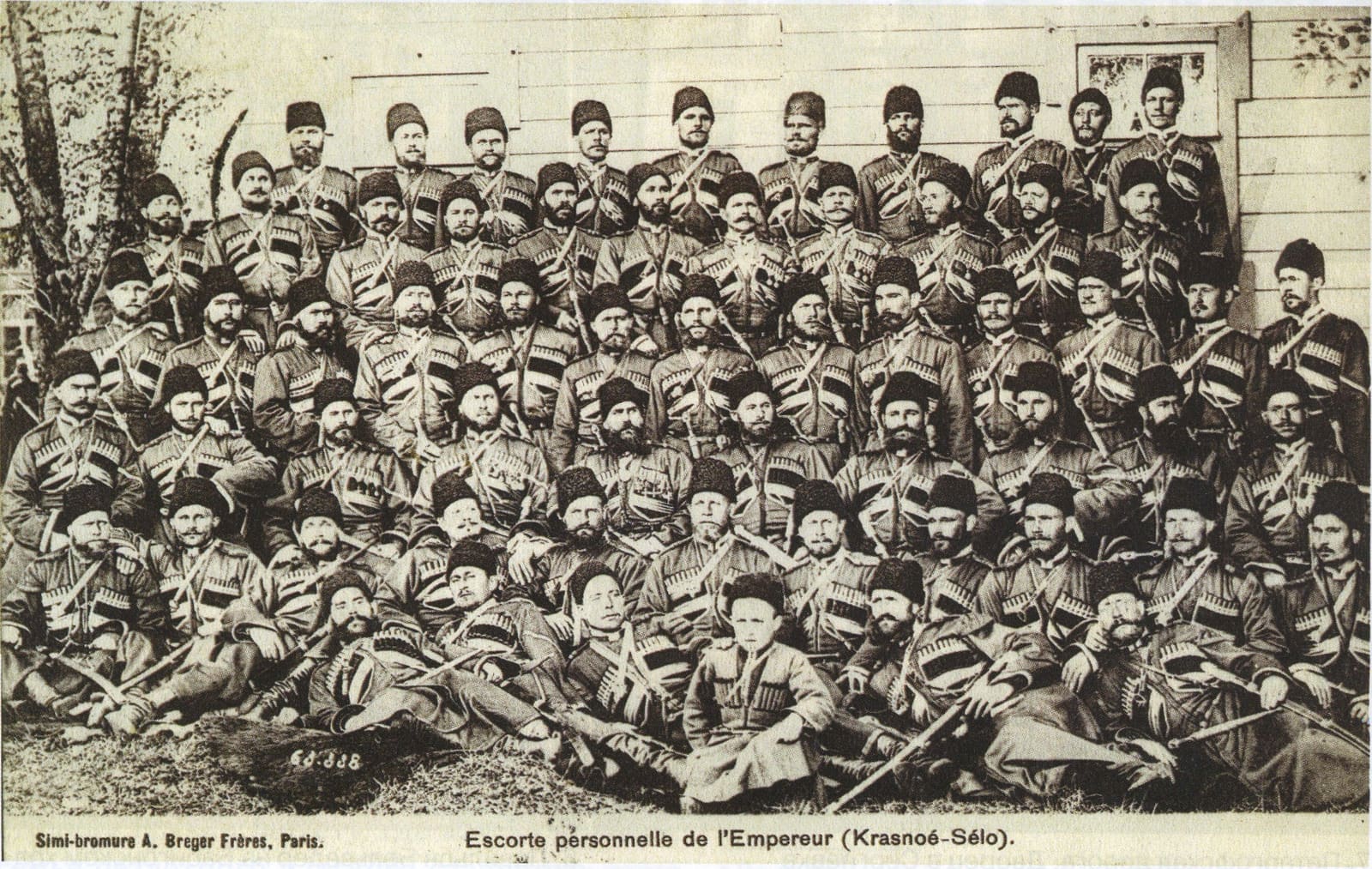
A Cossack went to serve on his own horse and in his own equipment. Even a man chosen for His Majesty’s Own Convoy (the Convoy, the Emperor’s Cossack bodyguard) had to buy, at his own expense and before leaving for the capital, a new regulation Guards saddle with the bows of its tree trimmed in thin white horn [◈ S097, p. 142]. Out of this Cossack need grew the craft by which several generations of Kalaushins of Batalpashinskaya — a stanitsa, or Cossack village, now the town of Cherkessk — made their living. “All the Kalaushins — the direct line for certain, and as far as the side line of Gavrila — were saddlers,” the family history records [◇ S001, No. 74].
A family craft
◇ family testimony
The earliest master saddler the family manuscript remembers is Nikolay, born in 1817 and married to Vasilisa [◇ S001, No. 7]. His son Aleksey Nikolayevich kept a saddlery workshop in Batalpashinskaya and, in his relatives’ words, was “at that time the most distinguished saddler in the Caucasus” [◇ S001, No. 32]. From the side line descended from Gavriil Ivanovich, the family remembers Pyotr Gavrilovich, who “was a master famous throughout the Caucasus for making saddles, horse collars and yokes” [◇ S001, No. 60].
Note on the roster. The roster enters Nikolay with the patronymic Alekseyevich. The parish and household lists show him as Nikolay Ivanovich, son of Ivan Trofimovich: in 1848 he is 32, with his wife Vasilisa and their children Stefan, Aleksey, Yelizaveta, Agafya and Ilya [◆ S012, no. 92, via S180, topic 25557]; in 1857 “Cossack Nikolay Ivanov Kalaushin and Vassa Andreyeva” have their son Ilya baptised [◆ S013, f. 174v]. Such lists do not record a man’s trade, so Nikolay Ivanovich’s saddlery is known to us from the family.
The crafts department at Batalpashinskaya (1887–1891)
In September 1887 the crafts department of the Batalpashinsk Town School added saddlery and harness-making; the following year it took 19 pupils for the trade — 15 saddlers and 4 harness-makers [◈ S159, Wayback copy of 13.08.2020]. The department’s report for 1887 lists five masters, the first being “the saddle master and also harness-maker, the Cossack A. Kalaushin” [◆ S035, 1888, suppl. to no. 16, 16.04.1888, p. 3]. The report for 1890 gives their names in full: Anton Kalaushin teaching saddlery and Stepan Kalaushin harness-making [◆ S035, 1891, no. 20, 18.05.1891, p. 2].
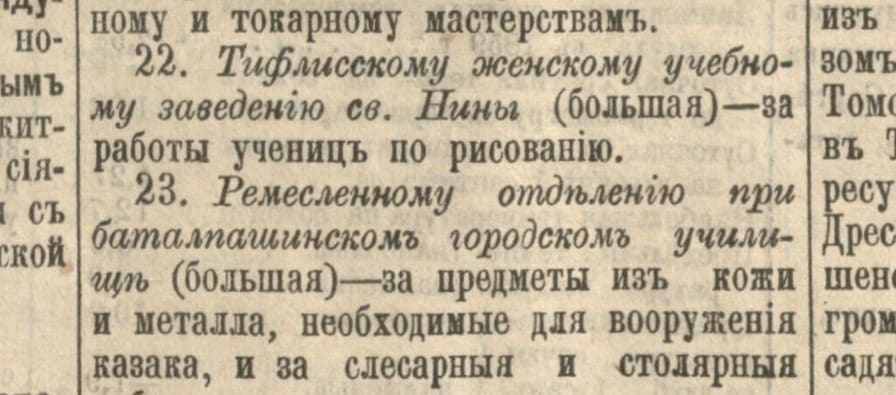
At the Caucasus Exhibition of 1889 in Tiflis the department received a diploma equivalent to a large silver medal “for articles of leather and metal needed to equip a Cossack, and for locksmith’s and joiner’s work” [◆ S036, no. 308, 20.11.1889, p. 1]; in 1896 its harness work was shown at Nizhny Novgorod [◆ S039, pt III, dept XIX, p. 135].
Note on the roster. The roster identifies this master (“A. Kalaushin”, 1887) as Aleksey Nikolayevich [◈ S001, No. 32, after KOV 1888]. In the 1890 report the department’s saddle master — unable to read and write, as in 1887 — is named as Anton [◆ S035, 1891, no. 20]. △ He was probably Anton Nikolayevich (No. 33), Aleksey Nikolayevich’s younger brother; the harness master Stepan was probably one of the Stepans Nikolayevich. △ The family’s long ties with crafts schools — first at Batalpashinskaya, later the Military Crafts Schools at Labinskaya and Maykop, where the Alekseyevich brothers taught (see below) — echo in the family’s words about the Kalaushins’ “school of applied leather crafts” [◇ S001, Nos. 71, 72].
Tiflis, 1889: a saddle and saddle straps
In the autumn of 1889 Tiflis (now Tbilisi) held the Caucasus Exhibition of Agriculture and Industry. In the list of exhibits from Kuban Oblast, under “Hides; boot-making, saddlery, harness…”, three Kalaushins from Batalpashinskaya appear [◆ S035, 1890, no. 13, 31.03.1890, p. 1]:
- Fedot — a lenchik, the wooden frame of a saddle [◈ S091, PDF p. 52], priced at 65 roubles; he was about eighteen;
- Matvey — “an archak [the frame of a Caucasian saddle] with fittings and saddle furniture of red strap with silver” (132 roubles 45 kopecks), and two more sets, in black and in white strap;
- Ilya — a saddle tree (35 roubles) and a saddle with fittings (50 roubles); △ probably Ilya Nikolayevich (No. 34), Aleksey Nikolayevich’s brother.
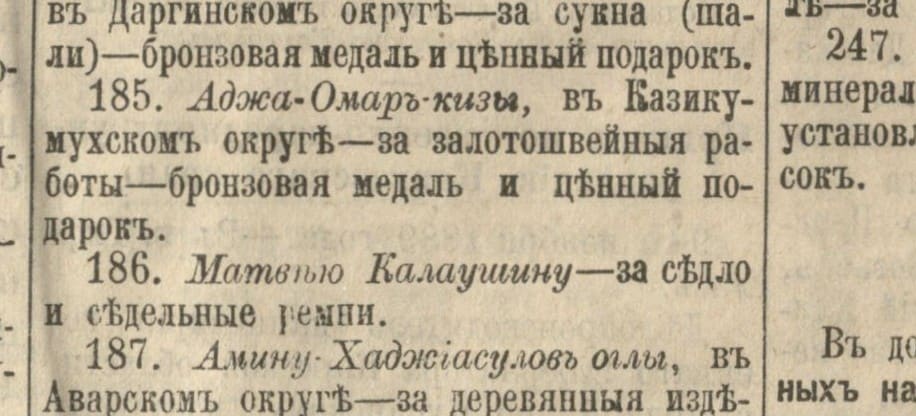
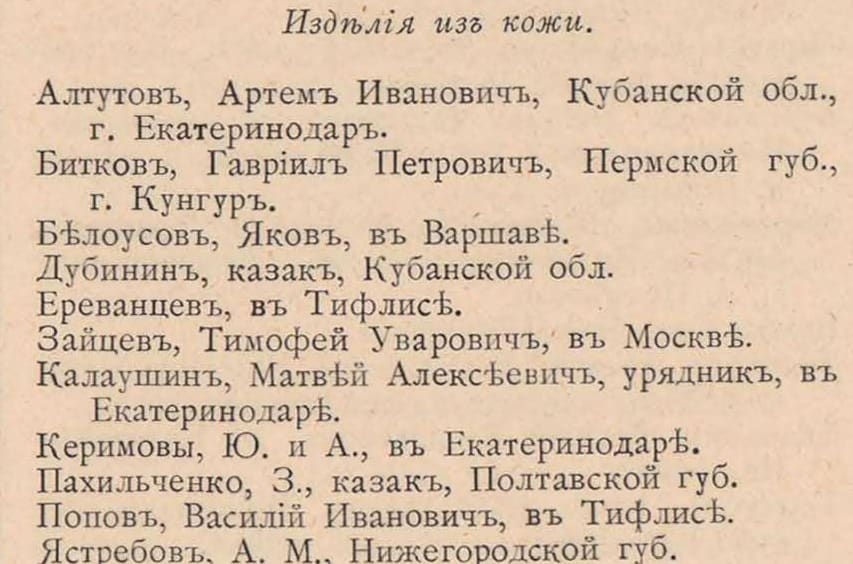
On 17 November 1889 the Tiflis newspaper Kavkaz printed, in its list of bronze-level awards, Department IX (cottage-industry section): “186. To Matvey Kalaushin — for a saddle and saddle straps” [◆ S036, no. 305, 17.11.1889, p. 2]. This was a bronze medal or the equivalent third-class diploma: there were not enough medals to go round, and diplomas were also given to private exhibitors [◆ S036, no. 302, 14.11.1889]. Matvey Alekseyevich (b. 1867) was then 21 or 22. It is the earliest exhibition award to a Kalaushin found so far, and the only one whose wording names a saddle outright.
The Alekseyevich brothers and the Convoy
Aleksey Nikolayevich and Anna Nikitichna had five sons and a daughter: Matvey (b. 1867), Mikhail (b. 1870), Fedot (b. 1871), Aleksandr (b. 1877 or 1878), Savva and Anna [◈ S001, Nos. 32, 71–76]. Four of the brothers — Matvey, Mikhail, Fedot and Aleksandr — became saddlers and harness-makers. Note on the roster: their entries are marked “.31”, but their patronymic and the lists of children show that their father is No. 32; △ the parent numbers in this part of the roster appear to have shifted when the manuscript was retyped.
Three of them served in the Convoy. Mikhail Alekseyevich served there as a Cossack and as an uryadnik (a Cossack non-commissioned officer) [◈ S033, via S180, topic 855]. Fedot Alekseyevich took the oath in 1891 and appears in the index of Host orders as a “saddler” [◈ S033, via S180, topic 855]; from 1892 he served in the Convoy, “first at Gatchina, under Alexander III, and then in the capital, St Petersburg, under Nicholas II”, as an uryadnik of the Life Guards 2nd Kuban Sotnia [◈ S001, No. 73]. Aleksandr Alekseyevich was an uryadnik of the Convoy in 1904–1908, and his son Boris was born in the Convoy barracks on Shpalernaya Street [◇ S001, No. 74, as told by Emiliya Fyodorovna Kalaushina]. Matvey Alekseyevich, the family recalls, was not taken into the Convoy because he was too short, and served in a Cossack regiment [◇ S001, No. 71].
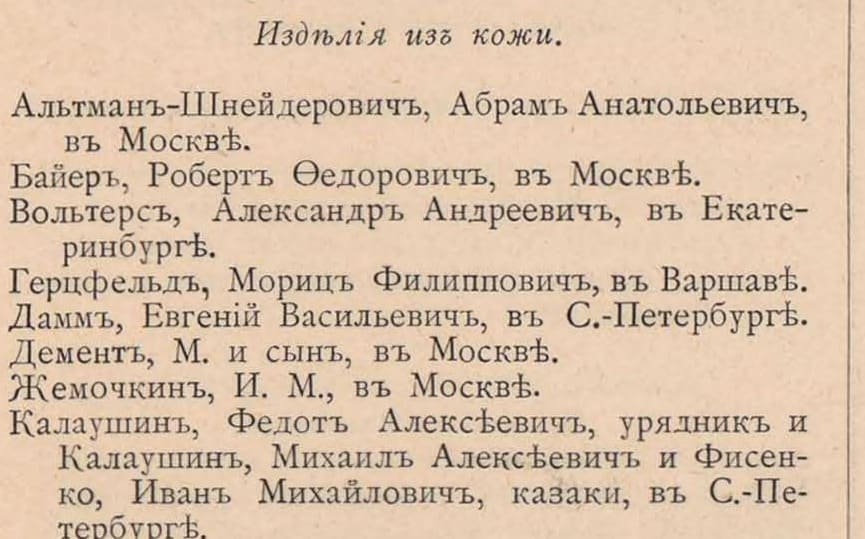
At the 16th All-Russian Industrial and Art Exhibition at Nizhny Novgorod in 1896 the brothers won two awards in the class “Leather goods”. The bronze medal went to “Kalaushin, Fedot Alekseyevich, uryadnik, and Kalaushin, Mikhail Alekseyevich, and Fisenko, Ivan Mikhailovich, Cossacks, in St Petersburg”; an honourable mention to “Kalaushin, Matvey Alekseyevich, uryadnik, in Yekaterinodar” [◆ S044, no. 1, pp. 33, 36; ◆ S039, pt III, p. 158]. △ Their work was most likely shown in the Military Department, among the exhibits of the Cossack hosts: the official index lists there “specimens of individual parts of the Cossack saddle” and “the horse equipment of a Cossack officer”, and awards in the Military Department were entered in the lists of the departments to which the objects “most closely relate” [◆ S040, p. 378; ◆ S039, pt III, p. 149].
N.V. Galushkin, an officer of the Convoy and its historian, writes that the Convoy officers’ saddles were supplied by “the Cossack Kalaushin of Batalpashinskaya stanitsa, famous throughout the Caucasus for the work of his workshop”; saddles were also bought in the Host crafts schools [◈ S097, p. 143, n. 24]. Galushkin gives no first name: the master could have been Aleksey Nikolayevich or any of his sons.
The saddle for the Shah of Persia
◇ family testimony · confirmed by relatives
The saddle for the Shah of Persia was made in Fedot Alekseyevich’s workshop on the order of Emperor Nicholas II; the work took two months. Fedot Alekseyevich took the saddle to St Petersburg himself. There, at a review of the Guards on his last day before going home at the end of his service, Prince Trubetskoy reported to the Emperor that the saddle had arrived. Nicholas II examined it, said it was very well made, and there and then congratulated Kalaushin on the title of Purveyor to the Court of His Imperial Majesty; a gold watch was granted with the title. Talking with the master, the Emperor asked how long he had been in St Petersburg and, learning that Trubetskoy had held up the presentation of the saddle for so long, showed his displeasure; once the Emperor had gone, Trubetskoy turned his anger on Fedot and sent him to the guardhouse for two days for an incautious answer. The promised gold watch never reached Fedot Alekseyevich. From then on the signboard of his workshop declared that it belonged to a Purveyor to the Court of His Imperial Majesty [◇ S001, No. 73]. The account is recorded in the family history, and relatives confirm it [◇ S003].
Matching the years
△ hypothesis · dating
The family does not give a year, but the records allow us to find it: the details of the account converge on 1900. (Russian dates are Old Style; the New Style was 12 days ahead until 29 February 1900 Old Style and 13 days ahead from 1 March.)
Fedot Alekseyevich could go home at the end of his service only once. He served in the Convoy from 1892 and was discharged by Order No. 60 of the Kuban Cossack Host of 17 June 1900, “retaining the Guards uniform and awarded the badge for service in the Convoy” [◈ S001, No. 73; ◈ S156, comment by Andro, 01.06.2013]. After that the records find him back in the Kuban: a silver medal at the Yekaterinodar exhibition in 1902, and from September 1907 to November 1909 stanitsa ataman of Batalpashinskaya [◆ S035, 1902, no. 255, 28.11.1902, p. 1; ◈ S156, database of stanitsa atamans, after KOV, 1907, no. 214; ◆ S035, 1909, no. 256, 03.12.1909, p. 1].
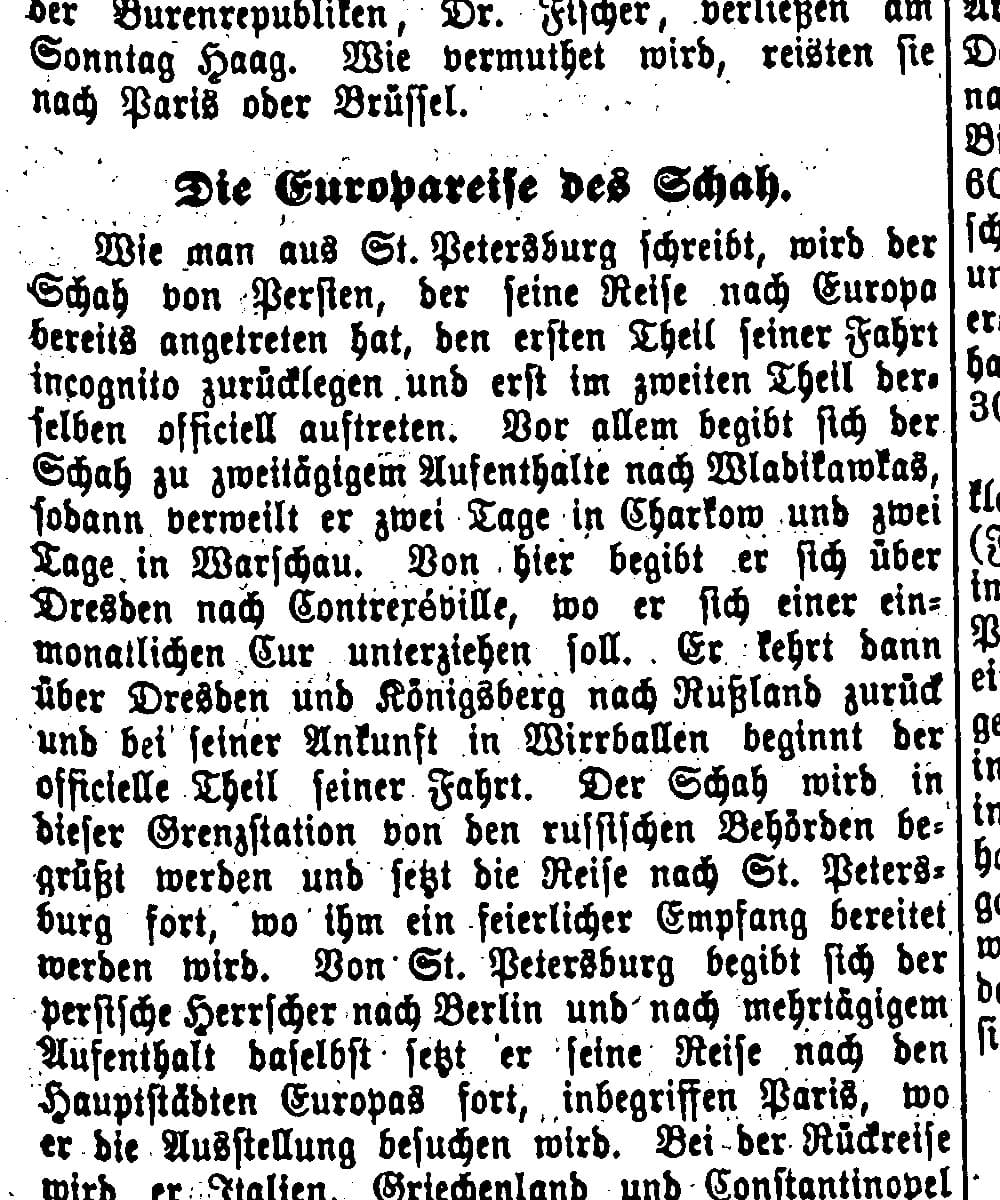
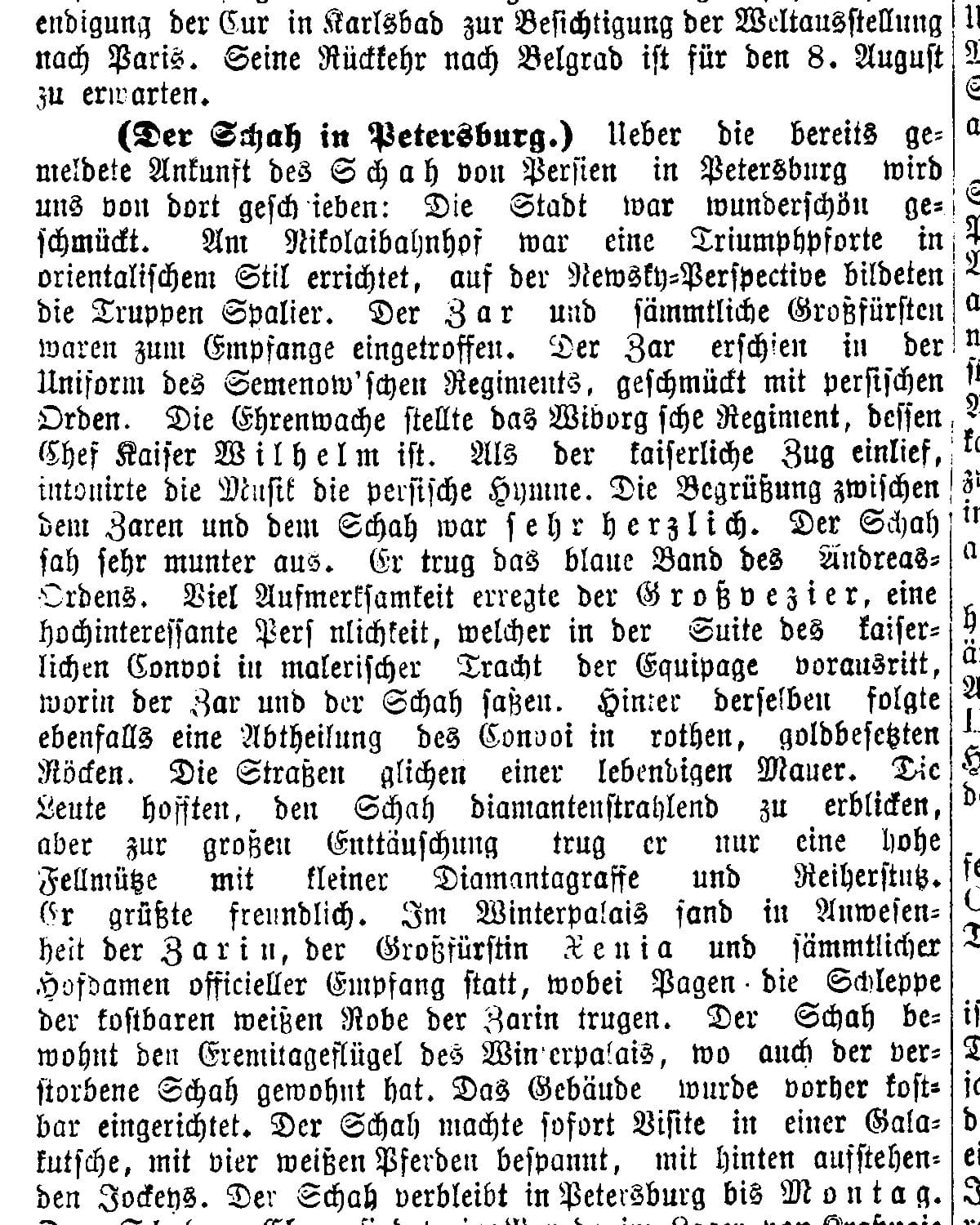
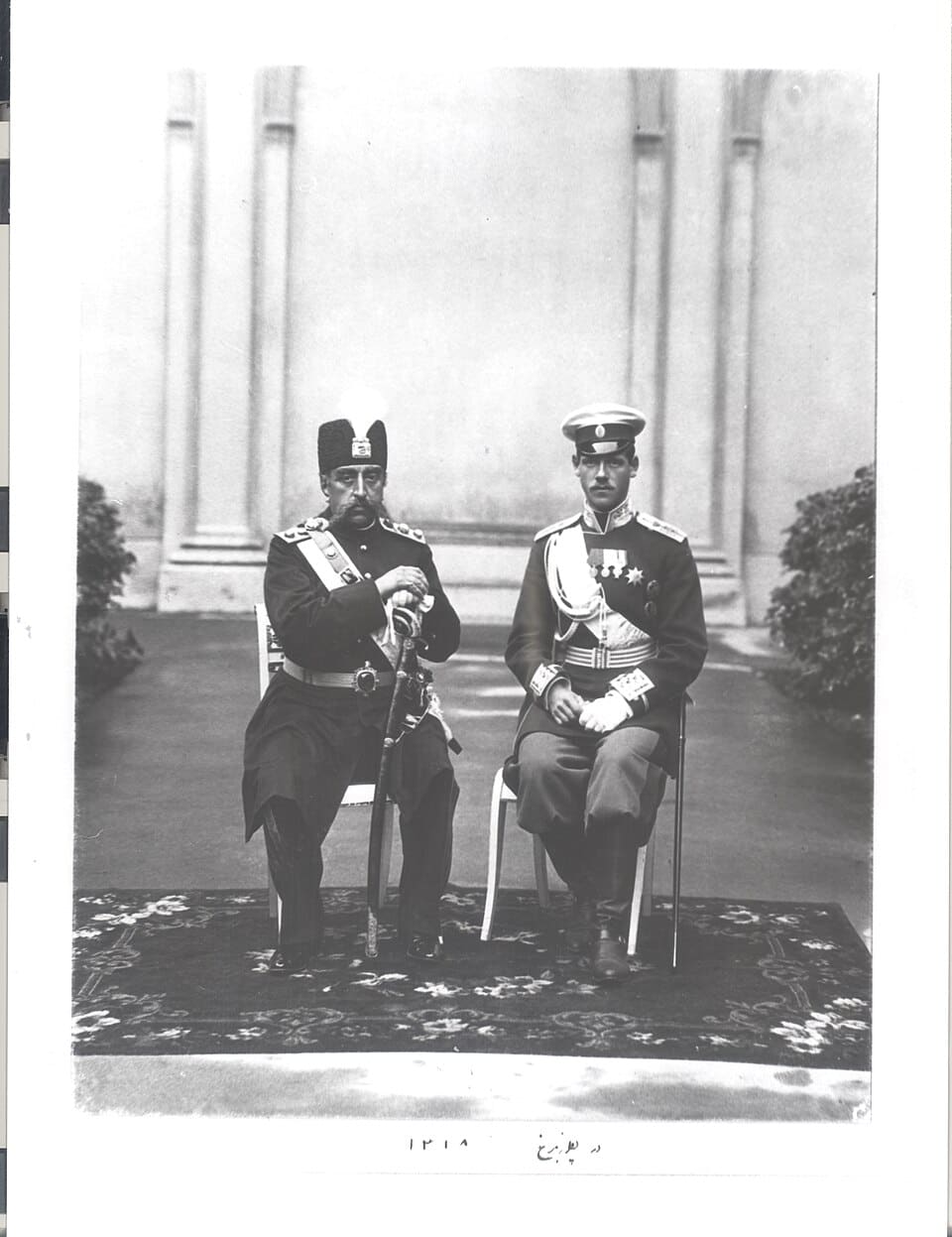
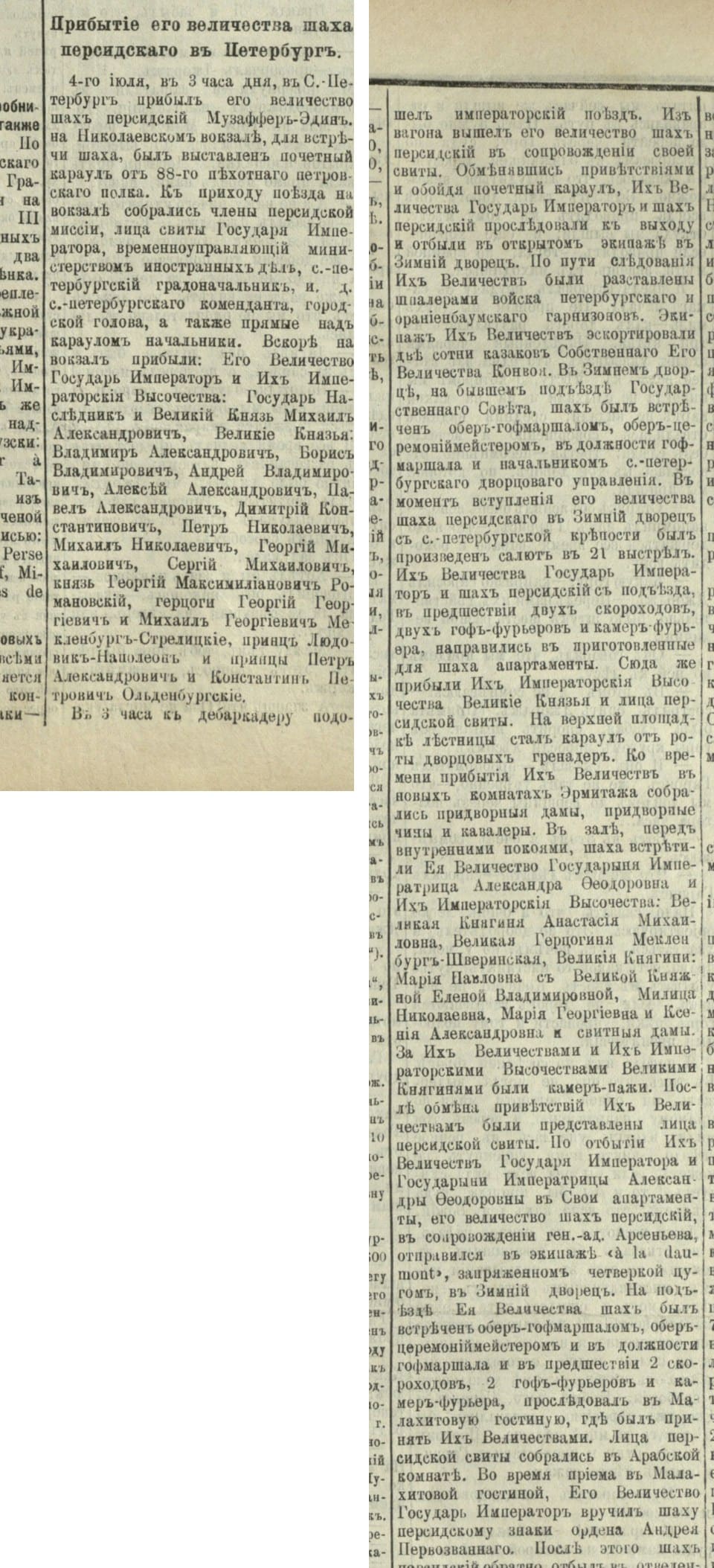
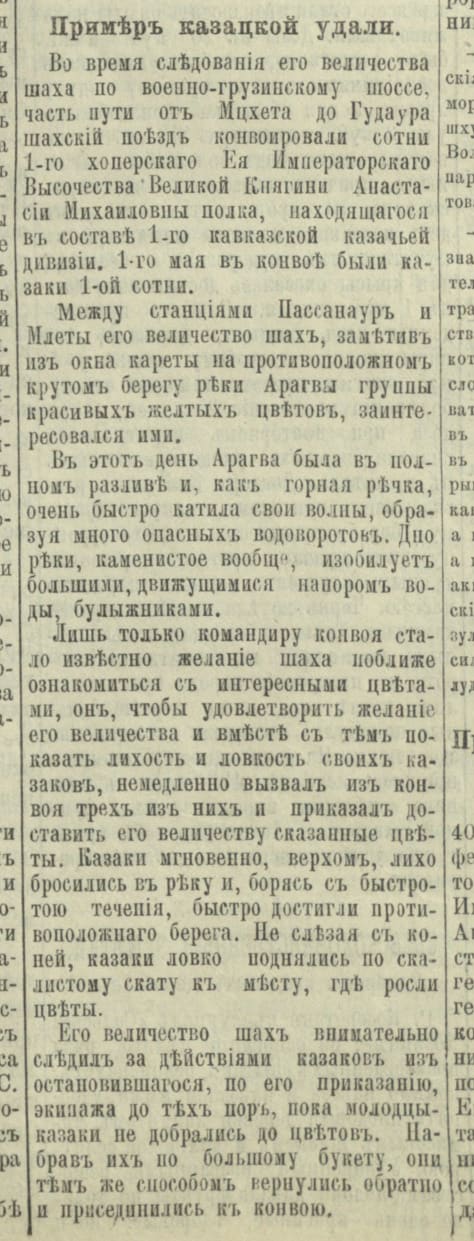
During his service a Shah of Persia came to the capital on a state visit only once — Mozaffar ad-Din Shah, 4–10 July 1900 Old Style (17–23 July New Style). The visit was known well in advance. In the first days of February 1900 St Petersburg reported that Nicholas II had invited the Shah; in the second half of February (early March New Style) came news that extensive preparations had been ordered for his reception; at first he was expected in St Petersburg at the end of May, but in April his route changed and the official part of the journey moved to July [◆ S048, 15.02.1900, p. 7; ◆ S049, 03.03.1900, p. 33; ◆ S050, 10.03.1900, p. 23; ◆ S051, 25.04.1900, p. 3] (the Austrian papers are dated New Style). A saddle ordered in February or March would, after “two months”, have been ready just at the end of May. In May the Shah crossed the Caucasus incognito, and on the Georgian Military Road, from Mtskheta to Gudauri, his cortège was escorted by sotnias of the 1st Khoper Regiment — the Kalaushins’ own countrymen [◆ S036, no. 184, 14.07.1900, p. 3].
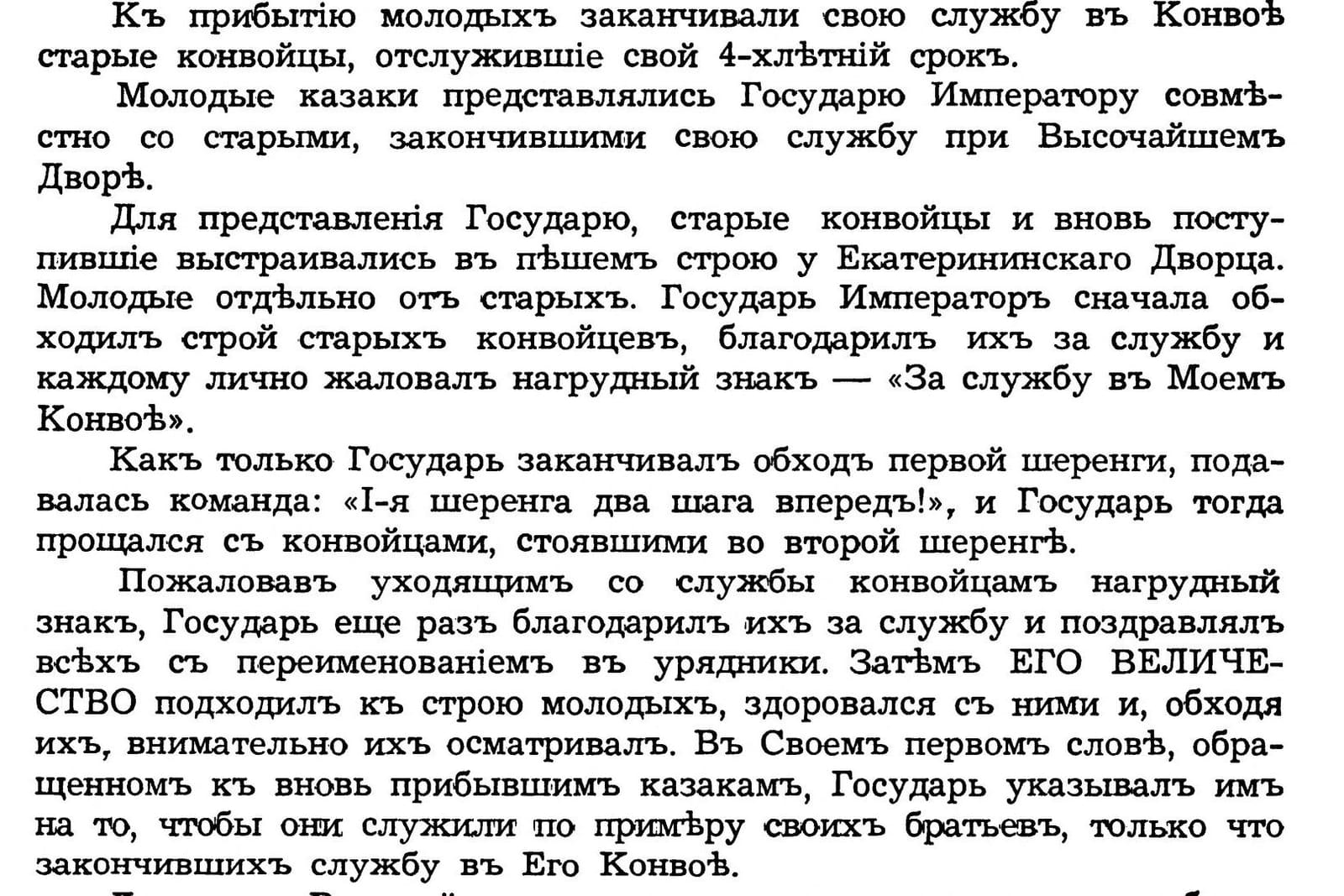
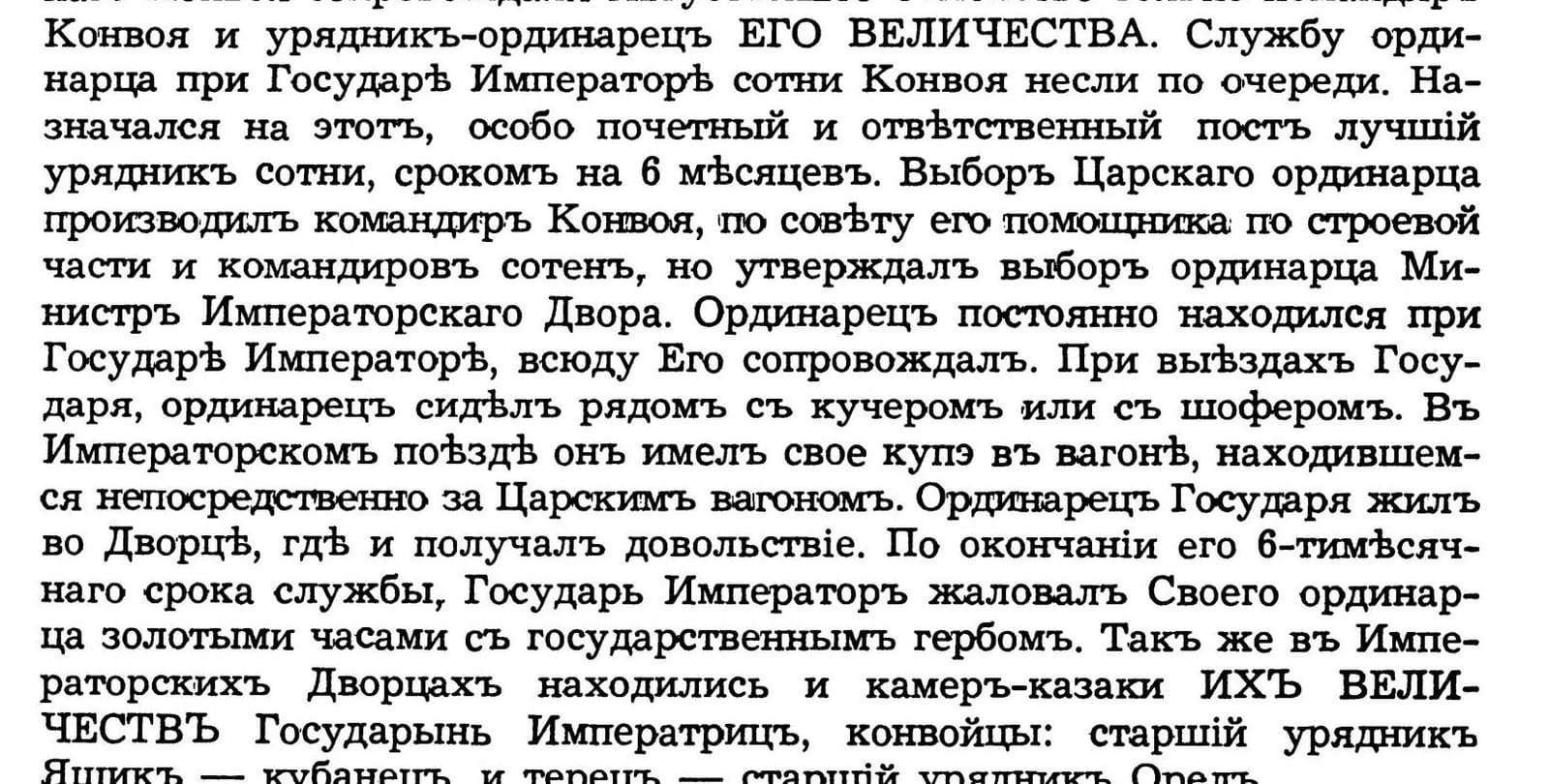
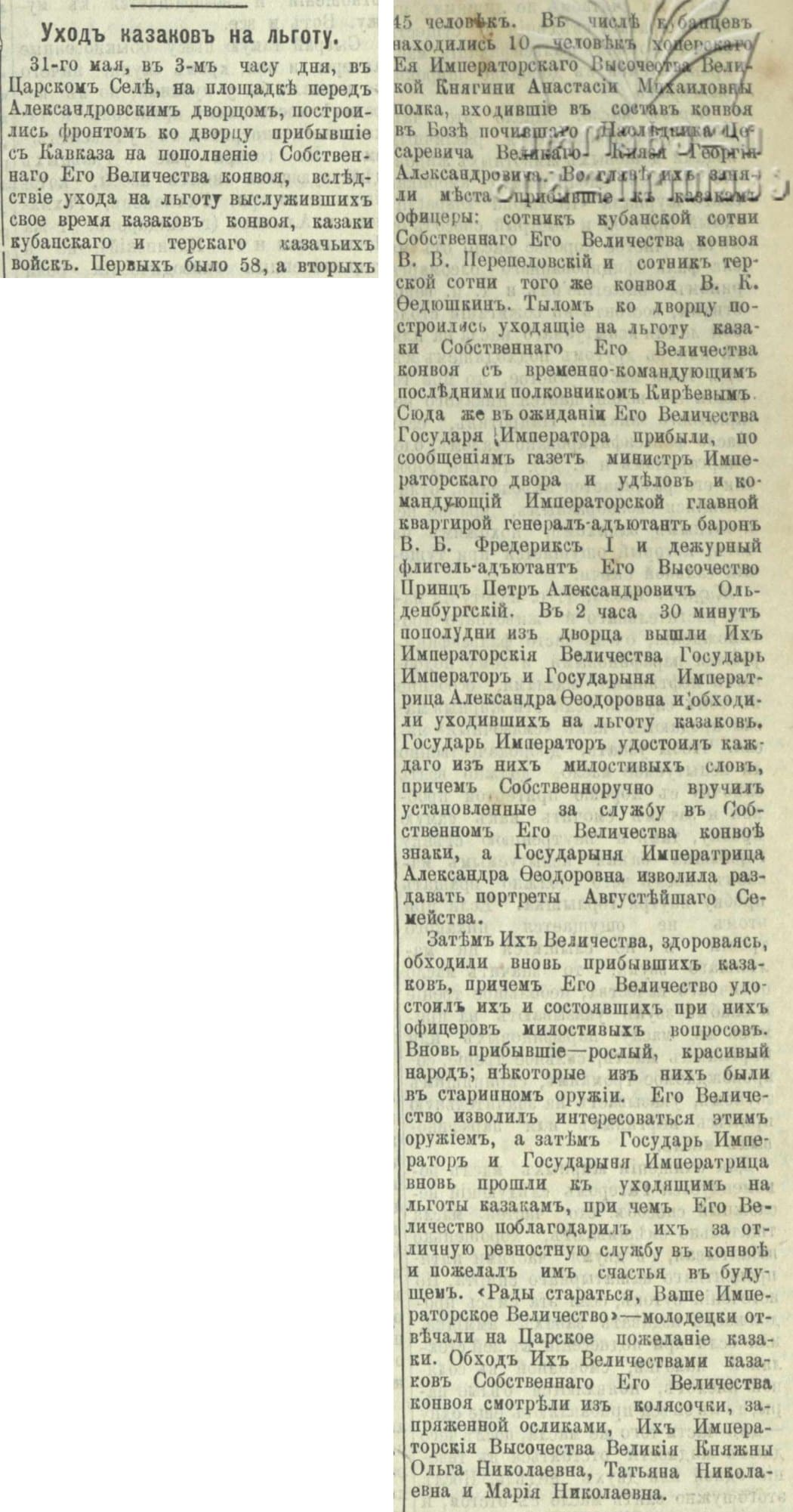
The farewell review of 1900 can be dated to the day. On Wednesday 31 May (13 June) 1900, at half past two in the afternoon, the Convoy Cossacks leaving for home were drawn up on the square in front of the Alexander Palace at Tsarskoye Selo, facing the young Kuban and Terek Cossacks who had come to replace them. Nicholas II and Empress Alexandra Feodorovna walked along the ranks. The Emperor “honoured each of them with gracious words”, handed out the Convoy service badges with his own hand, thanked the men for their service and wished them happiness; beside him stood the Minister of the Imperial Court, Baron V.B. Fredericks [◆ S036, no. 150, 10.06.1900, p. 3]. That day the Emperor wrote in his diary: “On the square in front of the palace the old Cossacks leaving for home and the new ones who had arrived for service were presented” [◆ S037, 31.05.1900, 2011 edition]. The diary records no other such review in 1900; on 4 June the Court moved to Peterhof. Galushkin describes the custom too: the departing men were presented to the Emperor together with the newcomers, and he handed each of them the badge “For Service in My Convoy” [◈ S097, pp. 144–145] — the very badge with which, under Order No. 60, Fedot Alekseyevich was discharged. The order followed the review by 17 days; the Shah arrived 34 days after it.
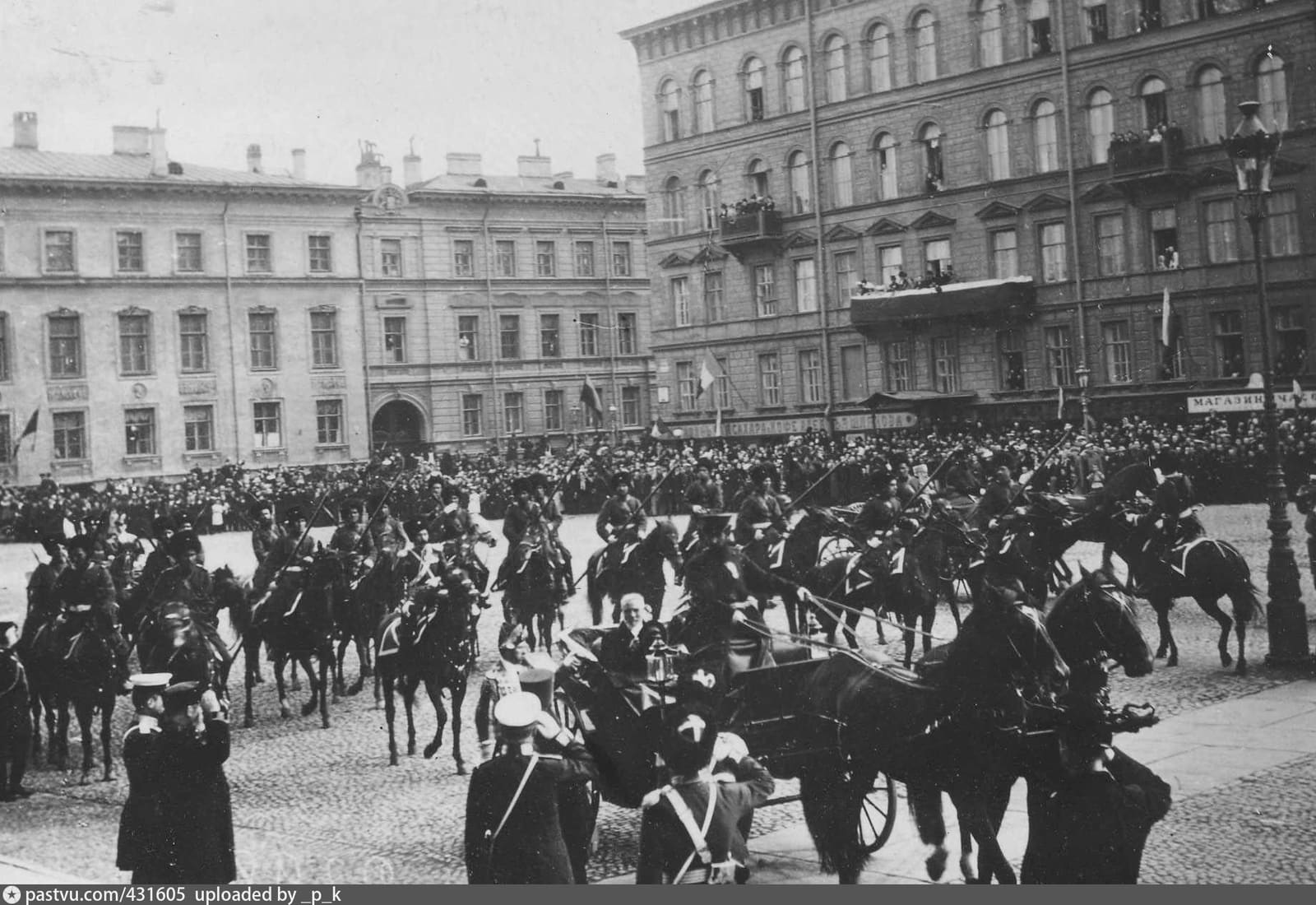
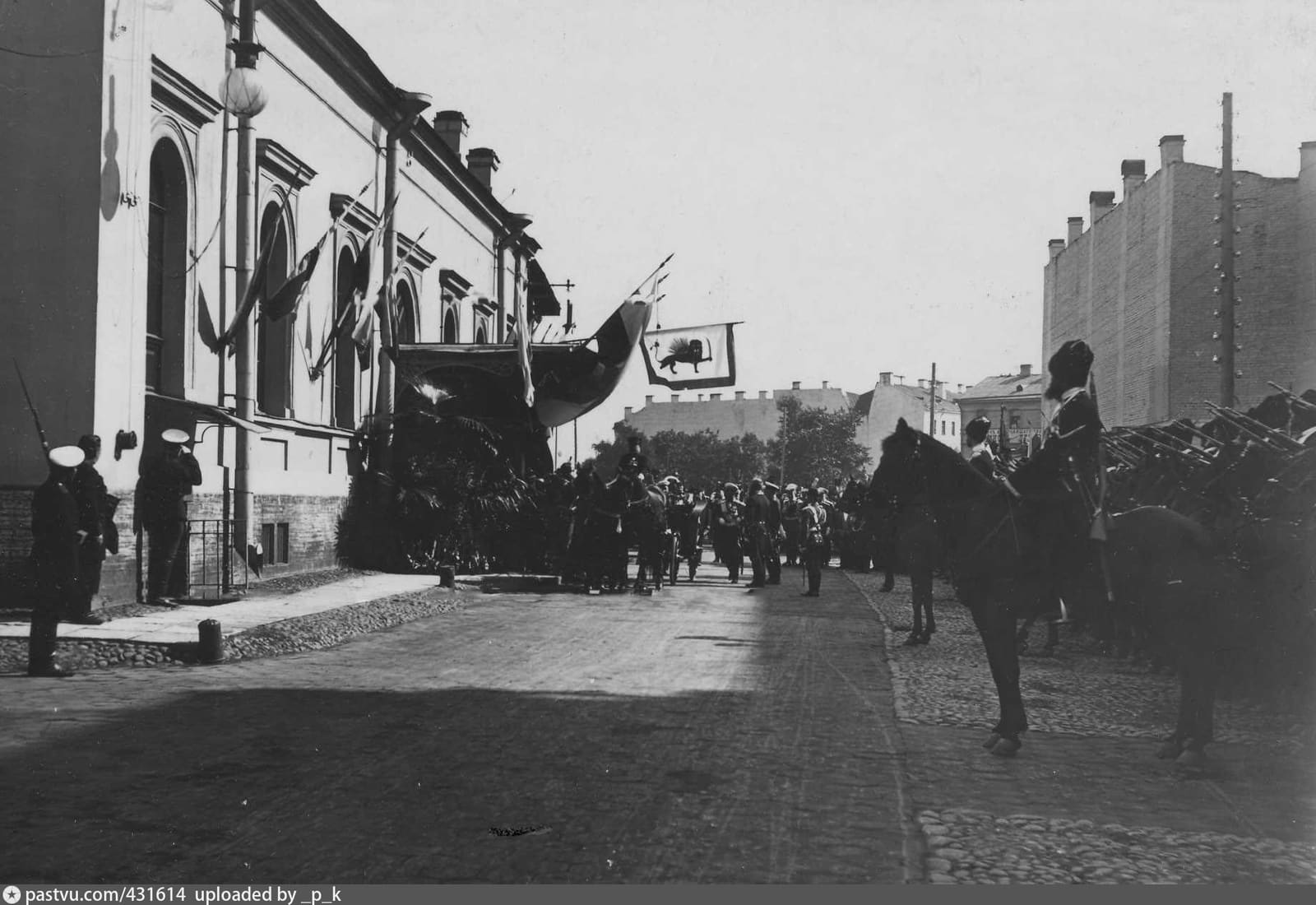
The Shah’s visit. On 4 July the Shah arrived at the Nikolayevsky Station; two sotnias of the Convoy escorted the carriage of the Emperor and his guest, and in the Malachite Room of the Winter Palace Nicholas II presented the Shah with the Order of St Andrew [◆ S036, no. 181, 11.07.1900, p. 3; ◆ S052, 20.07.1900, p. 5]. On 6 July there was a parade at Krasnoye Selo, on the 8th the Shah was taken to Tsarskoye Selo, and on the 10th, at the farewell luncheon, he gave the Emperor “a beautiful old sabre and his portrait” [◆ S037, 6–10.07.1900].
The most consistent dating is therefore spring and early summer 1900: the saddle was ordered around February or March, made in two months, and shown to the Emperor, most probably at the farewell review of 31 May 1900; it was intended for Mozaffar ad-Din Shah’s state visit of 4–10 July 1900. △ The Emperor’s question — how long had the master been in St Petersburg? — fits as well: a saddle made for a visit first expected at the end of May may well have had to wait once the visit was put back to July.
Other meetings between Russian emperors and shahs fit the family account less well. Naser al-Din Shah was in St Petersburg in May 1889, in the reign of Alexander III, before Fedot Alekseyevich had taken the oath [◈ S127]. Mozaffar ad-Din Shah met Nicholas II at the manoeuvres near Kursk in 1902 and at Peterhof in August 1905 [◆ S054, 19.09.1902, p. 2; ◆ S037, 20–24.08.1905], by which time Fedot Alekseyevich had left the Convoy. For Ahmad Shah’s coronation in Tehran in 1914 Russia sent a special envoy, and no review in St Petersburg could have been part of it [◆ S049, 21.07.1914].
Note on the roster. The same entry says that Fedot Alekseyevich served in the Convoy “from 1892 to 1911”, “after 19 years of service”. The numbered order of 1900 is more precise. △ “1911” most likely marks the end of his whole Cossack service liability (20 years under the statute, counting the preparatory grade and the reserve) [◈ S184, “Kazachestvo”]; it may also echo the Convoy’s jubilee of May 1911.
A note on names
In the family account the report is made by “Prince Trubetskoy”. In 1900 the Convoy was commanded by Baron Alexander Meyendorff (1893–1906); his nephew, Prince Georgy (Yury) Ivanovich Trubetskoy, took command in 1906 and held it until 1914 [◈ S097, p. 170; ◈ S188, “Sobstvenny Yego Imperatorskogo Velichestva Konvoy”, list of commanders; ◈ S188, “Trubetskoy, Georgy Ivanovich”]. △ The family most likely kept the name of the later, better-remembered commander, under whom Fedot’s younger brother Aleksandr Alekseyevich also served in the Convoy. On the day of the review, 31 May, the departing men were led by the acting commander of the Convoy, Colonel Kireyev, and the duty aide-de-camp at the Emperor’s side was Prince Peter of Oldenburg [◆ S036, no. 150, 10.06.1900, p. 3]; △ in retelling, that “prince” may have merged with the well-remembered prince of later years. Gifts of Caucasian saddles also reached the Emperor through the commander of the Convoy: on 11 December that same year Meyendorff came to Nicholas II “with a Caucasian parade saddle and shashka — an offering from some good Dagestani” [◆ S037, 11.12.1900].
The title and the watch
The title of Purveyor to the Imperial Court was granted by the Chancellery of the Ministry of the Imperial Court [◈ S108] — the ministry whose head, Baron Fredericks, stood beside the Emperor at the review of 31 May 1900. Watches were a customary imperial reward in the Convoy: the Emperor gave a gold watch bearing the State arms to his uryadnik orderly at the end of his six months’ duty at the Emperor’s side, for example, and the best marksmen received silver watches [◈ S097, pp. 151–152]; according to his descendants, the Vladikavkaz swordsmith Chilli Murtazaliyev received an inscribed gold watch from Nicholas II [◈ S091, PDF p. 58].
Where the documents may be found
- The diary of Nicholas II for 1900 (GA RF, f. 601, op. 1); the Chamber-Fourier Journal for 1900 (RGIA, f. 516, op. 1, d. 10 for 31 May; d. 11 for July).
- RGIA, f. 468 (His Imperial Majesty’s Cabinet): gifts to the Shah in 1900, and the Cabinet’s registers of items received and issued for 1900–1901 (a saddle from Uryadnik Kalaushin; a watch for him); f. 472: the file on F.A. Kalaushin’s purveyor title; the Court Stables Office (fond number to be confirmed).
- AVPRI, Persian Desk: the ceremonial of the 1900 visit and the exchange of gifts.
- Convoy orders for May–June 1900 (RGVIA); GAKK, Krasnodar: the text of Kuban Host Order No. 60 of 17.06.1900; Pravitelstvenny Vestnik and Novoye Vremya for 1–3 June 1900.
- The Safarnameh of the Shah’s first European journey (AH 1318), entries on St Petersburg; the treasury of the Golestan Palace.
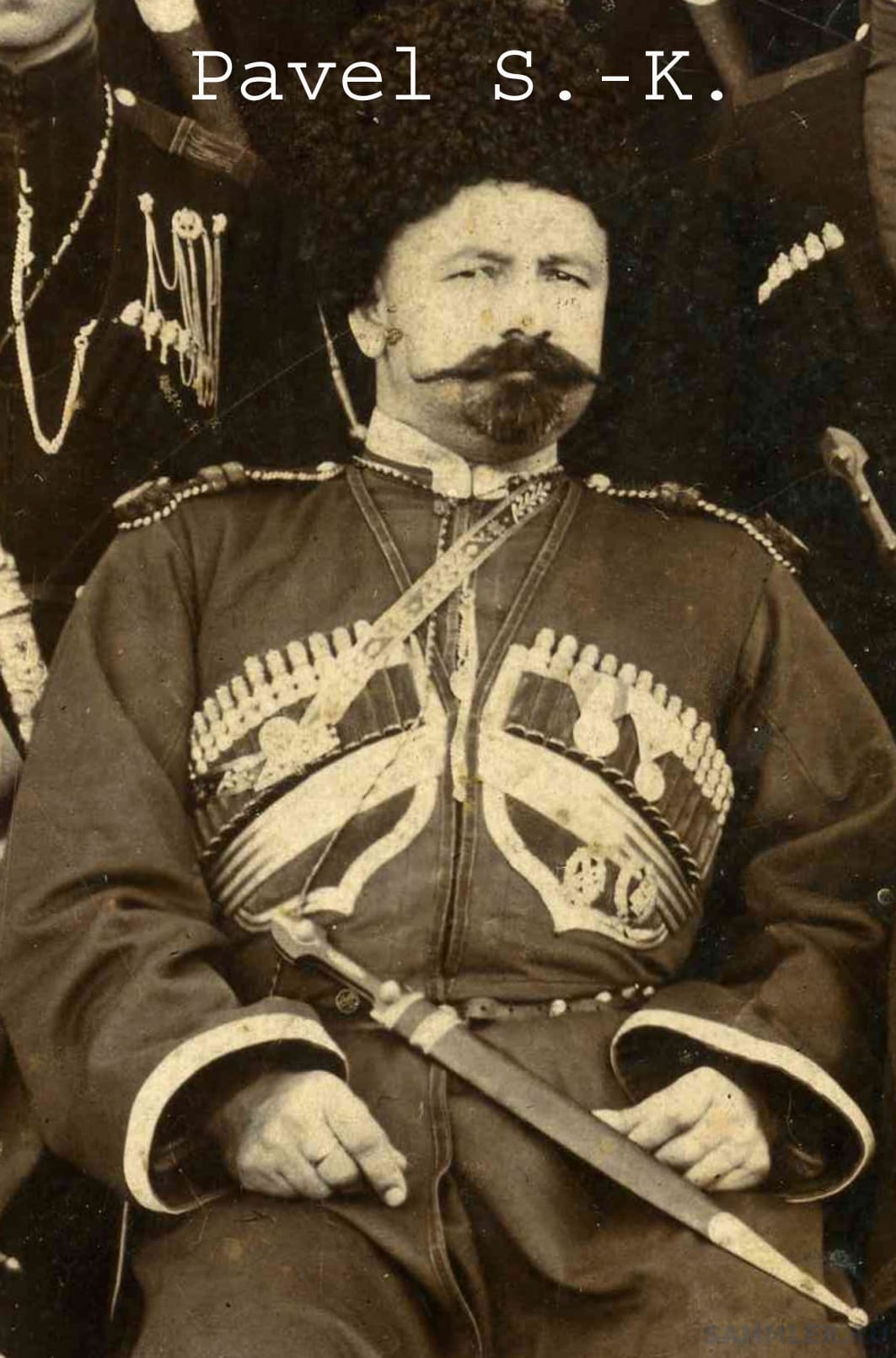
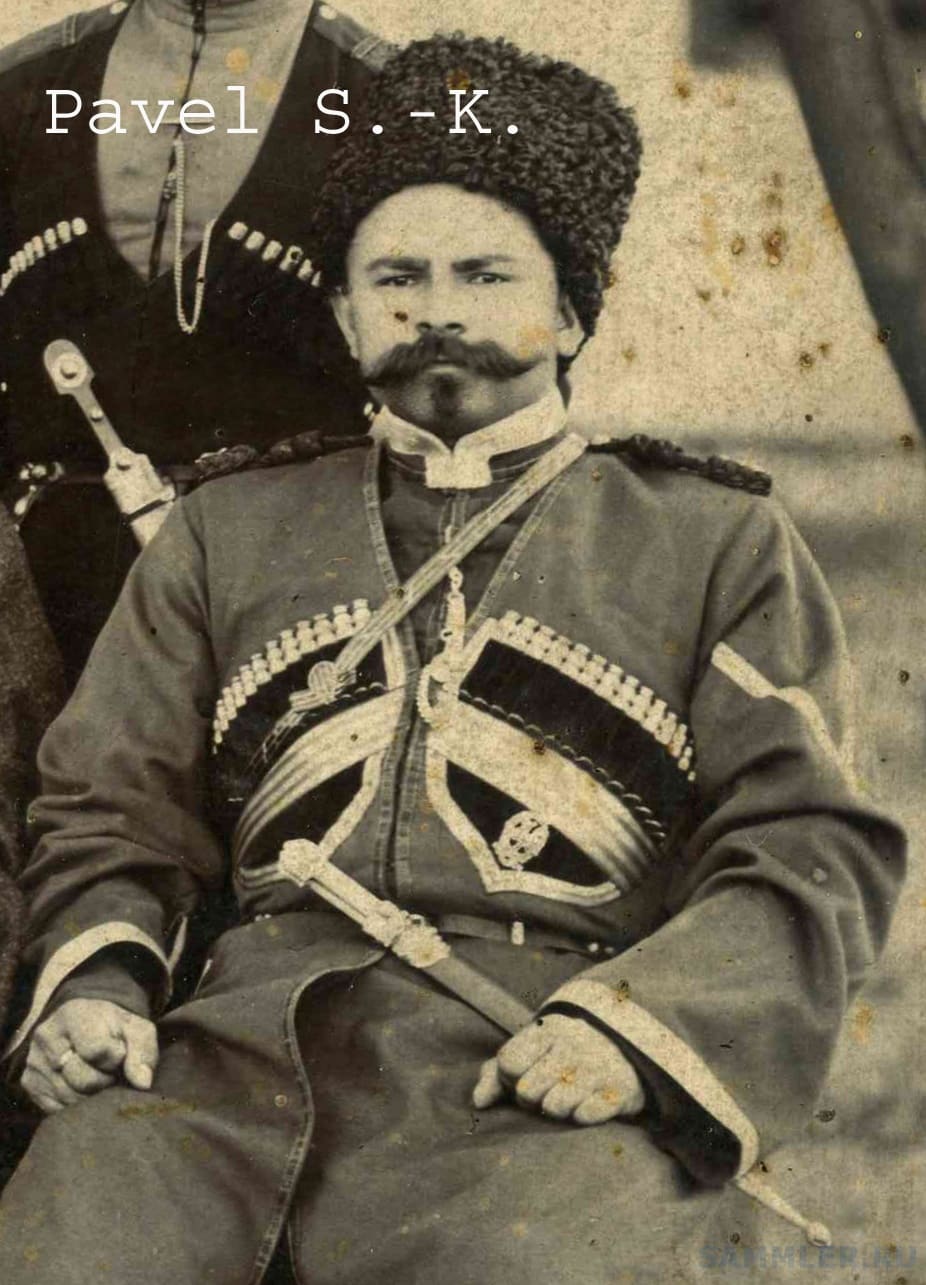
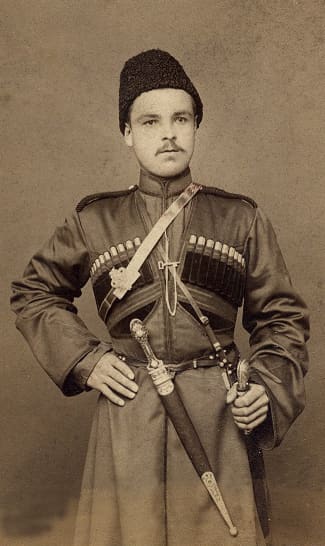
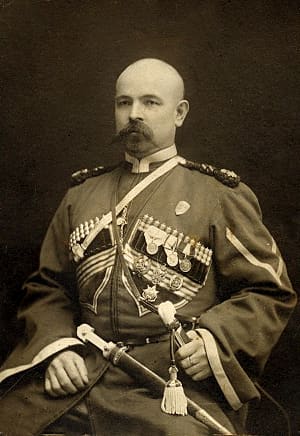
- Fedot Alekseyevich’s formal portrait, held by his descendants: one badge on his chest could not be identified by an awards specialist, who suggested it was oriental, perhaps Persian [◈ S179, 2017].
Purveyor to the Imperial Court
The title was granted on petition; the usual conditions included years of supplying the Court and taking part in exhibitions [◈ S108] — and Fedot Alekseyevich had exhibition awards. The List of Purveyors to the Imperial Court compiled at the beginning of 1915 names, among 1,340 firms and persons, “the saddle-maker Fedot Kalaushin of Batalpashinskaya stanitsa” [◈ S108]. Note on the roster: in retelling this passage the roster gives “40 firms and persons”; according to I.V. Zimin’s edition, the List has 1,340.
◇ family testimony
The family remembers the title for Matvey Alekseyevich too: his grave in Labinskaya bore the words “Purveyor to the Court of His Majesty” [◇ S001, No. 71]. Relatives also remembered “a great patent for supplying saddles to the Imperial Convoy” [◇ S001, No. 72].
Documentary note. On its walks along the former Aleksandrovsky Prospekt, the Labinsk museum still tells the story of “the house and shop of the brothers Kalaushin, Purveyors to the Imperial Court” [◈ S170, “Aleksandrovsky prospekt, 5 sentyabrya”]. Saddles from the Batalpashinskaya master were indeed supplied to the Convoy’s officers [◈ S097, p. 143, n. 24]. The document the family calls a patent should be sought among the purveyor files (RGIA, f. 472) and in the Convoy’s orders.
Teachers of the craft
After the Convoy, Mikhail Alekseyevich taught saddlery. In 1899, at the agricultural show held at the Voznesenskaya School of Horticulture near Labinskaya (its report was printed on 24 September), “Uryadnik Kalaushin, a teacher at the Labinskaya Military Crafts School, exhibited a Cossack saddle of elegant workmanship, of the latest Caucas[ian pattern]” and won a large silver medal [◆ S035, 1899, no. 203, 24.09.1899, p. 2]; △ probably Mikhail Alekseyevich. At the Kuban exhibition in Yekaterinodar in 1902 a reviewer singled out, in the pavilion of the Labinskaya school, “the invention of the master of the saddlery section, Mikhail Kalaushin — clamps for gluing the saddle tree”, which held both bows at once so that one master, or even a pupil, could do the gluing [◆ S035, 1902, no. 204, 21.09.1902, p. 2]. At the same show Mikhail and Fedot Alekseyevich each received a silver medal of the Kuban Economic Society “for saddlery work” [◆ S035, 1902, no. 255, 28.11.1902, p. 1].
Later the brothers taught at the Maykop Military Crafts School. In the 1910 graduation photograph, with saddle trees laid out in front of the group, a collector’s caption names Mikhail and Aleksandr Alekseyevich as master-teachers of the school [◈ S153, P.N. Strelyanov, 2020]. Aleksandr Alekseyevich’s family was living in Maykop at the time: the town’s parish register for 1909 records “Uryadnik of Batalpashinskaya stanitsa Aleksandr Alekseyev Kalaushin” and his wife Yevdokiya Fyodorovna [◆ S018, d. 63, via S160]. The Caucasus Calendar for 1913 lists among the school’s craft teachers “harness[-making]: Al[eksa]ndr Alekseyev[ich] Kalaushin” [◆ S058, 1913, PDF p. 970].
Awards, and the family’s Paris and London
◇ family testimony
The family remembered that the workshop’s products more than once won prizes and gold medals at the world exhibitions in Paris and London [◇ S001, Nos. 71, 72; ◇ S004].
Documentary note. The award lists found so far record Kalaushin masters at four exhibitions: Tiflis, 1889 (Matvey, “for a saddle and saddle straps”); Nizhny Novgorod, 1896 (a bronze medal to Fedot and Mikhail with I.M. Fisenko, and an honourable mention to Matvey); Voznesenskaya, 1899 (a large silver medal for a Cossack saddle); and Yekaterinodar, 1902 (silver medals to Mikhail and Fedot). The family’s words that the workshop “more than once won prizes” are borne out by the documents. At the Paris Exposition Universelle of 1900 the Cossack equipment was exhibited by the Main Directorate of Cossack Troops, and the catalogue names no makers [◆ S046]. Where to look: the jury reports of the Paris exhibition of 1900 (Group XVIII, Class 116); the Russian sections of the London exhibitions of 1862 and 1909; Kubanskiye Oblastnye Vedomosti of those years.
“Kalaus steel”
◇ family testimony
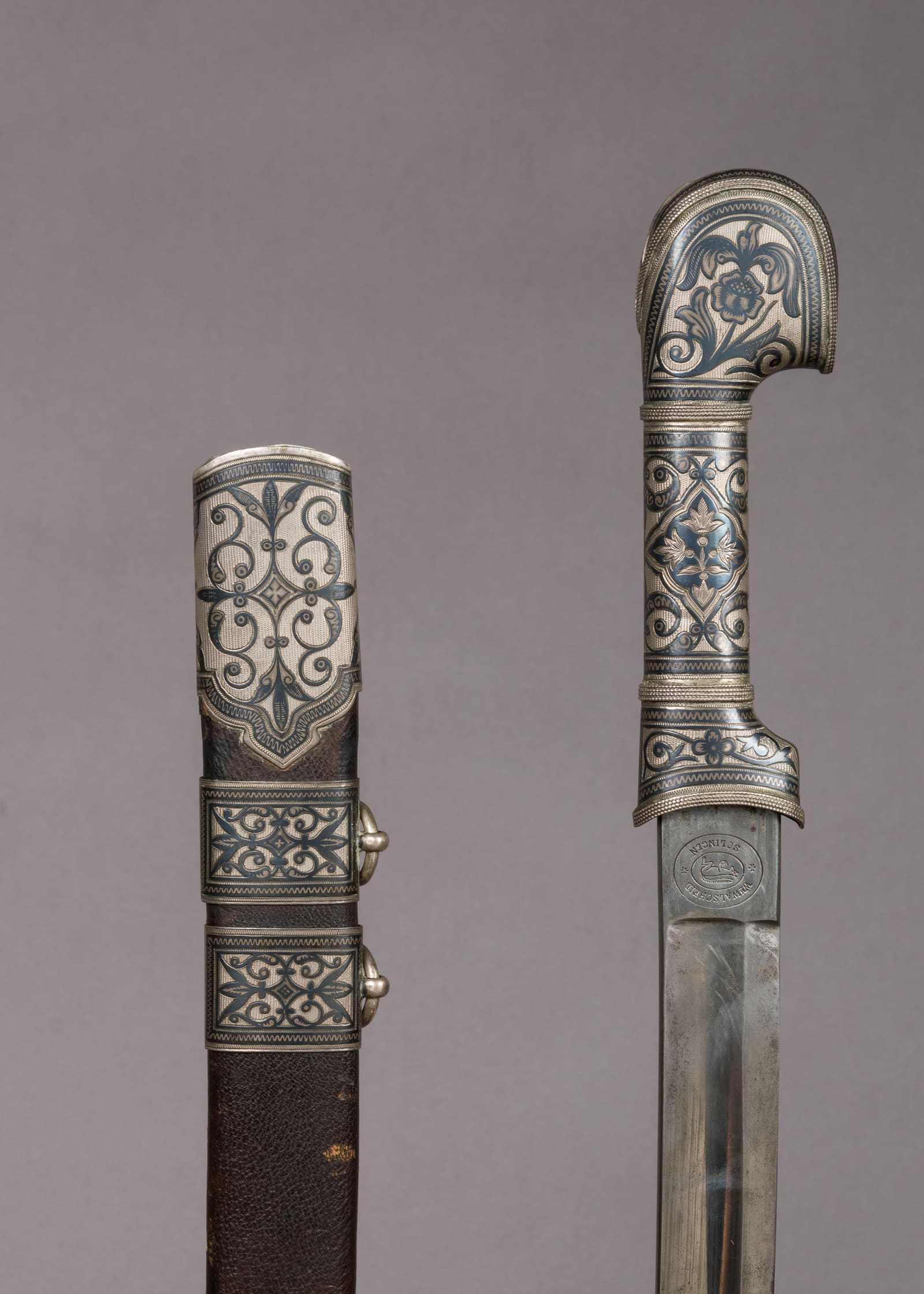
Matvey Alekseyevich made not only light Cossack saddles, “which had no price in the Caucasus”, but also adorned saddles with jeweller’s work and made harness, kinzhals (Caucasian daggers) and shashkas (Caucasian sabres). For his blades he obtained Damascus steel through Suleymanov — the father of Lyubov Dzhelalovna, wife of Semyon Geychenko — and re-tempered it himself. “At that time kinzhals of Kalaus steel were very highly valued in the Caucasus”, and in support the family cited the historian and Arabist Leonid Lavrov [◇ S001, No. 71]. The family had gone for such steel before: Boris Matveyevich, retelling his father’s words, said that on one of the journeys for Damascus steel, “which was then re-tempered for making kinzhals and sabres”, three brothers carried off from a well in a Circassian aul the future wife of Aleksey Nikolayevich — Anna Nikitichna, whom the family always called Annushka-cherkeshenka, Annushka the Circassian [◇ S001, No. 32].
△ hypothesis
Kalausskaya stal, “Kalaus steel”, is the family’s own name for the steel of the Kalaushin masters — most likely kalaushinskaya, “the Kalaushins’ steel”. In the Caucasus, imported Damascus blade steel that a well-known master had reforged and specially hardened was called by his name: “Bazalay steel”, “Chilli buolat” [◈ S091, PDF p. 58]. The word also carries an echo of the Kalaus River, in whose upper reaches the Khoper Cossacks lived from 1777 to 1825 [◆ S047, pt 1, ch. 2; ◈ S135].
Documentary note. Lyubov Geychenko’s father, Jalal, a Lak from Kazi-Kumukh, was a jeweller and swordsmith who had lived in Kutais (now Kutaisi) since before the Revolution [◈ S088, no. 10 (632), 2013]. Matvey Alekseyevich’s family also had ties to Kutais: his son Aleksey was born there in 1894 [◈ S001, No. 122]. The Kalaushins also received blades from the state works at Zlatoust: lists of unclaimed railway freight show “blades for Kalaushin” in 1903 and “steel goods” for “Koloushin” in 1910 [◆ S035, 1903, no. 213, 30.09.1903, p. 3; ◆ S035, 1910, no. 246, 13.11.1910, p. 3]. Almost every Convoy Cossack carried a shashka and kinzhal with Zlatoust blades in his own silver mounts [◈ S097, p. 143].
The last commission: Archduke Franz Ferdinand
◇ family testimony · confirmed by relatives
The family remembers the last commission that Matvey Alekseyevich carried out together with Fedot Alekseyevich as a complete set of parade equipment for Archduke Franz Ferdinand — “full parade harness, saddles, sabres, kinzhals and so on”. The family history records that it was a “political” commission, meant to help improve relations with Austria-Hungary; war came all the same in 1914, after the Archduke’s assassination [◇ S001, No. 71]. Relatives confirm that the commission was completed [◇ S003].
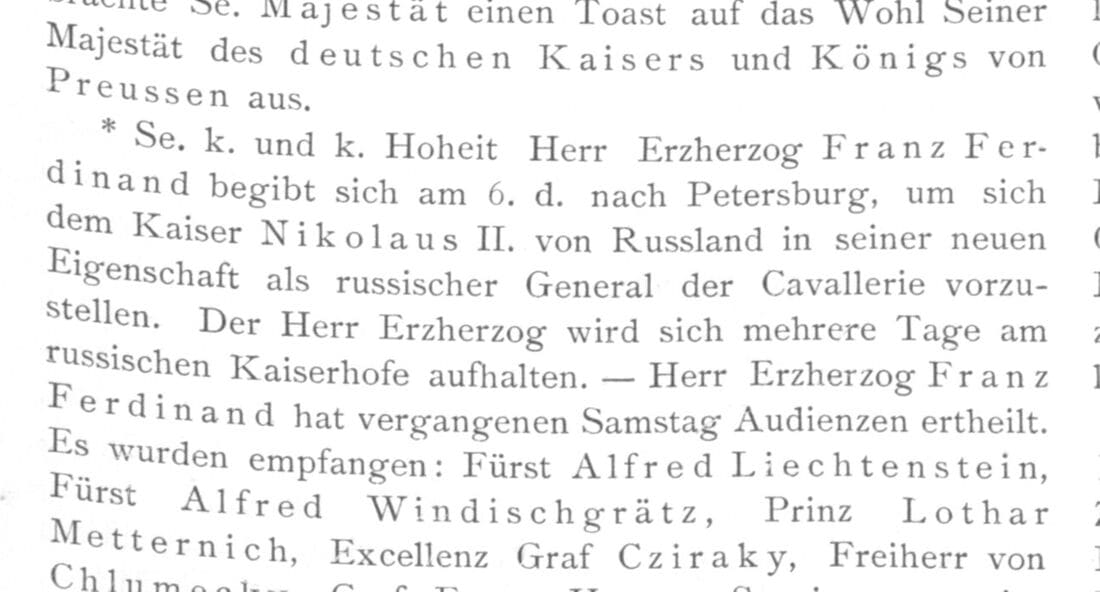
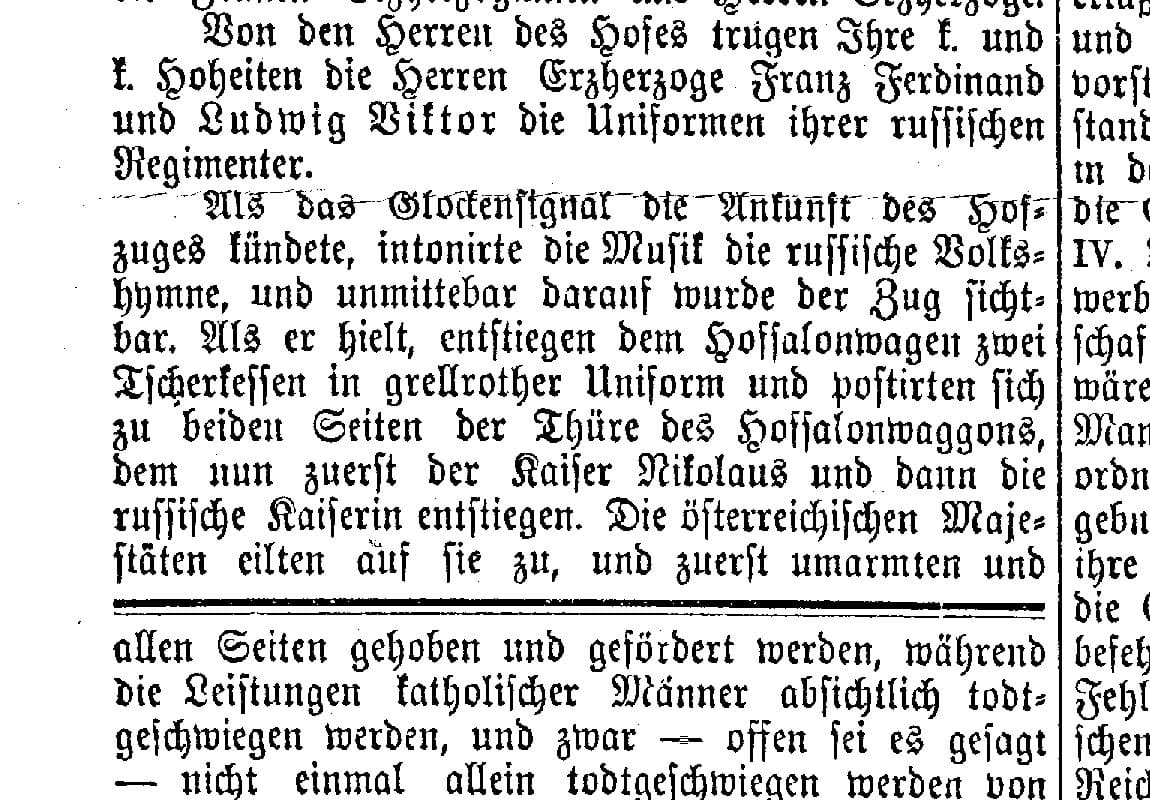
Matvey Alekseyevich died in 1912 [◇ S001, No. 71], so the work was finished by that year at the latest; △ if it was his last commission, probably in 1911–1912, when the workshop passed to him on Aleksey Nikolayevich’s death in 1911 [◇ S001, No. 71]. The Archduke had military ties with Russia: from 1891 he was honorary chief of the Russian 26th Bug Dragoon Regiment, later the 9th Uhlans, which bore his name [◈ S189, “Bugsky 9th Uhlan…”]. In August 1896 he met Nicholas II at the station in Vienna in the uniform of his Russian regiment, and, as the Austrian and Hungarian papers reported, “Circassians in bright red uniform” took post on either side of the door of the imperial saloon car [◆ S042, 28.08.1896, p. 2; ◆ S041, 27.08.1896, p. 11]; △ this was how the papers described Convoy Cossacks in their scarlet cherkeskas. In February 1902 he travelled to St Petersburg to present himself to Nicholas II as a General of Cavalry of the Russian army [◆ S055, 01.02.1902, p. 3].
Where the documents may be found. Haus-, Hof- und Staatsarchiv, Vienna: HA OMaA 505, the 1915 inventory of the Konopiště arms collection; Franz Ferdinand’s papers, cartons 35–40 “Ehrenpreise und Geschenke” (1892–1914), especially 39–40 (1910–1914); MdÄ AR F1-69-78, the journey to St Petersburg in 1902. The Czech National Heritage Institute (NPÚ) and Konopiště Castle. RGIA, f. 468 (His Imperial Majesty’s Cabinet), files on gifts.
Labinskaya: house, shop and garden
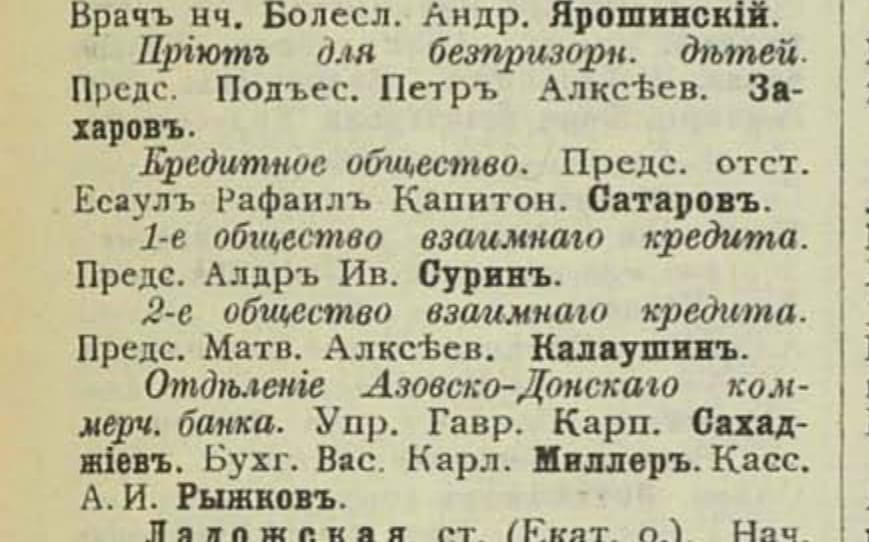
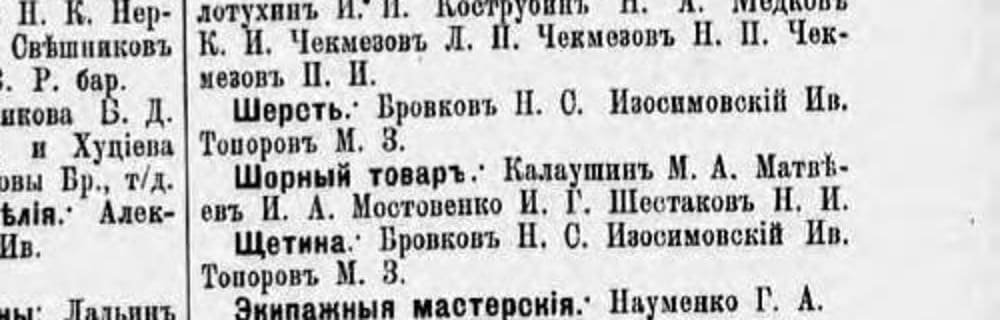
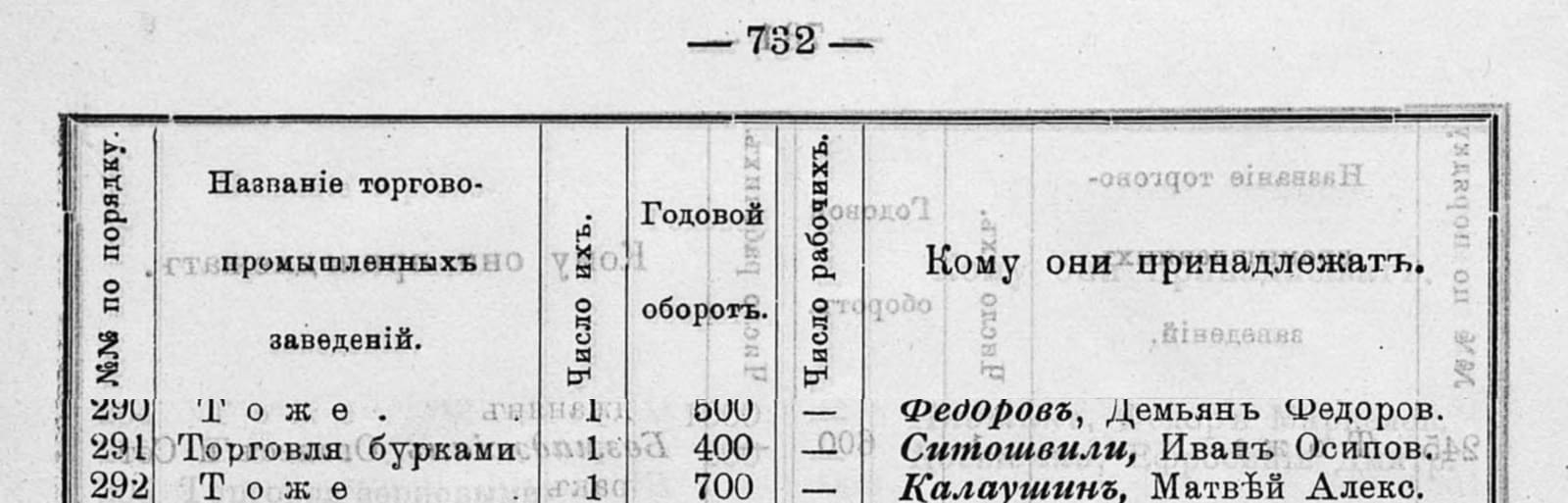
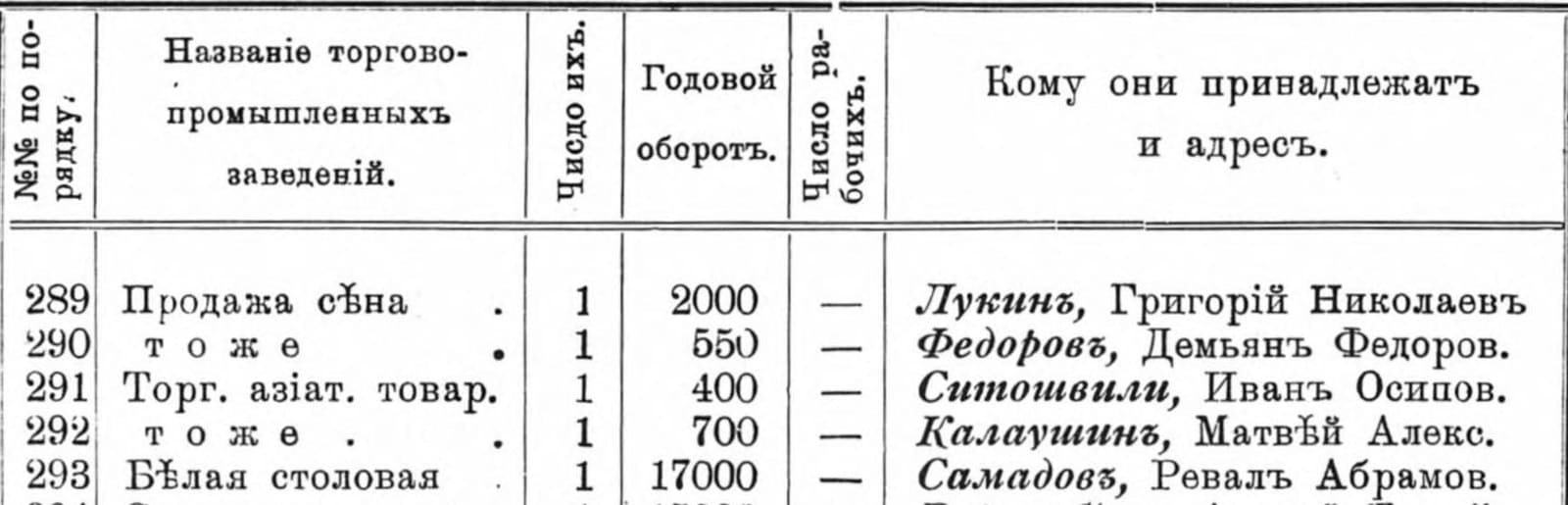
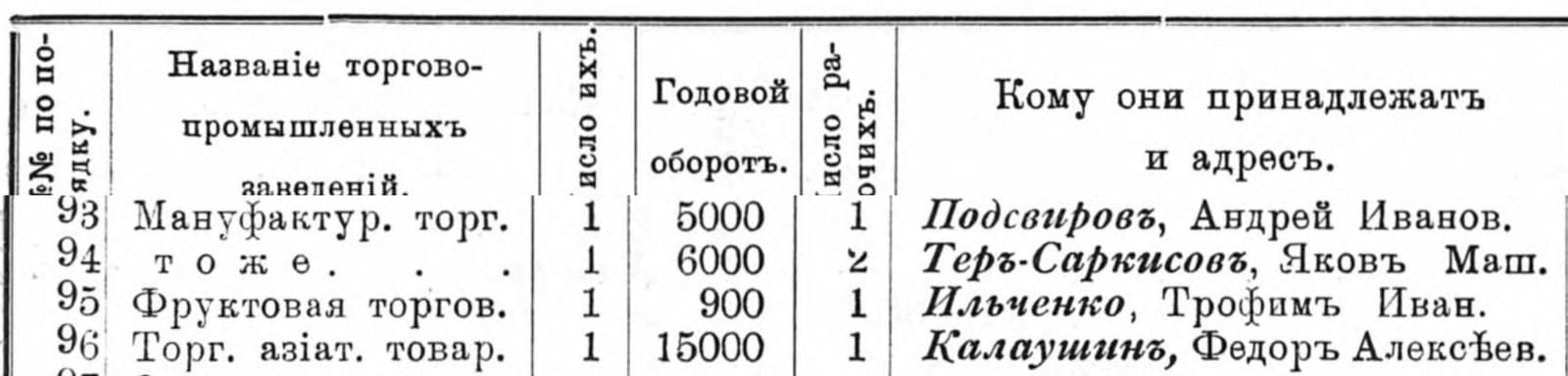
Three of the brothers — Matvey, Mikhail and Aleksandr — lived in Labinskaya [◇ S001, No. 72]. Here in 1904 Matvey Alekseyevich’s son Matvey was born, the future Pushkin scholar M.M. Kalaushin [◈ S170, “Labinsky pushkinist M.M. Kalaushin”]. In 1910 Matvey Alekseyevich chaired the stanitsa’s Second Mutual Credit Society [◆ S058, 1910, pt 2, cols 525–526]. The brothers’ trade left its trace in the directories: “Harness goods. Kalaushin M.A.” [◆ S059, col. 1412] — △ Matvey or Mikhail Alekseyevich, since both lived in Labinskaya; the Kuban Calendar for 1913 records Matvey Alekseyevich’s trade in burkas (felt cloaks), with a turnover of 700 roubles, while in the 1914 issue the same line is classed as trade in “Asian goods” [◆ S060, 1913, p. 732, no. 292; ◆ S060, 1914, p. 422, no. 292]. In Batalpashinskaya the same heading lists “Kalaushin, Fyodor Alekseyev[ich]” with a turnover of 15,000 roubles [◆ S060, 1914, p. 442, no. 96]; △ most likely Fedot Alekseyevich.
◇ family testimony
Mikhail Alekseyevich owned a two-storey house on Krasnaya Street, built in the 1890s, with a half-arch and a passage through to the inner courtyard. On the ground floor was a shop selling leather goods; the upper floor was the family’s home. The courtyard led into the Kalaushins’ private garden: trees, flower beds, little fountains, Chinese lanterns, electric lamps fed by their own power station, an “electrobiograph” — a cinematograph — and a shell-shaped bandstand where a military brass band played; entry cost very little, and the garden was “a place that drew the people of Labinskaya”. The brothers’ workshops stood on what is now Khalturina Street, between Krasnaya and Mira, and that stretch was called “Kalaushin Lane” [◇ S001, No. 72].
Documentary note. The “Kalaushin House”, 6 Krasnaya Street, Labinsk, built in the 1890s, is a listed heritage building of regional importance; the register does not say which brother owned it [◈ S187, “Cultural heritage of Russia / Krasnodar Krai / Labinsk District”, after the heritage register]. House No. 1 on Khalturina Street, where M.M. Kalaushin’s family lived, now carries a memorial plaque, put up at the initiative of the Labinsk local historian G.A. Vinogradova [◈ S170, “Labinskiye krayevedy: Galina Anatolyevna Vinogradova”]. Descendants of the Firsovs, an old Labinskaya family, recalled: “Father made horse harness and soles and delivered them to the Kalaushins, the owners of the saddlery and harness workshop” [◈ S170, “Vstrecha s potomkami pervoposelentsev Firsovykh”]. A cinema with its own electric motor is documented for Aleksandr Alekseyevich: in 1931 in Batalpashinsk he was deprived of his voting rights “as the owner of a cinema with its own electric motor” [◆ S020, via S157]; according to his daughter, in 1916 he had bought the Zlygosteva house in Labinskaya “together with a power station and a cinema”, where his son Boris showed films [◇ S001, No. 74]. The 1914 table of the stanitsa’s commercial and industrial establishments lists a single power station, that of G.S. Avakyants [◆ S060, 1914, p. 422, no. 321]; △ where the light in the Kalaushins’ garden came from, and what the power station at the Zlygosteva house was, may be shown by the purchase deeds for the Kalaushin houses in Labinskaya that were kept in the family [◇ S001, Nos. 32, 74].
◇ family testimony
In Batalpashinskaya, Fedot Alekseyevich’s workshop and his drapery shop stood on Sobornaya Street, on its south side. Six men worked in the workshop, from October to April; in summer they left for the fields and their own households and came back in the autumn, and the senior master was like one of the family in the owner’s house [◇ S001, No. 73].
The end of the workshop
◇ family testimony
In 1912 the family lost two of its masters. Matvey Alekseyevich, the family recalls, died of an accidental shot: at a meeting of the bank, his son-in-law or his daughter Yuliya’s fiancé met him on the stairs and, in jest, pointed a pistol at him. In the same year, relatives remember, Mikhail Alekseyevich was accidentally shot while hunting. The family workshop passed to Aleksandr Alekseyevich [◇ S001, Nos. 71, 72].
Fedot Alekseyevich, ataman of Batalpashinskaya in 1907–1909, was ataman of the stanitsa again during the Civil War, and in 1920 he was shot in Batalpashinskaya as a hostage [◈ S001, No. 73; ◈ S162, vol. “K” — 1921].
◇ family testimony
The craft, relatives say, saved Aleksandr Alekseyevich’s family: “This trade saved him and his family… from cruel repression.” He too seems to have been arrested, but was released on Budyonny’s orders “because he was a good saddler”; a sentry was posted at his house, and Red Army men were taught saddlery inside it [◇ S001, No. 74]. Aleksandr Alekseyevich died in Sukhumi in 1933 [◇ S001, No. 74].
What survives, and where to look
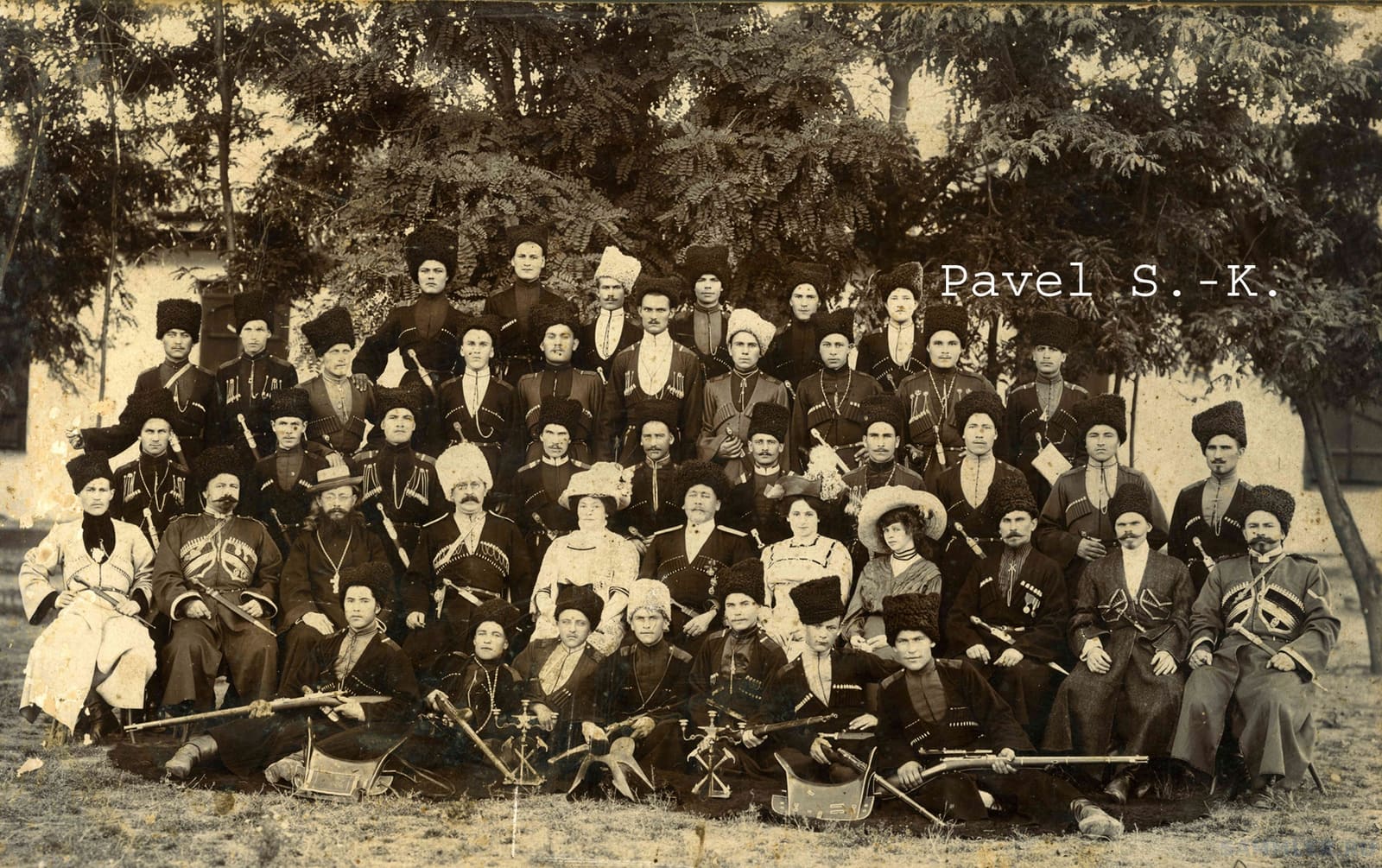
No saddle, kinzhal or shashka bearing the Kalaushin name has yet been identified in the museum catalogues available online; the State Catalogue of the Museum Fund has been searched only in part, and the catalogues of the Hermitage and the State Historical Museum have still to be searched. What survives is the house on Krasnaya Street in Labinsk, the documents of 1887–1915 cited in this chapter, the 1910 photograph of the Maykop school and the portraits of Fedot Alekseyevich kept by his descendants. △ The workshop’s pieces are worth looking for by a possible maker’s mark or inscription “Калаушинъ”, by the arms of a Purveyor to the Court, or by the names of the stanitsas.
Where to look (the descriptions of the items below name no maker):
- Labinsk Museum of History and Local Lore (F.I. Moiseyenko): a 19th-century “harness ring” (LM KP 30/305); photograph albums of 1905 and 1911 (LM KP 542, 541) [◈ S165].
- Krasnodar Museum-Reserve (Ye.D. Felitsyn): a “Cossack saddle with harness” and early 20th-century kinzhals “with the master’s mark” from the exhibition “The Gleam of Steel” (2020–2021) [◈ S169]; A.P. Chernov’s photograph “The pavilion of the Host workshops of Uman and Labinskaya at the third Kuban agricultural and industrial exhibition in Yekaterinodar” (September 1902, KM 7033/7) [◈ S165] — △ apparently the very pavilion in which Mikhail Kalaushin’s clamps were shown.
- Museums that inherited the court collections (Tsarskoye Selo, the Hermitage, the Moscow Kremlin Museums): the Cossack saddle and burka presented to the Tsesarevich Alexei in May 1909 on behalf of Kuban Oblast and the Armavir–Tuapse Railway Company [◆ S036, 1909, no. 106], and the saddle given on 17 May 1911, when, as the Emperor wrote, the deputations of the Kuban and Terek Hosts “presented Alexei with a little horse with a saddle, a cherkeska and arms” [◆ S037, 17.05.1911].
- Archives: RGIA, ff. 468 and 472; GAKK; the archives of the Caucasian Agricultural Society (Tbilisi), for the 1889 awards; the report of the Military Department of the 1896 exhibition (Russian State Library).
Documents
Translated from the Russian; the surname is given as in the source.
1887. “…5 masters: the saddle master and also harness-maker, the Cossack A. Kalaushin; the locksmith, Uryadnik V. Timoshenko; the joiner A. Esmansky; the bookbinder P. Feodotov; and the blacksmith V. Rabadzhiyev…” — Report on the crafts department of the Batalpashinsk Town School for 1887 [◆ S035, 1888, suppl. to no. 16, 16.04.1888, p. 3]
1889. “186. To Matvey Kalaushin — for a saddle and saddle straps.” — List of awards of the Caucasus Exhibition, Department IX, cottage-industry section [◆ S036, no. 305, 17.11.1889, p. 2]
1900. “His Majesty the Emperor honoured each of them with gracious words, and with His Own hand presented the badges established for service in His Majesty’s Own Convoy…” — “Cossacks leaving on reserve leave”, Tsarskoye Selo, 31 May 1900 [◆ S036, no. 150, 10.06.1900, p. 3]
Documents and illustrations




Images held by rights holders
- Image held by the rights holder — permission requested
Place · 1955–1959 · for comparison
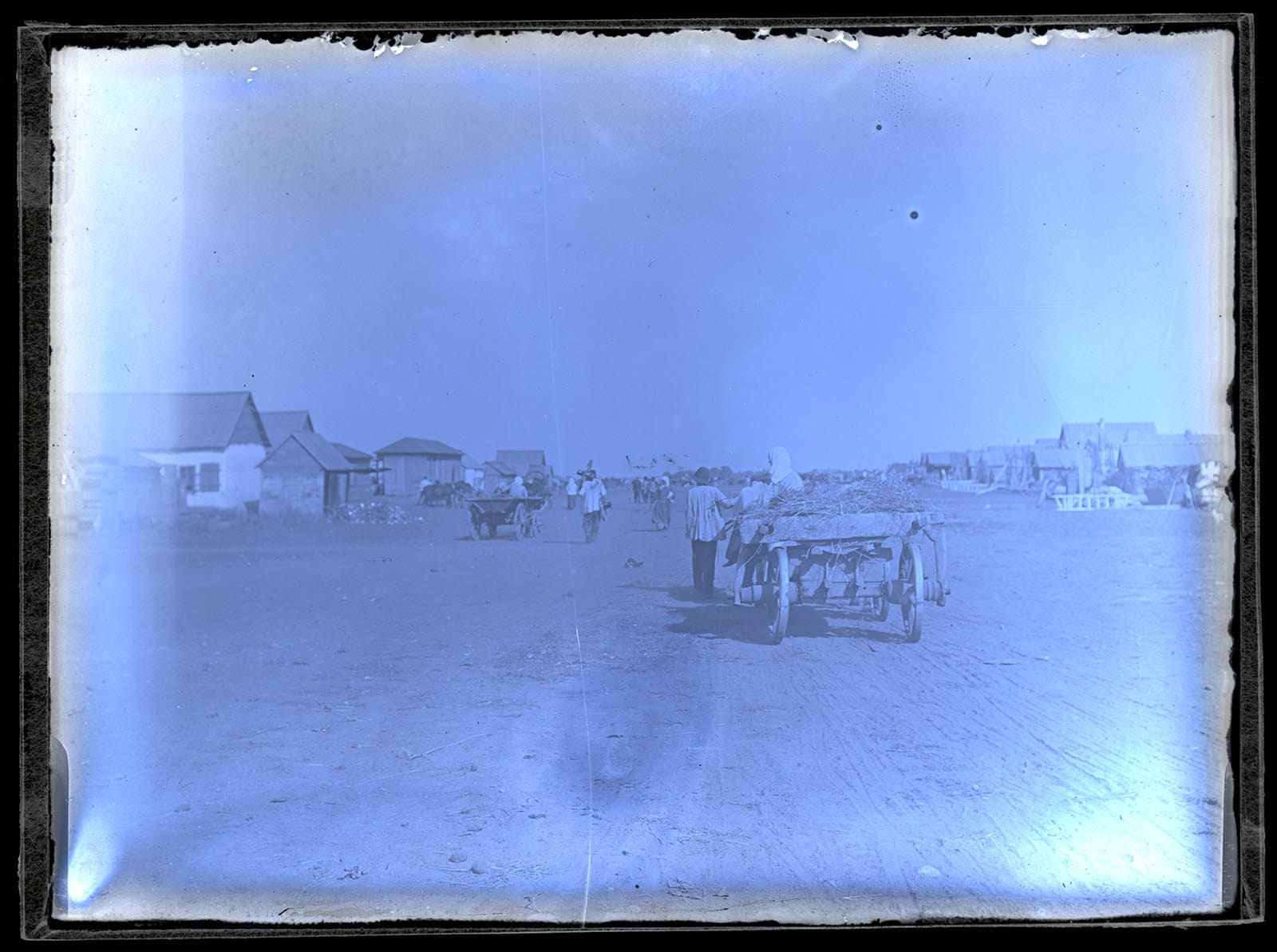
Labinsk, Krasnaya Street (former Aleksandrovsky Prospekt), 1955–59
Krasnaya Street, Labinsk, 1955–59; taken some 60–80 m from No. 6, listed in the heritage register as "Residential house of the Kalaushins" (1890s). Whether the house itself is in the frame has not been established [PastVu no. 895480; heritage list for Labinsk District].
PastVu (пользовательская загрузка) (загрузил пользователь Enat; автор неизвестен)
PastVu (pastvu.com/p/895480), photographer unknown
- Image held by the rights holder — permission requested
Photograph · 1934 ◇ family testimony
The family of Dzhalal Suleimanov, 1934
The family of Rukizhat (Lyubov) Dzhalalovna Suleimanova, later the wife of S. S. Geichenko; she is in the third row, left, with her father Dzhalal and mother Shamai in the second row; photograph of 1934. Dzhalal, a Lak from Kazi-Kumukh, had been a jeweller and armourer in Kutaisi "since before the Revolution". According to the Kalaushin family account, Matvei Alekseevich obtained Damascus steel "through Suleimanov, the father of Geichenko's wife" [Abdurakhmanova, Pskovskaya Gubernia, 2013, No. 10 (632); Roster of A. B. Kalaushin, no. 71].
Семейный архив Сулеймановых — Гейченко; публикация газеты «Псковская губерния» (2013)
Suleimanov–Geichenko family archive; Pskovskaya Gubernia, 2013
- Image held by the rights holder — permission requested
Object · 1851–1900 · for comparison
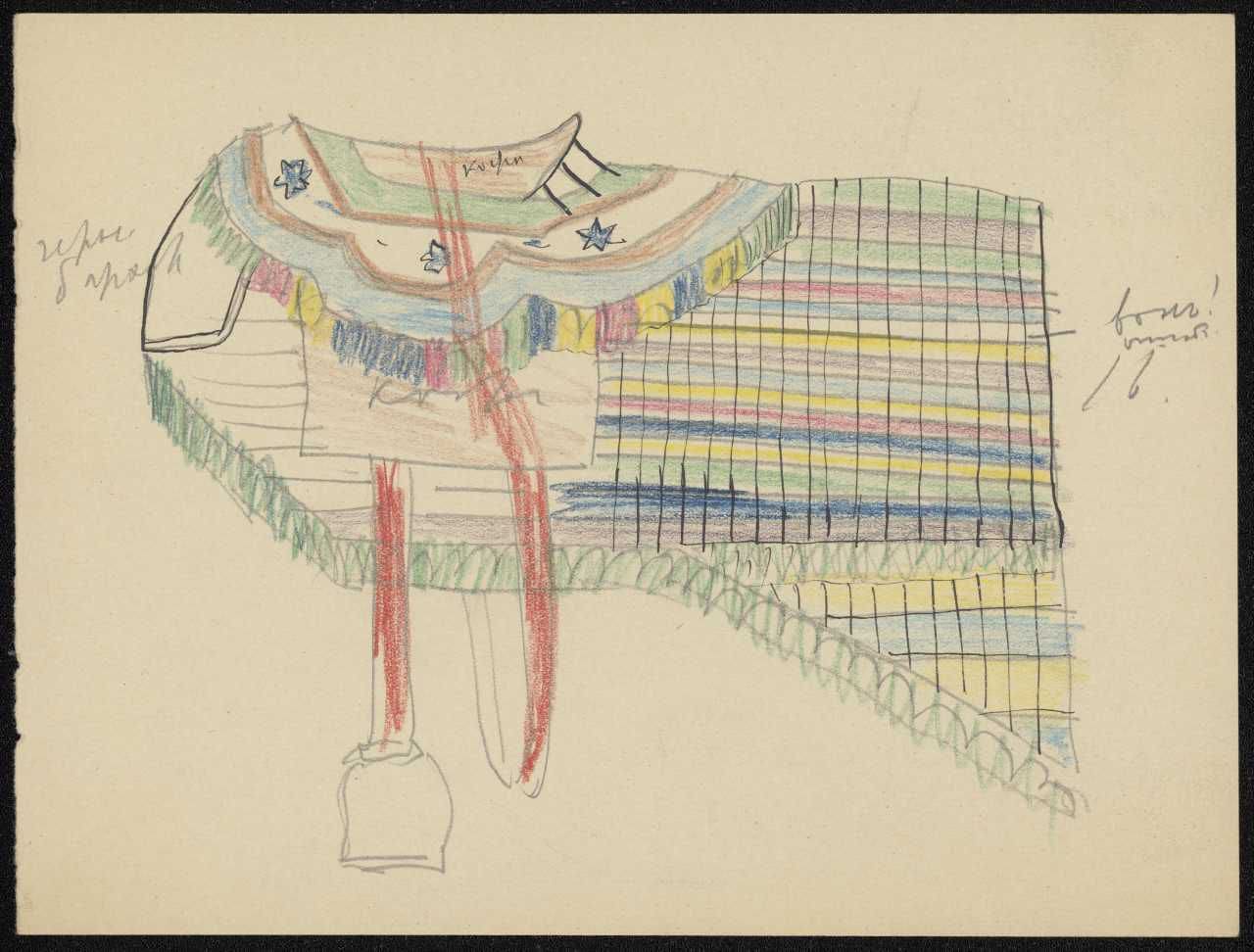
Caucasian parade saddle, second half of the 19th century (Moscow Kremlin Museums) — for illustration
Saddle with stirrups, crupper and seat cushion. Caucasus, second half of the 19th century. Wood, silver, iron, bone, leather, cloth, gold thread. Moscow Kremlin Museums, K-90/1-5. Maker not recorded; the museum classes it as eastern (Highland) work. Not a Kalaushin piece — for illustration.
Музеи Московского Кремля, К-90/1-5
© Moscow Kremlin Museums
Sources for this chapter
- S001 — A.B. Kalaushin’s roster Kalaushiny (philippov.spb.ru, version 03.02 of 13 July 2025)
- S003 — Family testimony: V.O. Kalaushin, 8–9 Oct 2026
- S004 — N.G. Firtich, “Matvey Matveyevich Kalaushin: on the centenary of his birth” (museum.ru, N20942, 2005)
- S012 — Batalpashinskaya confessional register (family list), 1848 (GASK, f. 135, d. 806)
- S013 — Batalpashinskaya parish register, 1857 (RGVIA, f. 14877, d. 2716)
- S018 — Maykop parish registers (NA RA, f. 77, op. 1-l)
- S020 — Archive of the Karachay-Cherkess Republic: decisions on disenfranchisement (1930–1932)
- S033 — Name index to the Orders of the Kuban Host, 1880–1899
- S035 — Kubanskiye Oblastnye Vedomosti (KOV)
- S036 — Kavkaz newspaper (Tiflis)
- S037 — Dnevniki imperatora Nikolaya II, vol. 1 (Moscow: ROSSPEN, 2011)
- S039 — Albom uchastnikov of the 1896 All-Russian Exhibition, pt III
- S040 — Obshchy ukazatel of the 1896 All-Russian Exhibition
- S041 — Pester Lloyd, 1896 (ANNO)
- S042 — Salzburger Chronik, 1896 (ANNO)
- S044 — Illyustrirovanny vestnik… progressa Rossii, no. 1 (1898)
- S046 — Catalogue général de la section russe. Exposition universelle de 1900
- S047 — V.G. Tolstov, Istoriya Khopyorskogo polka Kubanskogo kazachyego voyska, pt 1 (Tiflis, 1900)
- S048 — Wiener Zeitung, 1900 (ANNO)
- S049 — Prager Tagblatt, 1900, 1914 (ANNO)
- S050 — Neue Freie Presse, 1900 (ANNO)
- S051 — Vorarlberger Volksblatt, 1900 (ANNO)
- S052 — Neues Wiener Journal, 1900 (ANNO)
- S054 — Ostdeutsche Rundschau, 1902 (ANNO)
- S055 — Sport und Salon, 1902 (ANNO)
- S058 — Kavkazsky kalendar (Tiflis), 1910–1914
- S059 — Vsya Rossiya, 1912
- S060 — Kubansky kalendar for 1913 and 1914
- S088 — Z. Abdurakhmanova, “Roditelsky dom neprikosnovenen” (Pskovskaya guberniya, 2013)
- S091 — E.G. Astvatsaturyan, Oruzhiye narodov Kavkaza (1995)
- S097 — N.V. Galushkin, Sobstvenny Yego Imperatorskogo Velichestva Konvoy (San Francisco, 1961)
- S108 — I.V. Zimin et al., Yuvelirnye sokrovishcha Rossiyskogo imperatorskogo dvora (Moscow, 2013)
- S127 — Ye. Preobrazhenskaya, “Vizity shakha Persii v Rossiyu” (Naslediye Imperii)
- S135 — GASK Handbook 2008: Administrativno-territorialnoye ustroystvo Stavropolya… (Stavropol, 2008)
- S153 — sammler.ru: collectors’ forum (P.N. Strelyanov)
- S156 — Kubanskaya genealogiya (kubangenealogy.ucoz.ru)
- S157 — Open List (Otkryty Spisok, ru.openlist.wiki)
- S159 — “Tekhnicheskoye obrazovaniye dosovetskoy Kubani: istorichesky aspekt” (slavakubani.ru)
- S160 — Yandex Archive Search (yandex.ru/archive)
- S162 — S.V. Volkov, database Uchastniki Belogo dvizheniya v Rossii, vol. “K”
- S165 — State Catalogue of the Museum Fund of the Russian Federation (Goskatalog)
- S169 — Ye.D. Felitsyn Krasnodar Museum-Reserve (felicina.ru)
- S170 — F.I. Moiseyenko Labinsk Museum of History and Local Lore (labinskiymuzey.ru)
- S179 — Druzhina forum: thread “Sobstvenny Yego Imperatorskogo Velichestva Konvoy”
- S180 — Kubanskiye kazaki forum (kubancossack.0pk.me)
- S184 — Great Soviet Encyclopedia
- S187 — Wikivoyage: “Cultural heritage of Russia / Krasnodar Krai / Labinsk District”
- S188 — Russian Wikipedia — for general historical context
- S189 — Voennaya entsiklopediya, vol. 5 (St Petersburg: I.D. Sytin, 1911)
This page uses material from the Kalaushin family roster published on the Philippov website: https://philippov.spb.ru/?q=Kalaushiny (version 03.02 of 13 July 2025).