Chapter 7 of 14 · 1917–1931
The Upheaval
The Kalaushins in the Revolution, the Civil War and the first Soviet years (1917–1931)
In brief
The Revolution found the Kalaushins on the Persian front and in their home stanitsas; the Civil War divided the family, took the lives of Pavel Aleksandrovich and of Fedot Alekseyevich, shot as a hostage in 1920, while Pavel’s wife and their three children — among them the author’s great-grandfather — escaped from a burning barn. This chapter tells those years in the family’s own words and from the documents, from the Khoper Cossacks’ return from Persia in the spring of 1918 to the disenfranchisement lists of 1930–1934, an execution in 1931 and the rehabilitations that came decades later.
◆ documented◈ published source◇ family testimony△ hypothesisMore about the method
The thread· Quality· Exclusivity
This chapter is about what mastery could not prevent, and what it nevertheless preserved. Fedot Alekseyevich — Purveyor to the Imperial Court and stanitsa ataman in 1907–1909 — was shot in Batalpashinskaya as a hostage in 1920 [◈ S108; ◆ S035, 1909, no. 256, 03.12.1909, p. 1; ◈ S001, No. 73; ◈ S162, vol. “K” — 1921]. Aleksandr Alekseyevich, his relatives remember, was released because he was a good saddler — such masters, the family said, could be counted on the fingers even then — and in his house Red Army men were taught saddlery [◇ S001, No. 74].
The Revolution found the Kalaushins at opposite ends of the old empire: some at war in Persia, others at home in the stanitsas (Cossack villages) of the Batalpashinsk Department, among their workshops, orchards and beehives. In three years Batalpashinskaya stanitsa (now Cherkessk) changed hands several times, and almost every branch of the family suffered losses. This chapter covers those years of upheaval — in Russian, Smuta — and the decade that followed, when former craftsmen, traders and householders one after another found their names on the lists of people deprived of the vote. The family’s own accounts come first; the documents and published sources stand beside them.
Dates before 1 (14) February 1918 are Old Style, later dates New Style; in his memoirs A.G. Shkuro keeps to the Old Style.
Persia, 1917–1918: the road home
◇ family testimony
Roman Vasilyevich Kalaushin [S001, No. 100] was born on 14 October 1895 in Bekeshevskaya stanitsa and served in the 3rd Khoper Regiment. The family recalled that the Revolution found him “when the Cossacks of the Khoper regiments were at war with Persia”. The Cossacks “routed the Persians” and came home by sea: they “arrived by ship in Baku (Makhachkala), and here the revolutionaries would not let them ashore”. So the Cossacks fought their way ashore, took several trains by force, and “short of Mineralnye Vody they left the trains and rode off home on horseback” [◇ S001, No. 100].
In those years a Russian expeditionary corps under General N.N. Baratov was stationed in Persia; in the summer and autumn of 1917 its units held the front against Turkish troops, while Kurdish bands raided their rear [◈ S143, ch. 6]. There were many Khoper Cossacks among them: the 1st Khoper Regiment belonged to the 1st Caucasian Cossack Division, the 3rd to the Independent Kuban Brigade [◈ S152, pages of the 1st and 3rd Khoper Regiments, as of 01.06.1917], and Shkuro names both formations among those still holding the front in the autumn of 1917 [◈ S143, ch. 6]. On a 1916 photograph from Bekeshevskaya a collector has captioned Roman Vasilyevich as a Cossack of the 1st Khoper Regiment [◈ S153, P.N. Strelyanov, 09.10.2021]; the roster names the 3rd. According to the roster, Voyskovoy Starshina (Cossack lieutenant colonel) Yefim (Yevfimy) Mikhailovich Kalaushin also served in Baratov’s corps [◈ S001, No. 131], and “with him on this expedition were another Kalaushin, a sotnik … and also a praporshchik Kalaushin” [◈ S001, No. 131]. In 1916–1917 the 3rd Khoper Regiment had two Kalaushin officers, Sotnik (Cossack lieutenant) Aleksey Matveyevich [S001, No. 122] and Praporshchik (ensign) Semyon Ilyich [◈ S152, lists of officers of the 3rd Khoper Regiment, 10.1916 and 14.06.1917]; △ these are probably the men the roster means.
The same road home was described by A.G. Shkuro, the future general, who had begun the war with that regiment. In the spring of 1918, hiding from the soldiers’ committees, he sailed from the Persian port of Enzeli to Petrovsk (now Makhachkala) on the steamer that carried the 3rd Khoper Regiment; the Khoper Cossacks hid him in the hold. From Petrovsk the regiment travelled by troop train through Grozny; in places the track had been torn up and the small bridges burnt, and the line had to be repaired under fire. Shkuro writes that the Khoper men refused to be talked into killing their officers and instead warned them in secret that it was time to leave. He himself jumped from the train on the last stretch before Mineralnye Vody station, where, he had heard, the Bolsheviks kept a checkpoint, walked round the station and reached Kislovodsk in a goods wagon [◈ S143, chs 6–7]. △ The family account and Shkuro’s memoirs agree on the essentials — the sea, Makhachkala, the troop trains, Mineralnye Vody; most likely Roman Vasilyevich came home by the same route and in the same weeks, in the spring of 1918.
A stanitsa between masters
After the February Revolution, elected civil executive committees appeared in the Batalpashinsk Department alongside the old administration [◈ S130]. On 7 (20) February 1918 the department’s congress of Soviets, meeting in Batalpashinskaya, declared for Soviet power; on the night of 8 (21) February an anti-Soviet coup took place in the stanitsa, and on 15 March Ya. Balakhonov’s detachment restored Soviet rule [◈ S117, pp. 56–59, 64]. That spring, in the words of a local officer quoted by Shkuro, the new authorities were “trying to secure themselves by arrests, terror and merciless shootings”, which had already killed “a great many officers and the most prominent Cossacks” [◈ S143, ch. 7]. At dawn on 5 September 1918 Shkuro’s detachment took the stanitsa [◈ S143, ch. 15; ◈ S117, p. 104]; that autumn the Whites hanged Soviet officials on the central square [◈ S117, p. 105]. For about a year and a half, from September 1918 to March 1920, power in Karachay and Cherkessia lay with the Whites [◈ S092]. At nine in the evening on 22 March 1920 P. Kuryshko’s cavalry division occupied Batalpashinskaya, and the next day units of the 39th Division entered the stanitsa [◈ S117, p. 134]. That summer General M.A. Fostikov’s insurgents rose in the mountains; on 4 September 1920 they held Batalpashinskaya for a single day, and from mid-September the stanitsa remained in Red hands for good [◈ S096; ◈ S117, p. 162].
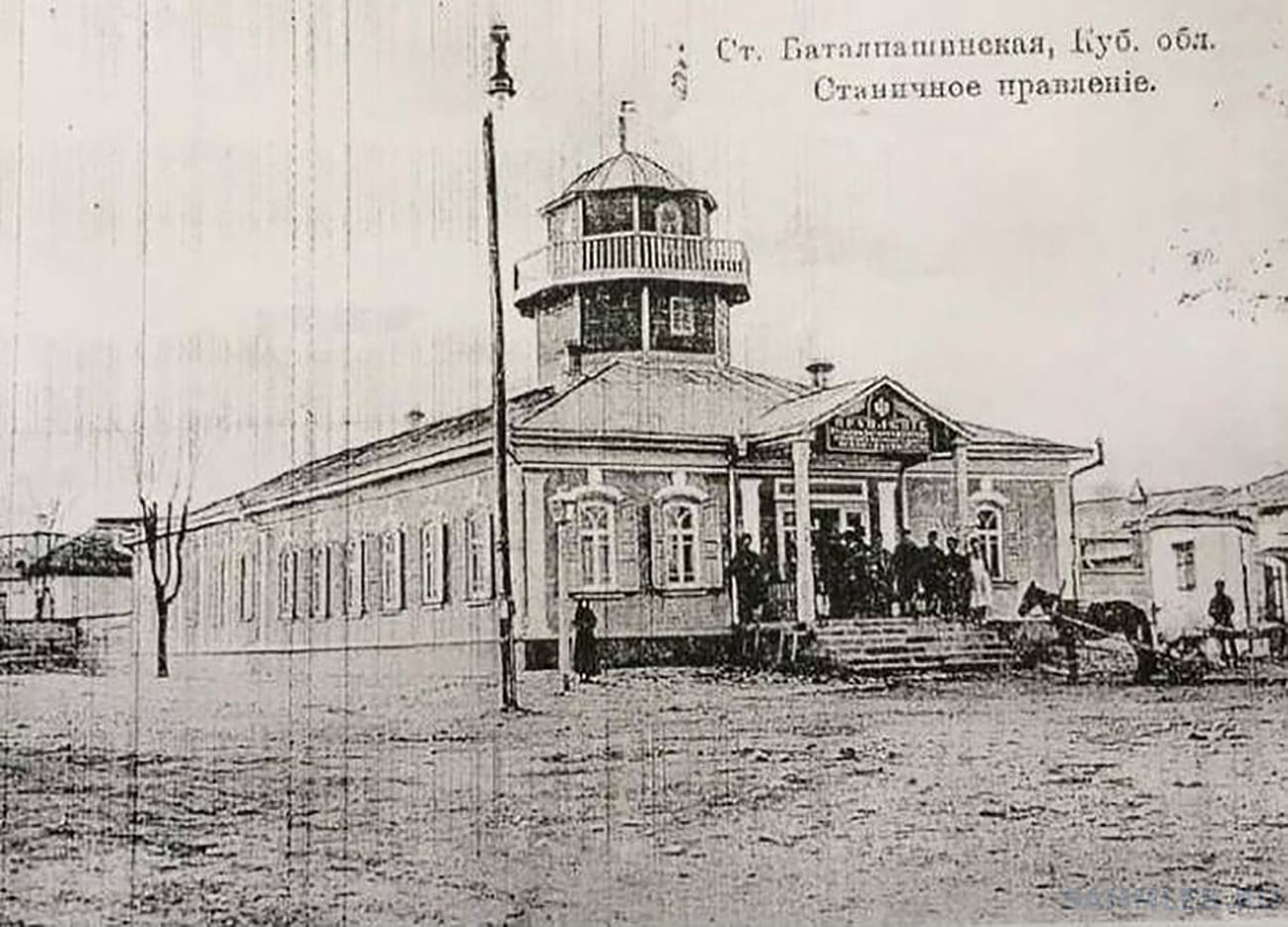
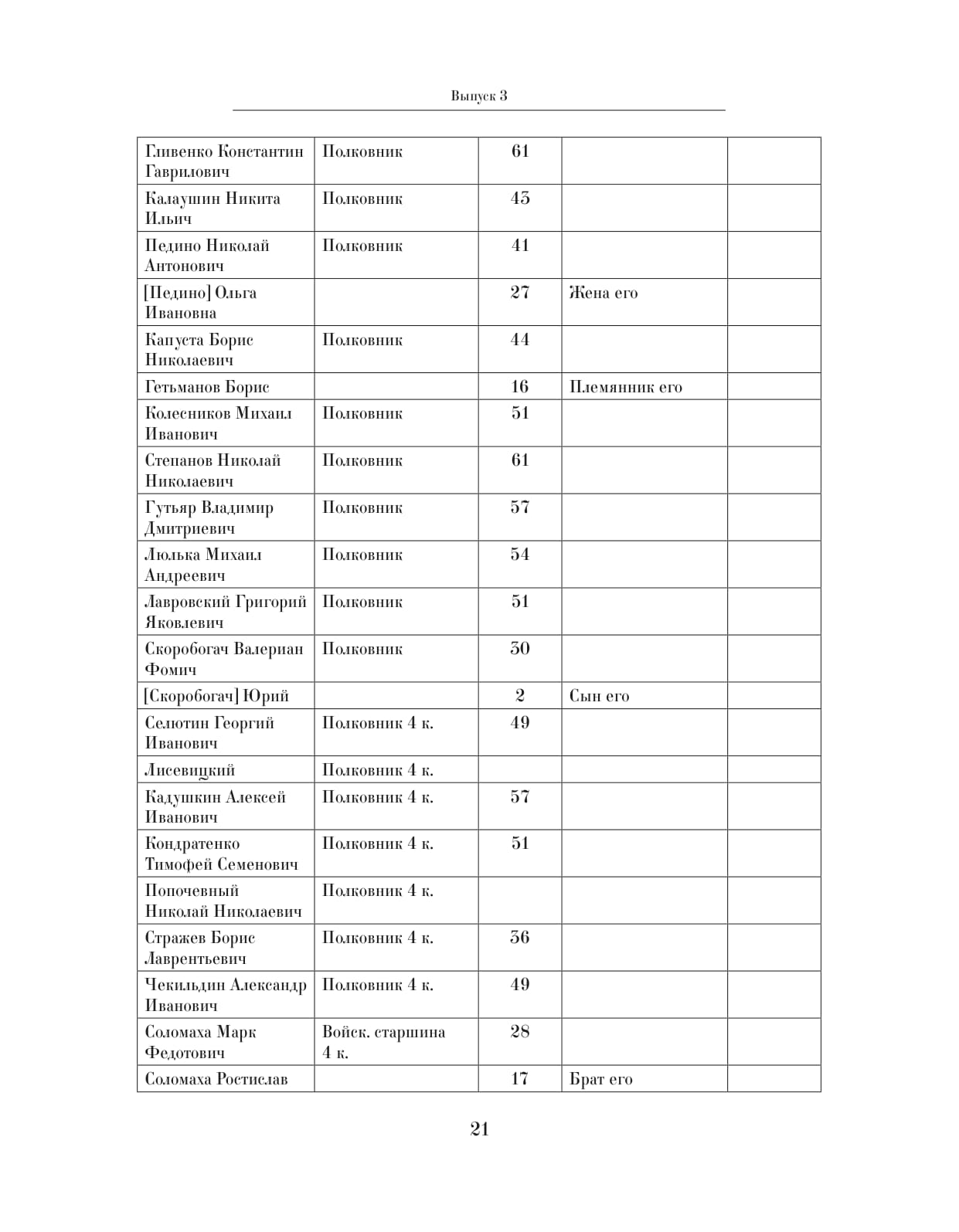
The Kalaushins found themselves on different sides. Under the Whites Fedot Alekseyevich [S001, No. 73] was ataman (elected head) of Batalpashinskaya (see below). His son Nikolay Fedotovich, the roster records, joined Shkuro in the autumn of 1918, when Shkuro took the stanitsa, and served under him as a podkhorunzhy (senior Cossack NCO) [◇ S001, No. 134]. Nikolay Aleksandrovich [S001, No. 137], born in 1901, a son of Aleksandr Alekseyevich [S001, No. 74], served in the Volunteer Army and went missing [◈ S162, vol. “K”]; the family remembered the words of “Aunt Marusya”: he had gone off “to fight the Reds” [◇ S001, No. 137]. Yefim Mikhailovich, in the Volunteer Army and the Armed Forces of South Russia, commanded the garrison of Prochnookopskaya stanitsa until April 1919, rose to colonel and died in 1920; family sources say he went missing that year [◈ S162, vol. “K”; ◇ S001, No. 131]. Nikita Ilyich [S001, No. 85] took part in the First Kuban (“Ice”) March, then headed the office (pravitel kantselyarii) of the Kuban regional quartermaster and stayed with the Russian Army until the evacuation of the Crimea [◈ S162, vol. “K”]; in Constantinople Colonel Nikita Ilyich Kalaushin appears in the “Nominal list of refugees to be sent on the steamer Kherson on 18 December 1920” [◆ S019, publ. in S082, no. 3, 2022, p. 21]. The sons of Matvey Alekseyevich [S001, No. 71] — Aleksey, Nikolay and Aleksandr — also went abroad with the Whites [◈ S162, vol. “K”; ◈ S001, Nos. 122, 125, 126]; their later lives are a story of their own. Aleksandr Alekseyevich, according to a collector’s caption to his photograph, was also in the Volunteer Army in 1918 [◈ S153, P.N. Strelyanov, 30.12.2020].
◇ family testimony
The Civil War passed through other branches of the family too. Pyotr Gavrilovich Kalaushin [S001, No. 60], a saddler “famous throughout the Caucasus”, and his brother were, as the family remembers, killed with pitchforks during the Civil War [◇ S001, No. 60]. Darya Vasilyevna Kalaushina [S001, No. 97] was “killed by the Reds without trial” in Bekeshevskaya stanitsa [◇ S001, No. 97]. In the same years three brothers, Dmitry, Semyon and Nikita Antonovich, lost their lives [◇ S001, Nos. 82–84].
Pavel Aleksandrovich and the burning barn
The direct line of the author of these pages runs through Pavel Aleksandrovich Kalaushin [S001, No. 70], son of Uryadnik (Cossack NCO) Aleksandr Nikolayevich [S001, No. 31], holder of the Insignia of the Military Order.
Note on the roster. The roster enters Pavel Aleksandrovich as No. 70.30, a son of Stefan Nikolayevich. His patronymic and the entry for Aleksandr Nikolayevich (“He has a son Pavel”) show that his father is No. 31, Aleksandr Nikolayevich [◈ S001, Nos. 31, 70]. △ The parent numbers in this part of the roster appear to have shifted when the manuscript was retyped.
△ He is probably the Pavel Kalaushin of Batalpashinskaya who was called up in 1903 and discharged in 1907 [◈ S156, Kuban Cossack Host conscript database]; and probably the Cossack of the 2nd Sotnia of the 1st Khoper Regiment who, on the evening of 16 May 1906 in Kutais (Kutaisi), rode in the escort ahead of General Alikhanov’s carriage when two bombs were thrown. The letter from the regiment’s acting commander states that Cossack Pavel Kalaushin was lightly wounded [◆ S056, no. 147, 07.07.1906, p. 6]. There is no other Pavel of the right age in the roster.
◇ family testimony
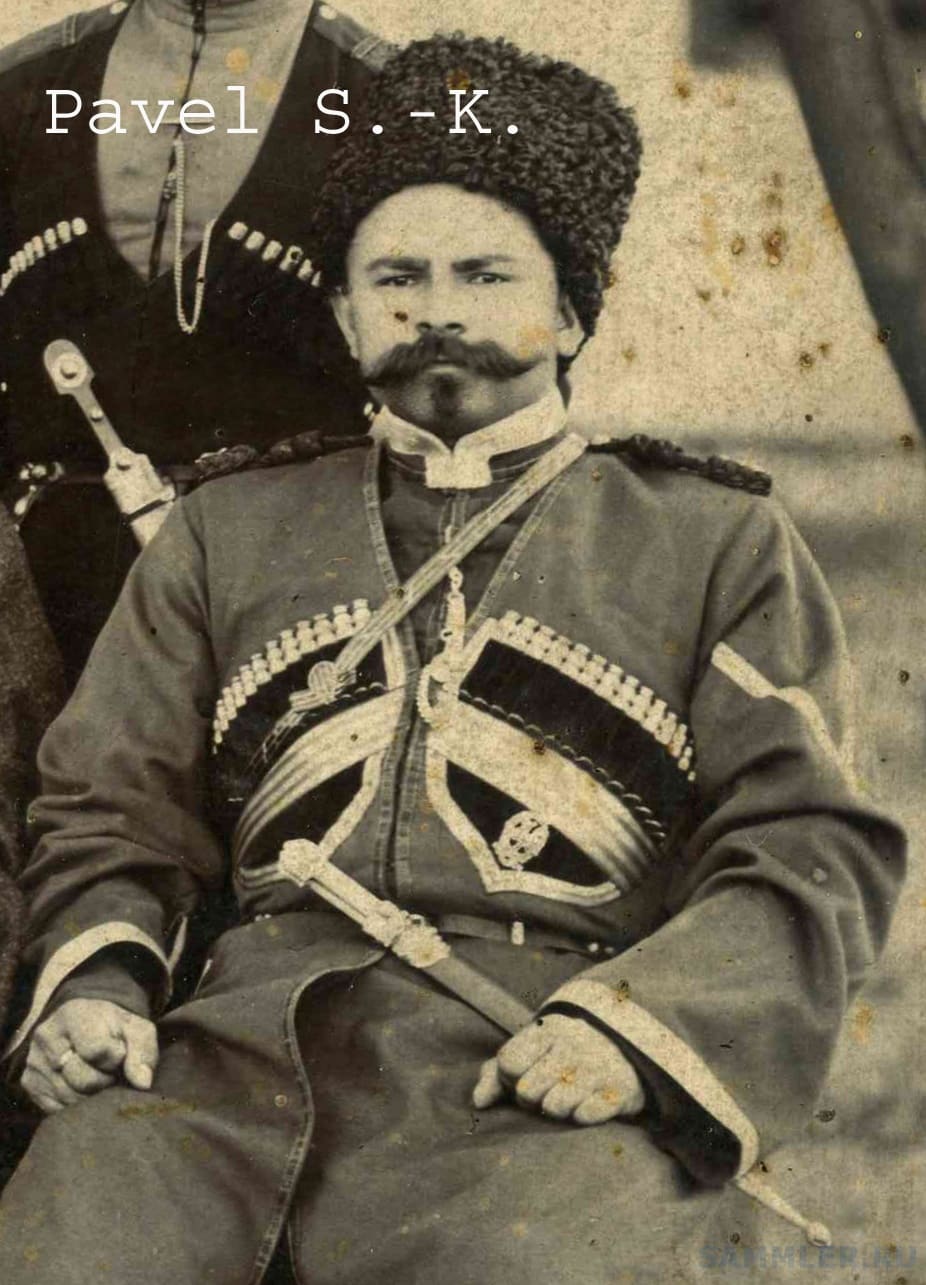
Pavel Aleksandrovich lived in Batalpashinskaya; the family had a large and prosperous farm and kept bees. “During the Revolution” Pavel Aleksandrovich was killed with pitchforks. His wife, Pelageya Alekseyevna, and their three small children were locked in a barn with other hostages, and the barn was set on fire. “Only by a miracle did they escape.” Afterwards the family lived in Cherkessk [◇ S001, No. 70].
The roster names three sons of Pavel Aleksandrovich: Mikhail (b. 1908), Nikolay (b. 1911) and Vyacheslav (b. 1915) [◈ S001, Nos. 70, 117–119]. Mikhail Pavlovich, the author’s great-grandfather, grew up a serious, strict, punctual man of principle and became an engineer in the food industry; he died in 1980 [◇ S001, No. 117; ◇ S003]. The youngest, Vyacheslav, died during the Civil War; Mikhail Pavlovich named his own son after him — Vyacheslav Mikhailovich (1943–1990), the author’s grandfather [◇ S001, Nos. 119, 202].
From the history of the stanitsa. The Civil War swept through Batalpashinskaya more than once. In the spring and summer of 1918 the Soviet authorities arrested and shot “the most prominent Cossacks”, and in neighbouring Suvorovskaya and Burgustanskaya took them as hostages [◈ S143, chs 7, 11]. In the spring of 1920, General Fostikov recalled, “everything was registered” on Kuban farms — grain, livestock, poultry, even the bees [◈ S139]. In the summer of 1920 families with children were taken hostage in the stanitsa: in July Fostikov’s sister and her six children were arrested there, and at the end of the month he learned that his father, his grandmother, his sister and her children and several other relatives had been shot [◈ S139]. In October 1920 K. Lander, special plenipotentiary of the Cheka, announced that the relatives of those who had gone to the mountains were “registered”, and that if the insurgents advanced, the adults among them would be shot and the young children deported [◈ S120, ch. “Krovavaya statistika”]. △ The family account is not dated (“during the Revolution”) and fits both periods of Soviet rule — the spring and summer of 1918 and the summer of 1920; what points to 1920 is that families with children were taken hostage in Batalpashinskaya precisely then. When the barn burned remains to be established from the documents.
Where the documents may be found. The State Archive of the Karachay-Cherkess Republic (Cherkessk): records of the Batalpashinsk Department revolutionary committee and executive committee, 1918–1921 — minutes, orders, lists of hostages. GARF, f. R-470 (the Special Commission for the Investigation of Bolshevik Atrocities, 1918–1920), if the fire took place in 1918. The FSB directorate for the Karachay-Cherkess Republic and the Karachay-Cherkess prosecutor’s office: an enquiry about Pavel Aleksandrovich’s fate and rehabilitation, which under the law of 1991 a relative may submit.
Fedot Alekseyevich: a hostage
In 1917 Fedot Alekseyevich Kalaushin [S001, No. 73], a first cousin of Pavel Aleksandrovich [◈ S001, Nos. 31, 32, 70, 73], was 46. Behind him lay eight years in His Majesty’s Own Convoy (the Cossack bodyguard of the Emperor), 1892–1900 [◈ S001, No. 73]; a saddlery workshop and a draper’s shop on Sobornaya Street [◇ S001, No. 73]; the title of Purveyor to the Imperial Court — his name stands in the official List of Purveyors compiled at the beginning of 1915 [◈ S108]; and two years as ataman: on 17 September 1907 Uryadnik Fedot Kalaushin was confirmed as ataman of Batalpashinskaya, and on 25 November 1909 he was released from the post “at his own request” [◈ S156, database of stanitsa atamans, after KOV, 1907, no. 214; ◆ S035, 1909, no. 256, 03.12.1909, p. 1]. His Convoy service and his purveyor’s title are told in detail in the chapters “At Court” and “The Workshop”.
◇ family testimony · confirmed by relatives
The saddle for the Shah of Persia (Iran) was made in Fedot Alekseyevich’s workshop on the order of Emperor Nicholas II; the work took two months. Fedot Alekseyevich took the saddle to St Petersburg himself. There, “at a review of the Guards, on the last day before going home (at the end of his service)”, Prince Trubetskoy reported to the Emperor that the saddle had arrived. Nicholas II examined it, said it was very well made, and there and then congratulated Kalaushin on the title of Purveyor to the Court of His Imperial Majesty; a gold watch was granted with the title. Talking with the master, the Emperor asked how long he had been in St Petersburg and, learning that Trubetskoy had put off presenting the saddle for so long, showed his displeasure. Once the Emperor had gone, Trubetskoy turned his anger on Fedot and sent him to the guardhouse for two days for an incautious answer. The promised gold watch never reached Fedot Alekseyevich [◇ S001, No. 73]. Relatives confirm the account; it is recorded in the family history [◇ S003].
△ hypothesis · dating
The years point to 1900. Fedot Alekseyevich served in the Convoy from 1892 and was discharged by Kuban Host Order No. 60 of 17 June 1900, “retaining the Guards uniform and awarded the badge for service in the Convoy” [◈ S001, No. 73]. The only state visit of a Persian shah to St Petersburg in those years was that of Mozaffar ad-Din Shah, 4–10 July 1900 Old Style (17–23 July New Style) [◆ S037, 4–10.07.1900; ◆ S036, no. 181, 11.07.1900, p. 3]. The press was reporting Nicholas II’s invitation to the Shah as early as February 1900; at first the Shah was expected in St Petersburg at the end of May, but in April his route was changed and the official reception in the capital was moved to his return journey [◆ S048, 15.02.1900, p. 7; ◆ S050, 10.03.1900, p. 23; ◆ S051, 25.04.1900, p. 3]. A gift for such a visit would naturally have been ordered in February or March, and with two months’ work the saddle would have been ready just by the end of May.
And on 31 May (13 June) 1900, on the square in front of the Alexander Palace at Tsarskoye Selo, came the farewell review of the Convoy Cossacks going home on lgota (into the reserve): the Emperor spoke a few gracious words to every one of them and handed out the badges for service in the Convoy with his own hand [◆ S036, no. 150, 10.06.1900, p. 3; ◆ S037, 31.05.1900]. The Emperor’s diary for 1900 records no other such review, and the family’s “review of the Guards on the last day before going home” is most naturally placed on that day: seventeen days later came the order discharging Fedot Alekseyevich — with the very badge the Emperor had handed out at the review — and two and a half weeks after that, on 4 July, the Shah arrived in St Petersburg. This also makes sense of the Emperor’s question about how long the master had been in town, and of his displeasure at the delay: the saddle, made for the original date, had to wait for its moment. The most consistent dating is spring to early summer 1900: the saddle was made in the spring (roughly March to May), the Emperor most probably saw it at the review of 31 May, and it was intended for Mozaffar ad-Din Shah’s visit of 4–10 July 1900.
Other meetings between Russian emperors and shahs fit the account less well. Naser al-Din Shah was in St Petersburg in May 1889, in the reign of Alexander III, before Fedot Alekseyevich had taken the oath (1891) [◈ S127; ◈ S001, No. 73]. When Mozaffar ad-Din Shah met Nicholas II at the manoeuvres near Kursk in 1902 and at Peterhof in 1905, Fedot Alekseyevich had already left the Convoy [◆ S054, 19.09.1902, p. 2; ◆ S037, 20–24.08.1905]. And for Ahmad Shah’s coronation in Tehran in 1914 Russia sent a special envoy [◆ S049, 21.07.1914]: a gift would then have gone to Tehran, with no review in St Petersburg.
A note on names. In 1900 the Convoy was commanded by Baron Alexander Meyendorff (1893–1906); on the day of the review, 31 May, the departing men were led by the acting commander, Colonel Kireyev [◆ S036, no. 150, 10.06.1900, p. 3]. Prince Georgy (Yury) Ivanovich Trubetskoy, Meyendorff’s nephew, took over the Convoy from his uncle in 1906 and commanded it until 1914 [◈ S097, p. 170; ◈ S188, “Trubetskoy, Georgy Ivanovich”]. △ The family most likely kept the name of the later, better-remembered commander, under whom, in 1906–1908, Fedot’s younger brother Aleksandr Alekseyevich also served in the Convoy [◇ S001, No. 74]. This is a note on names, not a contradiction of the account. Watches were a customary imperial reward in the Convoy: the Emperor gave a gold watch bearing the State arms, for example, to his orderly uryadnik at the end of six months’ duty with him [◈ S097, p. 151]. The saddle and the matching of the dates are discussed fully in the chapter “At Court”.
During the Civil War, under the Armed Forces of South Russia, Fedot Alekseyevich was once again ataman of Batalpashinskaya [◈ S162, vol. “K”; ◈ S001, No. 73]. The roster records his end briefly: “shot by the Bolsheviks as a hostage in Batalpashinskaya stanitsa by order of the special plenipotentiary of the Revolutionary Military Council of the 9th Army in 1920”; the compiler cites the newspaper Batalpashinskaya Pravda, 1920, no. 27 [◈ S001, No. 73]. The family remembered Fedot Alekseyevich as “a man of kind soul” [◇ S001, No. 73].
From the history of the stanitsa. The post named in the roster is known from published accounts of that very summer. When Fostikov’s insurgents rose in the mountains, Cheremukhin, special plenipotentiary of the Revolutionary Military Council of the 9th Army, was acting in the Batalpashinsk Department with emergency powers. On 1 August 1920 A. Metelev, chairman of the department’s revolutionary committee, wrote in Batalpashinskaya Pravda that “bandits and their accomplices will be destroyed without mercy”; on Cheremukhin’s orders twenty “agents and accomplices of the counter-revolution” were shot, and on 9 August an order was issued to punish the stanitsa of Kardonikskaya and the village of Georgiyevsko-Osetinskoye [◈ S117, pp. 160–161]. On 26 August Cheremukhin left with a detachment for Karachay; the detachment was destroyed, and he himself was later tried by a revolutionary tribunal and shot [◈ S096]. Batalpashinskaya Pravda was the organ of the department committee of the Russian Communist Party (Bolsheviks), elected on 20 May 1920; K.T. Laypanov quotes its issues from 18 June to 1 August 1920 [◈ S117, pp. 146, 189–190]. △ Judging by how often the paper came out, issue no. 27 most likely appeared in late July or August 1920, at the time of Cheremukhin’s orders. The available publications do not give lists of those shot, and we do not link Fedot Alekseyevich’s death to them.
Note on the roster. S.V. Volkov’s reference database dates Fedot Alekseyevich’s death to 1921 [◈ S162, vol. “K”]; the roster gives 1920 and cites a newspaper of that year. △ We follow the roster: both a newspaper of that name and the post of special plenipotentiary of the 9th Army’s Revolutionary Military Council in the Batalpashinsk Department are attested precisely in the summer of 1920.
◇ family testimony
After his father was shot, Nikolay Fedotovich moved to Sukhum (now Sukhumi) and worked as a driver for N.A. Lakoba, chairman of the Council of People’s Commissars of Abkhazia [◇ S001, No. 134]. Fedot Alekseyevich’s other children, Anna, Aleksey and Mariya, later lived in Sukhum as well [◇ S001, Nos. 74, 133, 135, 136], and his wife, Irina Mikhailovna, died there [◇ S001, No. 73]. The youngest daughter, Mariya Fedotovna, born in 1912, changed her patronymic, in her own words, “for reasons of safety”, and lived on as Mariya Fyodorovna [◇ S001, No. 136].
Where the documents may be found. The State Archive of the Karachay-Cherkess Republic: records of the Batalpashinsk Department revolutionary committee for 1920; orders of the special plenipotentiary of the 9th Army’s Revolutionary Military Council; lists of hostages and of those shot, July–September 1920; a file of Batalpashinskaya Pravda for 1920, above all no. 27. TsDODP KChR (the former Party archive), f. R-364, op. 1, d. 35a (Cheremukhin, 1920). GAKK (Krasnodar), f. R-158, op. 1, d. 32, f. 26 — △ the probable archival basis for Laypanov’s account of the twenty executions and the order of 9 August; f. R-102, op. 1, d. 42. RGVA, f. 192 (Headquarters of the 9th Kuban Army): orders of the army’s Revolutionary Military Council, May–November 1920. The FSB directorates for the Karachay-Cherkess Republic and for Krasnodar Krai; the Karachay-Cherkess prosecutor’s office: an enquiry about Fedot Alekseyevich’s rehabilitation.
“The craft saved them”: Aleksandr Alekseyevich’s house
Fedot’s younger brother, Aleksandr Alekseyevich Kalaushin [S001, No. 74], was born in 1877 or 1878; he served as an uryadnik in the Convoy, and in 1913 he taught harness-making at the Maykop Military Crafts School [◈ S162, vol. “K”; ◆ S058, 1913]. In 1916, according to his youngest daughter Lyudmila [S001, No. 142], he bought the Zlygosteva house in Labinskaya “together with a power station and a cinema”, where his son Boris showed the films [◇ S001, No. 74].
◇ family testimony
In the family, Aleksandr Alekseyevich was remembered as the one whom his craft protected: “This profession saved him and his family — the only one of all the Kalaushins — from the cruel repressions of de-Cossackisation in the post-revolutionary period.” It seems he too was arrested, but he was released on Budyonny’s orders: he was a good saddler, and such masters, the family said, could be counted on the fingers even then. A sentry was posted at his house, and Red Army men were taught saddlery inside it. His house gave shelter to the families of his brothers Savva [S001, No. 75] and Fedot and to the orphaned Shcherbinin children — “they lived as one big family of nineteen people” [◇ S001, No. 74].
His wife, Yevdokiya Fyodorovna, was also arrested. She was rescued by their daughter Mariya [S001, No. 140], then still a girl, who ran through the streets of Labinskaya after the column and talked the guard into letting her mother go for one gold coin, saying that her mother was “completely blind” and of no use to anyone. They let her go [◇ S001, No. 74].
Aleksandr Alekseyevich’s son Boris, born in 1904 in the Convoy barracks on Shpalernaya Street in St Petersburg, worked from 1920 to 1924, while still at the labour school, as a projectionist at the cinema of the district executive committee in Labinskaya — so his labour book records. It was the very cinema that had belonged to the family before the Revolution [◈ S001, No. 138]. In 1926 Boris Aleksandrovich became a student of chemistry at Leningrad University, and in August 1929 he was expelled “for his Cossack origin” [◈ S001, No. 138]. Many years later his son, Aleksandr Borisovich [S001, No. 221], compiled the Kalaushin family roster on which this chronicle rests.
Deprived of the vote, 1930–1934
From 1930 the Kalaushins began to appear in decisions depriving people of the right to vote; the disenfranchised were known as lishentsy (singular lishenets). In the documents of these years the former stanitsa is already called Batalpashinsk. The wording of the decisions, preserved in the Archive of the Karachay-Cherkess Republic, briefly names what these people lived on [◆ S020, via S157 and S155]:
- 6 December 1930, electoral commission of the Batalpashinsk town soviet: Aleksey Dmitriyevich [S001, No. 160] — “as one living on unearned income from rent”; deprived of the vote and exiled beyond the North Caucasus Krai. Vasily Ilyich — “exploiter of hired labour”; he is not in the roster, and his place in the family has yet to be found. Anastasiya Semyonovna — “as one who had a kulak farm, owner of a steam thresher and employer of hired labour”; the roster enters her as the wife of Mikhail Aleksandrovich [◈ S001, No. 141], △ but he was eighteen in 1930, and her place in the family has yet to be established.
- 24 January 1931, Presidium of the Batalpashinsk district executive committee: Sergey Ivanovich [S001, No. 104], before the Revolution a teacher and head of the two-class school at Zelenchukskaya [◈ S001, No. 104] — “as one living on unearned income from letting premises”. Note on the roster: the roster puts his birth at about 1893; Open List gives his age in 1931 as 42.
- 18 April 1931, Presidium of the Batalpashinsk district executive committee: Aleksandr Alekseyevich — “as the owner of a cinema with its own electric motor”; Stepan Ilyich [S001, No. 88], born in 1888 — as a trader.
- 4 July 1932, Presidium of the executive committee of the Cherkess Autonomous Oblast: Yuliya Matveyevna [S001, No. 123], a teacher, daughter of Matvey Alekseyevich — “as one who had a saddlery and harness workshop exploiting hired labour; letting of a house”. The craft by which several generations of Kalaushins had lived became, in this decision, the charge against her.
- 2 January 1934, Presidium of the Batalpashinsk town soviet: Pelageya Kalaushina — “as one who had a kulak farm; letting of houses”. The roster identifies her with Pelageya Matveyevna, daughter of Matvey Alekseyevich [◈ S001, No. 128].
◇ family testimony
In the Bekeshevskaya branch these years are remembered for dekulakisation. In the 1930s Roman Vasilyevich managed an alabaster works in the aul (mountain village) of Kubina in the Karachay Autonomous Oblast. Then the family was “dekulakised, de-Cossackised; they took everything there was to take”, and the mother of the family was left with five children and nothing. She obtained a paper stating that the dekulakisation had been wrong and that what had been taken must be returned, but the Red activists, the family recalled, “had carried it all off to their own homes, and there was nothing to give back to our family. All they returned was a sewing machine and an empty trunk.” In 1935 Roman Vasilyevich fled to Sulimov — as Batalpashinsk was called in 1934–1937 — bought an old, tumbledown cottage there and was reunited with his family [◇ S001, No. 100].
1931 and after
Grigory Vasilyevich Kalaushin [S001, No. 98], Roman Vasilyevich’s half-brother on the father’s side [◇ S001, No. 43], was born in 1888 in Starobekeshevskaya stanitsa and lived in Novobekeshevskaya; the Book of Memory lists him as an agricultural worker, while some family sources say he was a doctor [◇ S001, No. 98]. On 5 June 1931 the Collegium of the OGPU sentenced him as a member of “a militant, counter-revolutionary, insurgent, monarchist organisation, the Armiya istrebleniya (Army of Extermination)”; on 23 June 1931 he was shot in Krasnodar. On 14 November 1989 Grigory Vasilyevich was rehabilitated under the decree of the Presidium of the Supreme Soviet of the USSR of 16 January 1989 [◆ S111, via S157; case file P-48381r].
In the 1930s arrests reached others too. On 1 February 1938, in the Fyodorovsky district of Kustanay Oblast, Ivan Pavlovich Kalaushin, an agronomist at the Molotov state farm, was arrested; on 23 August 1938 the Kustanay regional court sentenced him under Articles 58-7, 58-10 and 58-11 of the RSFSR Criminal Code to fifteen years in corrective labour camps; in 1993 he was rehabilitated by the Prosecutor General’s Office of Kazakhstan [◆ S157, from the National Security Committee of Kazakhstan, Kostanay Oblast]. His birthplace is recorded obscurely as “Severopavlovsky Krai, town of Yezhovsk”. △ This garbled entry may conceal Yezhovo-Cherkessk — the name of Batalpashinsk in 1937–1939 — and Ivan Pavlovich may have belonged to Pavel Aleksandrovich’s family: Pavel Aleksandrovich’s son Nikolay was called up in July 1941 from Kustanay itself [◆ S175, record 29982103; ◈ S001, No. 118]. Ivan Pavlovich is not in the roster, and his place in the family has yet to be established.
◇ family testimony
According to the roster, Sergey Ivanovich was repressed in 1937 and later rehabilitated [◇ S001, No. 104]. Nikolay Fedotovich, who had moved from Sukhum to Leningrad, was arrested in the late 1930s and exiled to Kazakhstan, from where he was released in 1940 [◇ S001, No. 134]. Mikhail Aleksandrovich “was in prison in the thirties because of his origin” and came out together with Nikolay Fedotovich; a single rehabilitation document was drawn up for the two of them [◇ S001, No. 141]. Aleksandr Alekseyevich did not live to see those years: he died suddenly in Sukhum in 1933, sitting in a hammock [◇ S001, No. 74].
The restrictions on Cossacks serving in the Red Army were lifted by a decree of the Central Executive Committee of the USSR of 20 April 1936 [◈ S188, “Kazachyi chasti RKKA”] — “the Soviet authorities came to their senses only before the war”, the compiler of the roster wrote of those years [◇ S001, No. 138]. And on 16 July 1992 the resolution of the Supreme Soviet of the Russian Federation “On the rehabilitation of the Cossacks” annulled as unlawful, in so far as they were repressive, all acts against the Cossacks adopted since 1918 [◈ S188, “Raskazachivaniye”].
Documents
Extracts as published in the database, translated; addresses omitted.
1931, Batalpashinsk. “Kalaushin Aleksandr Alekseyevich… Sentenced: Minutes of the meeting of the Presidium of the Batalpashinsk district executive committee, 18 April 1931; charge: Art. 15 ‘b’ — as the owner of a cinema with its own electric motor. Sentence: deprived of electoral rights.” — Archive of the Karachay-Cherkess Republic [◆ S020, via S155 and S157]
1932, Batalpashinsk. “Kalaushina Yuliya Matveyevna… Sentenced: Minutes of the meeting of the Presidium of the regional executive committee of the Cherkess AO, 4 July 1932; charge: Art. 15 ‘a’, ‘e’ — as one who had a saddlery and harness workshop exploiting hired labour; letting of a house. Sentence: deprived of electoral rights.” — Archive of the Karachay-Cherkess Republic [◆ S020, via S155 and S157]
1931, Krasnodar. “Kalaushin Grigory Vasilyevich. Born 1888, Starobekeshevskaya stanitsa… Sentenced: Collegium of the OGPU, 5 June 1931 … Sentence: shooting. Shot 23 June 1931 … Rehabilitated 14 November 1989.” — Book of Memory of Krasnodar Krai [◆ S111, via S155 and S157]
Where the documents may be found
- Persia and the return of 1918. RGVIA: records of General N.N. Baratov’s expeditionary corps and of the 3rd Khoper Regiment for 1917–1918 (fond numbers to be confirmed); the list of officers of the 3rd Khoper Regiment as of 14.06.1917 (gwar.mil.ru). The memoirs of the corps commissar A.G. Yemelyanov, Persidsky front (The Persian Front).
- Batalpashinskaya, 1918–1920. The State Archive of the Karachay-Cherkess Republic; TsDODP KChR, f. R-364; GAKK, ff. R-158 and R-102; RGVA, f. 192; GARF, f. R-470 (details in the sections on Pavel Aleksandrovich and Fedot Alekseyevich). Newspapers of 1920: Batalpashinskaya Pravda and Krasnye Gory (Batalpashinskaya), Sovetsky Kavkaz (Pyatigorsk), Krasnoye Znamya (Krasnodar).
- Disenfranchisement, 1930–1934. The State Archive of the Karachay-Cherkess Republic: minutes of the electoral commission of the Batalpashinsk town soviet and of the presidiums of the Batalpashinsk district executive committee and of the Cherkess Autonomous Oblast executive committee; personal files of the lishentsy; also papers on the dekulakisation of Roman Vasilyevich’s family in the Karachay Autonomous Oblast and on the review of the case.
- Repression and rehabilitation. The FSB directorate for Krasnodar Krai and GAKK: case file P-48381r (G.V. Kalaushin). The National Security Committee and the Prosecutor General’s Office of the Republic of Kazakhstan: the case of I.P. Kalaushin (1938). The cases of N.F. and M.A. Kalaushin (late 1930s) and the document on their rehabilitation: FSB archives and the information centres of the Ministry of Internal Affairs at the places of arrest and exile (Leningrad, Sukhum, Kazakhstan).
- The university. TsGA SPb, f. R-7240 (Leningrad University): △ probably the student file of B.A. Kalaushin (1926–1929), in op. 10; such files are also held in the Joint Archive of St Petersburg University.
Documents and illustrations
Images held by rights holders
- Image held by the rights holder — permission requested
Place · 1931 · for comparison
St Nicholas Cathedral, Batalpashinskaya, 1931
St Nicholas Cathedral, Batalpashinskaya, 1931 — the year the stanitsa became a town [PastVu no. 970941].
PastVu (загрузка пользователя; автор снимка неизвестен)
PastVu (pastvu.com/p/970941); original source: cherkessk.su
Sources for this chapter
- S001 — A.B. Kalaushin’s roster Kalaushiny (philippov.spb.ru, version 03.02 of 13 July 2025)
- S003 — Family testimony: V.O. Kalaushin, 8–9 Oct 2026
- S019 — GARF, f. R-5982, op. 1, d. 57
- S020 — Archive of the Karachay-Cherkess Republic: decisions on disenfranchisement (1930–1932)
- S035 — Kubanskiye Oblastnye Vedomosti (KOV)
- S036 — Kavkaz newspaper (Tiflis)
- S037 — Dnevniki imperatora Nikolaya II, vol. 1 (Moscow: ROSSPEN, 2011)
- S048 — Wiener Zeitung, 1900 (ANNO)
- S049 — Prager Tagblatt, 1900, 1914 (ANNO)
- S050 — Neue Freie Presse, 1900 (ANNO)
- S051 — Vorarlberger Volksblatt, 1900 (ANNO)
- S054 — Ostdeutsche Rundschau, 1902 (ANNO)
- S056 — Russky Invalid, 1906
- S058 — Kavkazsky kalendar (Tiflis), 1910–1914
- S082 — Glavnoye spravochnoye byuro v Konstantinopole, 1920–1922 gg., no. 3 (Moscow, 2022)
- S092 — Sh. Batchayev, “Vlast belykh” (Den Respubliki, Cherkessk)
- S096 — A.Yu. Gaynulin, “Vosstaniye gortsev Verkhney Kubani osenyu 1920 g.” (2011)
- S097 — N.V. Galushkin, Sobstvenny Yego Imperatorskogo Velichestva Konvoy (San Francisco, 1961)
- S108 — I.V. Zimin et al., Yuvelirnye sokrovishcha Rossiyskogo imperatorskogo dvora (Moscow, 2013)
- S111 — Book of Memory of Krasnodar Krai
- S117 — K.T. Laypanov, Oktyabr v Karachayevo-Cherkesii (Cherkessk, 1971)
- S120 — S.P. Melgunov, Krasny terror v Rossii. 1918–1923
- S127 — Ye. Preobrazhenskaya, “Vizity shakha Persii v Rossiyu” (Naslediye Imperii)
- S130 — A.A. Sayko, “Formirovaniye grazhdanskikh ispolnitelnykh komitetov v Batalpashinskom otdele…” (Kavkazologiya, 2023)
- S139 — M.A. Fostikov, “Moyo vosstaniye na Kubani (mart — oktyabr 1920 goda)” (2004)
- S143 — A.G. Shkuro, Zapiski belogo partizana (Moscow, 2004)
- S152 — ria1914.info
- S153 — sammler.ru: collectors’ forum (P.N. Strelyanov)
- S155 — “Victims of Political Terror in the USSR” (lists.memo.ru)
- S156 — Kubanskaya genealogiya (kubangenealogy.ucoz.ru)
- S157 — Open List (Otkryty Spisok, ru.openlist.wiki)
- S160 — Yandex Archive Search (yandex.ru/archive)
- S162 — S.V. Volkov, database Uchastniki Belogo dvizheniya v Rossii, vol. “K”
- S175 — Podvig Naroda database (podvignaroda.ru)
- S188 — Russian Wikipedia — for general historical context
Illustrations
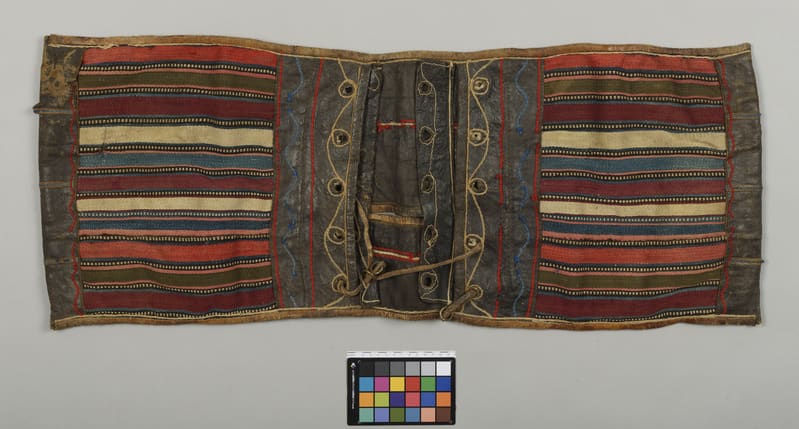
- Saddlebag of striped linen and leather, Persian work. According to the museum record, it was “brought from Persia during the First World War, in 1918, to Estonia” by a doctor who served in a Kuban Cossack regiment. For comparison: a memento of the Kuban regiments’ service in Persia. Not a Kalaushin piece. — Haapsalu ja Läänemaa Muuseumid, HM 410 E; CC0. (works-world-caucasus-east-ee-haapsalu-hm410e-saddlebag-persia-kubancossack)
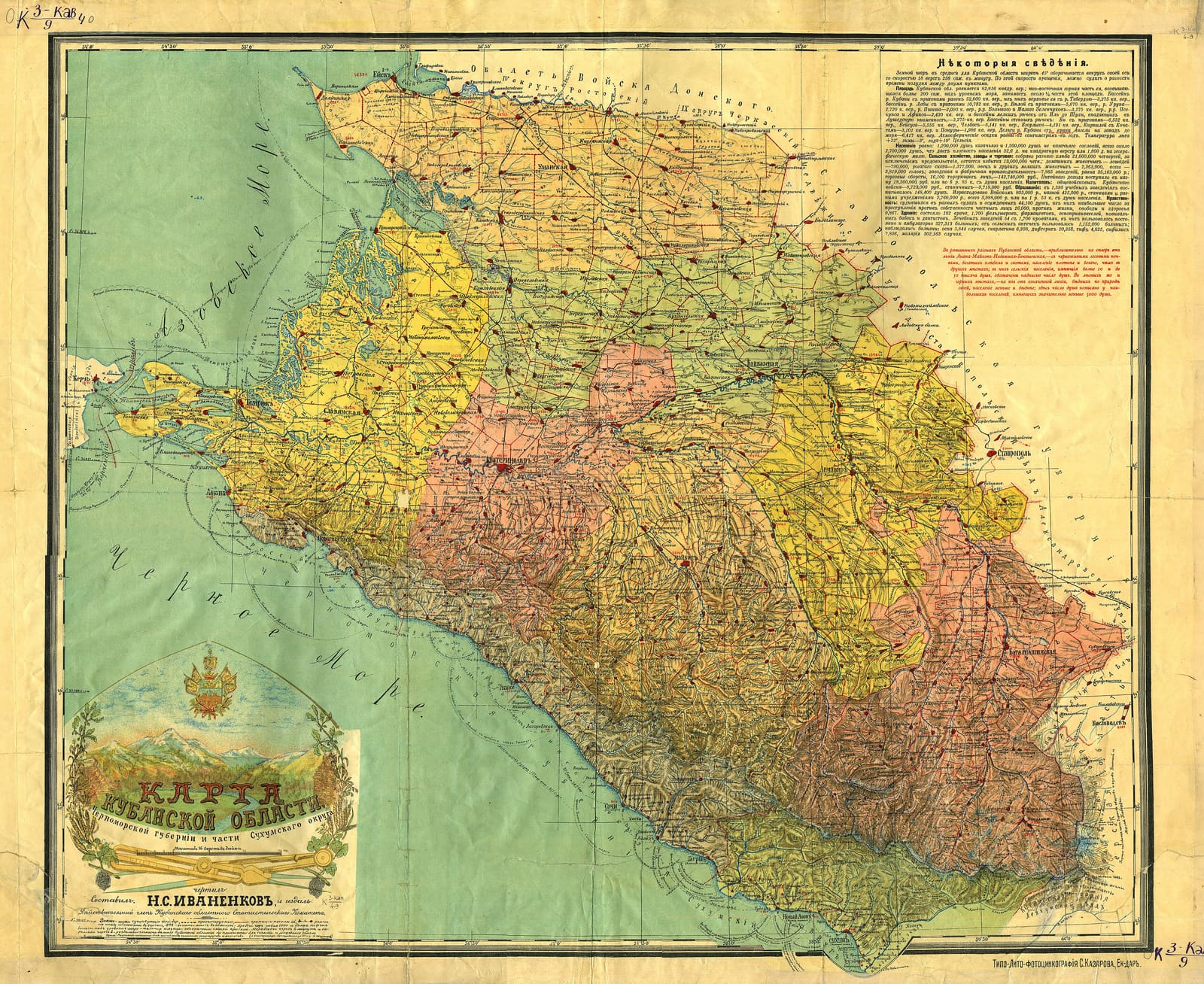
- Map of Kuban Oblast, the Black Sea Governorate and part of the Sukhum District, compiled by N.S. Ivanenkov, 1916. — Wikimedia Commons; public domain. (maps-commons-map-of-kuban-oblast-1916)
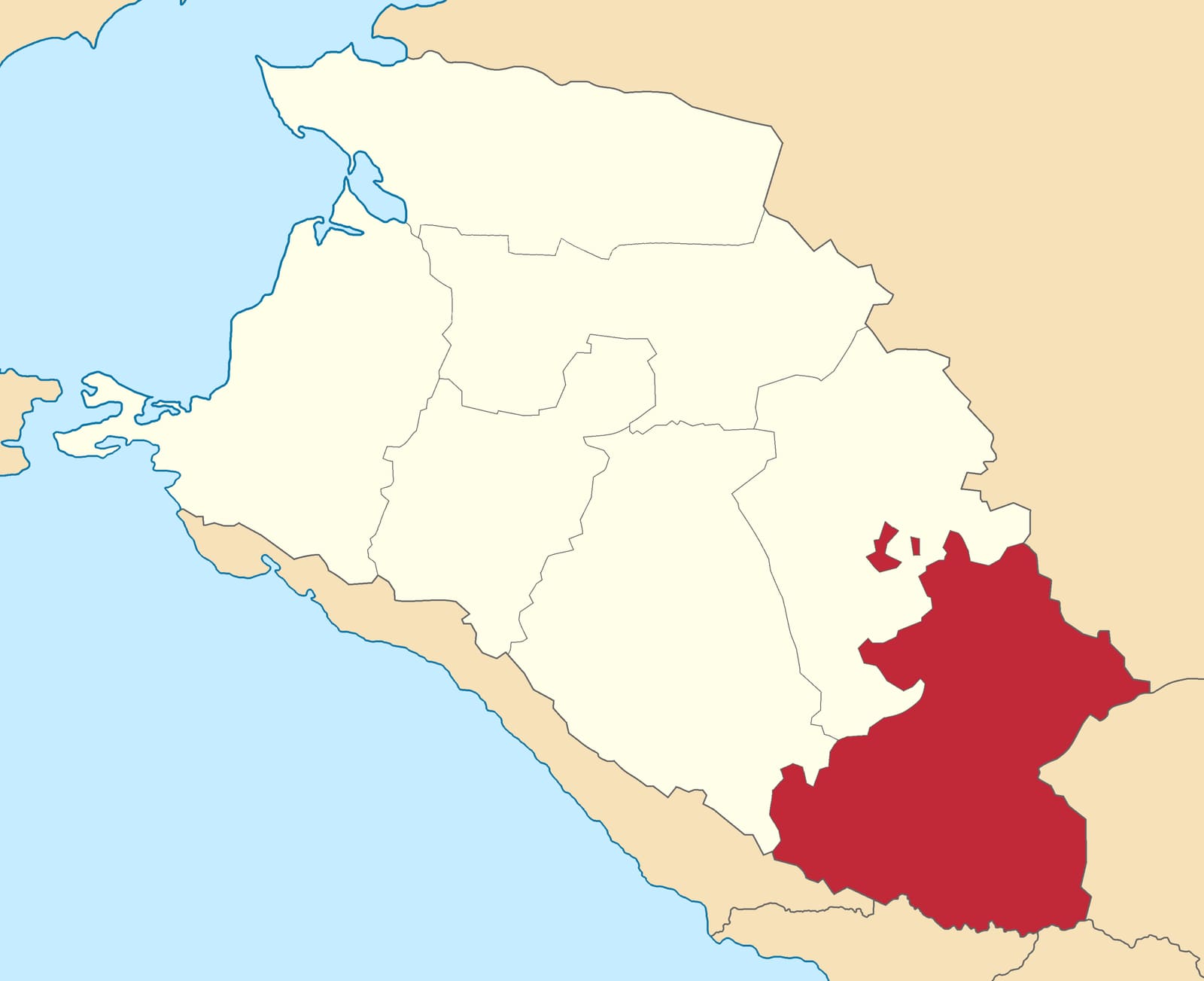
- The Batalpashinsk Department of Kuban Oblast within its pre-1917 borders: Batalpashinskaya, Bekeshevskaya and the other stanitsas of the department (modern map). — Map: Nunuxxx / Wikimedia Commons, CC BY-SA 4.0. (maps-commons-batalpashinsk-otdel-of-kuban-oblast)
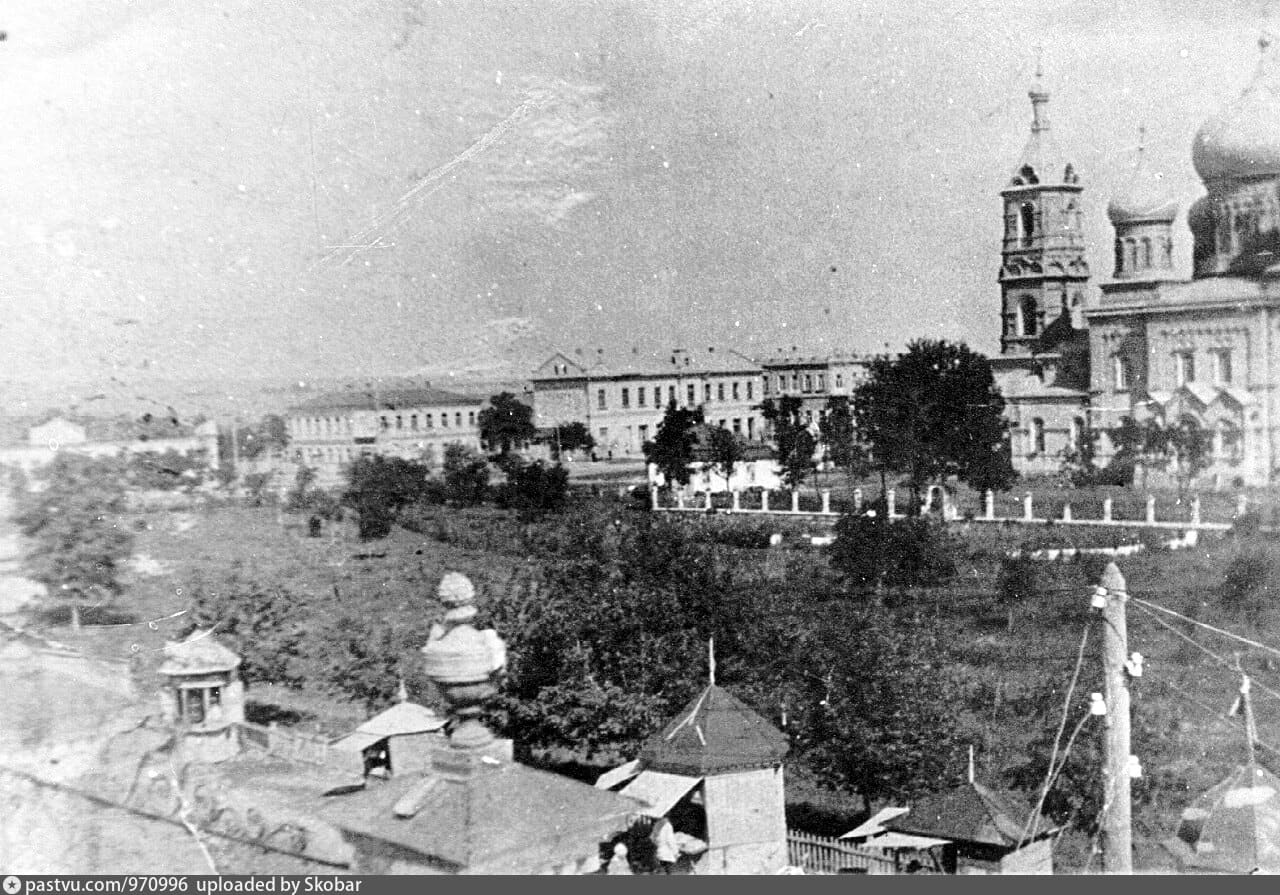
- Sobornaya Square, Batalpashinskaya stanitsa, c. 1910. Fedot Alekseyevich’s workshop and draper’s shop stood on Sobornaya Street. — PastVu, no. 970996; original: cherkessk.su; public domain. (places-pastvu-970996-batalpashinskaya-sobornaya-ploshchad)
- The stanitsa administration building of Batalpashinskaya, pre-revolutionary postcard. Fedot Alekseyevich was ataman of the stanitsa in 1907–1909 and again under the Whites. — Scan: SAMMLER.RU; public domain. (places-sammler-2386548-batalpashinskaya-stanichnoe-pravlenie-otkrytka)
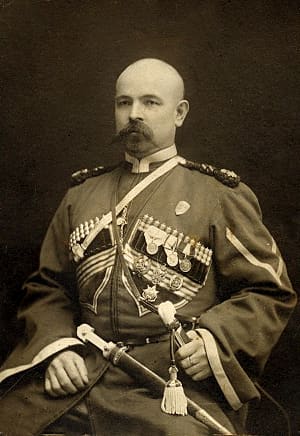
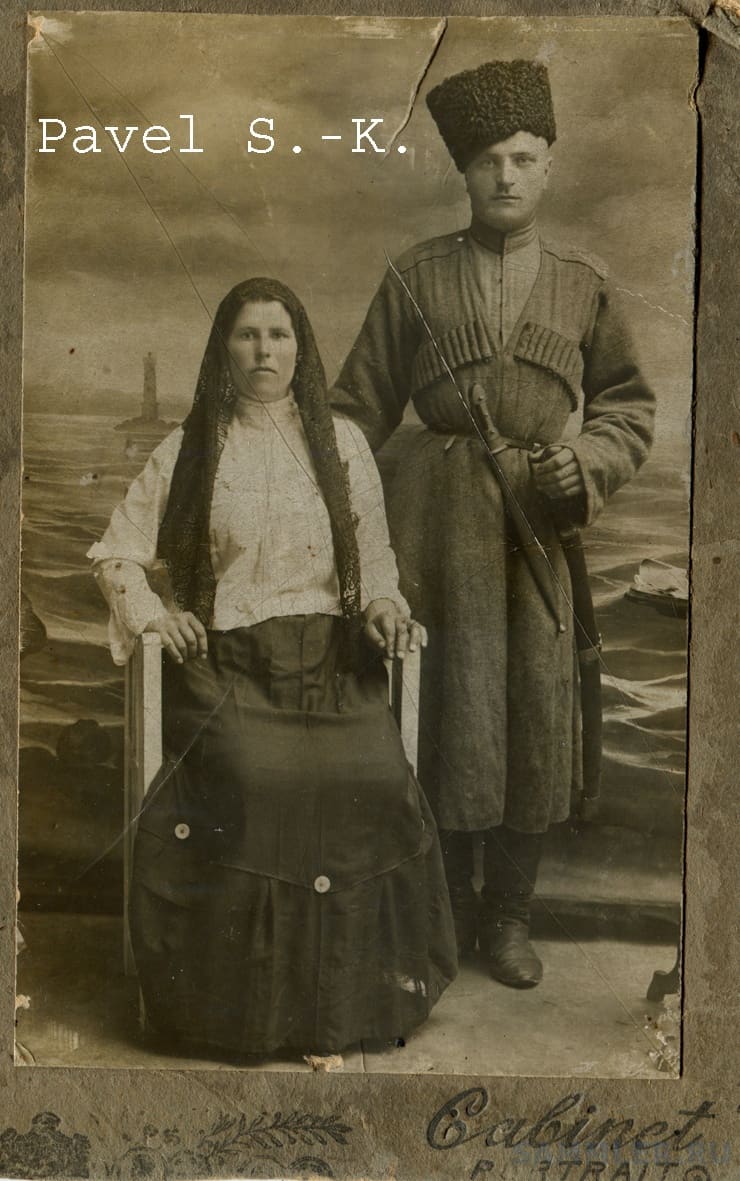
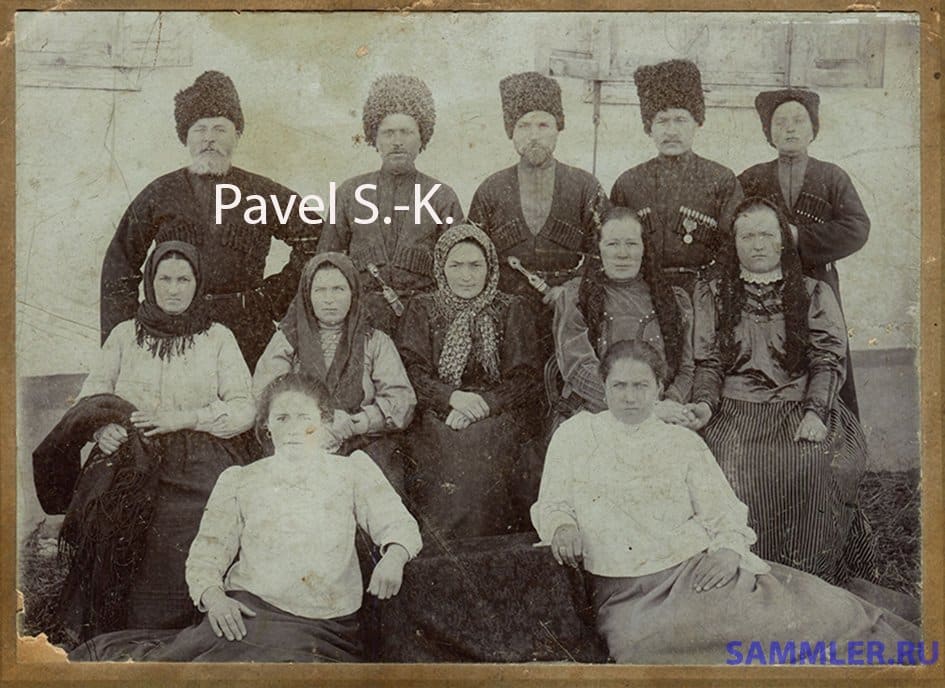
Awaiting permission from the rights holders: the formal portrait of Fedot Alekseyevich (family archive of his descendants; Kubanskaya genealogiya); Roman Vasilyevich with his wife Akulina Petrovna, 1916, and Vasily Afanasyevich with his sons, Grigory and Roman among them (P.N. Strelyanov collection, SAMMLER.RU); Aleksandr Alekseyevich among the masters of the Maykop Military Crafts School, 1910 (ibid.); St Nicholas Cathedral in Batalpashinskaya, 1931 (PastVu, no. 970941); the Constantinople list of refugees for the Kherson, 18 December 1920 (publication of the Heritage Institute, 2022).
This page uses material from the Kalaushin family roster published on the Philippov website: https://philippov.spb.ru/?q=Kalaushiny (version 03.02 of 13 July 2025).