Chapter 2 of 14 · c. 1737 – 1827
The Khoper
The founder, Trofim Pakhomovich, and half a century of the Khoper Cossacks on the Azov–Mozdok Line
In brief
The earliest Kalaushin named in the documents is Trofim Pakhomovich, a Khoper Cossack of Stavropolskaya stanitsa, born about 1737. This chapter follows the Khoper Cossacks from their river to the Caucasus in 1777–1781, describes life at the headwaters of the Kalaus, and tells how Trofim’s family moved on to the Kuban, to Batalpashinskaya stanitsa, in 1825–1827.
◆ documented◈ published source◇ family testimony△ hypothesisMore about the method
The thread
In this chapter the traits of the house cannot yet be seen, and the chronicle does not paint them in: there is a Khoper Cossack, Trofim Pakhomovich, his household No. 321 and the age recorded in the revision tale of 1815 [◆ S007, household no. 321]. Here begins the documentary footing of the whole chronicle — and the Cossack service whose needs, as “The Workshop” will tell, gave rise to the family’s saddlery.
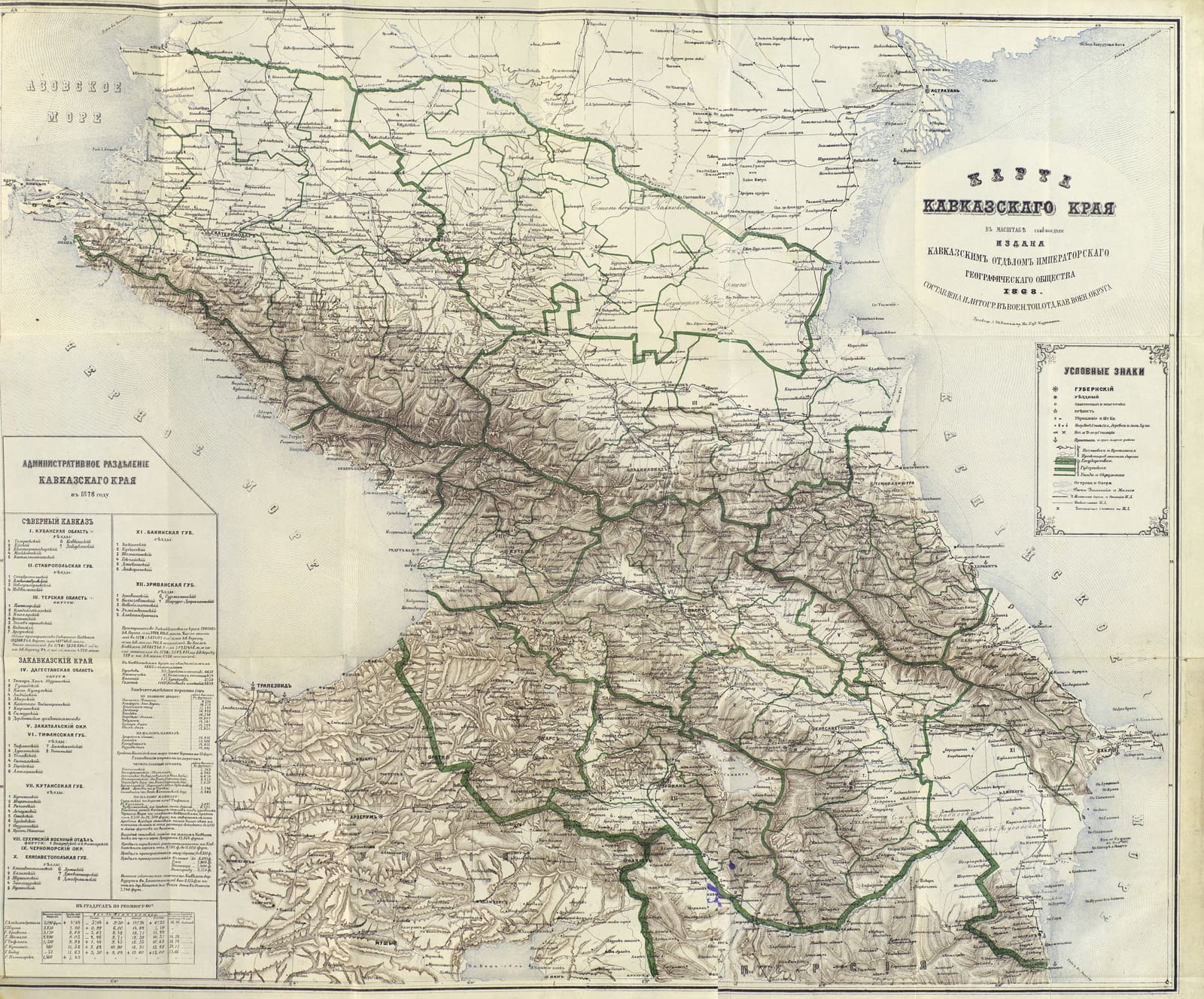
The earliest Kalaushin named in the documents is Trofim Pakhomovich Kalaushin, a Khoper Cossack of Stavropolskaya stanitsa (a Cossack village) [S001, No. 1; ◆ S007, household no. 321, via S181, topic 84017]. He was born about 1737, some forty years before the Khoper Regiment left its river for the Caucasus, and he lived to be at least eighty-five. In 1825–1827 his sons took the family on to the Kuban, to the new stanitsa of Batalpashinskaya. This chapter is about him, his children and the Khoper Cossacks among whom they lived.
On the Khoper
The Khoper Cossacks were the Don Cossacks who lived along the Khoper River [◈ S188, “Khopyorskiye kazaki”]. At the end of the 17th century, according to the map drawn by Count Jacob Bruce after the Azov campaign of 1696, there were seven Cossack townships on the Khoper. The northernmost was Pristansky, on the right bank, among the forests. Its name, the regimental historian V.G. Tolstov remarks, “speaks for itself”: fugitives from every side “came to settle” there (pristavat means to put in, to land), and the town had fairs and a landing-stage for river boats [◆ S047, pt 1, pp. 7–8]. On 17 July 1696 Cossacks, the Khoper men among them, broke into Azov and held two of its bastions. That day became the seniority date of the Khoper Regiment, and later of the whole Kuban Cossack Host [◆ S047, pt 1, pp. 13–14; ◈ S188, “Khopyorsky 1-y kazachy polk”].
In 1707–1708 the Khoper townships supported the rising of Kondraty Bulavin. A decree of 14 May 1711 ordered them to be moved to the stanitsas of the lower Don, and in July 1712 the people of Pristansky, Belyayevsky and Grigoryevsky went downriver; the townships themselves were laid waste [◆ S047, pt 1, pp. 21–22]. On the site of Pristansky rose the fortress of Novokhopyorsk. Its official founding year is 1710; Tolstov, who worked from the archival files, writes that it was built between 13 September and 2 November 1716 to a plan drawn by Peter I as early as 1712 [◆ S047, pt 1, pp. 23–24; ◈ S188, “Novokhopyorsk”].
In 1717, 94 former Khoper Cossacks with their families and 125 cherkasy — Cossacks of the Little Russian sloboda regiments — enrolled to settle at the new fortress. These men, in Tolstov’s words, “served as the nucleus of the Cossack community from which, sixty years later, the Khoper Regiment was formed”; around the fortress grew the slobodas (free settlements) of Gradskaya, Alferovka, Pykhovka and Krasnaya [◆ S047, pt 1, pp. 25–26]. By a decree of the War College of 21 December 1767, the 1,205 male Khoper people were “ordered to be counted as Cossacks” and allotted 15 desyatinas (a land measure of just over a hectare) a head [◆ S047, pt 1, p. 34]. On 24 September 1775 an order from Grigory Potemkin appointed Colonel Konon Ustinov commander, with instructions to form a regiment of five sotnias (Cossack squadrons, literally “hundreds”) from the best of the Khoper men [◆ S047, pt 1, p. 42].
“In a place where it is not needed”: the move to the Caucasus (1777–1781)
Under the Treaty of Küçük Kaynarca of 1774, Russia’s border in the Caucasus “was to be considered the Kalaus and Yeya rivers” [◆ S047, pt 1, p. 44]. Prince Potemkin resolved to extend the line of settlements from Mozdok towards the Don and to settle Khoper and Volga Cossacks along it. His report on the new Azov–Mozdok Line reads: “The Khoper Cossack regiment, which has its settlement 27 versts from the Don stanitsas and is therefore situated in a place where it is not needed, is to be ordered to move there next spring.” On 24 April 1777 Catherine II approved the report with the words “So be it” [◆ S047, pt 1, pp. 56–58].
Once the report was approved, two orders from Potemkin followed — on 16 May to Governor Yakobi, on 19 May to the regimental commander, Ustinov [◆ S047, pt 1, pp. 58–59]. The first to go to the Line were 500 Khoper Cossacks, without their families but with their horses. In early July the regiment assembled at Novokhopyorsk; on 6 August, together with the Vladimir Dragoon Regiment of Colonel Baron Schulz, it marched out of Tsaritsyn and crossed the Kalmyk steppe, covering 516 versts (a verst is just over a kilometre) in 25 days to the Madzhary tract on the Kuma. On 25 September the column reached Mozdok, and at the beginning of October it set out for the Line [◆ S047, pt 1, pp. 60–63]. The march was hard: more than half the Cossacks’ horses died — of the long road, of exhaustion and of the unfamiliar climate [◆ S047, pt 1, p. 68].
On 18 October, near a tributary of the Kalaus, Schulz left 250 Khoper Cossacks and two squadrons of dragoons to build the Aleksandrovskaya fortress (named Severnaya from 1778), and on 22 October he reached the site of the future Stavropol [◆ S047, pt 1, pp. 62–63]. That day — 22 October 1777 Old Style (2 November New Style; Russian dates before 1918 are given in the Old Style) — fortress No. 8 was founded, at first called Moskovskaya; from 22 November it became No. 7, “Stavropolskaya” [◈ S124; ◈ S135, p. 20]. Before winter they managed to put up only a guardhouse, a shed and stables, and spent the winter in camp; by the autumn of 1778 the Severnaya and Stavropol fortresses were complete [◆ S047, pt 1, p. 63]. The horseman on the arms of present-day Stavropol stands for the city’s founders — the Khoper Cossacks and the troopers of the Vladimir Dragoons [◈ S124].
The families followed. In the summer of 1778 the first party came from the Khoper, in 1779 the second, and in the summer of 1780 all the remaining “Cossacks, women and young children”. In February 1781 the Khoper Regiment was finally settled in four stanitsas — at the Severnaya, Stavropol, Moskovskaya and Donskaya fortresses, some 140 families in each; altogether “a few more than 3,000 souls of both sexes” had made the move [◆ S047, pt 1, pp. 66–67].
Stavropolskaya stanitsa
Stavropolskaya became the regimental stanitsa, the seat of the regiment’s headquarters [◆ S047, pt 1, p. 66]. It stood on the right bank of the little Tashla River, where Stavropol’s lower market later spread; the streets called Khoperskaya, Kazachya and Stanichnaya, Tolstov wrote in 1900, remained “as a reminder of the former Stavropolskaya stanitsa”. The stanitsa was enclosed by an earth rampart topped with a thorn fence of double wattle packed with earth, and by a deep ditch, and in places even by a stone wall with loopholes. From the oak and ash that then covered the hills around, the Khoper Cossacks built a church dedicated to the Kazan Icon of the Mother of God, whose feast falls on 22 October — the day the regiment arrived in 1777 [◆ S047, pt 1, p. 64]. As in the other Khoper stanitsas, guardhouses stood at the four gates; in the middle, on the square, stood the church behind a stone wall — the inhabitants’ last refuge in a raid — and the stanitsa office with a reserve of thirty or forty mounted Cossacks [◆ S047, pt 1, p. 65]. In 1779 the fortress beat off an attack by a force of 1,500 highlanders [◈ S124].
Life was hard. The 20 roubles a household promised for setting up home were never paid; rations were issued on the same scale as for soldiers. In 1783, when hail and locusts had destroyed almost all the crops, the treasury demanded the return of 6,000 chetverts (a dry measure) of grain rations issued to the families in the first years, and Potemkin ordered the debt written off for good [◆ S047, pt 1, pp. 68–69]. From the early 1780s a Cossack on service received 12 roubles a year and three chetverts of flour [◆ S047, pt 1, p. 70]. In 1785 Stavropol became a district town, peasant villages grew up around the stanitsas, and the Khoper Cossacks began to feel crowded on their old lands. A decree of 1786 allotted them 30 desyatinas for each male soul, but it remained “a dead letter”: the land around the stanitsas was formally surveyed only in 1820 [◆ S047, pt 1, pp. 74–76; ◈ S124].
The whole life of the stanitsa followed military rule. Orders came down from the regimental commander on ploughing, sowing and harvest, on the grazing of the herds, even on the keeping of the Lenten fast; Cossack girls were forbidden to marry soldiers or outsiders [◆ S047, pt 1, p. 78]. At twenty a Cossack took the oath. The young men came to the stanitsa office in long homespun coats (svitkas); the old Cossacks chopped the skirts short with an axe on a block — “o tak dobre bude!” (“there, that’s just right!”) — belted a sabre on each young man and led him to church. At forty-five a Cossack passed to internal service, and at fifty he retired [◆ S047, pt 1, pp. 79–80]. Youths between sixteen and twenty were kept on a separate list and could be sent to the stanitsa reserve or to the cordon posts, while retired and non-serving Cossacks kept up the post road with their own horses — from Donskaya through Moskovskaya and Stavropolskaya to Severnaya and Aleksandrovskaya, three Cossacks and six horses at each station [◆ S047, pt 1, p. 83].
The look of a Khoper Cossack changed too. On the Khoper and in the first years on the Line they wore a short hooked kaftan, wide trousers and a tall black lambskin cap with a red crown, and carried sabres, lances and Tula muskets. From the beginning of the 19th century they gradually took to the cherkeska (Circassian coat) with gazyri (cartridge pockets), the beshmet and soft leather boots, and to the shashka and kinzhal (Caucasian dagger); in 1828 the lance was abolished, and General Emanuel introduced a single uniform “of the Circassian pattern” for the Line Cossacks, confirmed on 16 January 1831 [◆ S047, pt 1, pp. 84–86]. In the same year, as Tolstov notes, “the title desyatnik was replaced by the word uryadnik” (a Cossack non-commissioned officer) [◆ S047, pt 1, p. 84, n.].
At the headwaters of the Kalaus
The Khoper section of the Line ran across the upper Kalaus — a great steppe river that rises on the same upland as the Yegorlyk and the Yeya [◆ S047, pt 1, pp. 45, 62–63]. The Severnaya fortress stood on the Chechera, a tributary of the Kalaus, and together with it the Stavropol fortress closed the passage along the Kalaus valley “between the Kalaus heights and the Black Forest” [◆ S047, pt 1, pp. 57–58; ◈ S188, “Azovo-Mozdokskaya ukreplyonnaya liniya”]. Dense forests stood on the upper Kalaus, and Nogai clans roamed along the river and its tributaries [◆ S047, pt 1, pp. 48, 50]. The description of the Line attached to Potemkin’s report noted that the water of the Kalaus was “good and wholesome” in its upper reaches but unfit to drink further down, especially in summer (see “Documents”). Even in the 20th century, until Kuban water was brought to it in 1967, the river often ran dry in summer [◈ S188, “Kalaus”].
◇ family testimony · A.B. Kalaushin’s roster
The river would echo in the family’s memory much later. The family recalls that Matvey Alekseyevich Kalaushin obtained Damascus steel through Suleymanov — the father of Lyubov Geychenko (née Suleymanova) — and re-tempered it himself, and that daggers “with Kalaus steel” (s kalausskoy stalyu) were very highly prized in the Caucasus in those days; the family cited the historian and Arabist Leonid Lavrov in support [◇ S001, No. 71]. More is told in the chapter on the workshop.
△ hypothesis · the name of the steel
Kalausskaya stal, “Kalaus steel”, is most likely kalaushinskaya, “the Kalaushins’ steel”: in the Caucasus a steel was named after the master who re-tempered an imported blade — “Bazalay steel”, “Chilli buolat” [◈ S091, PDF p. 58]. In the sound of the word one also hears the Kalaus River, at whose headwaters the Khoper Cossacks lived for almost half a century, from 1777 to 1825.
Trofim Pakhomovich
The earliest document known to us that names the Kalaushins is the revision tale (revizskaya skazka, a household census return) of Stavropolskaya stanitsa dated 18 November 1815, which lists 466 families, 2,456 people in all. Household No. 321 reads: “Trofim Pakhomov Kalaushin, 78. His wife Avdotya, 70. Their children: Ivan, 22; Aleksey, 16; Afanasy, 12; Andrey, 9; Anna, 19” [◆ S007, household no. 321, via S181, topic 84017]. The patronymic “Pakhomov” preserves one more name — that of Trofim’s father, Pakhom, of whom nothing else is known.
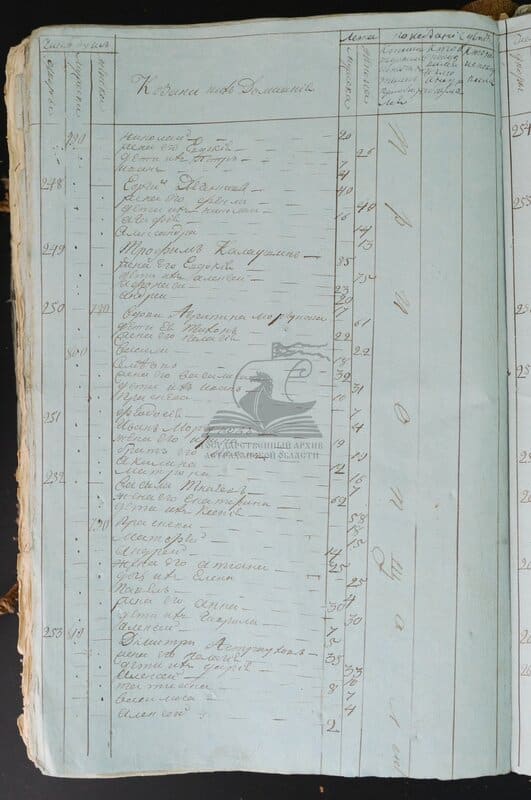
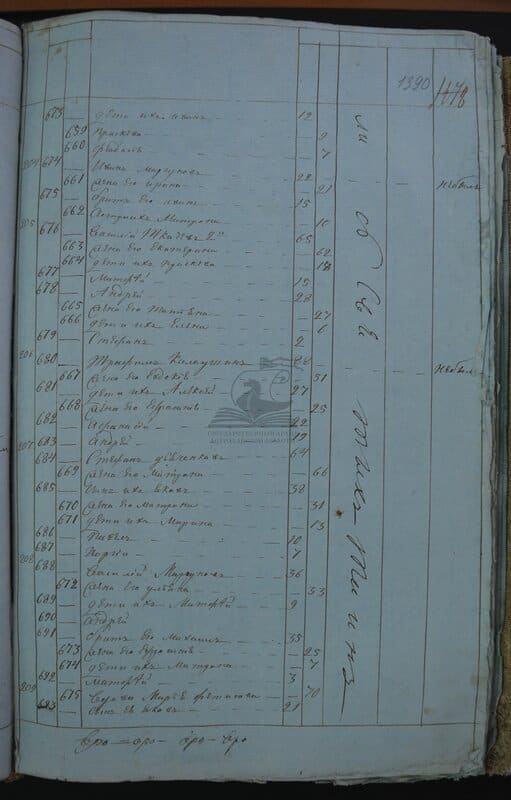
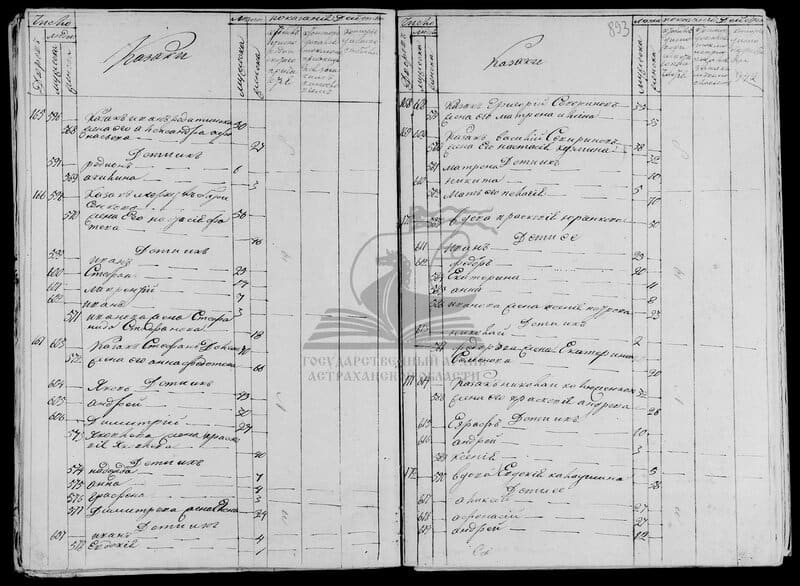
In one of the confessional registers of Stavropol district for 1822–1825, Trofim is 85; with him are his wife Yevdokiya (Avdotya is the popular form of the same name) and his sons Aleksey, Afanasy and Andrey. Ivan already heads his own household, with his wife Yefrosinya and their children Nikolay, Andrey and Nastasya [◆ S008, scans 597, 1287, 2733]. Yevdokiya’s age varies widely from list to list: 70 in 1815, over 70 and 51 in two registers of 1822–1825, 58 in 1827. Two of the four entries put her birth at about 1770, as the roster has it [◆ S007, household no. 321; ◆ S008, scans 1287, 2733; ◆ S009, no. 172; ◈ S001, No. 2]. △ That year also fits better with the birth of her youngest son, Andrey, in the early 1800s.
Trofim Pakhomovich also had an orchard. A valuation of July 1830 of the property of the Cossacks of the former Stavropolskaya stanitsa lists, among the orchards that had passed to Colonel Yefimovich, one “formerly belonging to the retired Cossack Trofim Kaloushin” [◆ S010, no. 155, via S181, topic 39076]. “Kaloushin” is the spelling of the source. △ He had probably retired long before: under the rules of the time a Cossack was discharged at fifty [◆ S047, pt 1, p. 80].
The compiler of the roster thought the founder “most likely a Don Cossack” [◈ S001, No. 1]. The Khoper community grew out of the Don Cossacks of the upper townships, joined at Novokhopyorsk by the cherkasy of the sloboda regiments; Tolstov even describes the regiment’s original population as “predominantly of Little Russian origin” [◆ S047, pt 1, pp. 25–26, 67]. △ Don roots are perfectly possible for a Khoper Cossack, and the compiler’s guess does not conflict with the documents; but where Trofim Pakhomovich himself came into the regiment from is not yet known. There are no Kalaushins in the published lists of Novokhopyorsk fortress of about 1771 (which cover only part of its people), nor in the name list of Stavropolskaya of 19 December 1782 (152 families) [◈ S102, vol. 1, pp. 278–284, 404–418; ◆ S006, both via S181, topic 84017]. △ He may have joined the regiment later, or lived at that time in another Khoper stanitsa — Severnaya, Moskovskaya or Donskaya — whose lists we have not yet seen. Between 1785 and 1832 the regiment also took in families of Polish prisoners of war, retired soldiers and settlers from Little Russia [◆ S047, pt 1, p. 67].
The eldest son, Ivan Trofimovich Kalaushin [S001, No. 3], was born in 1793 — the year given in the roster, and the year the 1815 revision tale yields too. In October 1810, aged seventeen, he began his service [◈ S001, No. 3, citing TsGVIA, f. 1058, op. 2, d. 143a]; under the rules of the day, youths from sixteen could already be called to the stanitsa reserve and the cordon posts [◆ S047, pt 1, p. 83].
Note on the roster. The roster says that Ivan began his service “in Batalpashinskaya stanitsa, in the 2nd Khoper Regiment, 5th Brigade”. In 1810 the Khoper Regiment was still a single regiment, Batalpashinskaya appeared only in 1825 and the 2nd Khoper Regiment in 1845; the family was then living in Stavropolskaya. △ Place and unit were apparently recorded as they stood in a later service record; the compiler himself noted his doubts about “Batalpashinskaya” [◈ S001, No. 3; ◈ S135, pp. 112–116, 535].
Anna Trofimovna (b. c. 1796) is known only from the 1815 revision tale; she is not in the roster. Aleksey Trofimovich [S001, No. 4] was born about 1796–1800, Afanasy [S001, No. 8] about 1800–1803, and Andrey [S001, No. 6] about 1801–1807 [◆ S007, household no. 321; ◆ S008; ◆ S009, no. 172, via S180, topic 25558].
◇ family testimony · as told by Olga Savvichna
In the family Afanasy Trofimovich was called Lagaga. Relatives remember that other Kalaushins bore the same nickname — Ilya Nikolayevich the Second (in Boris Matveyevich’s account) and Afanasy Yegorovich (according to Lev Petrovich) [◇ S001, Nos. 7, 8].
Trofim’s grandchildren — Nikolay Ivanovich (b. c. 1816) [S001, Nos. 7, 15] and Andrey Ivanovich (b. c. 1817–1819) [S001, No. 16], their sisters Nastasya (b. c. 1820; not in the roster), Irina [S001, No. 17] and Marina [S001, No. 18], and Stefan Alekseyevich (b. c. 1825) [S001, No. 11] — △ were most likely all born in Stavropolskaya [◆ S008; ◆ S009, nos. 172, 181]. According to the roster, the line to which the author of this chronicle belongs descends from Ivan Trofimovich and his son Nikolay; it is followed in the next chapter [◈ S001, Nos. 7, 31].
Note on the roster. Aleksandr Borisovich Kalaushin spent more than forty years compiling the Kalaushin roster. He worked from the 1827 confessional register, which lists the widow Yevdokiya and her sons, and from family accounts; the 1815 revision tale and the registers of 1822–1825 came to light later. The compiler identified the founder (No. 1) correctly — the man who, in the roster’s words, “was born about 1740” and had sons Ivan and Aleksey: he is Trofim Pakhomovich. The roster names Aleksey (No. 2, “c. 1791”) as Yevdokiya’s husband; the documents show that her husband was Trofim and that Aleksey was their son (No. 4), so there is no separate generation of an “Aleksey born c. 1791”. The roster’s introduction gives 1862 as Aleksey’s year of death without naming a source; Aleksey Trofimovich was alive in 1848 [◆ S012, no. 219, via S180, topic 25557], and △ the year may well refer to him. Of the “seven sons” the roster gives to Aleksey, Trofim’s sons were Ivan, Aleksey, Afanasy and Andrey; Nikolay and the second Andrey were Ivan’s sons, and Stefan was Aleksey’s [◆ S009, nos. 172, 181; ◆ S013, f. 174v, via S181, topic 20012]; the place of Grigory (b. 1830) in the family is still to be established. Ivan Alekseyevich, b. 1811 (No. 5), is Ivan Trofimovich (No. 3), and Nikolay Alekseyevich (No. 7) and Nikolay Ivanovich (No. 15) are one and the same man. Entry No. 6 (“Andrey Alekseyevich”) combines two people — Andrey Trofimovich and his nephew Andrey Ivanovich (No. 16) [◆ S012, nos. 92, 275]; Andrey Ivanovich’s story belongs to the next chapter. For Ivan’s line the number of generations from the founder stays the same. We keep the roster’s numbering so that every entry can be checked against it.
The last move: to the Kuban (1825–1827)
The idea of moving the Khoper Cossacks closer to the mountains had come up as early as 1809. The Cossacks answered then that a wholesale move would be “very burdensome” for them, since they had “only just settled in and made themselves at home” where they were; but if it was the Tsar’s will, “they are all ready to go wherever they are told” [◆ S047, pt 1, pp. 176–177]. The decision came in 1824, under General Aleksey Yermolov. Under the resettlement schedule, of the 441 households of Stavropolskaya, 300 were to go to the Karantinny post on the Kuma and 141 to the Batalpashinsk fortification on the Kuban [◆ S047, pt 1, pp. 177–178]. Batalpashinskaya stanitsa was founded on 1 October 1825 by Cossacks moved from Vorovskolesskaya and Stavropolskaya: the people of Vorovskolesskaya settled its northern part, the Stavropol people its southern part and centre [◈ S135, p. 535]. Houses in the new places were to be “of the lightest type”, of wattle or turluk daubed with clay. The move began in the autumn of 1825, and only in the late autumn of 1827, after the harvest had been gathered and threshed, did the Khoper Cossacks finally complete their move to the Kuban and the Kuma [◆ S047, pt 1, p. 179].
The Stavropol Cossacks wanted to take their old church with them. Most of the stanitsa went to Karantinnaya, and in 1831 the Cossacks there carried the church “on their own shoulders” to their new home, giving those who had settled in Batalpashinskaya part of the money granted for new churches [◆ S047, pt 1, p. 180].
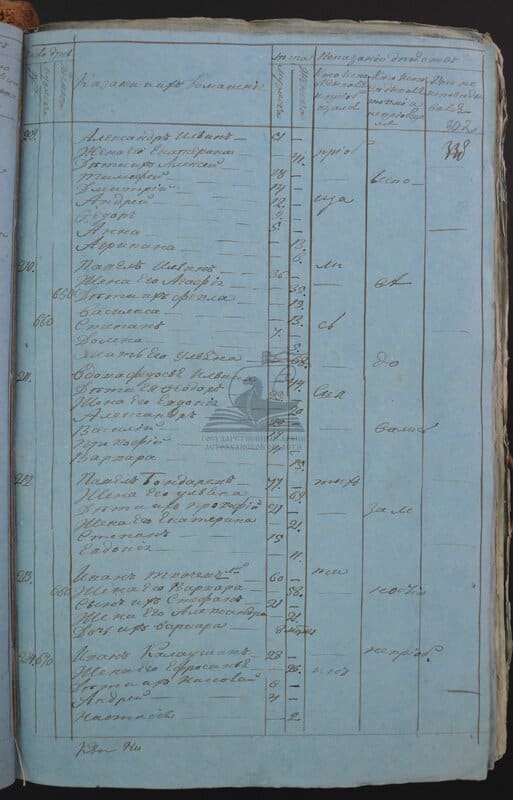
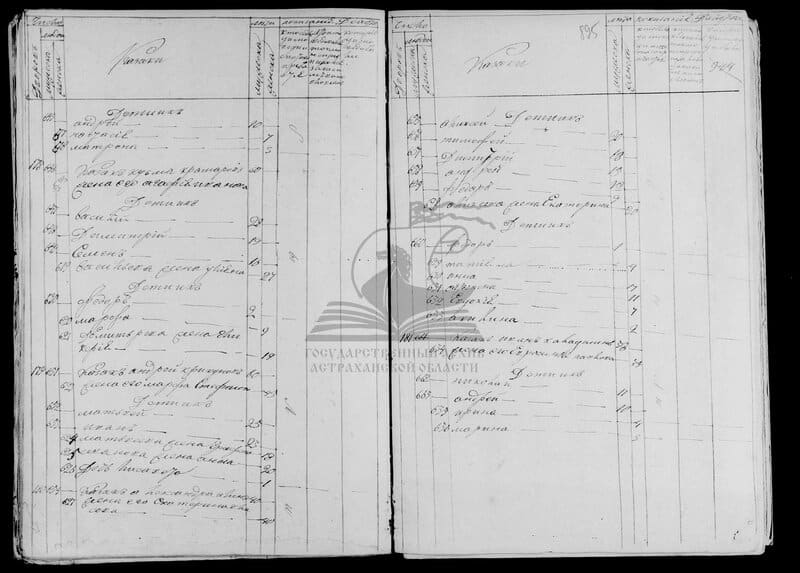
The 1827 confessional register of Batalpashinskaya, which counts 181 households, lists the Kalaushins twice. No. 172: “Widow Yevdokiya Kalaushina, 58. Her children: Aleksey, 27; Afanasy, 27; Andrey, 12”, with Aleksey’s wife Yevdokiya Semyonovna and their two-year-old son Stefan, and Afanasy’s wife Aleksandra. No. 181: “Cossack Ivan Kalaushin, 38. His wife Yefrosinya Pavlova, 35. Their children: Nikolay, 11; Andrey, 10; Irina, 4; Marina, 3” [◆ S009, nos. 172, 181, via S180, topic 25558; ◆ S009, scans 161, 163]. Andrey’s age, “12”, stands so in the original; other lists make him about twenty. Trofim Pakhomovich is no longer in the list: he died at some point between the registers of 1822–1825 and that of 1827. △ Both households come at the very end of the register; this may mean that the family arrived with the last parties from Stavropolskaya, though the order of entries may have depended on other things.
In 1831 the list of surnames from the household inventory of Batalpashinskaya has the name twice, as “Kalaushen” and “Kalaushin”; △ these are presumably the same two households [◈ S011, list of surnames via S181, topic 3165]. From now on the family’s story is the story of Batalpashinskaya.
◇ family testimony · A.B. Kalaushin’s roster
The family history records that Trofim’s grandson Nikolay Ivanovich (Nikolay Alekseyevich in the roster) was a Khoper Cossack and a master saddler [◇ S001, No. 7]. This is the first appearance in the family’s story of the craft for which the Kalaushins would be known in the generations to come.
Documents
1777. From the description of the Azov–Mozdok Line attached to Grigory Potemkin’s report: “Under No. 7, a fortress at the head of the Kalaus, called Adzhil. This fortress also covers the river, which in its upper reaches has great and excellent forests. Its water in the upper reaches is good and wholesome, but towards the middle of its course it spoils, and lower down, especially in summer, it is unfit for use” [◆ S047, pt 1, pp. 57–58].
1815. Revision tale of Stavropolskaya stanitsa of the Khoper Cossack Regiment, 18 November 1815: “321. Trofim Pakhomov Kalaushin, 78. His wife Avdotya, 70. Their children: Ivan, 22; Aleksey, 16; Afanasy, 12; Andrey, 9; Anna, 19” [◆ S007, via S181, topic 84017].
1830. Valuation of the establishments of the Cossacks of the former Stavropolskaya stanitsa, July 1830: “Orchards of the same Mr Yefimovich in 6 sections… the 6th, formerly belonging to the retired Cossack Trofim Kaloushin” [◆ S010, via S181, topic 39076].
Where the documents may be found
- GASK (State Archive of Stavropol Krai), f. 748, op. 1, d. 1: the original of the 1815 revision tale of Stavropolskaya (household no. 321); in the same fond or nearby, the returns of the 5th (1795) and 6th (1811) revisions of the Khoper Regiment — where Trofim Pakhomovich came from, and whether his father Pakhom was still living.
- GAAO (State Archive of Astrakhan Oblast), f. 599: parish registers of the Kazan church of Stavropolskaya for 1800–1805, 1808, 1810 and 1812, and confessional registers before 1825 — the births of Trofim’s children and the death of Pakhom.
- RGADA, f. 23, op. 1, d. 19 and neighbouring files: name lists of the other Khoper stanitsas in the 1780s (Severnaya, Moskovskaya, Donskaya).
- RGVIA, f. 14877, op. 1, d. 5159: the confessional registers of Batalpashinskaya for 1828 and 1830 — Yevdokiya’s last years and the exact time of Trofim’s death.
- TsGVIA/RGVIA, f. 1058, op. 2, d. 143a: the file the roster cites for Ivan Trofimovich’s service.
- RGIA, f. 383, op. 30, d. 520: the “File on the allotment of land to the town of Stavropol… for common pasture”, with the 1830 valuation of the orchards and establishments of the former Stavropolskaya stanitsa.
- GASK, f. 1300, op. 1, d. 413: papers on the resettlement of the Khoper Cossacks in 1825; GARO, f. 226, op. 7, d. 271: the 1831 household inventory of Batalpashinskaya.
Documents and illustrations
Sources for this chapter
- S001 — A.B. Kalaushin’s roster Kalaushiny (philippov.spb.ru, version 03.02 of 13 July 2025)
- S006 — Name list of the Khoper Regiment at Stavropol fortress, 19.12.1782 (RGADA)
- S007 — Revision tale of Stavropolskaya stanitsa, 18.11.1815 (GASK, f. 748)
- S008 — Confessional registers of Stavropol district, 1822–1825 (GAAO, f. 599, d. 3684)
- S009 — Batalpashinskaya confessional register, 1827 (GAAO, f. 599, d. 7148)
- S010 — Valuation of the establishments of the Cossacks of the former Stavropolskaya stanitsa, July 1830 (RGIA, f. 383)
- S011 — Household inventory of Batalpashinskaya, 1831 (GARO, f. 226)
- S012 — Batalpashinskaya confessional register (family list), 1848 (GASK, f. 135, d. 806)
- S013 — Batalpashinskaya parish register, 1857 (RGVIA, f. 14877, d. 2716)
- S047 — V.G. Tolstov, Istoriya Khopyorskogo polka Kubanskogo kazachyego voyska, pt 1 (Tiflis, 1900)
- S091 — E.G. Astvatsaturyan, Oruzhiye narodov Kavkaza (1995)
- S102 — I.I. Dmitrenko, Sbornik istoricheskikh materialov po istorii Kubanskogo kazachyego voyska, vol. 1 (St Petersburg, 1896)
- S124 — Passport of the City of Stavropol (2026)
- S135 — GASK Handbook 2008: Administrativno-territorialnoye ustroystvo Stavropolya… (Stavropol, 2008)
- S160 — Yandex Archive Search (yandex.ru/archive)
- S180 — Kubanskiye kazaki forum (kubancossack.0pk.me)
- S181 — VGD genealogy forum (forum.vgd.ru)
- S188 — Russian Wikipedia — for general historical context
Illustrations
- Map of the Caucasus Region, published by the Caucasian Branch of the Imperial Russian Geographical Society, 1868. — Wikimedia Commons; public domain. (maps-commons-karta-kavkazskogo-kraya-1868g)
- ◆ “Trofim Kalaushin, his wife Yevdokiya, their children Aleksey, Afanasy, Andrey”. Confessional registers of Stavropol district, 1822–1825. — State Archive of Astrakhan Oblast, f. 599, op. 2, d. 3684, scan 1287; scan: Yandex Archive Search. (web-sweep-gaao-599-2-3684-l1287-trofim-kalaushin-1822-1825)
- ◆ The same household in another year’s list: “Trofim Kalaushin, his wife Yevdokiya, their children Aleksey, his wife Yefrosiniya, Afanasy, Andrey”. — GAAO, f. 599, op. 2, d. 3684, scan 2733; scan: Yandex Archive Search. (web-sweep-gaao-599-2-3684-l2733-trofim-kalaushin-1822-1825)
- ◆ “Ivan Kalaushin, his wife Yefrosinya, their children Nikolay, Andrey, Nastasiya”. Confessional registers of Stavropol district, 1822–1825. — GAAO, f. 599, op. 2, d. 3684, scan 597; scan: Yandex Archive Search. (web-sweep-gaao-599-2-3684-l597-ivan-kalaushin-1822-1825)
- ◆ “Widow Yevdokiya Kalaushina, her children Aleksey, Afanasy, Andrey”. Confessional register, 1827. — GAAO, f. 599, op. 2, d. 7148, scan 161; scan: Yandex Archive Search. (web-sweep-gaao-599-2-7148-s161-vdova-evdokia-1827)
- ◆ “Cossack Ivan Kalaushin, his wife Yevrosinya Pavlova”. Confessional register, 1827. — GAAO, f. 599, op. 2, d. 7148, scan 163; scan: Yandex Archive Search. (web-sweep-gaao-599-2-7148-s163-ivan-kalaushin-1827)
This page uses material from the Kalaushin family roster published on the Philippov website: https://philippov.spb.ru/?q=Kalaushiny (version 03.02 of 13 July 2025).