Chapter 4 of 14 · 1810–1917
Service and Crosses
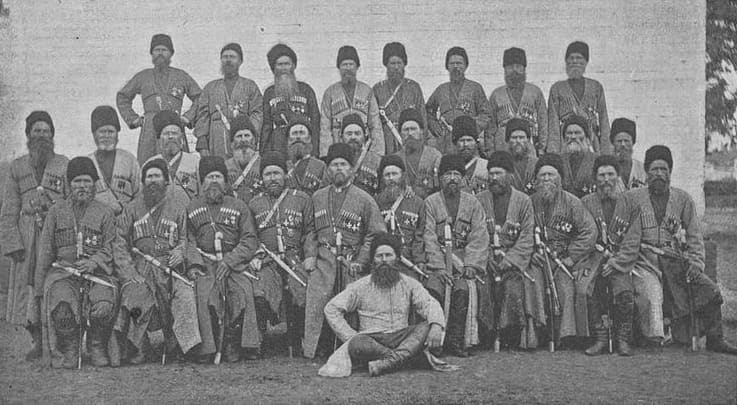
Khoper Cossacks, Convoy men and officers: the Kalaushins in service, 1810–1917
In brief
For more than a century the Kalaushins served in the Khoper regiments, in His Majesty’s Own Convoy and in the units of the Kuban Cossack Host — from a Cossack who joined in 1810 to a lieutenant colonel of 1916. This chapter follows that service through the regimental history, imperial orders, directories and newspapers, together with the family’s own memory, including the farewell review of 1900 and the saddle for the Shah of Persia.
◆ documented◈ published source◇ family testimony△ hypothesisMore about the method
The thread· Quality· Exclusivity
Exclusivity here means being chosen, not self-assessment: men were chosen for the Convoy, and in 1900 the Emperor thanked the departing Convoy men for their “excellent and zealous service” [◆ S036, no. 150, 10.06.1900, p. 3]. In this chapter “distinction” is the language of the documents themselves, not the chronicle’s praise: the family’s first known Insignia of the Military Order dates from 1859 [◆ S032, p. 7]. The quality of service shows in 1914: Stepan Yegorovich completed the Officer Cavalry School “with distinction”, and Yefim Mikhailovich’s unit was judged excellent at three inspections in succession [◆ S045, 1.09.1914, via S152; ◆ S045, 3.02.1914, via S152].
In October 1810 Ivan Trofimovich Kalaushin [S001, No. 3], then seventeen, entered the Khoper Cossack Regiment. A little over a century later his descendants and kinsmen were serving as staff adjutants and assistant regimental commanders on the Caucasian front. Between those dates lie cordon duty on the Kuban, the crosses of the Caucasian War, the battles of 1877 on Turkish soil, years in His Majesty’s Own Convoy (the Cossack bodyguard of the imperial family; hereafter the Convoy) and the officers’ commissions of the early 20th century. This chapter tells the story of the Kalaushins’ service from V.G. Tolstov’s history of the Khoper Regiment, imperial orders, directories and newspapers — and from the family’s own memory.
The Khoper Regiment and the first service
The Kalaushins were Khoper Cossacks. In 1815 the household of Trofim Pakhomovich lived in Stavropolskaya, one of the Khoper Regiment’s stanitsas (Cossack villages) on the Azov–Mozdok Line [◆ S007, household No. 321, via S181, topic 84017]. In 1825 the regiment was moved to the Kuban: Batalpashinskaya (now Cherkessk) was founded on 1 October 1825, and the settlers from Stavropolskaya moved there in 1826–1827 [◈ S135, p. 535; ◆ S009, nos. 172 and 181, via S180, topic 25558]. From then on Batalpashinskaya was the family’s home stanitsa, and from 1845, when the Khoper Regiment was split in two, it was the headquarters of “their own” 2nd Khoper Regiment [◈ S135, pp. 112–116].
Ivan Trofimovich was born in 1793. According to his service record of 1849, cited in the roster, he served from October 1810, was discharged “into full retirement” in January 1839, and in 1849, aged fifty-six, was listed as a retired Cossack [◈ S001, No. 3, from TsGVIA, f. 1058, op. 2, d. 143a]. In 1848 his household at Batalpashinskaya included his married sons Nikolay and Andrey with their families and seventeen-year-old Gavriil [◆ S012, household No. 92, via S180, topic 25557].
Note on the roster. The roster says that Ivan began his service in Batalpashinskaya stanitsa, in the 2nd Khoper Regiment of the 5th Brigade. In 1810 the regiment was still a single unit, Batalpashinskaya did not yet exist, and brigades appeared only in 1845; the family was then living in Stavropolskaya. The compiler of the roster himself doubted the word “Batalpashinskaya”. △ Most likely the stanitsa and unit are given as they appear in the service record of 1849.
Crosses of the Caucasian War
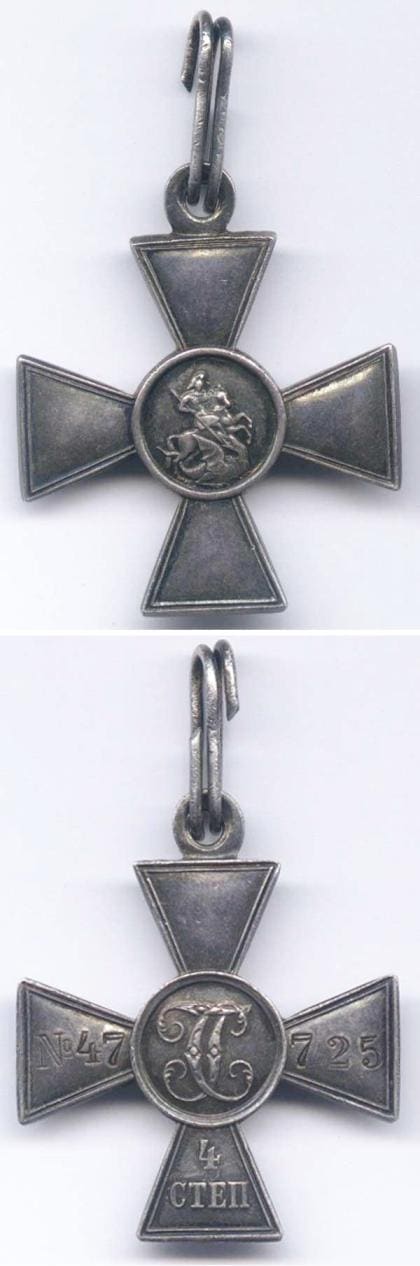
The Insignia of the Military Order — “the soldier’s St George Cross” — was given to the lower ranks for distinction in battle. The first Kalaushin known to have won it was Stepan (Stefan) Alekseyevich, son of Aleksey Trofimovich, born around 1825 [S001, No. 9]. He served from 1846 and was an uryadnik (Cossack non-commissioned officer) from 1856; in 1857 he was transferred to the 3rd Laba Regiment, which in 1858 became the 1st Urup Regiment. According to the roster he received insignia No. 6451 for repelling an enemy party that attacked a detachment of Cossacks near the stanitsa of Ispravnaya on 17 May 1858; between May and August of that year he took part in recapturing a large herd of horses from the enemy. He held the bronze medal in memory of the War of 1853–1856 and a stripe for ten years’ service; he could not read or write, and he “died young” [◈ S001, No. 9]. The War Minister’s order of 22 June 1859 lists him among those decorated for actions on the Right Flank of the Caucasus Line in the first half of 1858: “1st Urup: to the uryadniks Stepan Kalaushin, Ivan Kiporov” [◆ S032, p. 7].
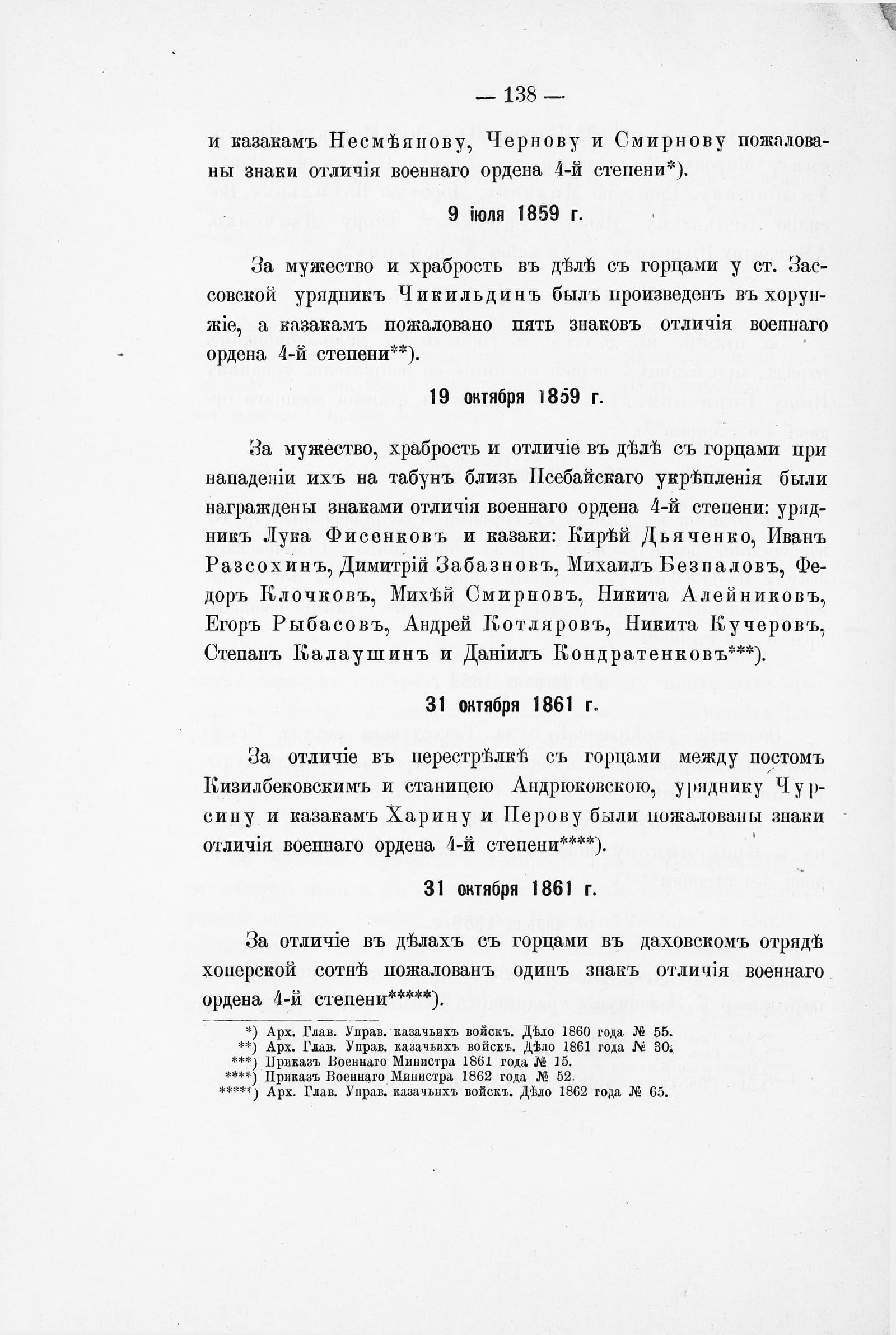
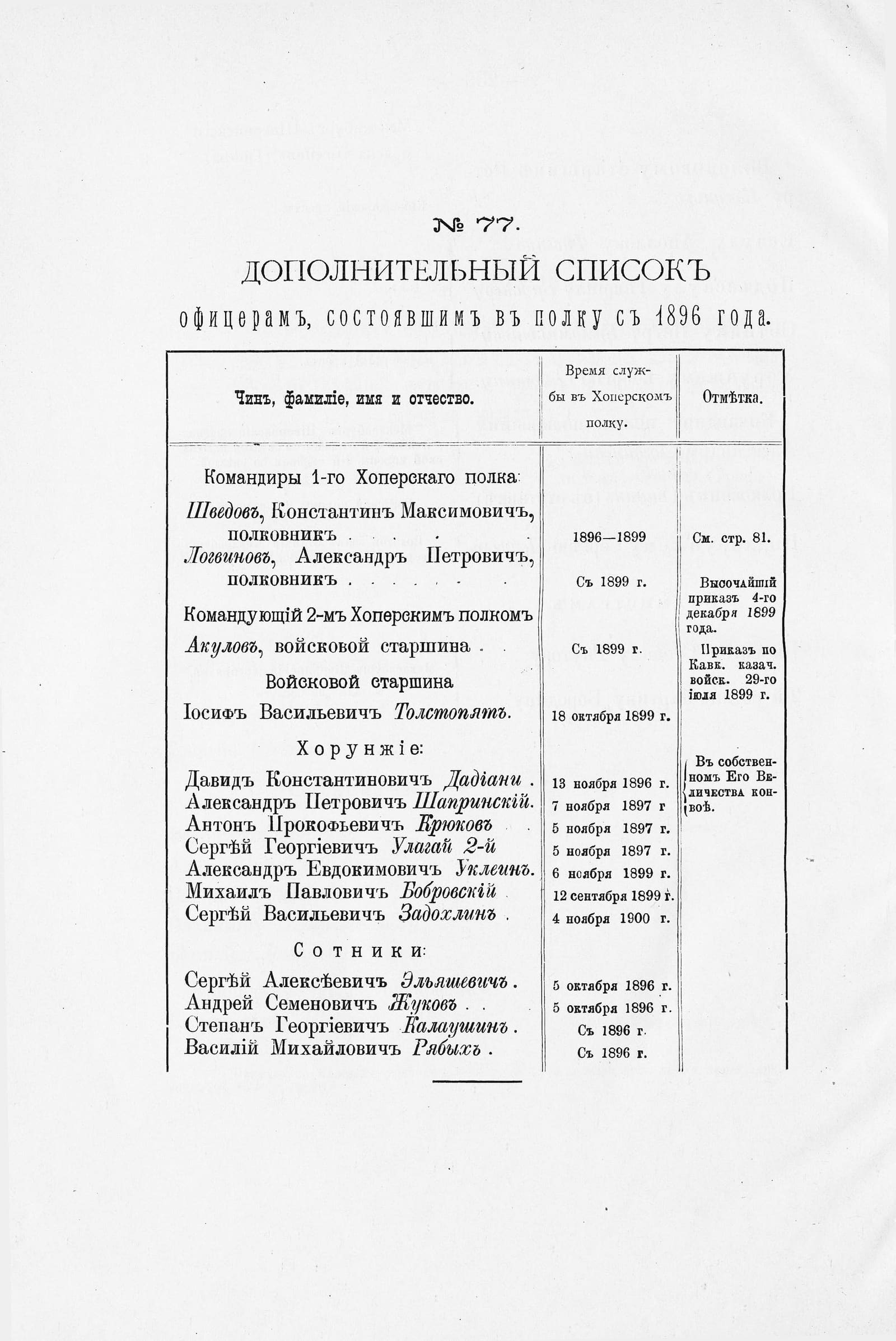
In the autumn of 1859 the same insignia was won by another Stepan Kalaushin. On 19 October 1859, at about ten in the morning, a party of some six hundred highlanders approached the Psebay fortification just as a herd of ration cattle was being driven to water under the cover of twenty-five Khoper Cossacks and a rifle company. The raiders cut off half the herd and drove it across the Malaya Laba. Two Khoper sotnias (squadrons) under Yesaul (captain) Fisenkov and Khorunzhy (cornet) Aleynikov burst out of the fortification, struck the raiders from the rear, recovered the cattle at the ford and cut their way into the enemy [◆ S053, pt 2, pp. 125–126]. For that day the Insignia of the Military Order, 4th class, went to Uryadnik Luka Fisenkov and twelve Cossacks, among them “Stepan Kalaushin”; the awards were announced by the War Minister’s order No. 15 of 1861 [◆ S053, App. 65, p. 138].
Note on the roster. The roster assigns the Psebay insignia (No. 10711) to Stefan Nikolayevich and gives his year of birth as 1847 [◈ S001, No. 30]. A Cossack decorated in 1859 cannot have been born in 1847. In 1848 Nikolay Ivanovich had a son Stefan, aged thirteen [◆ S012, household No. 92, via S180, topic 25557], and the roster itself has a Stepan Nikolayevich born in 1835 [S001, No. 48]; at the baptism of his son in 1857 he is still entered as a Cossack of the ranks [◆ S013, via S181, topic 20012]. △ The Psebay cavalier was most probably he; the officer’s career recorded under No. 30 belongs to Stepan Yegorovich, of whom more below.
According to the service lists cited in the roster (the register of 1874 and the list of uryadniks of 1887), Aleksandr [S001, No. 31] and Aleksey [S001, No. 32] Nikolayevich held the Insignia of the Military Order, the silver Medal “For the Conquest of the Western Caucasus” and the Cross “For Service in the Caucasus”; Fyodor Andreyevich [S001, No. 23] and Yegor (Georgy) Afanasyevich [S001, No. 42] held the same medal and cross [◈ S001, Nos. 23, 31, 32, 42]. Note on the roster: both Nikolayevichs are given the same insignia number, 19441; one number cannot have belonged to two men, and it can be checked in the RGVIA database of St George cavaliers. Yegor Afanasyevich took the oath in 1863, served in 1864 in the 17th Horse Regiment on the Trans-Kuban cordon line and in 1868 in the Horse Training Division, and in 1869 became an uryadnik of the 2nd Khoper Regiment [◈ S001, No. 42, from the 1874 service record]. △ The 17th Horse Regiment of the Kuban Host was the former 2nd Khoper: the regiments were given numbers in 1861 and merged again into a single Khoper Regiment in 1870 [◈ S188, “Khopyorsky 1-y kazachy polk”]. Gavriil Ivanovich [S001, No. 19] took the oath in 1851, became an uryadnik of the 2nd Khoper Regiment in 1858 and was still an uryadnik in 1877 [◈ S001, No. 19].
Dayar and Zeydekyan (1877)
In the Russo-Turkish War of 1877–78 the 2nd Khoper Regiment fought with the Erivan Detachment. On 9 June 1877 three of its sotnias, together with Cossacks of the Sunzha Regiment and infantry, went out to reconnoitre towards the village of Dayar and were attacked by the Turks. The Khoper men dismounted and, with the companies and batteries that came up, held the Dayar gorge all day; in the evening, as the Turks began to fall back, the Cossacks remounted and pursued them until dark. “The gallant Cossack breast,” Tolstov writes, “in glorious company with the infantry and artillery, held our right flank and did not yield the Turks a single inch of ground” [◆ S053, pt 2, pp. 234–244].
Two Kalaushins received the Insignia of the Military Order, 4th class, for Dayar. The list of decorated uryadniks includes “Yegor Koloushin”, and the list of prikaznys (lance corporals) “Ilya Koloushin” — that is how the name is printed in the book [◆ S053, App. 74, pp. 231–232]. Yegor is Yegor Afanasyevich, uryadnik of the 2nd Khoper Regiment; the roster also records his Dayar award [◈ S001, Nos. 34, 42]. Note on the roster. The roster enters the lance corporal as “Ilya the First Nikolayevich, b. 1880” [◈ S001, No. 34]. In the 1848 register Ilya, son of Nikolay Ivanovich, is three years old, so he was born around 1845 — the year also given under No. 52. △ Later he most probably appears as a “non-combatant of the senior grade” at the Uman Military Crafts School [◈ S033, via S180, topic 855].
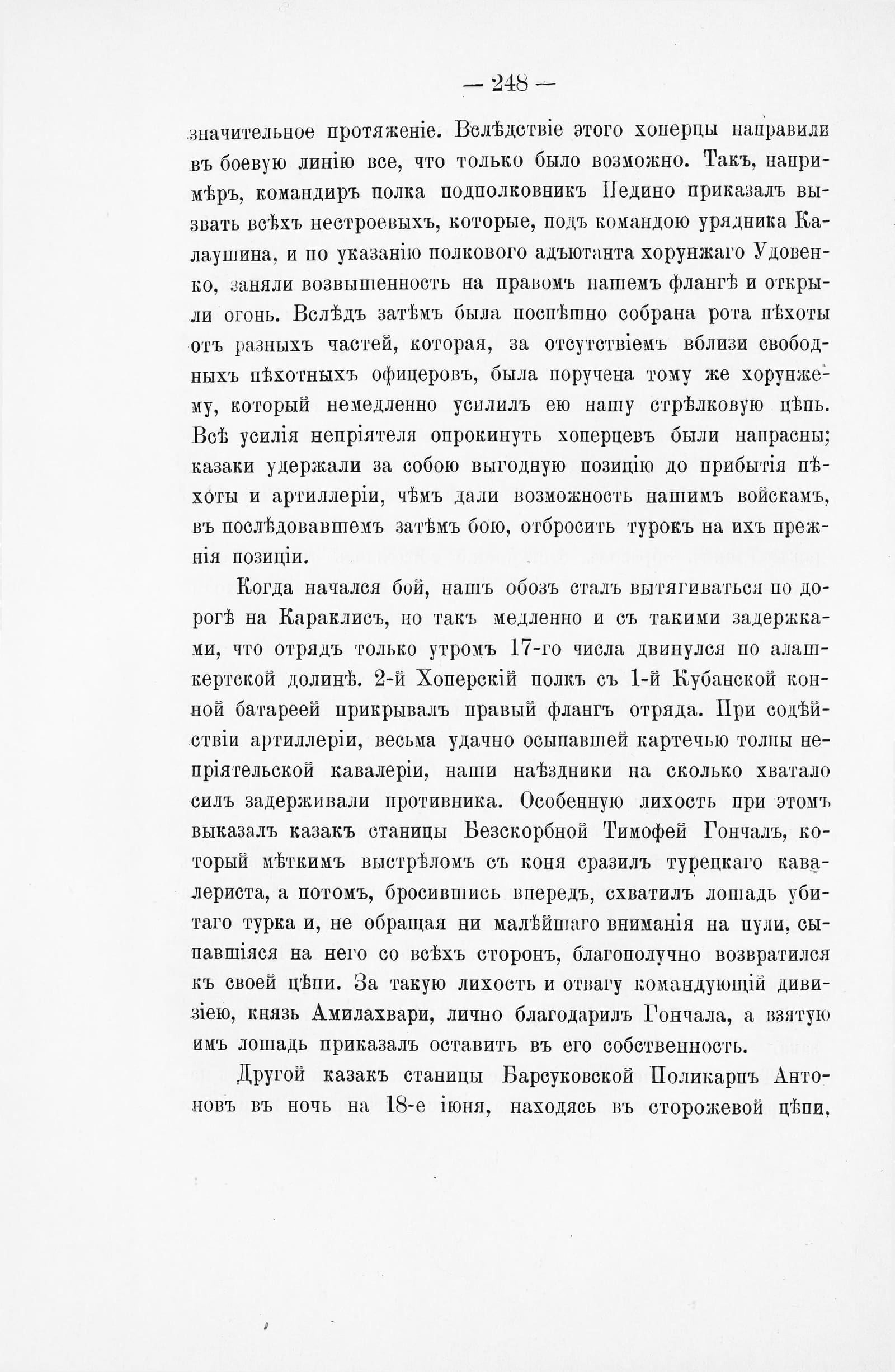
A week later, on 16 June, the Erivan Detachment was withdrawing, and at the village of Zeydekyan it had to give battle; the Khoper men sent every man they could into the firing line. The regimental commander, Lieutenant Colonel Pedino, “ordered all the non-combatants to be called out, and they, under the command of Uryadnik Kalaushin and at the direction of the regimental adjutant, Khorunzhy Udovenko, occupied the height on our right flank and opened fire”. The Khoper men held the position until the infantry and artillery arrived [◆ S053, pt 2, p. 248]. The uryadnik’s first name is not given. △ He may have been Yegor Afanasyevich or Gavriil Ivanovich, both uryadniks of the 2nd Khoper Regiment at the time.
In the Emperor’s Convoy
Alongside regimental service ran service in the Convoy; it is told in detail in the chapter “At Court”. In 1853 Andrey Kalaushin, an uryadnik of the 2nd Khoper Regiment serving in the Convoy, was appointed chamber Cossack (kamer-kazak) to the Tsesarevna, Maria Alexandrovna [◈ S001, No. 6, from the file “On the appointment of Uryadnik Kalaushin as chamber Cossack”]. Note on the roster. The roster names him Andrey Alekseyevich. According to the documents he is Andrey Ivanovich, son of Ivan Trofimovich: a service record of 1854 lists “Kalaushin Andrey Ivanov”, Batalpashinskaya, chamber Cossack, aged 36 [◈ S156, database of service records, service record of 1854]; in 1848 he had a wife and daughters Matrona and Feodosiya — the very family that went with him to St Petersburg — and in 1857 his daughter appears in the parish register as “the chamber Cossack’s unmarried daughter Fedosya Andreyeva Kalaushina” [◆ S012, household No. 92, via S180, topic 25557; ◆ S013, ff. 178v–179v, via S181, topic 20012]. In 1877, according to the roster, Fyodor Andreyevich was an uryadnik of the 1st Squadron of the Convoy [◈ S001, No. 23, from the list of uryadniks for 1877].
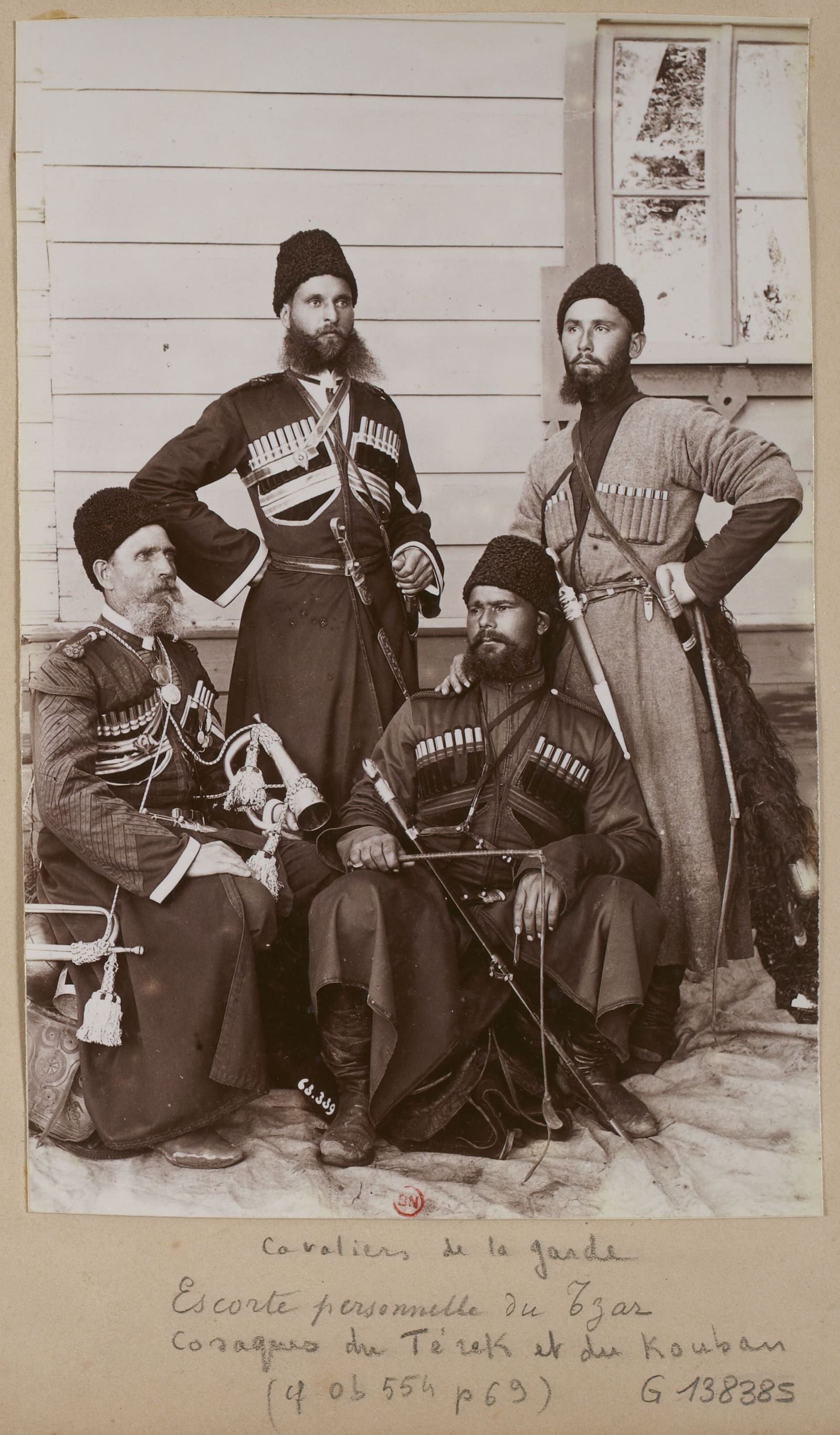
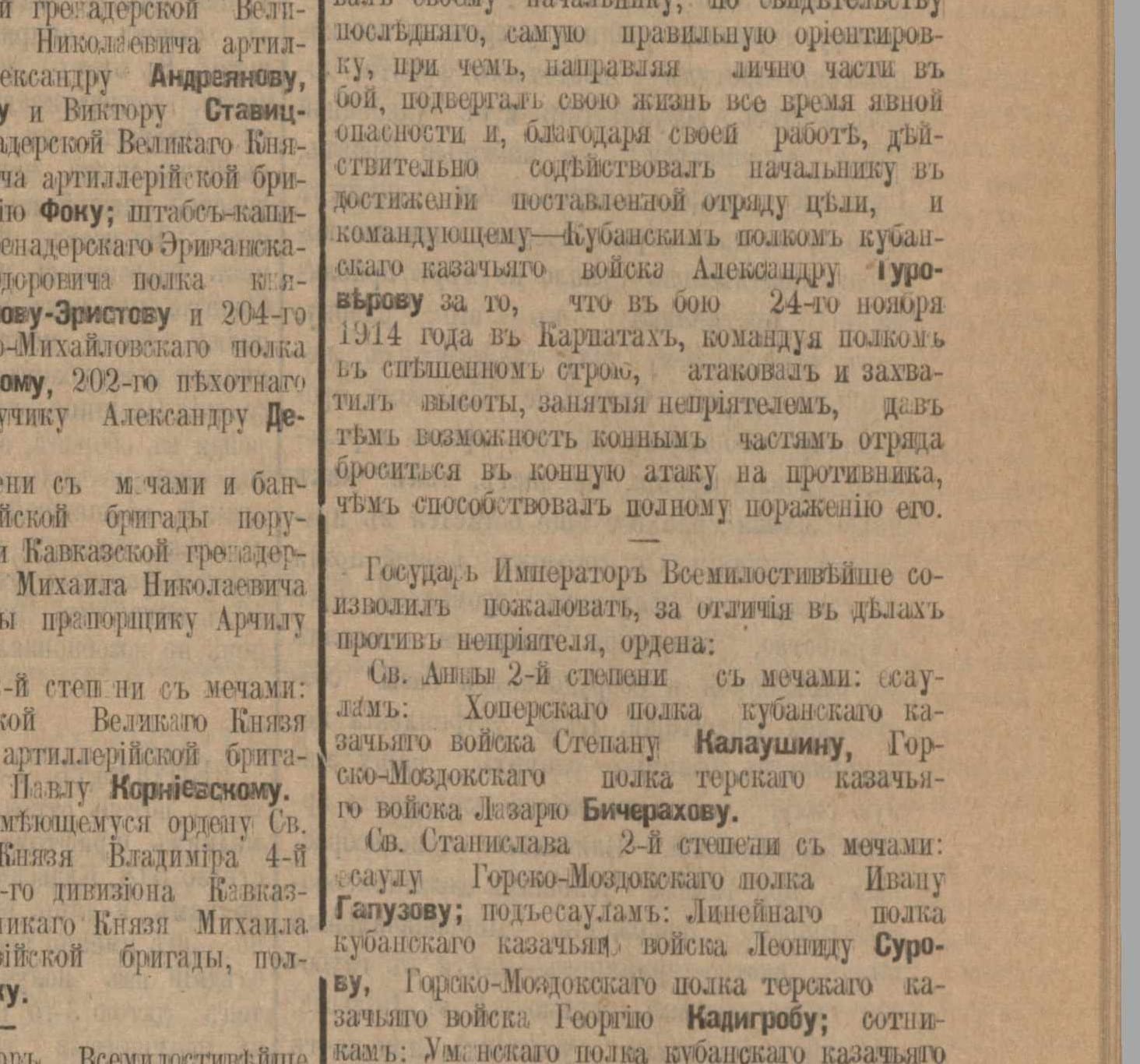
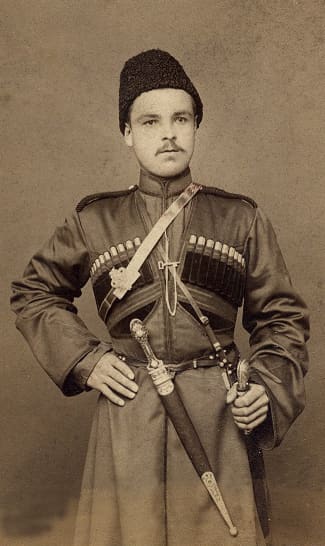
A Cossack chosen for the Convoy had to buy, at his own expense and from the Host crafts school, a new Guards saddle whose pommels were trimmed with thin white horn [◈ S097, p. 142]; the saddles of the Convoy’s officers, N.V. Galushkin writes, came from “the Cossack of Batalpashinskaya Kalaushin, famous throughout the Caucasus for the work of his workshop” [◈ S097, p. 143, n. 24]. In the 1890s two sons of the master saddler Aleksey Nikolayevich served in the Convoy: Mikhail [S001, No. 72], born on 9 July 1870, as a Cossack and then an uryadnik, and Fedot [S001, No. 73], born in 1871, entered in the index of Host orders as a “saddler”, who took the oath in 1891 [◈ S033, via S180, topic 855; ◈ S001, No. 73]. The same index lists an Ivan Kalaushin, “uryadnik of the Convoy”, without patronymic [◈ S033]; △ he was most probably their first cousin Ivan Stepanovich [S001, No. 77], whom the roster calls a Convoy uryadnik [◈ S001, No. 77]. The eldest brother, Matvey Alekseyevich [S001, No. 71], did not join the Convoy: the family remembered that he served in a Cossack regiment at Labinskaya but was not taken into the Convoy “because he was too short” [◇ S001, No. 71].
Fedot Alekseyevich served in the Convoy from 1892, first at Gatchina under Alexander III and then in St Petersburg under Nicholas II, as an uryadnik of the Life Guards 2nd Kuban Sotnia [◈ S001, No. 73]. In 1896 Uryadnik Fedot Alekseyevich and the Cossacks Mikhail Alekseyevich and I.M. Fisenko, entered as “in St Petersburg”, won a bronze medal for leather goods at the All-Russian Exhibition in Nizhny Novgorod [◆ S044, no. 1, p. 33]. In January 1897, by Kuban Host Order No. 5, Fedot Alekseyevich was “by Imperial leave permitted to accept and wear the Mecklenburg-Schwerin silver medals of Grand Duke Friedrich Franz III” [◈ S001, No. 73]; the Grand Duke’s wife, Grand Duchess Anastasia Mikhailovna, was honorary chief of the 1st Khoper Regiment, and at her request Khoper officers and men received Mecklenburg-Schwerin orders and medals in 1885 and 1896 [◆ S053, pt 2, p. 339] (more in the chapter “At Court”). By Order No. 60 of the Kuban Cossack Host of 17 June 1900 Fedot Alekseyevich was discharged, “retaining the Guards uniform and awarded the badge for service in the Convoy” [◈ S001, No. 73]. Note on the roster. The same entry says that he served in the Convoy “from 1892 to 1911” and came home “after 19 years of service”; the numbered and dated order is the firmer source — he was in the Convoy from 1892 to 1900. △ “1911” and “19 years” may refer to his whole Cossack service obligation, or to the Convoy’s jubilee of 1911, which the family remembered well.
The farewell review and the saddle for the Shah of Persia
◇ family testimony · confirmed by relatives
The saddle for the Shah of Persia (Iran) was made in Fedot Alekseyevich’s workshop on the order of Emperor Nicholas II; the work took two months. Fedot Alekseyevich took the saddle to St Petersburg himself. There, at a review of the Guards on his last day before going home at the end of his service, Prince Trubetskoy reported to the Emperor that the saddle had arrived. Nicholas II examined it, said it was very well made, and there and then congratulated Kalaushin on the title of Purveyor to the Court of His Imperial Majesty; a gold watch was granted with the title. Talking with the master, the Emperor asked how long he had been in St Petersburg and, learning that Trubetskoy had kept putting off the presentation of the saddle, showed his displeasure. Once the Emperor had gone, Trubetskoy turned his anger on Fedot and sent him to the guardhouse for two days for an incautious answer. The promised gold watch never reached Fedot Alekseyevich. The family also remembers the signboard of his workshop at Batalpashinskaya, which declared that the workshop belonged to a Purveyor to the Court of His Imperial Majesty — a title that, as the family tells it, was granted to him after the saddle for the Shah [◇ S001, No. 73]. Relatives confirm the account; it is recorded in the family history [◇ S003].
△ hypothesis · dating
The years point to 1900. Fedot Alekseyevich served in the Convoy from 1892 and was discharged by Kuban Host Order No. 60 of 17 June 1900 [◈ S001, No. 73]; the only state visit of a Persian shah to St Petersburg in those years was that of Mozaffar ad-Din Shah, 4–10 (17–23) July 1900 [◆ S037, 4–10.07.1900; ◆ S036, no. 181, 11.07.1900, p. 3]. The visit was known well in advance: in February 1900 St Petersburg reported the invitation Nicholas II had sent to the Shah, in early March the preparations for his reception, and at first he was expected in the capital at the end of May [◆ S048, 15.02.1900, p. 7; ◆ S049, 03.03.1900, p. 33; ◆ S050, 10.03.1900, p. 23]. In April the route was changed and the official reception moved to the return journey [◆ S051, 25.04.1900, p. 3]; in May, as the Shah crossed the Caucasus, sotnias of the 1st Khoper Regiment escorted his cortège along the Georgian Military Road from Mtskheta to Gudaur [◆ S036, no. 184, 14.07.1900, p. 3]. Two months’ work on the saddle therefore falls in the spring of 1900.
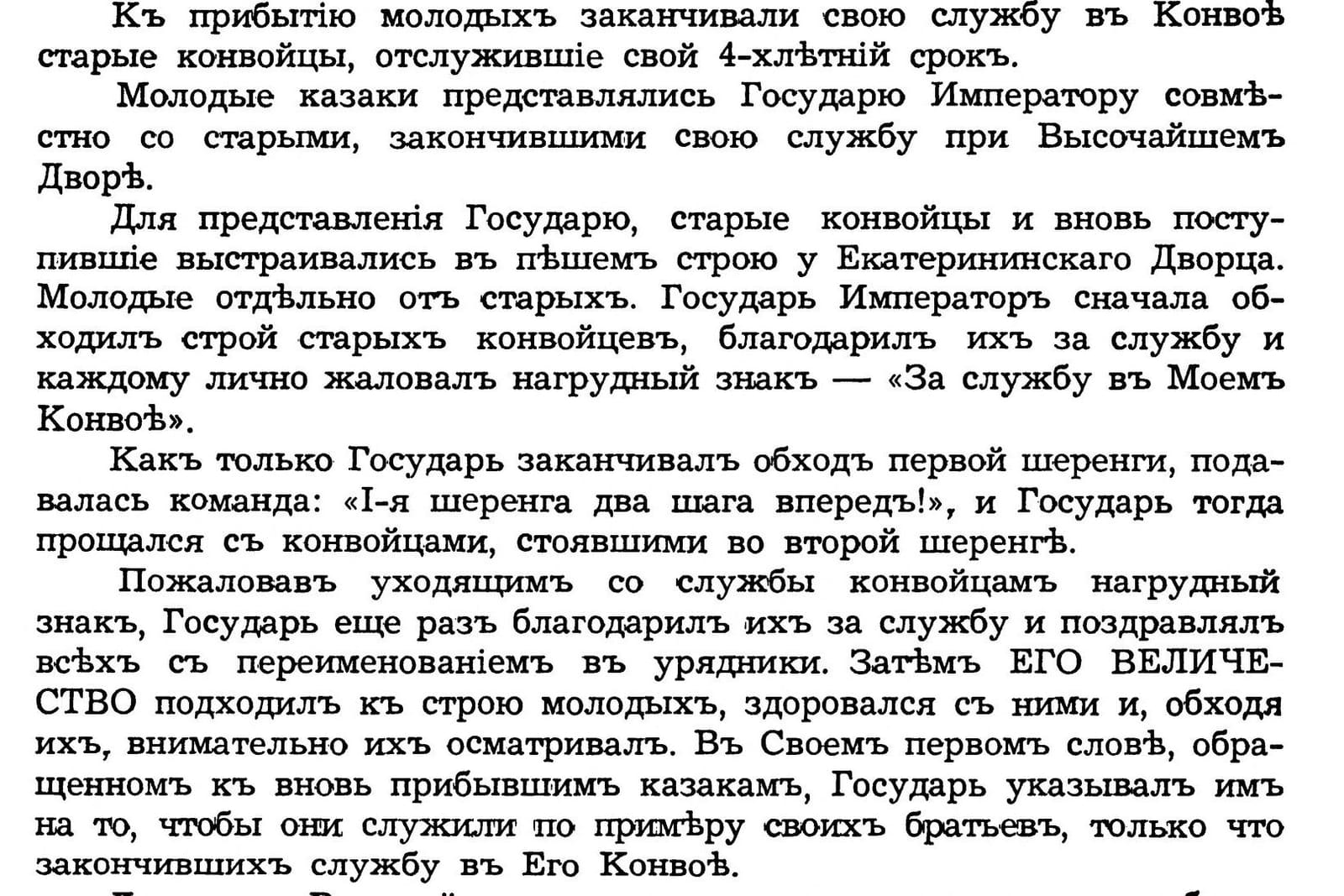
“The last day before going home” was most probably the farewell review of Convoy Cossacks leaving on lgota (reserve leave). In 1900 it took place on Wednesday, 31 May (13 June N.S.), in front of the Alexander Palace at Tsarskoye Selo: the Emperor “honoured each of them with gracious words” and handed out the Convoy service badges with his own hand, while the Minister of the Imperial Court, Baron V.B. Fredericks, stood beside him [◆ S036, no. 150, 10.06.1900, p. 3; ◆ S037, 31.05.1900]. The Emperor’s diary records no other presentation of departing Convoy men that year. It was with this very badge that Fedot Alekseyevich was discharged by Order No. 60 seventeen days later, and two and a half weeks after that the Shah arrived. The Emperor’s question — how long the master had been in the capital — and his displeasure at the delay make sense if the saddle had been made for the original date at the end of May and the reception was then put off until July. The most consistent dating is spring to early summer 1900: the saddle was being prepared for Mozaffar ad-Din Shah’s visit, and it was most probably shown to the Emperor at the review of 31 May.
Other “shah” dates fit the family account less well. Naser al-Din Shah was in St Petersburg in May 1889, in the reign of Alexander III, before Fedot Alekseyevich had taken the oath [◈ S127]. Mozaffar ad-Din Shah met Nicholas II at the manoeuvres near Kursk in 1902 and at Peterhof in August 1905 [◆ S054, 19.09.1902, p. 2; ◆ S037, 20–24.08.1905], by which time Fedot Alekseyevich had left the Convoy. For Ahmad Shah’s coronation in Tehran in 1914 Russia sent a special envoy [◆ S049, 21.07.1914]; a gift would then have gone to Tehran, with no review in St Petersburg.
A note on names. In 1900 the Convoy was commanded by Baron Alexander Meyendorff (1893–1906); on the day of the review, 31 May, the departing men were led by the acting commander, Colonel Kireyev [◆ S036, no. 150, 10.06.1900, p. 3]. Prince Georgy (Yury) Ivanovich Trubetskoy, Meyendorff’s nephew, took over the Convoy from his uncle in 1906 and commanded it until 1914 [◈ S097, pp. 119, 170; ◈ S188, “Trubetskoy, Georgy Ivanovich”]. △ The family most likely kept the name of the later, better-remembered commander: according to the family, Fedot’s younger brother Aleksandr Alekseyevich was still serving in the Convoy under him (1904–1908), and under him the Convoy celebrated its centenary. This is an ordinary feature of family memory, not a contradiction of the account.
The title and the watch. The List of Purveyors to the Imperial Court compiled at the beginning of 1915 names “the saddle-maker Fedot Kalaushin of Batalpashinskaya stanitsa” [◈ S108]. Watches were a customary imperial reward in the Convoy: the Emperor gave a gold watch bearing the State arms, for example, to his Convoy orderly at the end of his term of duty [◈ S097, p. 151]. Further detail, and the full list of archives where papers about the saddle may be found, are given in the chapter “At Court”.
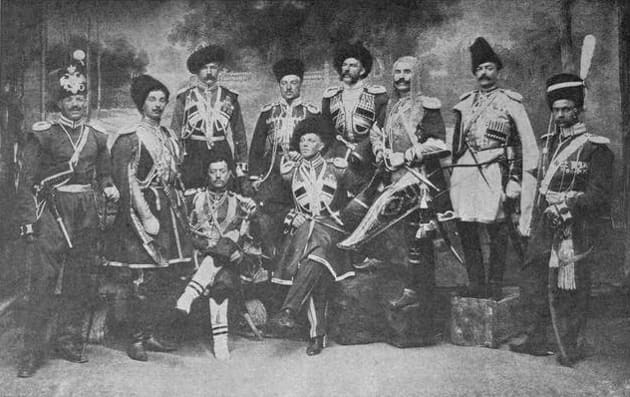
Aleksandr Alekseyevich [S001, No. 74] was also a Convoy uryadnik [◈ S162, vol. “K”]; according to Emiliya Fyodorovna Kalaushina, he served in St Petersburg in 1904–1908 [◇ S001, No. 74]. The Convoy celebrated its centenary in May 1911 at Tsarskoye Selo; among the guests were delegations of the Kuban and Terek Hosts and a great many former Convoy men [◈ S097, pp. 173–176]. According to the roster, one of the ten delegates of the Kuban Host was Ivan Stepanovich Kalaushin, a podkhorunzhy (senior NCO) of Batalpashinskaya stanitsa [◈ S001, No. 77].
Officers
In the 1890s the Kalaushins began to rise to officer rank. Among the first were the sons of Yegor Afanasyevich, Afanasy and Stepan.
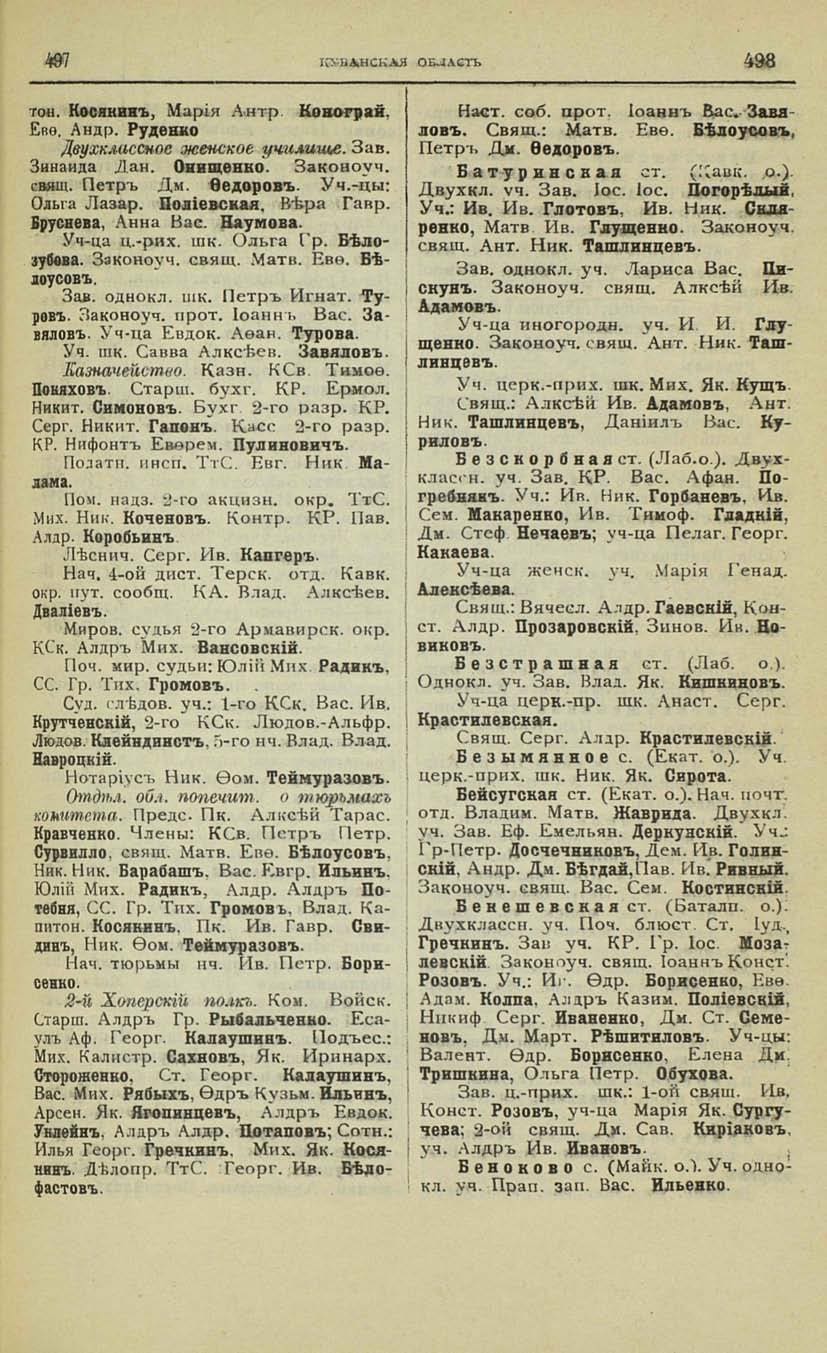
Afanasy Yegorovich (Georgiyevich) [S001, No. 92] was born on 6 July 1864 [◈ S033]. He finished the four-class Batalpashinsk school and the Stavropol Cossack Junker School; from 1884 he served as a Cossack and uryadnik of the 1st and 2nd Khoper Regiments, in 1891 was commissioned khorunzhy in the 1st Uman Regiment, and in 1895 became sotnik (lieutenant) [◈ S001, No. 92, from the alphabetical list of Kuban Host officers, TsGVIA, f. 330, op. 60, d. 1271; ◆ S043, to 1.12.1897, via S152]. In 1902 he was transferred to the 1st Khoper Regiment; in 1905 he received the Order of St Stanislaus, 3rd class; by 1909 he was a podyesaul (staff captain) of the 2nd Khoper Regiment [◆ S045, 18.08.1902 and 6.05.1905, via S152; ◆ S057, p. 617]. By Imperial Order of 6 May 1909 he was promoted to yesaul with seniority from 22 April 1903, and in December of that year was transferred to the 1st Taman General Bezkrovny Regiment [◆ S045, 6.05.1909 and 12.12.1909, via S152]. In the Caucasus Calendar for 1910 the list of the 2nd Khoper Regiment shows “Yesaul Af. Georg. Kalaushin” and, among the podyesauls, “St. Georg. Kalaushin” — two brothers in one regiment [◆ S058, 1910, pt 2, col. 497].
◇ family testimony · from Olga Savvichna and Lev Petrovich. Olga Savvichna remembered him with a big greying beard, very like Aleksey Nikolayevich; on his farmstead the children picked prunes. Drawing on her recollections and on what Lev Petrovich said, the compiler of the roster believed that it was he whom the family called “Lagaga” [◇ S001, No. 92].
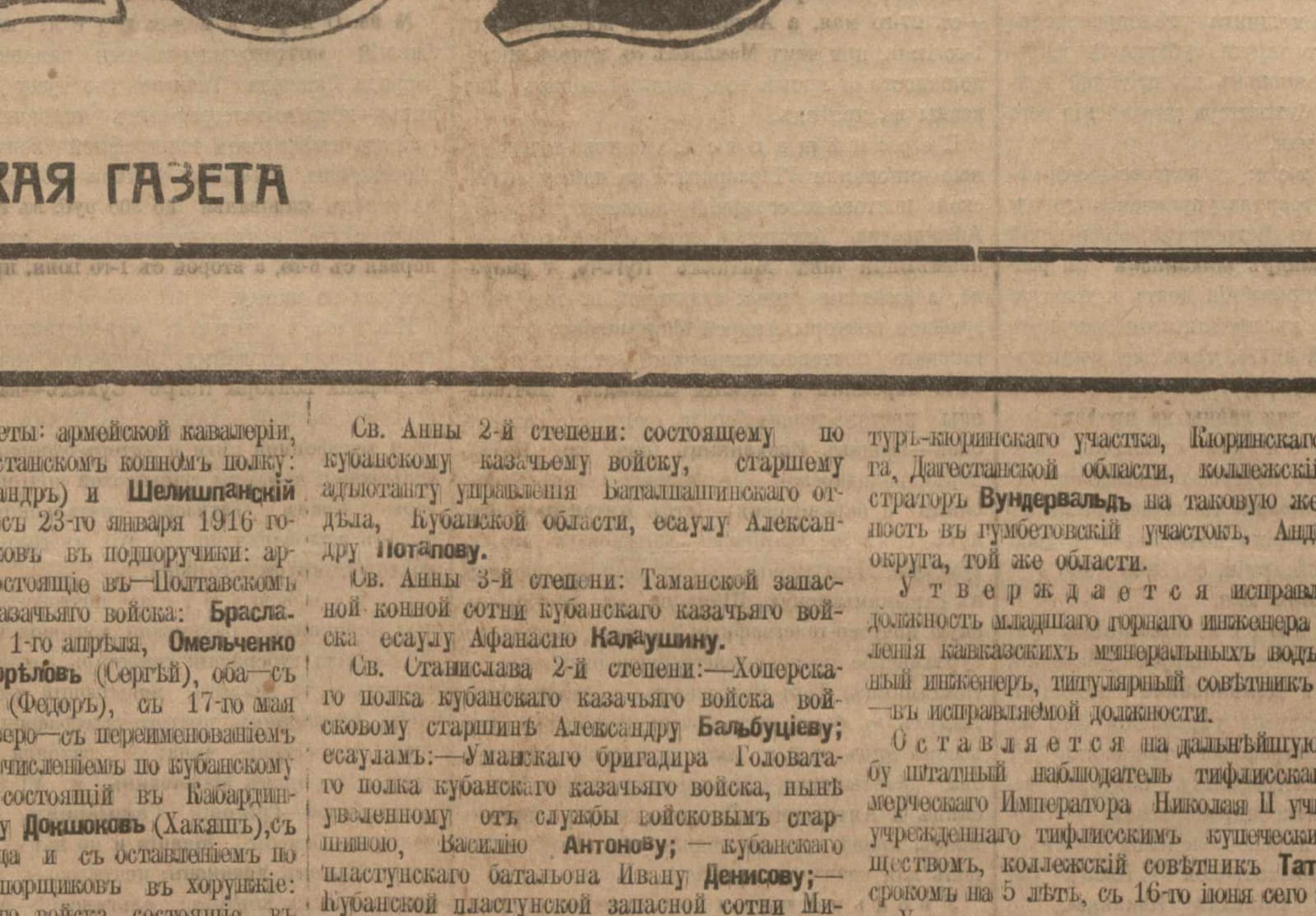
Note on the roster. The roster also has an “Afanasy Grigoryevich”, born on 6 July 1864 — khorunzhy in 1891, sotnik in 1895, yesaul from 1903, and in 1914 a yesaul of the 1st Taman Regiment [◈ S001, No. 47]. △ This is the same Afanasy Yegorovich: the date of birth, ranks, regiments and the order of 1905 all coincide; the patronymic “Grigoryevich” comes from the list of yesauls for 1914 [◆ S061, to 10.01.1914, via S152]. The date 22 April 1903 is his seniority in rank, not the date of promotion. In August 1916 the newspaper Kavkaz printed the award of the Order of St Anna, 3rd class, to “Yesaul Afanasy Kalaushin of the Taman Reserve Horse Sotnia” [◆ S036, no. 192, 26.08.1916, p. 1]. △ This is probably he; the roster gives 1915 as the year of his death.
Stepan Yegorovich (Georgiyevich) [S001, No. 93] was probably born on 26 April 1868 (the index gives that date for a “Stefan” without patronymic) [◈ S033]. An uryadnik of the 2nd and 1st Khoper Regiments and a podkhorunzhy, he became a khorunzhy in 1896 [◆ S043, to 1.12.1897, via S152]; in the appendix to the regimental history published in 1901 he is already a sotnik of the 1st Khoper Regiment [◆ S053, App. 77, p. 240]. In 1903 he received the Order of St Stanislaus, 3rd class, and in 1909, as a podyesaul of the 2nd Khoper Regiment, the Order of St Anna, 3rd class [◆ S045, 30.01.1903 and 28.12.1909, via S152]. In 1914 he completed the Cossack department of the Officer Cavalry School “with distinction” and was awarded the Order of St Stanislaus, 2nd class [◆ S045, 1.09.1914, via S152].
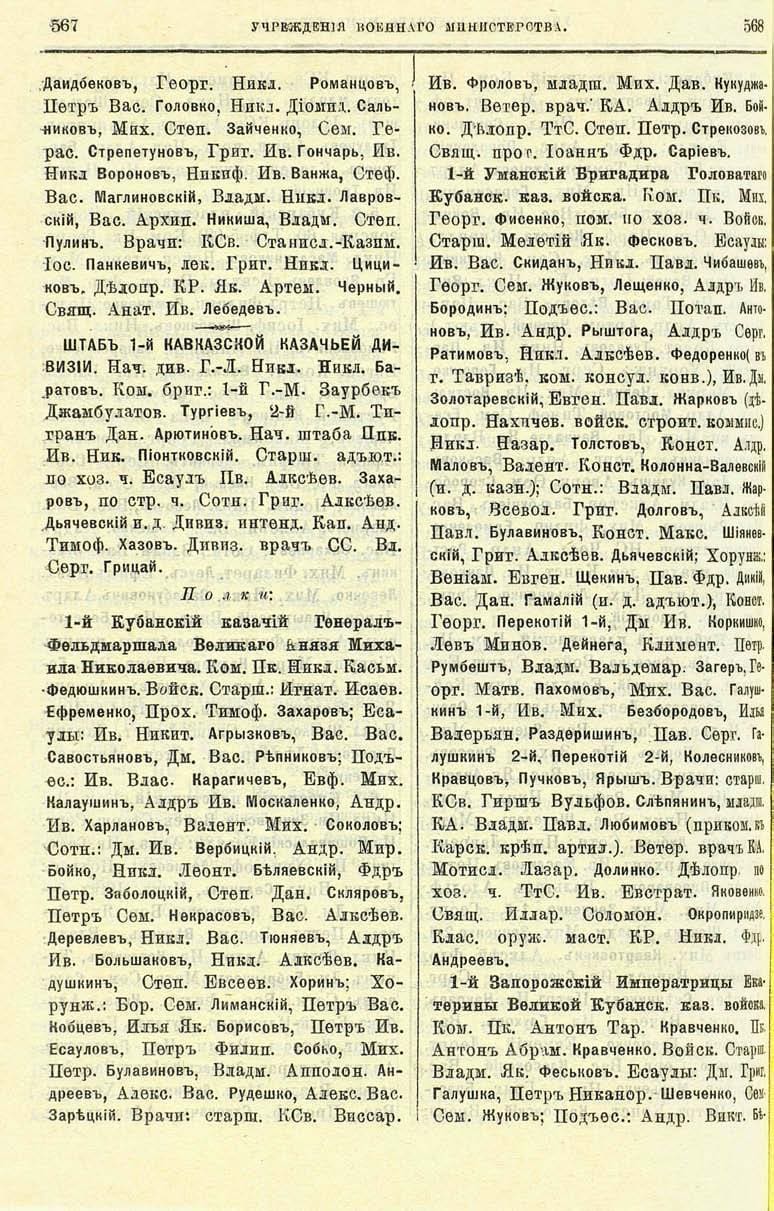
Yefim (Yevfimy) Mikhailovich [S001, No. 131] was born on 25 December 1877 [◈ S033]. He finished the Batalpashinsk Town School and, in 1897, the Stavropol Cossack Junker School in the first category; he served as a Cossack and podkhorunzhy of the 1st Yekaterinodar Regiment and as a khorunzhy of the 1st Kuban Regiment [◆ Stavropol Junker School graduates 1897, via S152; ◈ S033]. Sotnik from 1902 and podyesaul from 1906, he received the Order of St Stanislaus, 3rd class (1906), and of St Anna, 3rd class (1909); in 1912–1914 he was a podyesaul of the 1st Kuban Regiment [◆ S045, 1.06.1902, 6.05.1906, 1.06.1906 and 28.12.1909, via S152; ◆ S058, 1912, p. 496; 1914, p. 567]. In February 1914 he received the Order of St Stanislaus, 2nd class, because his unit had been judged excellent at three annual inspections in succession [◆ S045, 3.02.1914, via S152]. Note on the roster. The roster makes him a son of Mikhail Alekseyevich [◈ S001, No. 131], but Mikhail Alekseyevich was born in 1870, only seven years earlier. △ Yefim’s father was probably one of the two Mikhail Afanasyeviches.
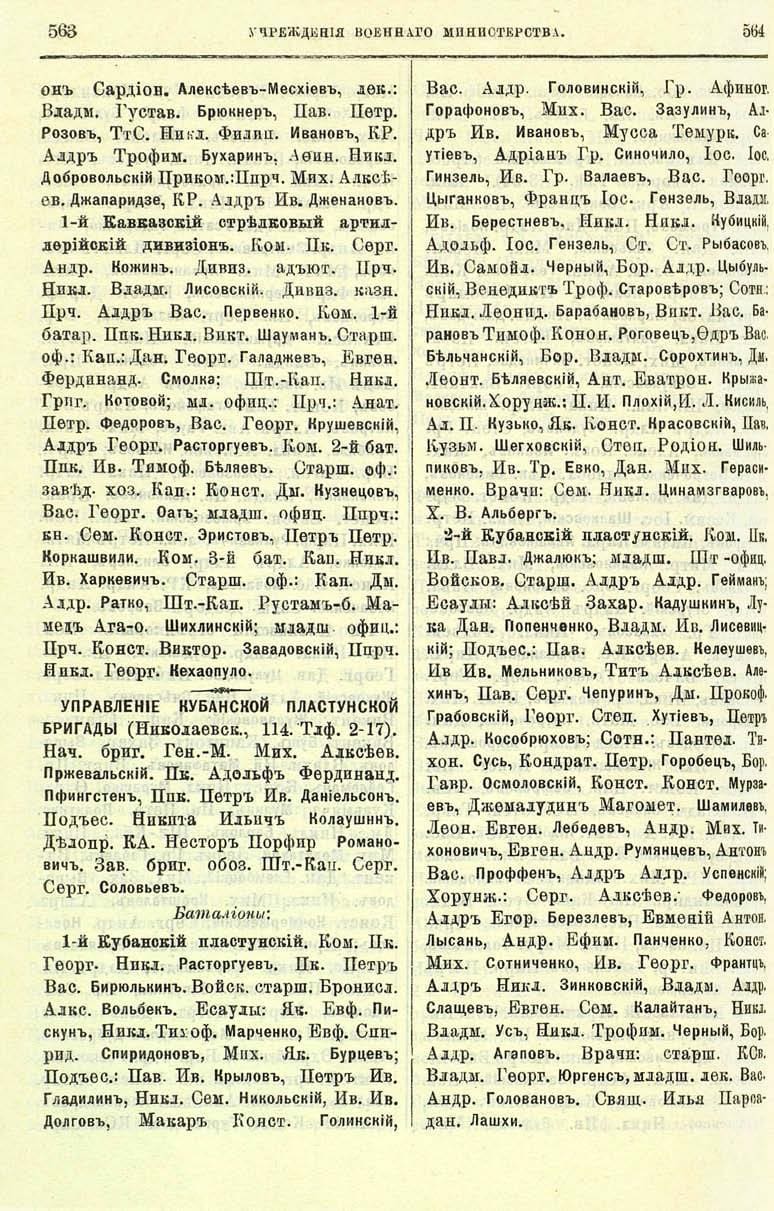
Nikita Ilyich [S001, No. 85], son of Ilya Nikolayevich — most probably the very lance corporal who distinguished himself at Dayar — was born on 26 May 1878 [◈ S033]. He served as a Cossack of the 1st Yekaterinodar Regiment and as an uryadnik of the 5th Kuban Plastun (Cossack foot scout) Battalion; in 1900 he was commissioned khorunzhy in the 3rd Kuban Plastun Battalion; in 1906 he received the Order of St Stanislaus, 3rd class, and in 1909, by then senior adjutant of the headquarters of the Kuban Plastun Brigade, the Order of St Anna, 3rd class [◆ S045, 21.06.1900, 12.03.1906 and 6.05.1909, via S152]. The brigade headquarters was in Tiflis (Tbilisi); the Caucasus Calendar for 1914 spells his name “Kolaushin”, and its address section lists “Kalaushin Nikita Il., podyesaul, staff of the Kuban Plastun Brigade, Yelizavetinskaya 105” [◆ S058, 1914].
The Great War
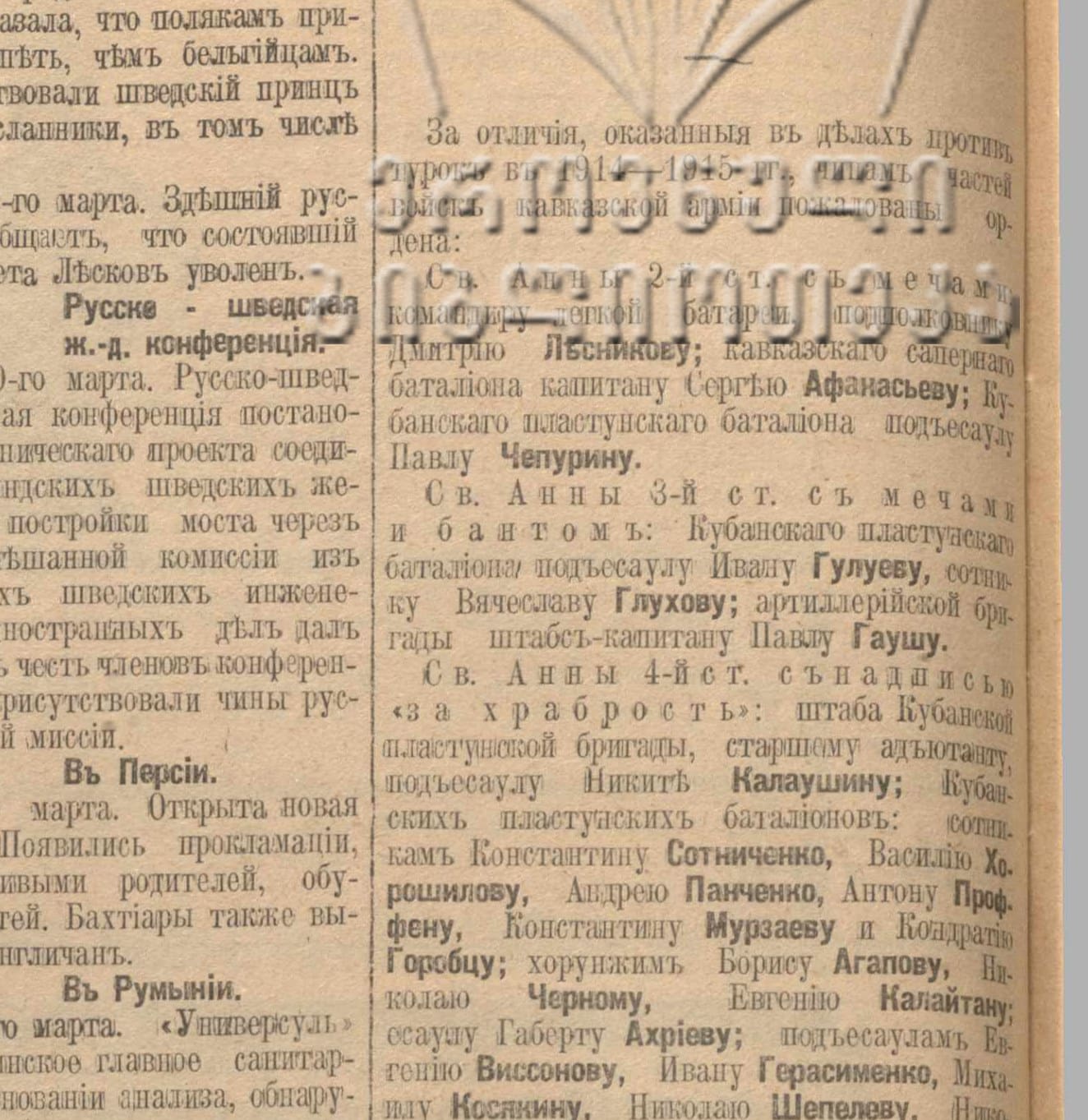
In the autumn of 1914 Nikita Ilyich was senior adjutant on the staff of the 1st Kuban Plastun Brigade. On 19 October General Przhevalsky’s brigade was ordered to advance into Turkish territory and take Karakilise; a few days later, one march short of its objective, it was turned back and sent by forced march into the Passin valley to support General Baratov’s troops. Describing this movement, General E.V. Maslovsky cited in a footnote the information of the brigade’s senior adjutant for operations, Yesaul (later Colonel) N.I. Kalaushin, held in his own archive [◈ S119, p. 52, n.]. For distinction in actions against the Turks in 1914–1915 Nikita Ilyich received the Order of St Anna, 4th class, inscribed “For Bravery” [◆ S036, no. 73, 2.04.1915, p. 2]; the award was confirmed in the autumn [◆ S036, no. 219, 29.09.1915, p. 1]. In February 1916, as a yesaul and still senior adjutant of the brigade staff, he received the Order of St Vladimir, 4th class [◆ S045, 14.02.1916].
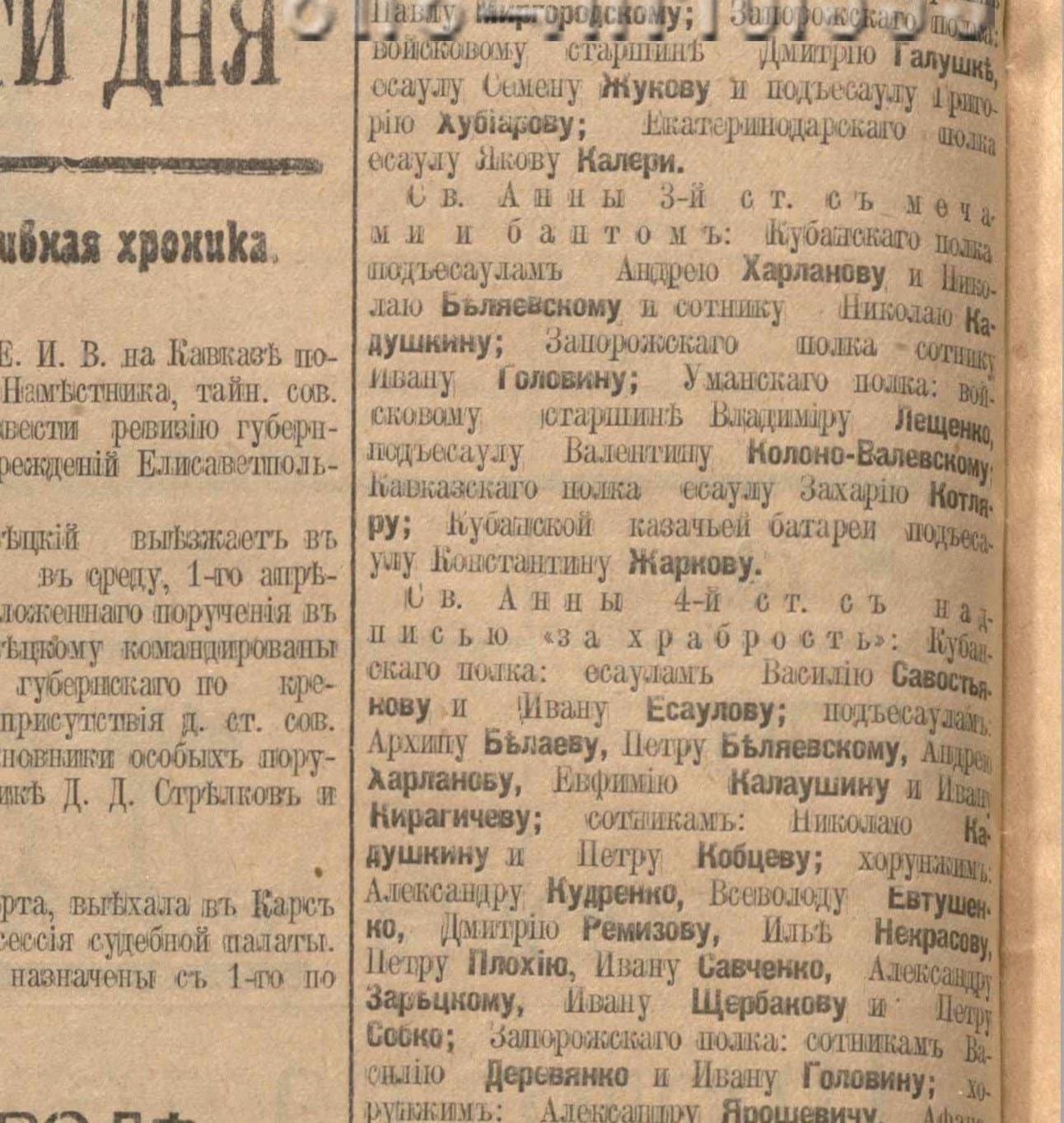
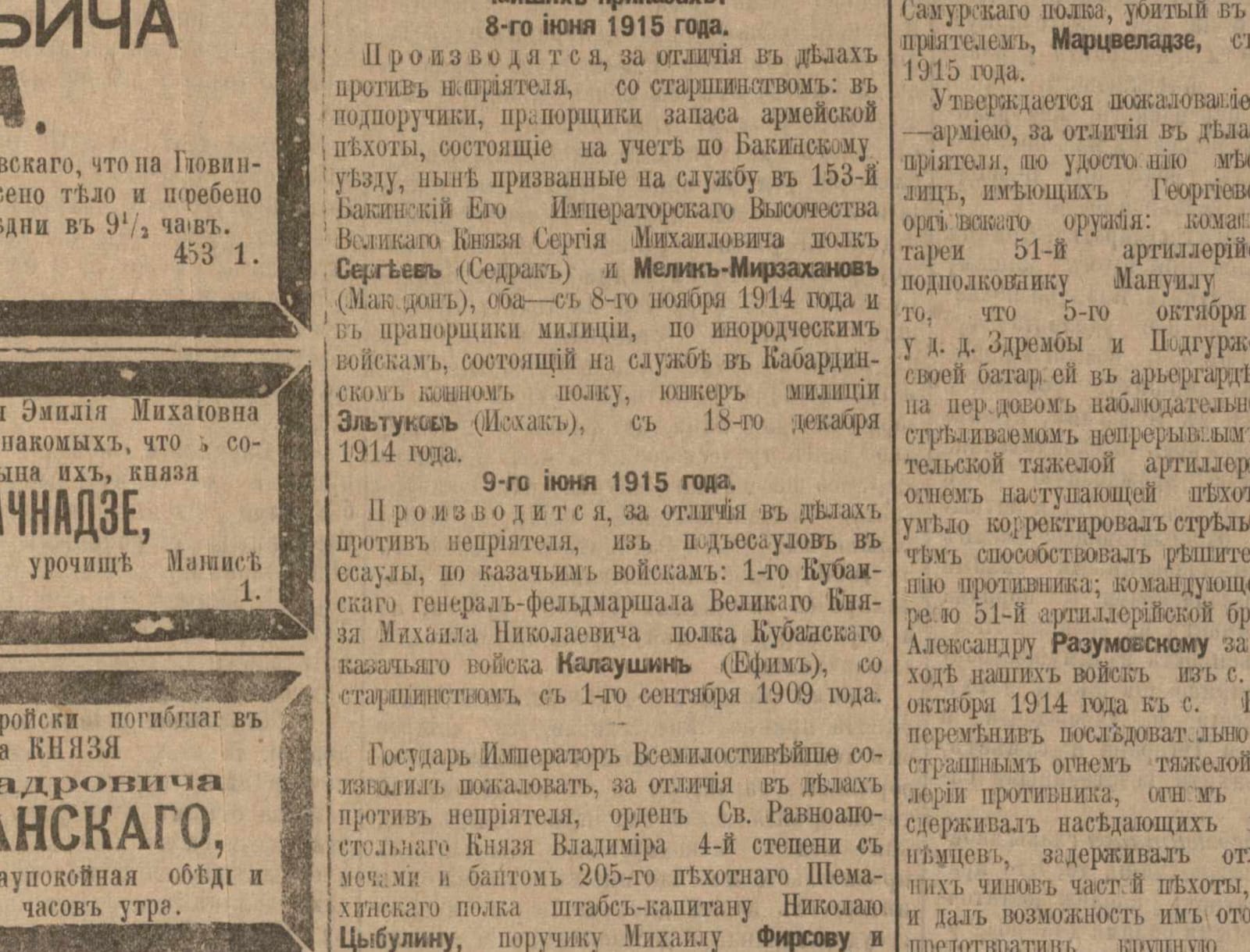
Yefim Mikhailovich fought with the 1st Kuban Regiment on the same front. In the spring of 1915 Kavkaz printed his name among those awarded the Order of St Anna, 4th class, “For Bravery” for actions against the Turks; the award was confirmed by Imperial Order of 19 October 1915 [◆ S036, no. 72, 1915, p. 2; ◆ S045, 19.10.1915]. On 9 June 1915 he was promoted yesaul for distinction in action (with seniority from 1 September 1909); in 1916 he became a voyskovoy starshina (lieutenant colonel) with seniority from 19 February 1916; in December 1916 he received swords to his Order of St Stanislaus, 2nd class [◆ S036, no. 144, 26.06.1915, p. 1; ◆ S065, June 1916; ◆ S045, 8.12.1916]. By 1 January 1917 he was assistant commander of the 1st Kuban Regiment [◈ 1st Kuban Regiment to 1.01.1917, via S152]. According to the roster he served with General Baratov’s Expeditionary Corps [◈ S001, No. 131]. Note on the roster. The Orders of St Anna, 3rd class with swords and bow, and 2nd class with swords, which the roster gives to Yefim, match the awards of Aleksey Matveyevich (see below).
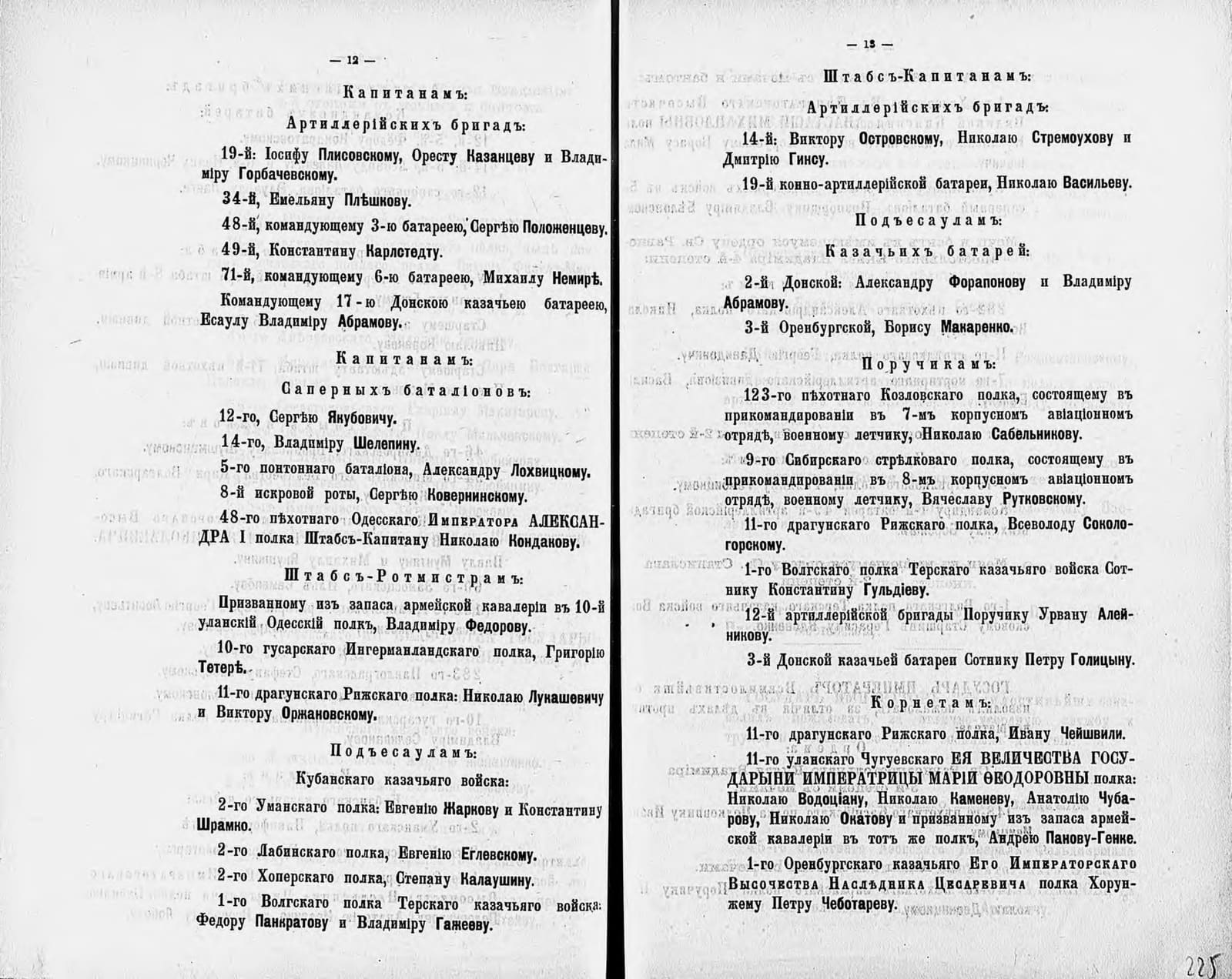
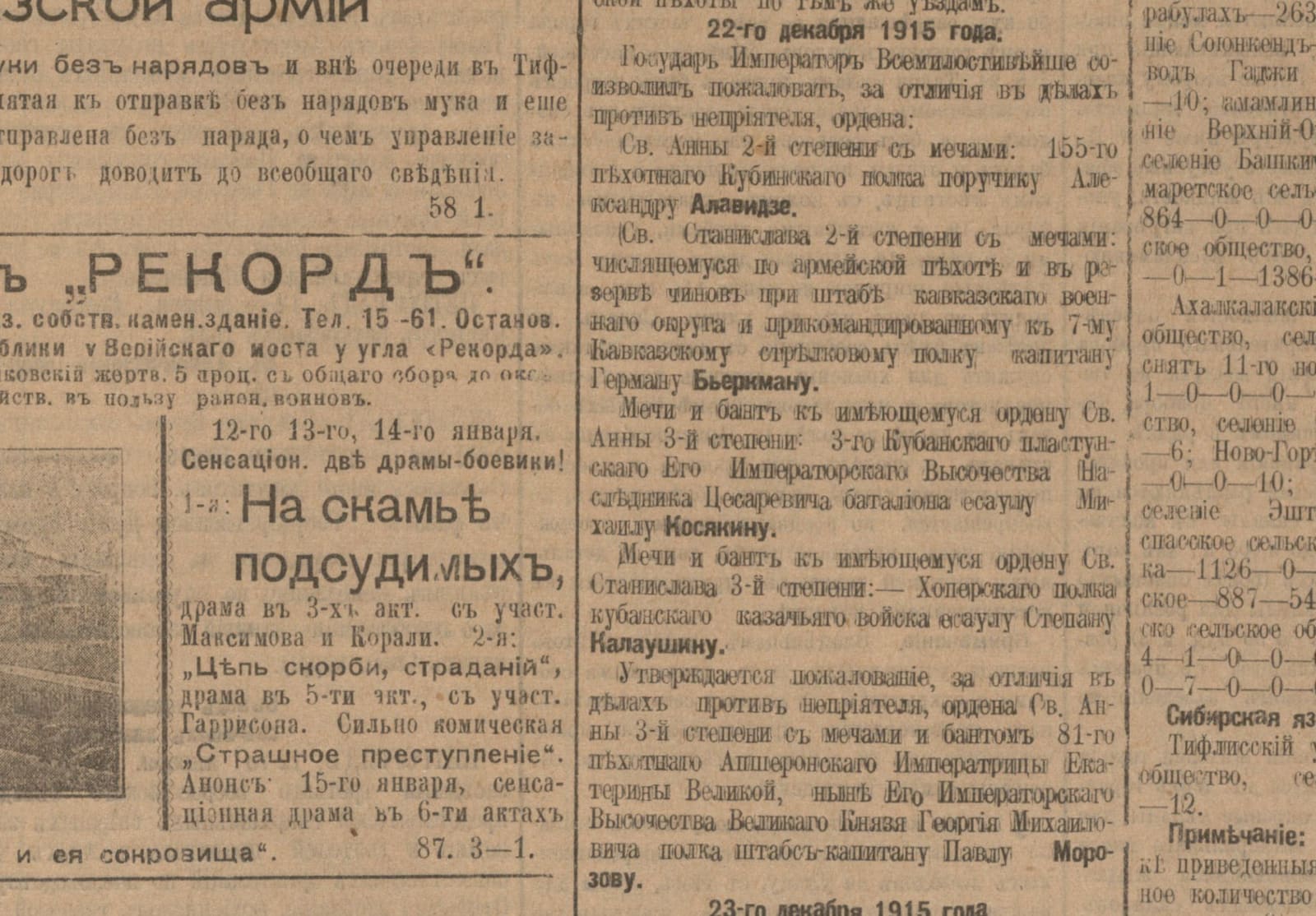
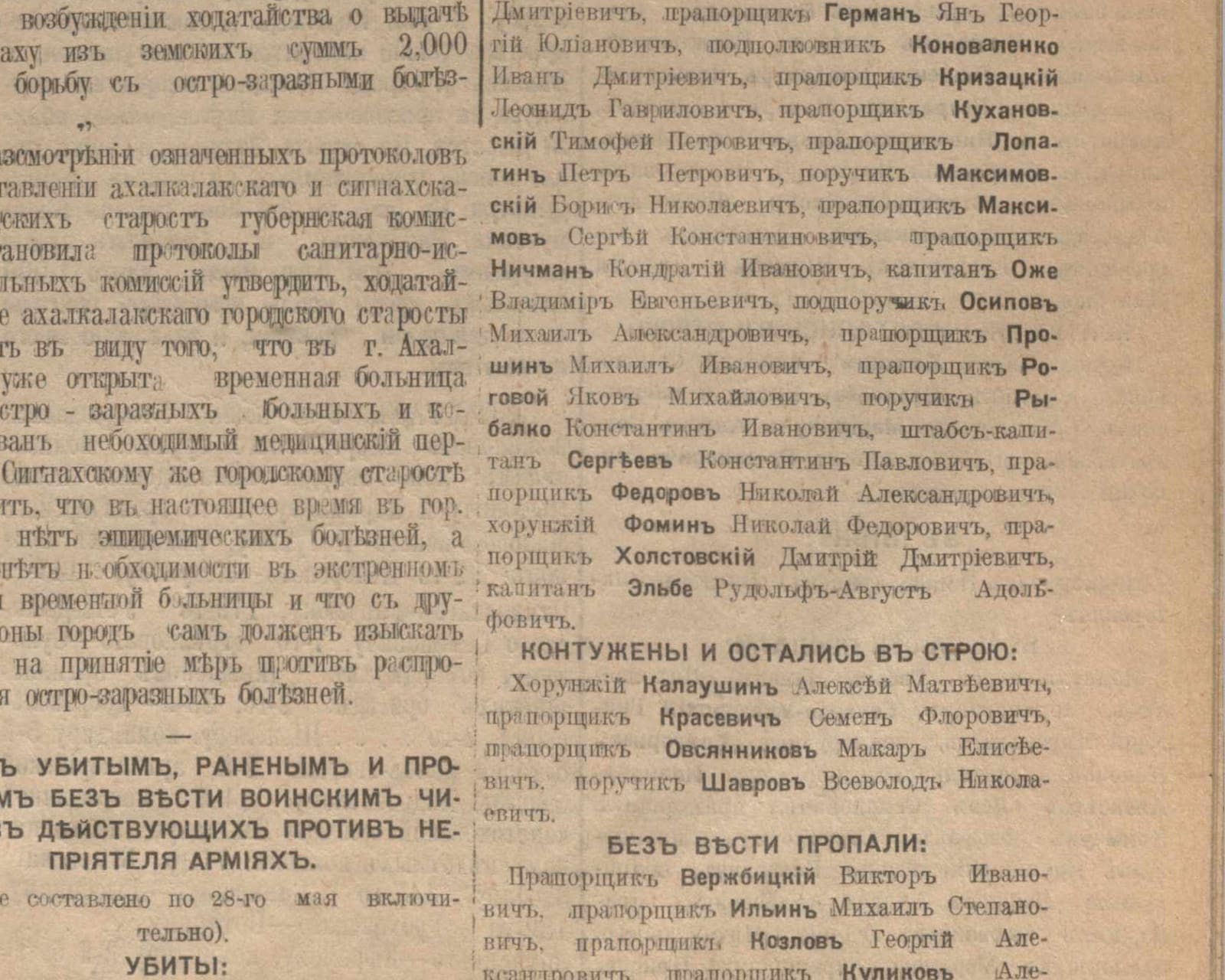
Stepan Yegorovich began the war as a podyesaul of the 2nd Khoper Regiment. On 17 March 1915, for distinction in action, he was awarded the Order of St Vladimir, 4th class with swords and bow [◆ S045, 17.03.1915; ◆ S036, no. 78, 8.04.1915, p. 1]; in April the award of the Order of St Anna, 4th class, “For Bravery” was confirmed [◈ S045, 29.04.1915, via S063, no. 1286]; and in May, by now a yesaul, he received the Order of St Anna, 2nd class with swords [◈ S045, 21.05.1915, via S063, no. 1291; ◆ S036, no. 130, 10.06.1915, p. 1]. He fell in 1915: in the summer Russkoye Slovo listed Yesaul Stepan Georgiyevich Kalaushin among those who had died of wounds, and an Imperial Order of July 1916 struck him off the rolls among those killed in action [◆ S062, no. 174, 29.07.1915, via S152; ◆ S045, July 1916]. His awards kept coming after the news of his death: swords and bow to the Order of St Stanislaus, 3rd class (order of 22 December 1915), and to the Order of St Anna, 3rd class (April 1916) [◆ S036, no. 10, 14.01.1916, p. 1; ◆ S045, April 1916].
Aleksey Matveyevich [S001, No. 122], son of Matvey Alekseyevich, was commissioned khorunzhy from the Yelisavetgrad Cavalry School into the 3rd Khoper Regiment by Imperial Order of 1 October 1914, with seniority from 12 July 1914 [◆ S045, 1.10.1914, via S152]. In May 1915 he was concussed but remained in the line [◆ S062, no. 122, 29.05.1915, via S152; ◆ S036, no. 131, 11.06.1915, p. 1]. In 1916 the award to him of the Order of St Stanislaus, 2nd class with swords, was confirmed [◆ S045, 17.06.1916]; in October 1916 Sotnik Kalaushin was regimental adjutant of the 3rd Khoper Regiment and held the Orders of St Stanislaus and St Anna, 3rd class with swords and bow, St Stanislaus, 2nd class with swords, St Anna, 4th class “For Bravery”, and St Anna, 2nd class with swords [◈ S066, 10.1916, via S152]. Note on the roster. The roster dates his graduation to 12 June 1912; by the Imperial Order he was commissioned in 1914, with seniority from 12 July.
In the same regiment served Praporshchik (ensign) Semyon Ilyich Kalaushin, a graduate of the Batalpashinsk Town School and the Gori School of Ensigns [◈ S066, 10.1916 and 14.06.1917, via S152]. △ The roster has two men named Semyon Ilyich [S001, Nos. 87, 91]; which of them was the ensign is not yet known. On 1 January 1916 a Nikolay Kalaushin was commissioned praporshchik from the Tiflis Military School into the 4th Reserve Plastun Sotnia; in May 1917 Khorunzhy Nikolay Kalaushin of the 10th Kuban Plastun Battalion was promoted sotnik with seniority from 15 November 1916 [◆ S064, 1.01.1916, via S152; ◆ S067, 24–31.05.1917, via S152]. △ They are probably the same man; his place in the family is still to be found.
◇ family testimony
Roman Vasilyevich Kalaushin [S001, No. 100] of Bekeshevskaya stanitsa served in the 3rd Khoper Regiment. The Revolution found the Khoper Cossacks at war in Persia. The Cossacks came by ship to Baku, where they were not allowed ashore; they landed by force, seized several trains, abandoned them short of Mineralnye Vody and rode home on horseback [◇ S001, No. 100].
Documents
1859, Psebay. “For courage, bravery and distinction in action against the highlanders when they attacked the herd near the Psebay fortification, the Insignia of the Military Order, 4th class, were awarded to Uryadnik Luka Fisenkov and the Cossacks … Stepan Kalaushin and Daniil Kondratenkov.” — V.G. Tolstov, Istoriya Khoperskogo polka, Appendices, Tiflis, 1901, App. 65, p. 138.
1877, Zeydekyan. “…the regimental commander, Lieutenant Colonel Pedino, ordered all the non-combatants to be called out, and they, under the command of Uryadnik Kalaushin and at the direction of the regimental adjutant, Khorunzhy Udovenko, occupied the height on our right flank and opened fire.” — Ibid., pt 2, p. 248.
1900, Tsarskoye Selo. “His Majesty the Emperor honoured each of them with gracious words and handed them, with His own hand, the badges established for service in His Majesty’s Own Convoy.” — “Cossacks leaving on reserve leave”, Kavkaz, no. 150, 10.06.1900, p. 3.
Where the documents may be found
- RGVIA, St George cavaliers database: Insignia of the Military Order Nos. 6451, 10711, 19441.
- RGVIA, f. 330 (Main Directorate of Cossack Hosts): the service lists of uryadniks for 1859, 1874, 1877 and 1887 cited in the roster (op. 55, d. 37 and 2147; op. 56, d. 452 and 455).
- The 1853 file “On the appointment of Uryadnik Kalaushin as chamber Cossack” (given in the roster as “TsGVIA, f. 366, op. 1058, d. 2, vol. 1”; reference to be confirmed); RGIA, records of the Ministry of the Imperial Court: service records of chamber Cossacks; TsGIA SPb, f. 19: St Petersburg parish registers for 1853–1857.
- War Minister’s order No. 15 of 1861 (Psebay); orders of the Caucasus Military District for 1877–1881 (Dayar).
- RGVIA, f. 400 and f. 409: service records of Afanasy and Stepan Yegorovich, Yefim Mikhailovich and Nikita Ilyich; f. 408, op. 1, d. 498 and 15097: officer lists of the 2nd Khoper Regiment (1914, 1915); the officer list of the 3rd Khoper Regiment to 14.06.1917.
- GAKK, Krasnodar, f. 396, 249, 318: orders of the Kuban Host (1897, No. 5; 1900, No. 60) and household registers; Kubanskiye Oblastnye Vedomosti for 1897 and 1900.
- The saddle for the Shah and the purveyor title: the Chamber-Fourier Journal for 1900 (RGIA, f. 516, op. 1 (219/2728), d. 10 — the review of 31 May; d. 11 — the Shah’s visit of 4–10 July); His Imperial Majesty’s Cabinet (RGIA, f. 468): gifts to the Shah in 1900; the Chancellery of the Ministry of the Imperial Court (RGIA, f. 472): the file on F.A. Kalaushin’s purveyor title; Convoy orders for May–June 1900 (fond number to be confirmed); AVPRI, Persian Desk. The full list is in the chapter “At Court”.
- The Convoy centenary of 1911: lists of the Host delegations (Kuban Host orders for 1911, GAKK; Kubanskiye Oblastnye Vedomosti).
- Bakhmeteff Archive, Columbia University: Maslovskii Papers — N.I. Kalaushin’s material on the 1914 advance.
Documents and illustrations
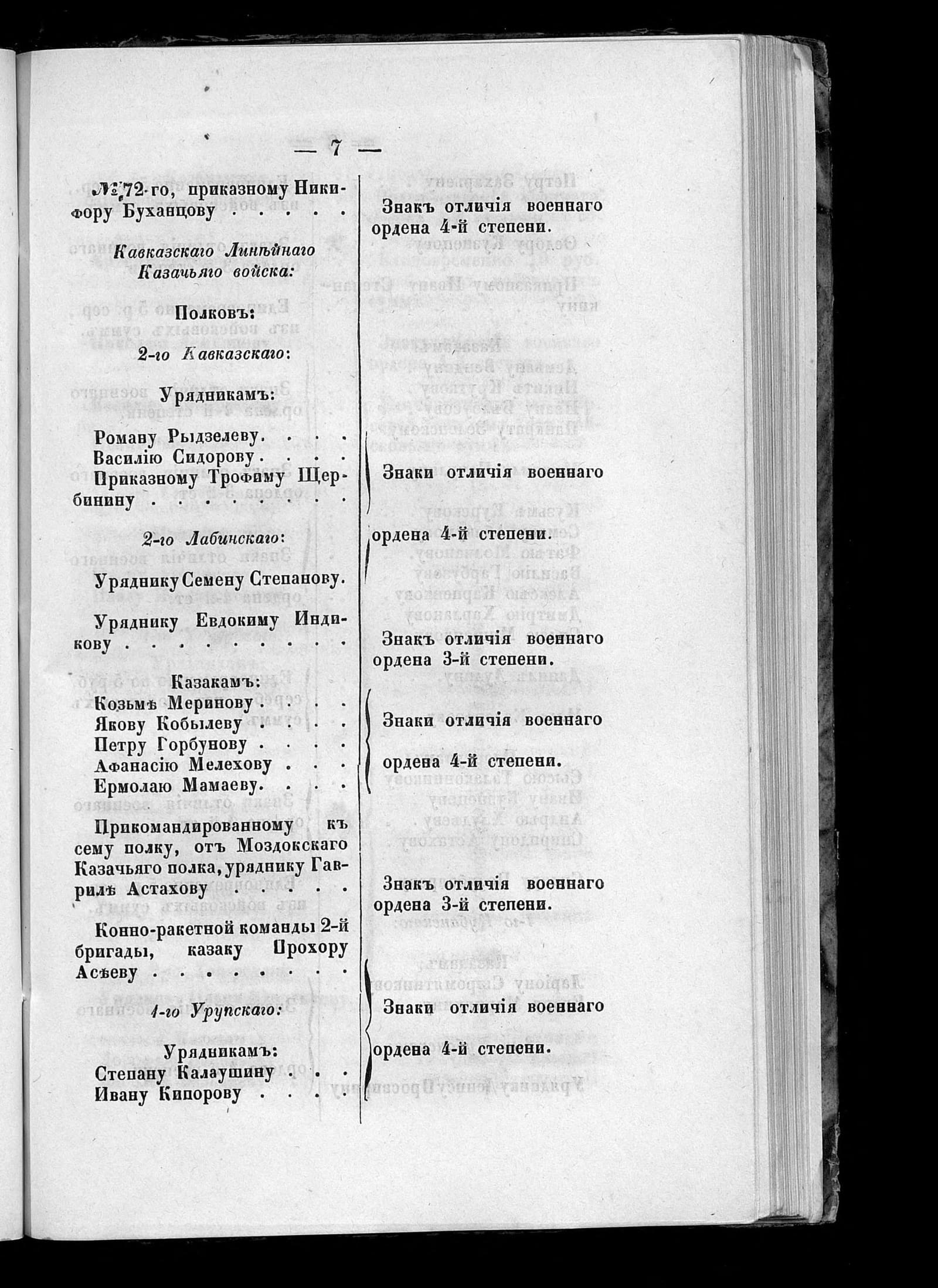
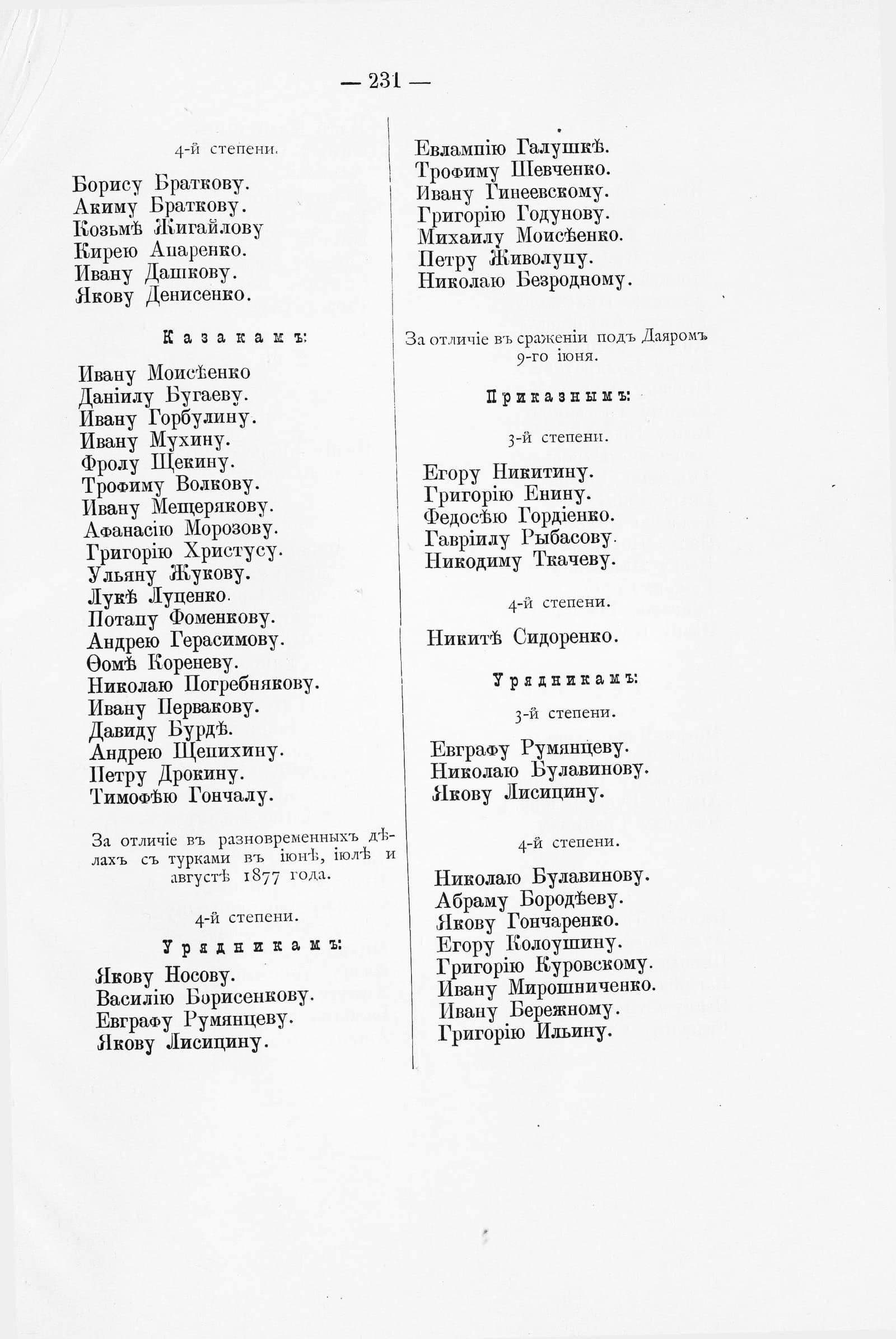
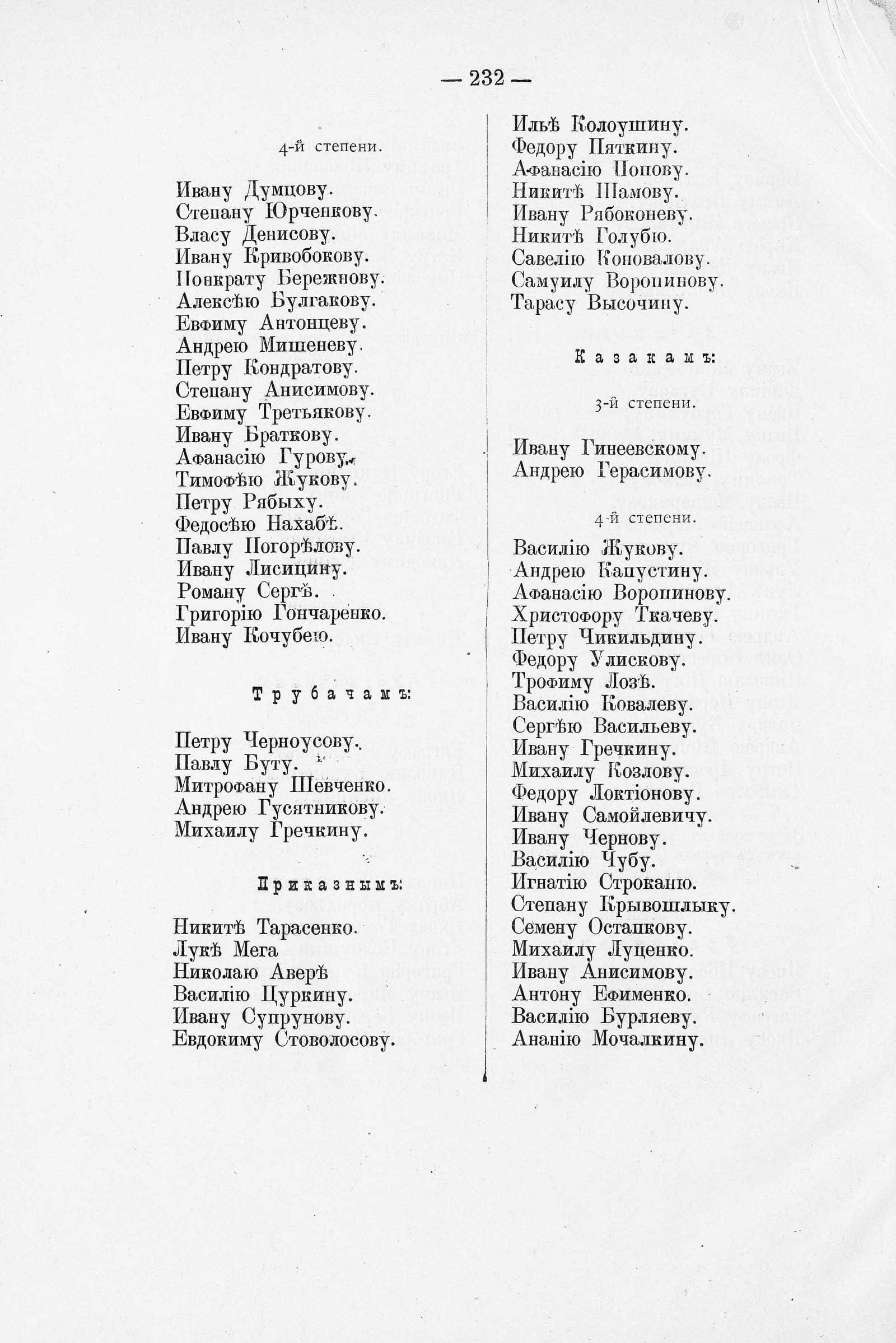

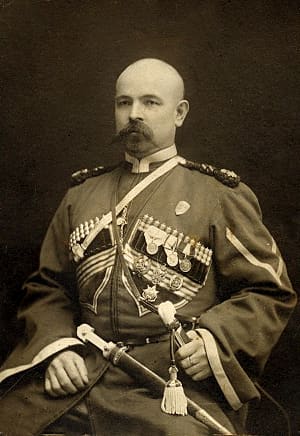
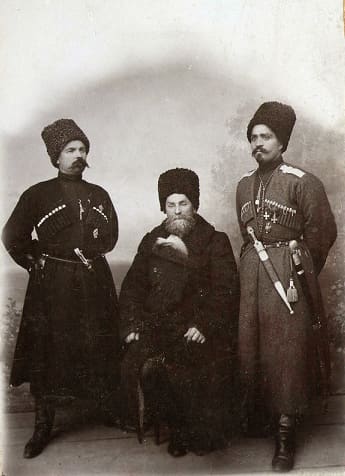
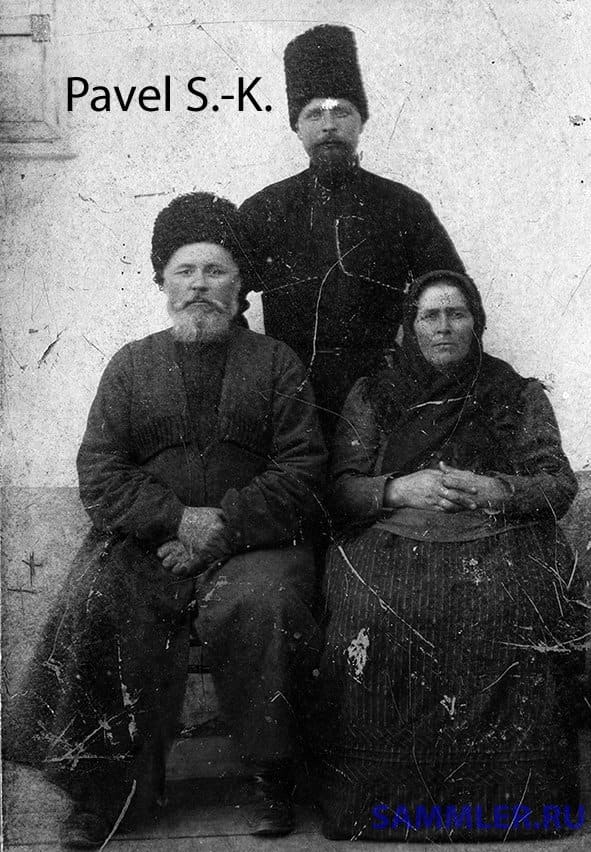
Images held by rights holders
- Image held by the rights holder — permission requested
Document · 1961 ◈ published source
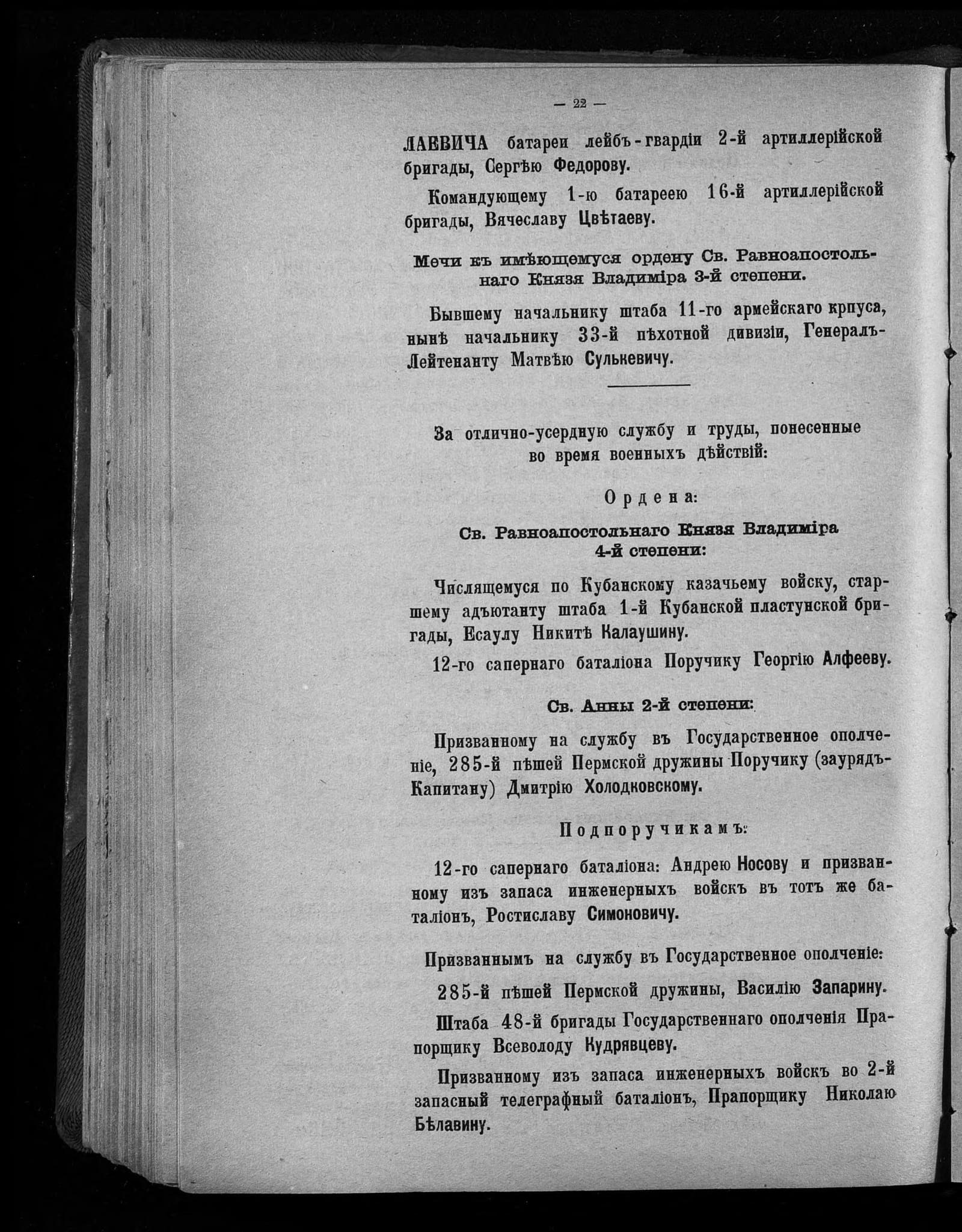
Galushkin 1961, p. 143: Convoy equipment and the note on Kalaushin saddles
Page of N. V. Galushkin's "His Imperial Majesty's Own Convoy" with note 24: "Saddles for the officers were supplied by the Cossack Kalaushin of Batalpashinskaya, famous throughout the Caucasus for the work of his workshop" [Galushkin 1961, p. 143].
Internet Archive (цифровая копия)
Quotation: N. V. Galushkin, His Imperial Majesty's Own Convoy, 1961 (scan: Internet Archive)
Sources for this chapter
- S001 — A.B. Kalaushin’s roster Kalaushiny (philippov.spb.ru, version 03.02 of 13 July 2025)
- S003 — Family testimony: V.O. Kalaushin, 8–9 Oct 2026
- S007 — Revision tale of Stavropolskaya stanitsa, 18.11.1815 (GASK, f. 748)
- S009 — Batalpashinskaya confessional register, 1827 (GAAO, f. 599, d. 7148)
- S012 — Batalpashinskaya confessional register (family list), 1848 (GASK, f. 135, d. 806)
- S013 — Batalpashinskaya parish register, 1857 (RGVIA, f. 14877, d. 2716)
- S032 — Order of the War Minister on the irregular forces, No. 32 of 22.06.1859
- S033 — Name index to the Orders of the Kuban Host, 1880–1899
- S036 — Kavkaz newspaper (Tiflis)
- S037 — Dnevniki imperatora Nikolaya II, vol. 1 (Moscow: ROSSPEN, 2011)
- S043 — Kuban Host seniority lists, 1897 and 1898
- S044 — Illyustrirovanny vestnik… progressa Rossii, no. 1 (1898)
- S045 — Imperial Orders (Vysochayshiye prikazy)
- S048 — Wiener Zeitung, 1900 (ANNO)
- S049 — Prager Tagblatt, 1900, 1914 (ANNO)
- S050 — Neue Freie Presse, 1900 (ANNO)
- S051 — Vorarlberger Volksblatt, 1900 (ANNO)
- S053 — V.G. Tolstov, Istoriya Khopyorskogo polka…, pt 2; Appendices (Tiflis, 1901)
- S054 — Ostdeutsche Rundschau, 1902 (ANNO)
- S057 — General list of officers… to 1.01.1909
- S058 — Kavkazsky kalendar (Tiflis), 1910–1914
- S061 — List of yesauls… to 10.01.1914
- S062 — Russkoye Slovo, 1915
- S063 — Razvedchik journal, 1915
- S064 — Supplement to the Imperial Order of 1.01.1916
- S065 — Orders on military ranks, 1916
- S066 — Officer lists of the 3rd Khoper Regiment (10.1916 and 14.06.1917)
- S067 — Order to the Army and Navy on military ranks, May 1917
- S097 — N.V. Galushkin, Sobstvenny Yego Imperatorskogo Velichestva Konvoy (San Francisco, 1961)
- S108 — I.V. Zimin et al., Yuvelirnye sokrovishcha Rossiyskogo imperatorskogo dvora (Moscow, 2013)
- S119 — E.V. Maslovsky, Mirovaya voyna na Kavkazskom fronte, 1914–1917 g. (Paris, 1933)
- S127 — Ye. Preobrazhenskaya, “Vizity shakha Persii v Rossiyu” (Naslediye Imperii)
- S135 — GASK Handbook 2008: Administrativno-territorialnoye ustroystvo Stavropolya… (Stavropol, 2008)
- S152 — ria1914.info
- S162 — S.V. Volkov, database Uchastniki Belogo dvizheniya v Rossii, vol. “K”
- S156 — Kubanskaya genealogiya (kubangenealogy.ucoz.ru)
- S180 — Kubanskiye kazaki forum (kubancossack.0pk.me)
- S181 — VGD genealogy forum (forum.vgd.ru)
- S188 — Russian Wikipedia — for general historical context
This page uses material from the Kalaushin family roster published on the Philippov website: https://philippov.spb.ru/?q=Kalaushiny (version 03.02 of 13 July 2025).