Chapter 10 of 14 · 1904–1968
Pushkin House
Matvey Matveyevich Kalaushin (1904–1968), Pushkin scholar and museum-maker
In brief
The youngest son of a Labinskaya saddler and a pupil of Boris Eikhenbaum, Matvey Matveyevich Kalaushin spent more than twenty years building the literary museums of Pushkin House in Leningrad, lived through the blockade winter there, looked after the ruined Pushkin Reserve at Mikhailovskoye after its liberation — where Semyon Geychenko was made director in 1945 on his recommendation — and in 1953–1965 was the first director of the All-Union Pushkin Museum. This chapter follows his museum work from the act of 1934 to the opening of the Pushkin exhibition in the Alexander Palace in 1949, the attacks on him in 1946 and 1951, his letters in RGALI, the ways he has been remembered — from the centenary exhibition at Mikhailovskoye (2005) to the plaque in Labinsk — and the double marriage that joined the Kalaushins and the Chirskovs.
◆ documented◈ published source◇ family testimony△ hypothesisMore about the method
The thread· Exclusivity· System
Matvey Matveyevich built museums as a system: guidelines for travelling popular exhibitions (1936–1940), a series of albums “in portraits and illustrations”, catalogues [◈ S177; ◈ S178; ◈ S151]. According to a study of the founders of literary museums, he initiated and helped to organise more than 30 literary and art museums, and in 1953–1965 he was the first director of the All-Union Pushkin Museum [◈ S105; ◈ S150].
The youngest son of a saddler from a Kuban stanitsa (Cossack village) became one of the people who built Leningrad’s literary museums. Matvey Matveyevich Kalaushin [S001, No. 127] worked for more than twenty years in the museum of Pushkin House — the Institute of Literature of the Academy of Sciences — lived through the blockade winter there, looked after the ruined estate of Mikhailovskoye after the war, helped open the Pushkin museum in the Alexander Palace at Tsarskoye Selo in the jubilee year of 1949, and became the first director of the All-Union Pushkin Museum. His name appears in official acts and minutes, in the letters and memoirs of Pushkin scholars — and in the family’s memory, which has kept his childhood pet name, Matylyok.
Labinskaya
Matvey Matveyevich was born on 23 July 1904 Old Style (5 August New Style) in the stanitsa of Labinskaya in Kuban Oblast, now the town of Labinsk [◆ S070; ◈ S004]. His father, Matvey Alekseyevich Kalaushin [S001, No. 71], a Cossack of Batalpashinskaya stanitsa, kept a saddlery and harness workshop at Labinskaya; his mother, Pelageya Yemelyanovna, née Podlobkova, was Matvey Alekseyevich’s second wife and herself a native of Labinskaya [◈ S001, No. 71].
◇ family testimony · the grandson’s sketch
There were nine children in the family (the roster names eleven from Matvey Alekseyevich’s two marriages [◈ S001, No. 71]), and the youngest, Matyusha, was fondly called Matylyok — a pet name that plays on motylyok, ‘little moth’. The household lived by the motto “No feeling is holier than friendship”, and Matvey Matveyevich, his grandson writes, kept to it all his life. The family recalled that his father “held the status of Purveyor to the Court of His Imperial Majesty” and that the work of his shop “was more than once awarded prizes and gold medals at world exhibitions in Paris and London” [◇ S004; ◇ S001, No. 71]. Matvey Alekseyevich’s grave at Labinskaya bore the words “Purveyor to the Court of His Majesty” [◇ S001, No. 71].
Documentary context. In the award lists found so far, Matvey Alekseyevich appears, in all likelihood, twice: at the Caucasus Exhibition of 1889 in Tiflis (Tbilisi) an award of bronze rank “for a saddle and saddle straps” went to “Matvey Kalaushin”, and at the All-Russian Exhibition of 1896 in Nizhny Novgorod Matvey Alekseyevich received an honourable mention [◆ S036, no. 305, 17.11.1889, p. 2; ◆ S044, no. 1, p. 36]. The 1915 List of Purveyors to the Imperial Court names his brother, Fedot Alekseyevich [◈ S108]. The workshop, its awards and its commissions are the subject of the chapter “The Workshop”.
Matvey Alekseyevich died in 1912, when his youngest son was eight; the family spoke of an accidental shot [◇ S001, No. 71]. Three of Matvey Matveyevich’s elder brothers — Aleksey, Nikolay and Aleksandr — left with the Whites during the Civil War and went into emigration [◈ S001, No. 71].
In 1913 Matvey entered the Labinskaya gymnasium, from which he graduated in 1922 [◈ S004; ◈ S001, No. 127].
◇ family testimony
From 1920, “from the moment Soviet power was established in the North Caucasus”, he worked, while still a schoolboy, as secretary of the revkom (revolutionary committee) of the aul (mountain village) of Khodz in the Adyghe Autonomous Oblast [◇ S004; ◇ S001, No. 127].
University and Eikhenbaum
◇ family testimony
In 1922 Matvey entered the Don University, and in 1923 he was transferred “for outstanding progress in his studies” to the university in Petrograd. “From 1923 the life, fate and work of Matvey Matveyevich became inseparably bound up with Petersburg,” his grandson writes [◇ S004; ◇ S001, No. 127].
He graduated from Leningrad University in 1926 [◈ S086, no. 20, p. 19; ◈ S107]. His diploma thesis, and later his candidate’s dissertation, were written under the supervision of Boris Eikhenbaum, and he became a Candidate of Philology [◈ S104, n. 17]. The diploma thesis was titled “Pushkin and His Time”; for admission to postgraduate study in 1927 he submitted a work on “Pushkin and the Russian Historical Novel” [◈ S107; ◈ S004], and the 1934 directory of Leningrad scholars gives his field, briefly, as “the historical novel of the ’30s” [◆ S070]. He combined postgraduate study with work as a guide and then as a methodologist in the palace museums [◈ S004]. Semyon Geychenko, who had graduated from the same university a year earlier, recalled that he knew Kalaushin “from working in Peterhof” [◈ S086, no. 20, p. 19; ◈ S100, p. 176].
In 1931 Kalaushin was given the rank of research fellow, first class, and of dotsent (associate professor), and was sent to the Institute of Literature of the Academy of Sciences — Pushkin House [◈ S004]. There he rose from research fellow and head of the exhibitions department to head of the Literary Museum [◈ S086, no. 89, p. 45, n. 7]; he worked in the Literary Museum for more than twenty years, fourteen of them as its head [◈ S107].
The museum of Pushkin House
On 25 January 1934, at a meeting of the Pushkin Commission of the Academy of Sciences, Kalaushin reported on the museum’s work on the exhibition in Pushkin’s last apartment, at Moika 12; the renewed exhibition was formally opened on 2 February [◆ S021, op. 1 (1934), ed. khr. 7, ff. 24, 26, via S137]. For the centenary of the poet’s death the Leningrad Regional Pushkin Committee opened a jubilee exhibition in nineteen halls of the Hermitage on 22 February 1937; “the scholarly secretaries of the exhibition were S.Ya. Gessen and M.M. Kalaushin” [◆ S072, p. 524 ff.].
He thought of an exhibition as a story told in pictures: in 1936–1940 he compiled the guidelines for travelling popular exhibitions on Pushkin, Gorky and Shevchenko [◈ S177; ◈ S178]. In the Lermontov exhibition of 1939, mounted by the Institute of Literature and the Russian Museum, “M.M. Kalaushin and V.L. Bubnova took a large part” [◆ S073, p. 556]. The first design for the future Nekrasov museum (ordered by the Leningrad City Soviet on 9 January 1938) was made by S.S. Geychenko, who had moved to the museum of Pushkin House from the Russian Museum. With Kalaushin he prepared an exhibition on Mayakovsky and travelled on special passes into the frontier zone to advise on the restoration of the estate at Mikhailovskoye [◈ S086, no. 20, pp. 20–21].
◇ family testimony
His love of art, the grandson writes, brought Matvey Matveyevich together with many painters and sculptors — Radlov, Khizhinsky, Milashevsky, Belashova, Anikushin, Glikman, Bunin; he “more than once drew artists into museum work, commissioning paintings and sculptures from them” [◇ S004]. In his article of 1936 Kalaushin himself lists the paintings by N.K. Shvede-Radlova and A.A. Osmerkin and the watercolours by L.S. Khizhinsky bought and commissioned for the Reserve’s museum [◆ S071, p. 392].
Mikhailovskoye before the war
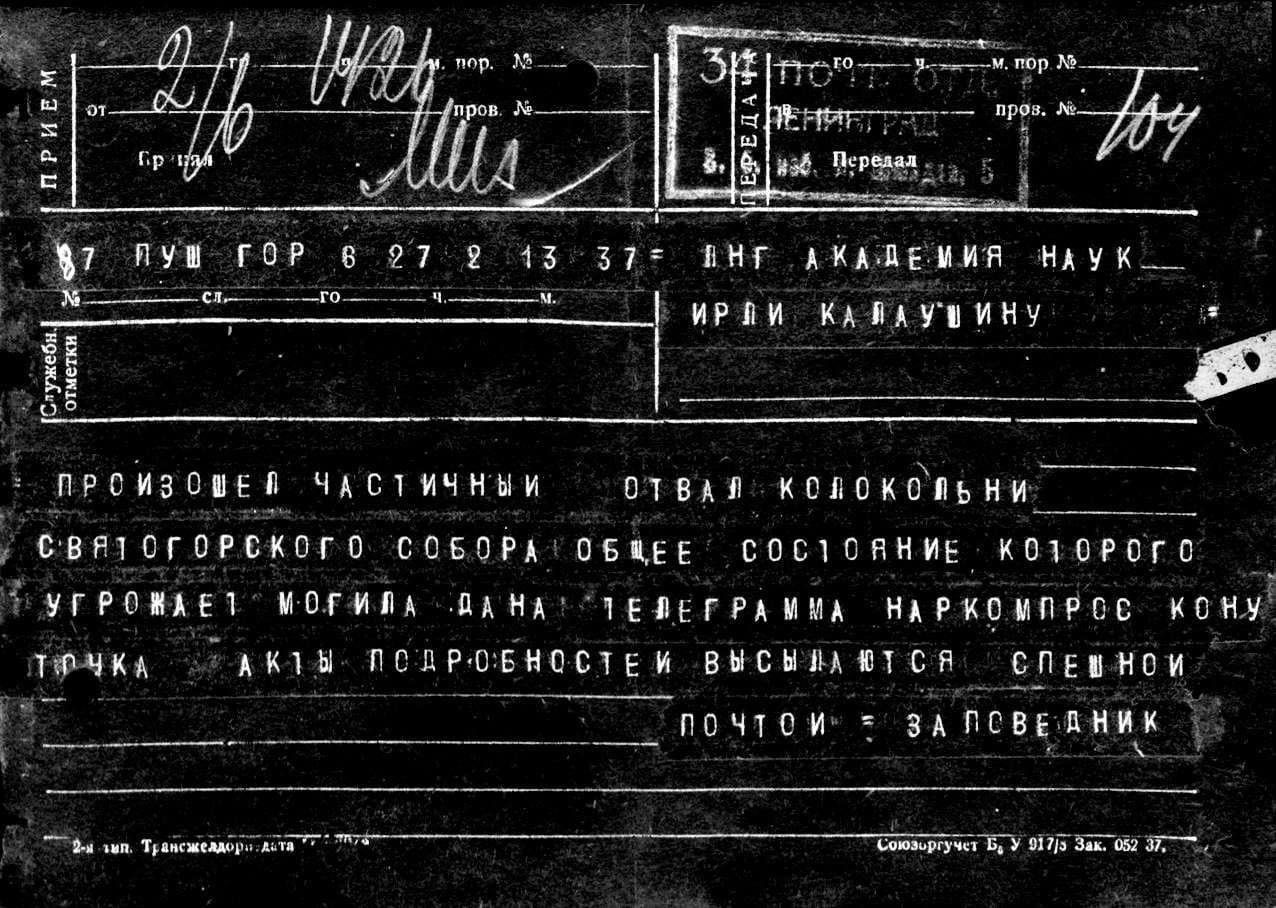
The Pushkin Reserve, declared in 1922, passed from hand to hand for ten years, and Nanny’s Cottage, as Kalaushin wrote, was “turned into an apiary and a store for all sorts of equipment”; on 16 November 1933 the Leningrad Regional Executive Committee handed the Reserve to the Academy of Sciences [◆ S071, pp. 390–391]. On 17 January 1934 the act of transfer was signed on the Academy’s side by the chairman of the commission, Zh.M. Yenukidze, by “IRLI research fellow, first class, M.M. Kalaushin” and by the technician B.V. Nikitin [◆ act of 17.01.1934, publ. in S086, no. 19, p. 196]. Supervision of the Reserve’s museum and research work was entrusted to a “troika” — Yu.G. Oksman, D.P. Yakubovich and “M.M. Kalaushin, a member of the museum staff of the Institute of Literature” [◈ S086, no. 19, p. 196]. In the summer of 1934 the head of the museum, N.L. Patsko, telegraphed “IRLI Kalaushin” in Leningrad that the belfry of the Svyatogorsk cathedral had partly collapsed and was endangering the poet’s grave [◆ S021, op. 1 (1933), d. 24, f. 104; publ. in S086, no. 112, pp. 235–236].
N.I. Granovskaya, later chief curator of the All-Union Pushkin Museum, remembered that Kalaushin went to the Reserve when “there was no house, there were ashes”, and a pig farm and a poultry farm stood on Mikhailovskoye land; in the fight to have them moved out he took “a great, great part” [◈ S086, no. 33, p. 83]. In the summer of 1935 the artists N.E. Radlov, N.K. Shvede-Radlova and L.S. Khizhinsky worked in the Reserve, and on 29–30 August the district’s first exhibition of their work was held [◆ S071, p. 392].
◇ family testimony
Matvey Matveyevich encouraged his son Boris’s gifts: “at six, at Trigorskoye, Borya went out sketching with the artists N.E. Radlov and L.S. Khizhinsky” [◇ S001, No. 213].
In June 1936 a visitor from Kalinin noted that the account of the Pushkin places given by “research fellow M.M. Kalaushin” was “extremely interesting” [◈ S107]. In the winter of 1940–41 Kalaushin sent N.I. Granovskaya to work in the Reserve [◈ S086, no. 33, p. 78]. On 8 June 1941 L.B. Modzalevsky, V.A. Manuylov, M.M. Kalaushin and V.K. Zazhurilo came from Pushkin House to the Pushkin festival at Mikhailovskoye, and Geychenko was with them [◈ S086, no. 87, pp. 252–253]. The war began two weeks later.
The blockade
In the blockade winter of 1941–42 the few staff who remained — among them M.M. Kalaushin, Ye.P. Naselenko, V.M. Glinka and N.N. Fonyakova — guarded the part of the collections left in the city and kept night watch in the attics, putting out incendiary bombs [◈ S140, pp. 9–10]. Kalaushin served as commandant of Pushkin House; in N.N. Fonyakova’s words, the safety of the building and its treasures rested on him, as did “the care of the staff (getting the ration cards, arranging visits to the sick and burying the dead)” [◈ S129].
Dmitry Likhachev recalled that Kalaushin had himself been dismissed from the Institute “one of the first” and had worked as a hospital orderly, and then came back: “After Kanailov left, M.M. Kalaushin took charge of the Institute. The dismissals stopped.” He took on V.M. Glinka, brought V.A. Manuylov closer, and later hired M.I. Steblin-Kamensky: “These four people saved the Institute until 1945” [◈ S118, p. 19]. In March 1942 it was “Kalaushin and Manuylov from the Institute of Literature” who gave Likhachev his referral to the hospital for dystrophics at the House of Scholars [◈ S118, Vospominaniya, via pravmir.ru].
In July 1942 Kalaushin was sent to Tashkent, escorting a trainload of the most valuable museum material into evacuation [◈ S129; ◈ S107]; he left V.A. Manuylov in charge at the Institute [◈ S118, p. 19]. The family spent the beginning of the blockade in Leningrad [◈ S163]; in the besieged city and then in evacuation in Tashkent, Boris, aged twelve to fourteen, made dozens of hand-written “little books”, acting as their author, illustrator and publisher [◈ S001, No. 213]. Matvey Matveyevich was awarded the Medal “For Valiant Labour in the Great Patriotic War 1941–1945”; it was shown at the All-Russian Pushkin Museum’s 2010 exhibition Tikhy podvig (“A Quiet Feat”) [◈ S129].
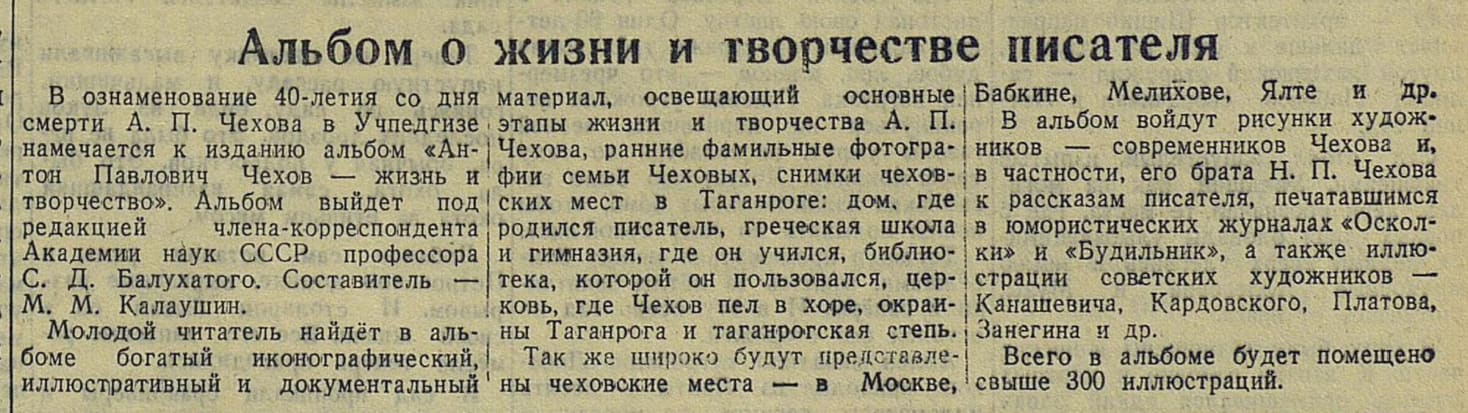
After the blockade was lifted he took charge of bringing the Institute’s treasures and property back from evacuation [◈ S107]. On 15 July 1944 Leningradskaya Pravda announced an album being prepared for the fortieth anniversary of Chekhov’s death: “Compiler — M.M. Kalaushin” [◆ S074, no. 168, 15.07.1944, p. 3]. △ This is most likely the album that appeared only in 1957 as A.P. Chekhov v portretakh, illyustratsiyakh, dokumentakh.
Mikhailovskoye, 1944–1945
In the spring of 1944 Kalaushin was searching for an old friend. S.S. Geychenko had been arrested on a false denunciation in July 1941, rehabilitated and called up into the army in July 1943, and had lost part of his left arm at the front [◈ S086, no. 71, p. 176]. On 16 April 1944 Kalaushin wrote to him at an evacuation hospital: “I want to fix you up at Peterhof. They are short of workers there. Don’t lose touch with me.” Hearing nothing, he wrote again on 15 May: “Semyon! You one-armed devil! I’m chasing you all over the Soviet Union and I can’t catch up with you!” [◈ S086, no. 71, pp. 179–180].
An act of 27 November 1944, signed by the director of the Institute of Literature, P.I. Lebedev-Polyansky, by the Reserve’s deputy director, N.I. Aksenov, by “the head of the Institute’s Literary Museum” M.M. Kalaushin and by others, recorded that the Reserve had been “completely destroyed and plundered” [◆ S024, no. 40, f. 17, via S123]. M.A. Shpineva, the Reserve’s supplies manager from August 1944, remembered: “Late in the autumn Matvey Matveyevich Kalaushin came to Mikhailovskoye from Leningrad, looked at everything, paid us our wages for all the months past and took us back with him. There’s nothing to do here in winter, he said.” The staff spent the winter in Leningrad, helping the Institute with its inventory [◈ S144, repr. S087, no. 5 (8), 2014, p. 12]. The Reserve’s archive holds his plans of the German fortifications at Savkino and in the centre of Mikhailovskoye, drawn up “while the trail was still warm” [◈ S086, no. 64, p. 33]. On 9 January 1945 the Institute’s deputy director, L.A. Plotkin, and “the head of the museum”, Kalaushin, thanked the secretary of the Pskov regional Party committee, L.M. Antyufeyev, for his help to the Reserve and for the promised working horse [◆ S025, f. 59; publ. in S086, no. 89, pp. 44–45].
In March 1945 Geychenko came to Leningrad from Tbilisi at the Academy’s summons. The Academy’s vice-president, L.A. Orbeli, told him of the decision to send him to the Reserve. “No one argued more strongly for sending me to the Reserve than Matvey Matveyevich Kalaushin, whom I knew from working in Peterhof; later, just before the war, we worked together in the museum of Pushkin House, where Matvey Matveyevich was the head,” Geychenko wrote [◈ S100, p. 176]. By Institute Order No. 59 of 15 April 1945 he was appointed director of the Reserve [◈ S086, no. 19, p. 204]. Granovskaya remembered that Kalaushin gave his friend “the very highest recommendation, which people later began to forget”; in her account (she repeats what others told her) S.I. Vavilov comes to Pushkin House and asks who is in charge of the Reserve — and “they ran straight off to fetch Matvey Matveyevich” [◈ S086, no. 33, p. 84]. △ Her memory has probably merged different meetings: Vavilov became President of the Academy of Sciences only in July 1945 [◈ S188, “Vavilov, Sergey Ivanovich”].
On 12 April 1945 Geychenko set out for Pskov with the guide L.N. Nazarova and Boris Kalaushin, “the future artist, who was travelling with me to sketch the ruined Pushkin monuments” [◈ S100, p. 179]. On 16 May the fifteen-year-old Boris finished a rough plan of the park at Petrovskoye, marking the minefield and dugouts, and he drew Nanny’s Cottage in pencil [◈ S086, no. 83, p. 177; ◈ S087, no. 2 (13), 2015, p. 3].
“He handed over the post”: the family’s words and the documents
◇ family testimony
The family history records that S.S. Geychenko was “the director of the Pushkin Reserve at the village of Mikhailovskoye, to whom Matvey Matveyevich Kalaushin handed over this post” [◇ S001, No. 71]. Of the friendship between the two museum men the family said: “They were not just colleagues, not just friends — they loved each other tenderly. That, perhaps, is how Pushkin and Delvig were friends: people remember that when they met they kissed each other’s hands” [◇ S001, No. 127].
Note on the roster. No document found so far calls Matvey Matveyevich director of the Pushkin Reserve. From 1934 he oversaw the Reserve on behalf of Pushkin House, after the liberation he looked after it in practice, and in the spring of 1945 S.S. Geychenko was appointed director on his recommendation [◈ S086, no. 19, pp. 196, 204; ◈ S100, p. 176; ◈ S086, no. 33, p. 84]. The roster also says that Geychenko was director “from 1944”; according to the Institute’s order, it was from 15 April 1945 [◈ S001, No. 127; ◈ S086, no. 19, p. 204]. △ The family’s phrase “handed over the post” most likely grew from the fact that between July 1944 and April 1945 it was Kalaushin who dealt with the Reserve for the Institute. The friendship shows, too, in M. Dudin’s comic verses for Geychenko’s birthday in 1961: Ruslan, the dog at Mikhailovskoye, “doesn’t bark at Kalaushin” [◈ S086, no. 26, p. 184].
◇ family testimony
A Caucasian thread also linked the Kalaushins with the Geychenko family. The roster records that Matvey Alekseyevich “obtained Damascus steel through Suleymanov and re-tempered it” for his kinzhals (Caucasian daggers) and shashkas; Suleymanov was the father of Geychenko’s wife, Lyubov Dzhelalovna [◇ S001, No. 71].
Context. Lyubov Dzhelalovna’s father (Dzhalalovna in the publication), the Lak Dzhalal Suleymanov, was “a jeweller and gunsmith” who had lived in Kutais (Kutaisi) “since before the Revolution” [◈ S088]. On kalausskaya stal, “Kalaus steel” — the family’s own name for the steel of the Kalaushin masters — see the chapter “The Workshop”.
The jubilee of 1949
In April 1946 the Institute made M.M. Kalaushin responsible for the restoration of the Reserve “on the museum side” [◈ S086, no. 5, pp. 62–63]. In the same year the Nekrasov museum opened in the poet’s apartment on Liteyny Prospekt — the first museum to open in Leningrad after the war; its exhibition was prepared by Kalaushin and O.V. Loman with V.E. Yevgenyev-Maksimov [◈ S086, no. 20, p. 20; ◈ S089]. On 10 February 1947 Pushkin’s apartment at Moika 12 reopened, and M.M. Kalaushin, Ye.V. Freydel and O.V. Loman signed the visitors’ book that day [◈ S086, no. 96, p. 202]. In May 1947 Geychenko and Kalaushin sent Lebedev-Polyansky the plan of the exhibition in Nanny’s Cottage for approval [◈ S086, no. 68, pp. 33–34], and Granovskaya, at Kalaushin’s request and Geychenko’s wish, was assigned to the Reserve [◈ S086, no. 33, p. 81].
In the spring of 1949 the Institute of Literature held a Pushkin session in Pskov, at which “the head of the literary museum of the Institute of Literature, M.M. Kalaushin” gave a paper on “The All-Union Pushkin Museum and the Pushkin Reserve” [◆ S075, no. 20, 15.05.1949]. On 10 June 1949 the first exhibition of the Pushkin Museum opened in the Alexander Palace at Tsarskoye Selo (then the town of Pushkin); the ribbon was cut by the President of the Academy of Sciences, S.I. Vavilov [◈ S204, Tsarskoye Selo chronicle, 10.06.1949]. Kalaushin was among those who opened this museum, the future All-Union Pushkin Museum: Mikhailovskaya Pushkiniana has published a photograph captioned “On the opening day of the All-Union Pushkin Museum in the Alexander Palace”, showing, right to left, Vavilov, Geychenko and Kalaushin [◈ S086, no. 26, p. 36]. At the 2005 exhibition the same photograph was captioned as the opening of the house-museum at Mikhailovskoye [◈ S004]. △ Vavilov was at both openings in those days — Granovskaya remembered that at Mikhailovskoye “Geychenko and Kalaushin were beside him” [◈ S086, no. 33, p. 84] — so exactly where this photograph was taken remains an open question.
Pushkin’s house-museum at Mikhailovskoye opened on 12 June 1949; on 14 June a commission accepted the exhibition, and the first name in its act is “the head of the Museum of the Institute of Literature of the USSR Academy of Sciences, Kalaushin M.M.” [◆ S024, d. 94; publ. in S086, no. 64, p. 56]. In the documents of those days he signs as head of the museum of the Institute of Literature; later publications already call him head of the All-Union Pushkin Museum [◈ S086, no. 19, p. 196, n.; ◈ S086, no. 26, p. 36]. On 19 June 1952, “in accordance with the instruction” of Kalaushin, the remains of V.P. Gannibal were moved from the graveyard by the destroyed Church of the Resurrection at Voronich to the grounds of the Reserve [◆ record of 19.06.1952, publ. in S086, no. 90, p. 185].
◇ family testimony
The grandson writes: “It was thanks to the decision and support of M.M. Kalaushin that the then young Anikushin was able to win the competition for the best monument to Pushkin” in Arts Square [◇ S004].
Documentary context. In the long discussions of the competition entries, the Pushkin scholars B.V. Tomashevsky and M.M. Kalaushin, together with the sculptors V.B. Pinchuk and V.L. Simonov, were of one mind: “In Anikushin’s work we see the greatest success” [◈ S086, no. 66, p. 136]. At the unveiling of the monument on 19 June 1957 the speakers included “the director of the All-Union Pushkin Museum, M. Kalaushin” [◆ S077, no. 171, 20.06.1957]; he spoke at the same monument again on 10 February 1962, the 125th anniversary of the poet’s death [◆ S077, no. 42, 11.02.1962].
Attacks: 1946 and 1951
In the autumn of 1946 a commission of the Pskov regional Party committee inspected the Reserve. In December the assistant director for administration, N.I. Aksenov, sent the Institute and the committee a report which said, among other things, that the Reserve’s “scientific forester” “is a relative of Kalaushin M.M., director of the Museum of the Institute of Literature”, and that “research” was being done at public expense by people who came for their holidays, including “Kalaushin, son of the director of the museum of the Institute of Literature” — that is, Boris [◆ S025, ff. 46–51; publ. in S086, no. 96, pp. 151–155]. The committee’s bureau, which met only on 20 January 1947, judged the Reserve’s work more mildly and made no attacks on individuals [◈ S086, no. 96, p. 156].
In the summer of 1949, the year of the campaign against “cosmopolitans”, an audit by the Ministry of Finance found at Pushkin House, among other things, “inflated payments for works by contemporary artists acquired for the IRLI museum” [◈ S104, n. 16]. On 26 December 1951 I.P. Lapitsky, a university lecturer, wrote to the Party Central Committee secretary G.M. Malenkov about “outrages” at Pushkin House: according to him, the Communist A.E. Parushkin had “exposed the anti-state activities of the director of the museum of Pushkin House, M.M. Kalaushin”, while Kalaushin, together with V.P. Adrianova-Perets and the chief accountant, was “gathering around himself” “bearers of bourgeois ideology”; the letter also spoke of “flagrant violations of financial discipline” [◆ I.P. Lapitsky’s letter to G.M. Malenkov, 26.12.1951, publ. in S104]. The publication says nothing of any consequences for Matvey Matveyevich. Two years later he was at the head of the new All-Union Pushkin Museum.
The All-Union Pushkin Museum
On 16 June 1953 a government decree transferred the Pushkin collections of Pushkin House, except the manuscripts and the poet’s library, to the Ministry of Culture; this was how the All-Union Pushkin Museum took shape — the Lyceum, the apartment at Moika 12, Nekrasov’s apartment and, briefly, the Pushkin Reserve [◈ S086, no. 102, p. 61]. On 17 December 1953 Kalaushin, as “acting director”, asked the Library of the Academy of Sciences to allow stock to be gathered for the library of “a new independent museum and research institution of all-Union importance” [◆ publ. in S086, no. 102, p. 63]; in April 1954 he reported to the Ministry that the former Biron stables on the Moika had been assigned to the museum and its library housed there [◆ S027, Personnel Dept., ed. khr. 12, f. 4; publ. in S086, no. 102, p. 61]. He was the museum’s first director until 1965; in December 1965 he was succeeded by M.N. Petay [◈ S150].
He chaired the museum’s purchasing committee [◈ S086, no. 78, p. 83] and took part in the discussion of the Pushkin monument for Pushkinskiye Gory (1958) [◈ S086, no. 27, pp. 183–184]; on 6 February 1960 he and colleagues from the museum visited Anna Akhmatova [◈ S093]. On a book given to the Pushkin Reserve for its fortieth anniversary on 24 March 1962 he signed himself “Director of the All-Union Pushkin Museum: M. Kalaushin” [◆ S086, no. 19, p. 229].
Notes on the roster. The roster says that Matvey Matveyevich headed the museum “almost until his death”; according to the museum, it was until 1965 [◈ S001, No. 127; ◈ S150]. According to the roster and the grandson’s sketch, the museum “was created on the basis of the Jubilee Pushkin Exhibition” of 1937, of which Kalaushin was one of the leading organisers [◈ S001, No. 127; ◈ S004]. The sources add precision: Kalaushin was one of the two scholarly secretaries of the Leningrad exhibition in the Hermitage, while the museum grew out of the All-Union Pushkin Exhibition of 1937 in Moscow, for which exhibits from Pushkin House also served as a basis [◆ S072; ◈ S191; ◈ S140, p. 9].
◇ family testimony
“On M.M. Kalaushin’s initiative and with his direct participation, 39 literary and art museums were created,” the family history records [◇ S001, No. 127; ◇ S004].
Context. An article on the founders of Russian literary museums names him as first director of the All-Union Pushkin Museum, “who initiated the creation of more than 30 literary and art museums and took part in organising them” [◈ S105]. K.B. Zhuchkov names the Pushkin museums at Boldino, Odessa and Kishinev [◈ S107].
Books and albums
Matvey Matveyevich wrote on Korolenko, Saltykov-Shchedrin, Dobrolyubov, Chernyshevsky, Gleb Uspensky, Gorky and Mayakovsky, but the link between literature and the visual arts, his grandson writes, held a special place in his work — hence his exhibitions and his series of albums in which a writer’s life is told through portraits and illustrations [◈ S004]. The principal publications:
- “Pushkinskiye mesta” (1936) and “Pushkinskaya vystavka v Leningrade” (1937, with N. Shimanov), in the Vremennik Pushkinskoy komissii.
- T.G. Shevchenko v portretakh i illyustratsiyakh (1940), compiler; M.Yu. Lermontov, exhibition catalogue (1941), with V.L. Bubnova and P.E. Kornilov, edited by B.M. Eikhenbaum [◈ S151, OL38587642W, OL42214971W].
- Pushkin v portretakh i illyustratsiyakh (1951; 2nd edn 1954), compiler [◈ S177, 01005805697].
- Nikolay Alekseyevich Nekrasov. Zhizn i tvorchestvo (1955) and A.P. Chekhov v portretakh, illyustratsiyakh, dokumentakh (1957), compiler [◈ S177, 01005896765, 01006288314].
- Editor of A.M. Gordin’s Pushkinsky zapovednik (1956) and of the catalogue Vystavka pamyati Adama Mitskevicha (1957) [◆ S076; ◈ S151].
- Pushkin i yego vremya, vol. 1 (1962), executive editor; it includes his article “Early unpublished illustrations to Ruslan and Lyudmila” [◈ S095, n. 100].
- Zdes zhil Pushkin: pushkinskiye mesta Sovetskogo Soyuza (1963), general editor with A.M. Gordin [◈ S151, OL22448219W].
The library of Pushkin House holds books he inscribed to V.A. Manuylov (1958) and B.P. Gorodetsky (1963) [◈ S083, no. 2, BAN, 2016, nos. 376–377].
Letters in RGALI
The Russian State Archive of Literature and Art (RGALI) holds Kalaushin’s letter to the critic K.L. Zelinsky (30 May 1957) and Zelinsky’s letters to him (2 February and 2 April 1957), as well as Kalaushin’s letters to the Pushkin scholar T.G. Tsyavlovskaya (19 March 1956 and 3 March 1959). Here too is Emiliya Fyodorovna Kalaushina’s letter to Yu.G. Oksman of 30 December 1968 [◈ S028, f. 1604, op. 1, ed. khr. 270, 611; f. 2558, op. 2, ed. khr. 1254; f. 2567, op. 1, ed. khr. 541]. We have not yet seen the texts of these letters.
The Kalaushins and the Chirskovs
Matvey Matveyevich was married to Emiliya Fyodorovna, née Chirskova, who had studied at a music college under the well-known musician Sergey Alpers [◈ S001, No. 127; ◈ S163]. They had a son, Boris (1929–1999), later a graphic artist and illustrator, and a daughter, Yuliya (b. 1939) [◈ S001, Nos. 127, 213, 214]. Emiliya Fyodorovna’s brother, the screenwriter Boris Fyodorovich Chirskov, married Aleksandra Aleksandrovna Kalaushina (1907–1980), daughter of Aleksandr Alekseyevich and Matvey Matveyevich’s first cousin [◈ S001, Nos. 127, 139]. So the two families were joined twice over. On 1 May 1946 the Peterhof historian N.I. Arkhipov called on Matvey Matveyevich, found Boris Fyodorovich there, and in the evening they “admired the Neva and the fireworks” together; the editor of the letter calls Chirskov “a relative of M.M. Kalaushin” [◆ letters of N.I. Arkhipov to S.S. Geychenko, publ. in S086, no. 51, p. 170].
B.F. Chirskov was born in 1904 into a priest’s family — on 23 July (5 August), according to one reference work, the same day as Matvey Matveyevich, and on 10 (23) August according to another [◈ S125; ◈ S188, “Chirskov, Boris Fyodorovich”]. In 1921 he entered the Don University, then transferred to Leningrad University, graduating in 1925; he was a curator at the Alexander Palace museum and from 1931 wrote for Lenfilm. In 1933 he was arrested and exiled to Kolpashevo; later he wrote the screenplays for Valery Chkalov, Zoya, Veliky perelom (“The Turning Point”) and Khozhdeniye po mukam (“The Road to Calvary”), and received a Stalin Prize (1946) [◈ S125; ◈ S188, “Chirskov, Boris Fyodorovich”]. △ The paths of the two young men from the South — the Don University, the transfer to Leningrad, the museums — are so alike that the families probably first met there. The Chirskovs had two sons, Nikita and Fyodor [◈ S001, No. 139]. Boris Fyodorovich died in 1966; Aleksandra Aleksandrovna and their younger son were later buried beside him in the Bogoslovskoye Cemetery [◈ S125].
Note on the roster. The roster says that Emiliya Fyodorovna “died in 1947”. The letters tell a different story: in May 1955 Arkhipov writes that “Emiliya Fyodorovna was in bed with flu”, and on 30 December 1968 she herself writes to Yu.G. Oksman [◆ S086, no. 51, p. 185; ◈ S028, f. 2567, op. 1, ed. khr. 541]. The roster itself, too, repeatedly passes on her stories. △ The year of death is probably a slip made when the manuscript was retyped.
Emiliya Fyodorovna was one of the family’s chief storytellers. It is from her that the roster records Aleksandr Alekseyevich’s service as an uryadnik (Cossack non-commissioned officer) in His Majesty’s Own Convoy, the Emperor’s Cossack bodyguard, in 1904–1908, and the birth of his son Boris in the Convoy barracks on Shpalernaya Street [◇ S001, No. 74]. Those St Petersburg years also help in matching the dates of another family account: the saddle for the Shah of Persia.
◇ family testimony · confirmed by relatives
The saddle for the Shah of Persia was made on the order of Emperor Nicholas II in the workshop of Fedot Alekseyevich, Matvey Alekseyevich’s brother; the work took two months, and Fedot Alekseyevich took the saddle to St Petersburg himself. At a review of the Guards, on his last day before going home at the end of his service, Prince Trubetskoy reported to the Emperor that the saddle had arrived. Nicholas II examined it, said it was very well made, and there and then congratulated the master on the title of Purveyor to the Court of His Imperial Majesty; the gold watch promised with the title never reached Fedot Alekseyevich [◇ S001, No. 73]. The story is recorded in the family history, and relatives confirm it [◇ S003].
△ hypothesis · dating
The years point to 1900. Fedot Alekseyevich served in the Convoy from 1892 and was discharged by Order No. 60 of the Kuban Cossack Host of 17 June 1900, “retaining the Guards uniform and awarded the badge for service in the Convoy” [◈ S001, No. 73]. The only state visit of a Persian shah to St Petersburg during his service was that of Mozaffar ad-Din Shah, 4–10 July 1900 (17–23 July New Style) [◆ S036, no. 181, 11.07.1900, p. 3; ◆ S037, 4–10.07.1900, 2011 edn]. It was known well in advance: in February 1900 the press reported the invitation sent to the Shah, and in April the route of his journey [◆ S048, 15.02.1900, p. 7; ◆ S051, 25.04.1900, p. 3]. Two months’ work on the saddle therefore falls in the spring of 1900, and the “review on the last day” matches the farewell presentation of the departing Convoy Cossacks at Tsarskoye Selo on 31 May 1900, when the Emperor spoke a few words to each man and handed out the badges for service in the Convoy with his own hands [◆ S036, no. 150, 10.06.1900, p. 3; ◆ S037, 31.05.1900, 2011 edn] — the very badge with which Fedot Alekseyevich was discharged. The most consistent dating is spring to early summer 1900: the saddle was being prepared for Mozaffar ad-Din Shah’s visit. Other meetings with shahs fit the account less well: Naser al-Din Shah was in St Petersburg in May 1889, in the reign of Alexander III, before Fedot Alekseyevich’s service began; Nicholas II met Mozaffar ad-Din near Kursk in 1902 and at Peterhof in 1905, when Fedot Alekseyevich had already left the Convoy; and for Ahmad Shah’s coronation in Tehran in 1914 Russia sent a special envoy [◈ S127; ◆ S054, 19.09.1902, p. 2; ◆ S037, 20–24.08.1905; ◆ S049, 21.07.1914].
A note on names. In the family account it is “Prince Trubetskoy” who reports the saddle to the Emperor. In 1900 the Convoy was commanded by Baron Alexander Meyendorff; Prince Georgy (Yury) Ivanovich Trubetskoy took command in 1906 and held it until 1914 [◈ S097, p. 170; ◈ S188, “Sobstvenny Yego Imperatorskogo Velichestva Konvoy”, list of commanders]. △ The family most likely kept the name of this later, better-remembered commander, under whom Fedot’s younger brother, Aleksandr Alekseyevich, served in the Convoy [◇ S001, No. 74]. Fedot Alekseyevich’s title of Purveyor to the Court is confirmed by the official list of 1915 [◈ S108]. The whole story, with the archives where documents about the saddle may be found, is told in the chapter “The Workshop”.
Last years and remembrance
On the eve of New Year 1952 the Kalaushins celebrated Boris’s wedding [◆ S086, no. 51, p. 182]. At the end of 1963 Matvey Matveyevich spent about a month in the Academy hospital, and in 1966 Arkhipov writes that he visits him now and then: “he is incurably ill” [◆ S086, no. 51, pp. 190, 192]. Matvey Matveyevich Kalaushin died on 10 December 1968 [◈ S001, No. 127; ◈ S107]. Three weeks later Emiliya Fyodorovna wrote to Yu.G. Oksman, who in 1934 had sat with her husband on the “troika” overseeing the Reserve [◈ S028, f. 2567, op. 1, ed. khr. 541; ◈ S086, no. 19, p. 196].
◇ family testimony
Matvey Matveyevich and Emiliya Fyodorovna are buried in the Bogoslovskoye Cemetery in St Petersburg, next to the Chirskovs; a bust of Matvey Matveyevich stands on his grave [◇ S001, Nos. 127, 139, 224].
For his sixtieth birthday in 1964 the staff of the Pushkin Reserve gave him a watercolour of Pushkin’s study at Mikhailovskoye, in a mount bearing dozens of signatures [◆ watercolour address of 1964, image: S004]. In the exhibition “The Keeper’s Study” at Mikhailovskoye (as described in 2002) his photograph has its place: “he was bound to the Pushkin Museum Reserve by both professional and friendly interest” [◈ S086, no. 21, p. 62].
For his centenary, in 2004, the All-Russian Pushkin Museum opened the exhibition Nash pervy direktor (“Our First Director”) in the Biron stables at Moika 12; his grandson attended the opening [◈ S001, No. 127]. From 11 February to 17 March 2005 the Mikhailovskoye Museum Reserve showed the exhibition Matvey Matveyevich Kalaushin: Centenary of His Birth; for it his grandson wrote the biographical sketch quoted throughout this chapter [◈ S004; ◈ S001, No. 127]. In Labinsk, on the initiative of local historians, a memorial plaque has been placed on No. 1 Khalturina Street, the house where he was born and where his family lived [◈ S170, 27.04.2025; ◈ S001, No. 127].
Documents
1944. “During the three years in which the German occupiers held sway, from July 1941 to July 1944, the Pushkin Reserve… has been completely destroyed and plundered.” — Act of 27 November 1944, signed by P.I. Lebedev-Polyansky, N.I. Aksenov, M.M. Kalaushin and others [◆ S024, no. 40, f. 17, via S123]
1945. “…we are most grateful to you for your kind consent to give the Reserve one working horse for the necessary maintenance and restoration work…” — Letter from the Institute of Literature of the USSR Academy of Sciences to L.M. Antyufeyev, secretary of the Pskov regional Party committee, 9 January 1945; signed by L.A. Plotkin and “head of the museum M.M. Kalaushin” [◆ S025, f. 59; publ. in S086, no. 89, pp. 44–45]
1949. “We, the undersigned, the head of the Museum of the Institute of Literature of the USSR Academy of Sciences Kalaushin M.M., the Director of the Pushkin Reserve of the USSR Academy of Sciences Geychenko S.S. … have drawn up the present Act to the effect that the museum exhibition on the theme ‘The Life and Work of Pushkin’, housed in the House-Museum at the village of Mikhailovskoye, has been accepted…” — Act of acceptance of the exhibition, 14 June 1949 [◆ S024, d. 94; publ. in S086, no. 64, p. 56]
Where the documents may be found
- St Petersburg Branch of the Archive of the Russian Academy of Sciences (SPbF ARAN), f. 150 (Institute of Russian Literature): M.M. Kalaushin’s personnel file (1931–1953); op. 1 (1934), ed. khr. 7 — minutes of the Pushkin Commission; op. 1 (1933), d. 24 — correspondence with the Reserve.
- Research Archive of the Pushkin Reserve (Mikhailovskoye Museum Reserve): Institute Order No. 59 of 15.04.1945; d. 40 (act of 27.11.1944; the 1947 plan for Nanny’s Cottage); d. 94 (act of 14.06.1949); Pl/ch, d. 14 (the 1946 plan based on Kalaushin’s); PZ-KP-250 (plan of the Petrovskoye park, B.M. Kalaushin, 1945). Also the photographic collection, the materials of the 2005 exhibition and the 1964 watercolour address (location to be confirmed).
- ODNILS GAPO (Pskov), f. 1219, op. 1, d. 352, ff. 45–59 — correspondence of the Institute and the Reserve with the regional Party committee, 1945–1946.
- RGALI: f. 1604, op. 1, ed. khr. 270, 611; f. 2558, op. 2, ed. khr. 1254; f. 2567, op. 1, ed. khr. 541; f. 2968, op. 1, ed. khr. 99 (copy of a 1948 letter to “M.M. Koloushin” — possibly to him); for B.F. Chirskov, f. 631, op. 40, ed. khr. 1465.
- TsGALI St Petersburg — M.M. Kalaushin’s correspondence with V.A. Manuylov about the evacuation (fond number to be confirmed).
- Archive of the All-Russian Pushkin Museum: Personnel Dept., ed. khr. 12; materials of the exhibition Nash pervy direktor (2004).
- Pushkinskaya entsiklopediya “Mikhailovskoye”, vol. 1 (2003), section “Personalii”; an obituary may be found in the Pushkin Commission’s publications of 1968–1970.
- Manuscripts Department of the National Library of Russia, f. 117 (V.V. Bush), ed. khr. 125 — letters of V.E. Yevgenyev-Maksimov mentioning Kalaushin.
- On the saddle for the Shah of Persia (in detail in the chapter “The Workshop”): RGIA, f. 468 (His Imperial Majesty’s Cabinet) — gifts to the Shah in 1900, a watch for Uryadnik Kalaushin; f. 472 — the file on F.A. Kalaushin’s purveyor title; f. 516 — the Chamber-Fourier Journal for 1900; GAKK, Krasnodar — the text of Kuban Host Order No. 60 of 17.06.1900.
Documents and illustrations
Images held by rights holders
- Image held by the rights holder — permission requested
Photograph · 06.1949 ◈ published source
M. M. Kalaushin, S. S. Geichenko and S. I. Vavilov on the opening day of the All-Union Pushkin Museum, 1949
Caption in the publication: "On the opening day of the All-Union A. S. Pushkin Museum in the Alexander Palace. Right to left: President of the USSR Academy of Sciences Academician S. I. Vavilov, director of the Mikhailovskoye State Museum Reserve S. S. Geichenko, director of the All-Union A. S. Pushkin Museum M. M. Kalaushin." Matvei Matveevich is on the left. The opening took place on 10 June 1949; on museum.ru the same photograph is captioned as the opening of the house-museum at Mikhailovskoye [Mikhailovskaya Pushkiniana, issue 26, p. 36].
ГМЗ «Михайловское» (публикация); исходный снимок — архив ПЗ или ВМП (не установлено)
Publ.: Mikhailovskaya Pushkiniana, issue 26; Mikhailovskoye Museum Reserve
- Image held by the rights holder — permission requested
Photograph · 06.1949 ◈ published source
M. M. Kalaushin, S. S. Geichenko and S. I. Vavilov, June 1949 (museum.ru version)
The same photograph as published by "Museums of Russia", captioned "At the opening of the A. S. Pushkin house-estate at Mikhailovskoye, 1949"; left to right, M. M. Kalaushin, S. S. Geichenko, S. I. Vavilov (per the caption in Mikhailovskaya Pushkiniana, issue 26). The sources differ on where it was taken — the Alexander Palace on 10 June or Mikhailovskoye on 12–14 June 1949 [museum.ru, N20942].
Выставка ГМЗ «Михайловское» 2005 (museum.ru); копия — Wayback Machine
"Museums of Russia" (museum.ru), Mikhailovskoye Museum exhibition, 2005
- Image held by the rights holder — permission requested
Photograph · 10.06.1949 ◈ published source
S. I. Vavilov at the opening of the Pushkin Museum in the Alexander Palace, 10 June 1949
"President of the USSR Academy of Sciences S. I. Vavilov at the opening of the first exhibition of the Pushkin Museum in the Alexander Palace, 1949" (source caption). The opening took place on 10 June 1949. The heavy-set man on the right behind the microphones resembles M. M. Kalaushin; this is our conjecture — he is not named in the caption [Encyclopaedia of St Petersburg, Tsarskoye Selo chronicle, 10 Jun 1949].
Энциклопедия Санкт-Петербурга (encspb.ru); автор снимка не указан
Encyclopaedia of St Petersburg (encspb.ru)
- Image held by the rights holder — permission requested
Photograph · 1940–1960 ◈ published source
Matvei Matveevich Kalaushin (1904–1968), portrait
Matvei Matveevich Kalaushin (1904–1968) — staff member and director of the Literary Museum of Pushkin House, curator of the Pushkin Reserve on behalf of the Institute of Literature; on his recommendation S. S. Geichenko was appointed director of the Reserve in 1945; in 1949 he opened the All-Union A. S. Pushkin Museum in the Alexander Palace. Portrait from the centenary exhibition [museum.ru, N20942; Mikhailovskaya Pushkiniana, issues 19, 26, 51].
Семейный архив / ГМЗ «Михайловское» (выставка 2005, museum.ru)
"Museums of Russia" (museum.ru), Mikhailovskoye Museum exhibition, 2005
- Image held by the rights holder — permission requested
Work of art · 1964 ◆ documented
Pushkin's study at Mikhailovskoye — a watercolour given to M. M. Kalaushin for his 60th birthday, 1964
Watercolour of A. S. Pushkin's study in the house-museum at Mikhailovskoye, in a mount signed by the staff and inscribed: "To dear Matvei Matveevich Kalaushin on his sixtieth birthday… From the staff of the Pushkin Reserve", 1964. The artist is not identified [museum.ru, N20942].
Семейное / музейное собрание (выставка ГМЗ «Михайловское» 2005, museum.ru)
"Museums of Russia" (museum.ru), Mikhailovskoye Museum exhibition, 2005
- Image held by the rights holder — permission requested
Photograph · 1949 ◈ published source
M. M. Kalaushin with his family at Mikhailovskoye, 1949
"M. M. Kalaushin with his family at Mikhailovskoye, 1949" (source caption). The other people are not named [museum.ru, N20942; exhibition "Matvei Matveevich Kalaushin: centenary", Mikhailovskoye Museum Reserve, 2005].
Семейный архив / ГМЗ «Михайловское» (выставка 2005, museum.ru)
"Museums of Russia" (museum.ru), Mikhailovskoye Museum exhibition, 2005
- Image held by the rights holder — permission requested
Work of art · 1945 ◈ published source
B. M. Kalaushin, "Nanny's Cottage", Mikhailovskoye, 1945
Boris Matveevich Kalaushin's pencil drawing "Nanny's Cottage", 1945: Mikhailovskoye soon after its liberation; the artist was 15 or 16, and the sheet is signed "BKalaushin 45". Published in the Pushkin Reserve's newspaper for the 70th anniversary of Victory [Pushkinsky Ugolok, 2015, No. 2 (13), p. 3].
Место хранения оригинала не указано (вероятно, ГМЗ «Михайловское»)
© heirs of B. M. Kalaushin; published by the Mikhailovskoye Museum Reserve
- Image held by the rights holder — permission requested
Work of art · 1950 ◆ documented
B. M. Kalaushin, "Mikhailovskoye. View of the estate", 1950 (cover of Mikhailovskaya Pushkiniana, issue 89)
Cover of Mikhailovskaya Pushkiniana, issue 89, "The Pushkin Reserve in the 20th Century" (2022), with Boris Matveevich Kalaushin's drawing "Mikhailovskoye. View of the estate. 1950" from the Pushkin Reserve collection [Mikhailovskaya Pushkiniana, issue 89].
ГМЗ «Михайловское», ПЗ-КП-415 Г-190
© heirs of B. M. Kalaushin; Mikhailovskoye Museum Reserve
- Image held by the rights holder — permission requested
Work of art · 1941 ◈ published source
Boris Kalaushin's home-made booklet "Two Notebooks", 1941
A home-made booklet Boris Kalaushin made as a boy: "The Green Lamp Library. Chant-Tulle. Two Notebooks", with the imprint "Literature and Children", MCMXLI (1941); on the left, the mark of his childhood "publishing house", "LI". Copies of Boris's home-made books from the years of the Siege and the evacuation were given to the People's Museum "And the Muses Were Not Silent…" [Khukhrina 2022, p. 30, fig. 3].
Семья Б.М. Калаушина (оригинал, по-видимому); копии — Народный музей «А музы не молчали…», СПб.
Family archive; published in O. V. Khukhrina, Kulturnaya zhizn Yuga Rossii, 2022, no. 3
- Image held by the rights holder — permission requested
Photograph · 1934 ◇ family testimony
The family of Dzhalal Suleimanov, 1934
The family of Rukizhat (Lyubov) Dzhalalovna Suleimanova, later the wife of S. S. Geichenko; she is in the third row, left, with her father Dzhalal and mother Shamai in the second row; photograph of 1934. Dzhalal, a Lak from Kazi-Kumukh, had been a jeweller and armourer in Kutaisi "since before the Revolution". According to the Kalaushin family account, Matvei Alekseevich obtained Damascus steel "through Suleimanov, the father of Geichenko's wife" [Abdurakhmanova, Pskovskaya Gubernia, 2013, No. 10 (632); Roster of A. B. Kalaushin, no. 71].
Семейный архив Сулеймановых — Гейченко; публикация газеты «Псковская губерния» (2013)
Suleimanov–Geichenko family archive; Pskovskaya Gubernia, 2013
Sources for this chapter
- S001 — A.B. Kalaushin’s roster Kalaushiny (philippov.spb.ru, version 03.02 of 13 July 2025)
- S003 — Family testimony: V.O. Kalaushin, 8–9 Oct 2026
- S004 — N.G. Firtich, “Matvey Matveyevich Kalaushin: on the centenary of his birth” (museum.ru, N20942, 2005)
- S021 — SPbF ARAN, f. 150 (Pushkin Commission)
- S024 — Pushkin Reserve Research Archive
- S025 — ODNILS GAPO, f. 1219, op. 1, d. 352
- S027 — Archive of the All-Russian Pushkin Museum
- S028 — RGALI (online catalogue and inventories)
- S036 — Kavkaz newspaper (Tiflis)
- S037 — Dnevniki imperatora Nikolaya II, vol. 1 (Moscow: ROSSPEN, 2011)
- S044 — Illyustrirovanny vestnik… progressa Rossii, no. 1 (1898)
- S048 — Wiener Zeitung, 1900 (ANNO)
- S049 — Prager Tagblatt, 1900, 1914 (ANNO)
- S051 — Vorarlberger Volksblatt, 1900 (ANNO)
- S054 — Ostdeutsche Rundschau, 1902 (ANNO)
- S070 — Nauka i nauchnye rabotniki SSSR, pt 5 (Leningrad, 1934)
- S071 — M.M. Kalaushin, “Pushkinskiye mesta” (Vremennik Pushkinskoy komissii 1, 1936)
- S072 — M. Kalaushin and N. Shimanov, “Pushkinskaya vystavka v Leningrade” (Vremennik Pushkinskoy komissii 3, 1937)
- S073 — Vremennik Pushkinskoy komissii 6 (1941)
- S074 — Leningradskaya Pravda, 1944
- S075 — Ogonyok, 1949
- S076 — A.M. Gordin, Pushkinsky zapovednik (Moscow, 1956; ed. M.M. Kalaushin)
- S077 — Pravda, 1957, 1962
- S083 — Izdaniya s darstvennymi nadpisyami iz sobraniya biblioteki Pushkinskogo Doma, no. 2 (St Petersburg, 2016)
- S086 — Mikhailovskaya Pushkiniana, the Mikhailovskoye Museum Reserve series
- S087 — Pushkinsky Ugolok, newspaper of the Pushkin Reserve
- S088 — Z. Abdurakhmanova, “Roditelsky dom neprikosnovenen” (Pskovskaya guberniya, 2013)
- S089 — L.G. Agamalyan, “Entsiklopediya ‘Literaturnye muzei Rossii’ i Literaturny muzey Pushkinskogo Doma” (2021)
- S093 — M.V. Bokarius, “Glavny khranitel” (All-Russian Pushkin Museum library website)
- S095 — V.E. Vatsuro, “Pushkiniana v periodike i sbornikakh statey (1961–1962)” (1963)
- S097 — N.V. Galushkin, Sobstvenny Yego Imperatorskogo Velichestva Konvoy (San Francisco, 1961)
- S100 — S.S. Geychenko, U Lukomorya (Leningrad, 1986)
- S104 — P. Druzhinin, “Pushkinsky Dom pod ognyom bolshevistskoy kritiki” (NLO, 2011)
- S105 — L.M. Epifanova, “K voprosu personifikatsii istorii… literaturnykh muzeyev” (2024)
- S107 — K.B. Zhuchkov, “Poyezdka v Pushkinskiye Gory v 1936 g.” (Pskov, 2020)
- S108 — I.V. Zimin et al., Yuvelirnye sokrovishcha Rossiyskogo imperatorskogo dvora (Moscow, 2013)
- S118 — D.S. Likhachev, “Kak my ostalis zhivy” (Neva, 1991)
- S123 — I.Yu. Parchevskaya, “‘Vot kabinet…’” (Vestnik Pskovskogo gosudarstvennogo universiteta, 2014)
- S125 — S. Petrova, “Chirskov Boris Fyodorovich” (Literatory Sankt-Peterburga. XX vek)
- S127 — Ye. Preobrazhenskaya, “Vizity shakha Persii v Rossiyu” (Naslediye Imperii)
- S129 — A.G. Rabinyants, “Tikhy podvig” (All-Russian Pushkin Museum library website)
- S137 — V.V. Turchanenko, “Nauchnye zasedaniya… Pushkinskoy komissii AN SSSR… 1931–1936 gg.” (2020)
- S140 — A.I. Khvatov, Literaturny muzey Pushkinskogo Doma (Leningrad, 1982)
- S144 — M.A. Shpinyova, “Vsya nasha semya zapovedniku sluzhila” (1994; repr. 2014)
- S150 — museumpushkin.ru: “140 years of the first Pushkin museum”
- S151 — Open Library (openlibrary.org)
- S163 — All-Russian Pushkin Museum: exhibition “Boris Kalaushin: From the Academy to Abstraction” (2015)
- S170 — F.I. Moiseyenko Labinsk Museum of History and Local Lore (labinskiymuzey.ru)
- S177 — Russian State Library (RSL), online catalogue
- S178 — National Library of Russia (RNB/NLR), online catalogue
- S188 — Russian Wikipedia — for general historical context
- S191 — A.D. Margolis, “Pushkina A.S. Vserossiysky muzey” (Tsarskoye Selo encyclopaedia)
- S204 — Encyclopaedia of St Petersburg (encspb.ru)
This page uses material from the Kalaushin family roster published on the Philippov website: https://philippov.spb.ru/?q=Kalaushiny (version 03.02 of 13 July 2025).