Chapter 1 of 14 · 17th century – present
The Name
Kalaushin: a travelling bag, an earflap hat and the Kalaus River
In brief
Where the rare surname Kalaushin came from, and how clerks wrote it down — from “Trofim Pakhomov Kalaushin” in the census return of 1815 to “Koloushin”, “Kaloushin” and “Kelaushin the 1st”. The chapter brings together the dialect words *kalaush* (a travelling bag) and *kalaushka* (an earflap hat), the history of the Kalaus River and the family’s account of Yuliya Matveyevna and S.S. Goloushev, and ranks the explanations of the name by likelihood.
◆ documented◈ published source◇ family testimony△ hypothesisMore about the method
The thread· Quality
The name is rare — by forebears.io’s estimate, borne by about 220 people in 2014 [◈ S148, 2014 data] — and that is a circumstance, not a merit. The chapter gathers every spelling, from “Kaloushin” to “Kelaushin the 1st”, in one place and ranks the theories of origin by likelihood. The Kalaus River also echoes in the family’s own name for its masters’ steel — “Kalaus steel”: kinzhals made with it, the family history records, were very highly valued in the Caucasus [◇ S001, No. 71].
Kalaushin is a rare name. The surname website forebears.io estimated that in 2014 about 94 people bore the masculine form and about 127 the feminine form, Kalaushina, almost all of them in Russia [◈ S148, 2014 data]. None of the dictionaries of Russian surnames we have been able to consult explains it. This chapter gathers what the documents, the dictionaries and the family’s own memory tell us about the name: how it was written down, which words and which river it echoes — and which of the explanations seems the most likely.
The earliest record
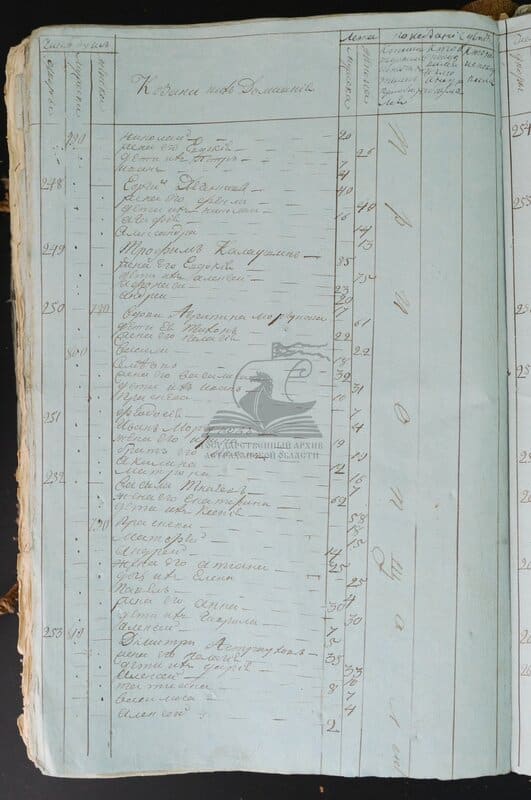
The earliest Kalaushin known to us from documents is Trofim Pakhomovich Kalaushin, a Cossack of the Khoper Regiment living in Stavropolskaya stanitsa (a Cossack village). In the family roster he appears as the unnamed founder of the line, born “around 1740” [S001, No. 1]. In the revizskaya skazka — the household return compiled for the poll-tax census, or “revision” — drawn up for the stanitsa on 18 November 1815 (Old Style, like all Russian dates in this chapter before 1918), he heads household No. 321: “Trofim Pakhomov Kalaushin”, aged 78, with his wife Avdotya and their children Ivan, Anna, Aleksey, Afanasy and Andrey [◆ S007, no. 321, from a transcription on S181, topic 84017]. He was therefore born about 1737. In the confessional registers of Stavropol uyezd (district) for 1822–1825 the clerk wrote “Трофимъ Калаушинъ” (Trofim Kalaushin) and gave his age as 85 [◆ S008, scan 1287, via S160].
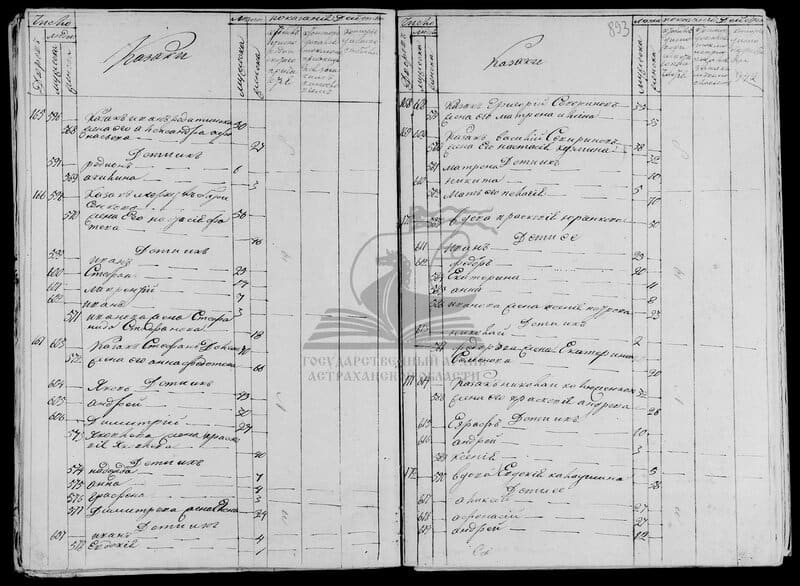
By 1827 Trofim Pakhomovich was no longer alive. In the confessional register of Batalpashinskaya stanitsa (now Cherkessk) his wife appears as “the widow Yevdokiya Kalaushina” — Avdotya is simply the everyday form of Yevdokiya — with her sons Aleksey, Afanasy and Andrey; the eldest son, Ivan, already had a household of his own [◆ S009, scans 161, 163, via S160]. The family had moved to the Kuban with the other Cossacks of Stavropolskaya: in 1826–1827 the Stavropol Cossacks were resettled in the stanitsas of Batalpashinskaya and Karantinnaya [◈ S181, topic 84017, publisher’s introduction to the 1815 revision tale].
The patronymic “Pakhomov” preserves the name of one more generation: Trofim’s father was called Pakhom. Nothing else is known of him.
How the Kalaushins came to the Khoper Regiment has not yet been established. The name does not appear in the published transcriptions of the lists of Novokhopyorsk fortress of 1771 or of the first settlers of Stavropolskaya in 1782 [◈ S102, vol. 1, pp. 278–284, 404–418; ◈ S006, — both via S181, topic 84017]. △ Trofim may have joined the regiment later, or lived at that time in another Khoper stanitsa. The compiler of the family roster, Aleksandr Borisovich Kalaushin [S001, No. 221], who “for more than 40 years gathered the facts grain by grain” about the family, thought the founder was “most likely a Don Cossack” [◈ S001, dedication; No. 1]. This is his suggestion; it can only be tested against the 18th-century lists of the Don and Khoper Cossack settlements.
Note on the roster. The roster enters the founder (No. 1) without a first name, born “around 1740”, with sons Ivan and Aleksey, and places in the next generation an Aleksey (No. 2), born “around 1791”, husband of Yevdokiya and father of seven sons. According to the revision tale of 1815 and the confessional registers of 1822–1827, Yevdokiya’s (Avdotya’s) husband was Trofim himself, and Aleksey was their son, born about 1796–1800 [◆ S007, no. 321; ◆ S008; ◆ S009]. The compiler, who did not have the revision tale of 1815 to hand, got the essentials right: the founder was born around 1740, and his sons included Ivan and Aleksey. △ It seems there was no separate generation of an “Aleksey born c. 1791”.
One name, many spellings
From the very first documents the name wavers. The revision tale of 1815 and the confessional registers of the 1820s write “Калаушин” (Kalaushin); but in a statement of July 1830 valuing the orchards of the Cossacks of “the former Stavropolskaya stanitsa”, Trofim’s orchard is described as “formerly belonging to the retired Cossack Trofim Калоушин” (Kaloushin) [◆ S010, no. 155, from a transcription on S181, topic 39076]. A year later, in the list of surnames from the household inventory of Batalpashinskaya, the name occurs twice — as “Калаушен” (Kalaushen) and “Калаушин” [◈ S011, list of surnames via S181, topic 3165].
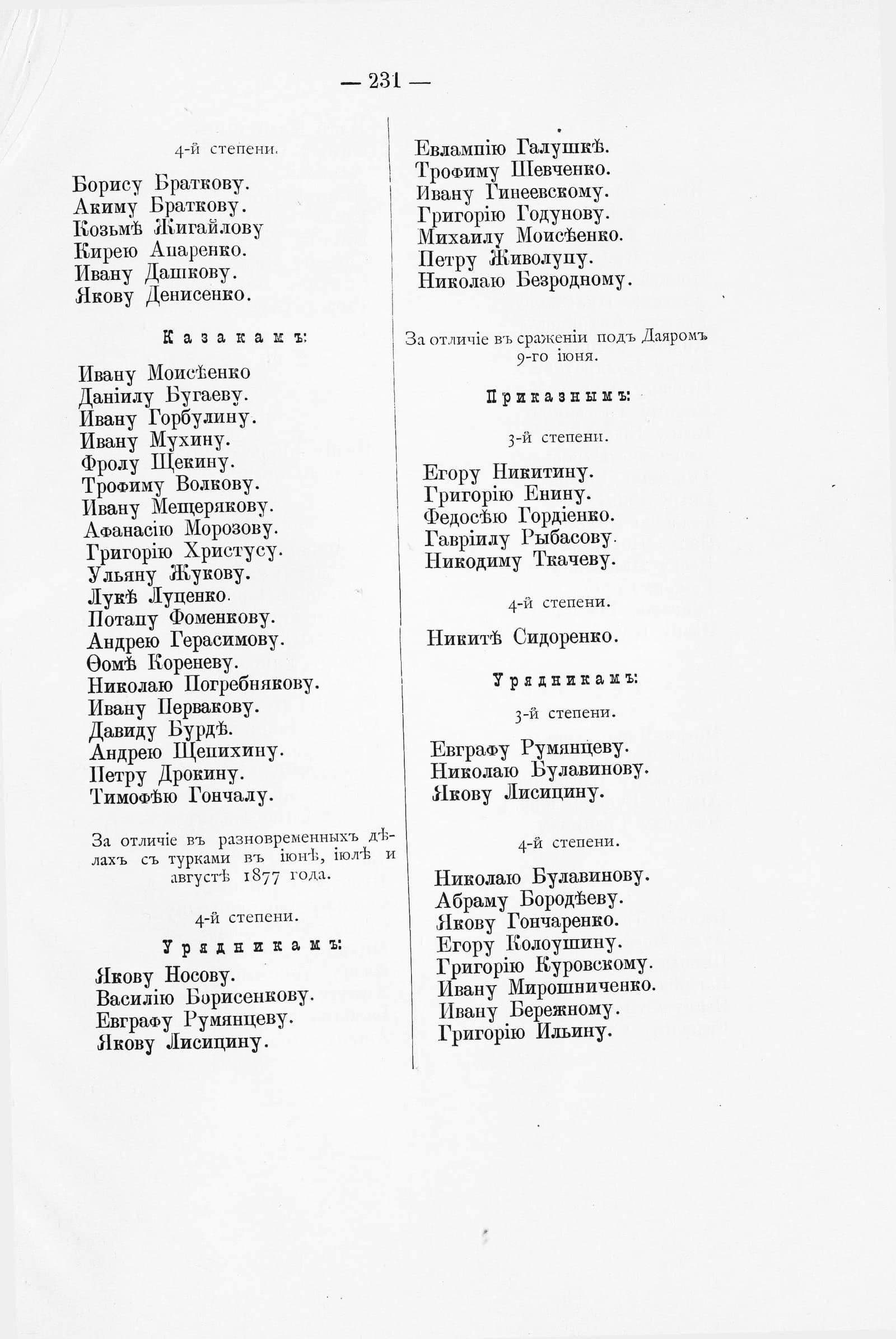
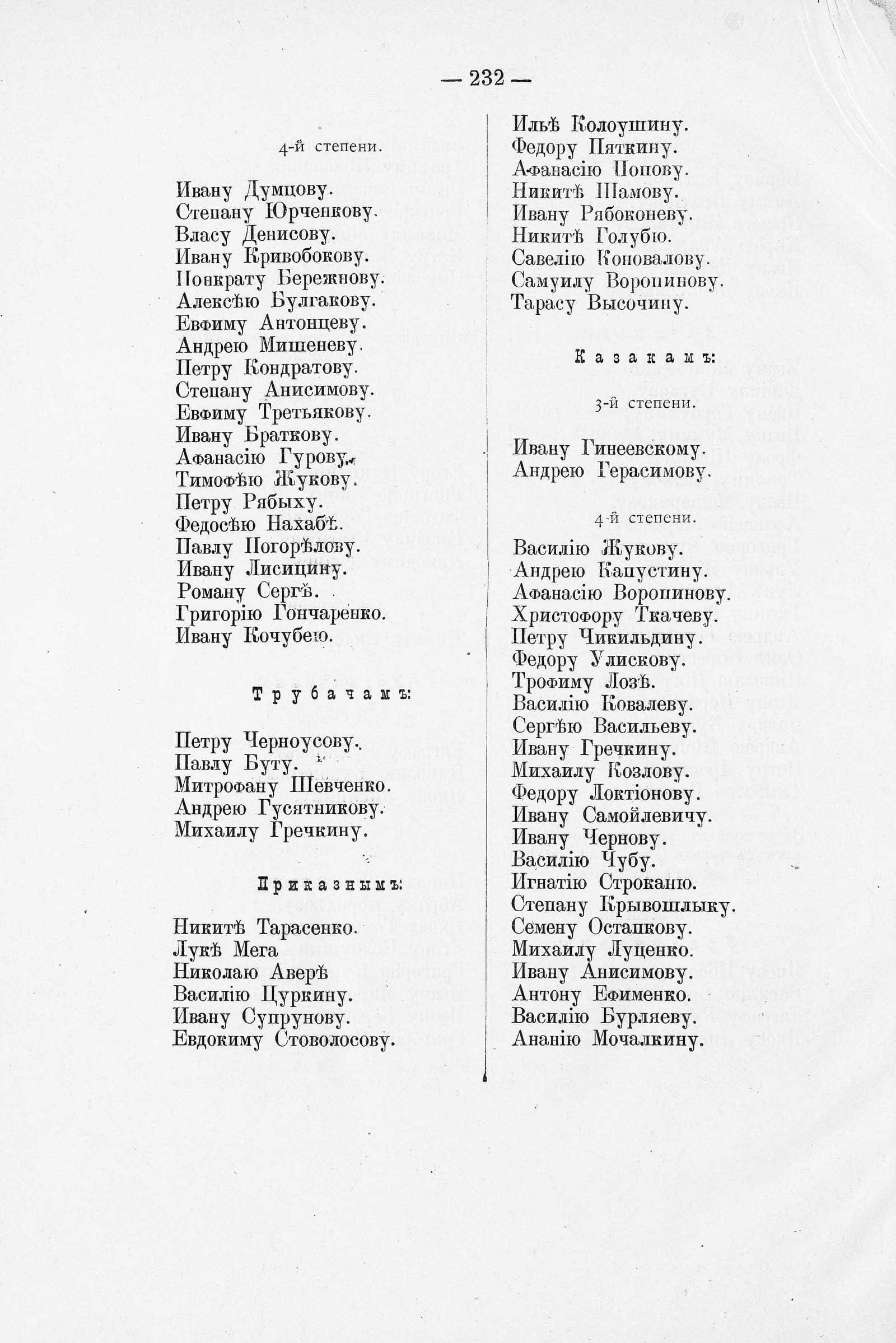
Later the variety only grows. For the battle of Dayar on 9 June 1877, in the Russo-Turkish War, two Cossacks of the family serving in the 2nd Khoper Regiment received the Insignia of the Military Order, 4th class: Uryadnik (Cossack non-commissioned officer) Yegor (Georgy) Afanasyevich Kalaushin [S001, No. 42] and the prikazny (lance corporal) Ilya Nikolayevich Kalaushin [S001, No. 34]. In the award list printed by the regiment’s historian, V.G. Tolstov, they appear as “Егору Колоушину” and “Илье Колоушину” — Koloushin [◆ S053, App. 74, pp. 231–232]. The roster calls them “Uryadnik Yegor КОлОушин” and “Prikazny Ilya КалОушин”, the compiler marking in capitals the letters that differ from the usual spelling [◈ S001, No. 34].
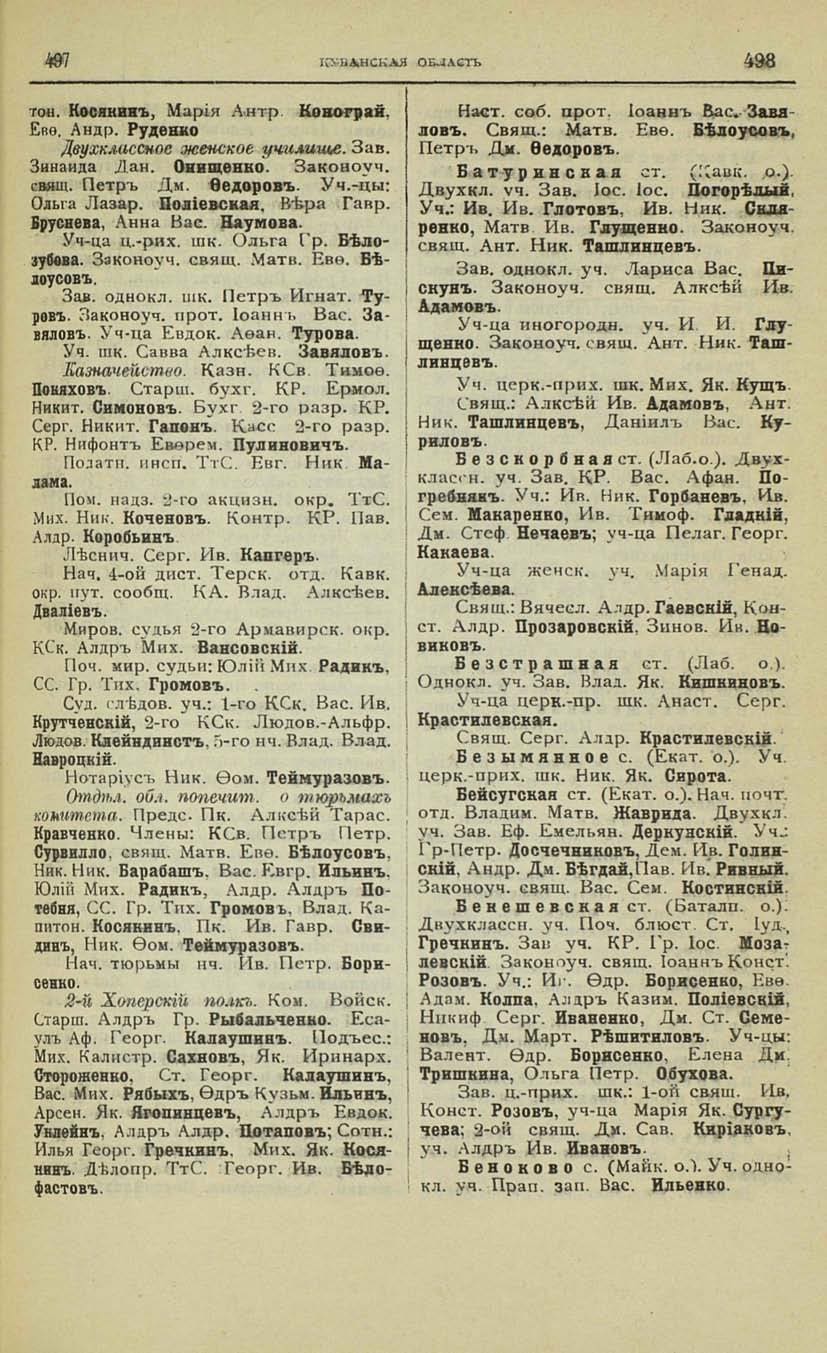
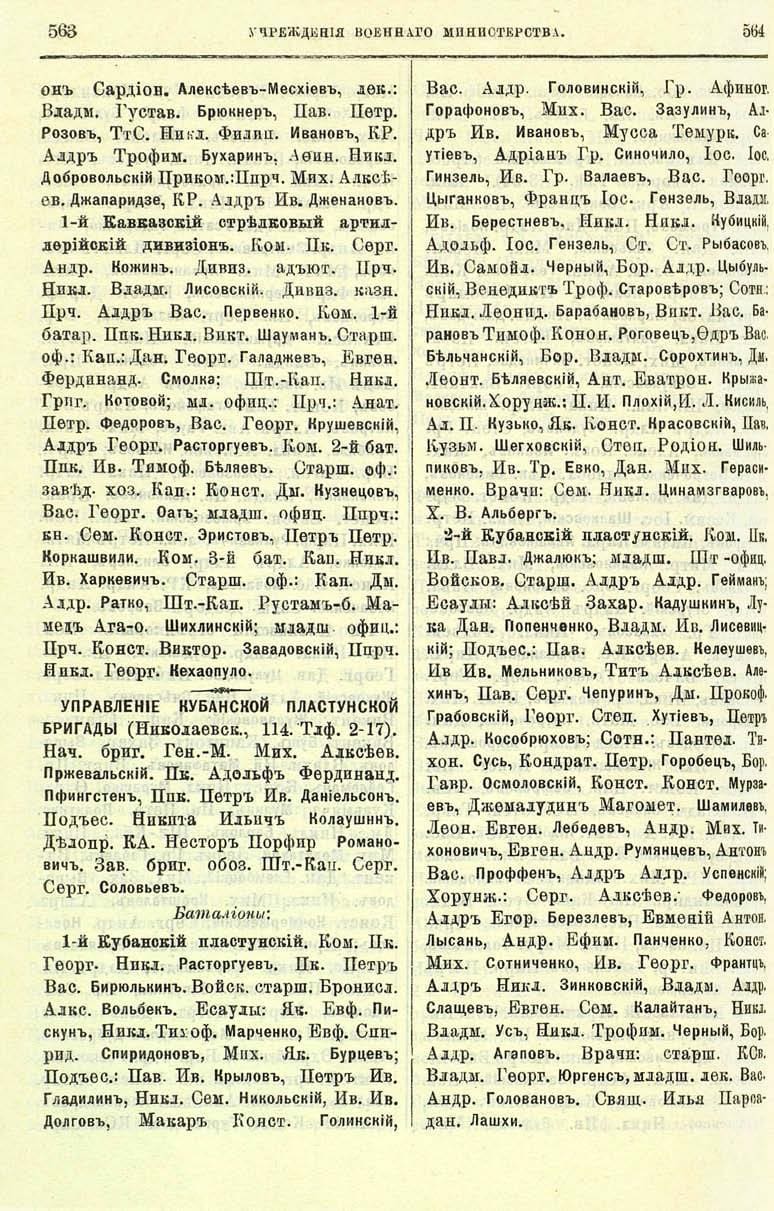
According to the roster, the Caucasus Calendar once printed Yegor Afanasyevich’s sons, the 2nd Khoper Regiment officers Afanasy Yegorovich (Georgiyevich) [S001, No. 92] and Stepan Yegorovich (Georgiyevich) [S001, No. 93], as “Келаушин 1-й” and “Калаушин 2-й” — Kelaushin the 1st and Kalaushin the 2nd (around 1909, to judge by the context in the roster). The compiler remarked that “errors of this kind are very common both in the literature and in archival documents” [◈ S001, No. 92]. In the calendar for 1910 both brothers are printed alike: “Есаулъ Аф. Георг. Калаушинъ” (Yesaul Af. Georg. Kalaushin) and “Подъес.: … Ст. Георг. Калаушинъ” (Podyesaul … St. Georg. Kalaushin) — a yesaul being a Cossack captain and a podyesaul a staff captain [◆ S058, 1910, pt 2, col. 497]. In the calendar for 1914, Podyesaul Nikita Ilyich Kalaushin [S001, No. 85] became “Колаушинъ” (Kolaushin) in the staff list of the Kuban Plastun (foot Cossack) Brigade, while in the address section of the same volume he remained “Калаушинъ” [◆ S058, 1914, PDF pp. 932, 1235].
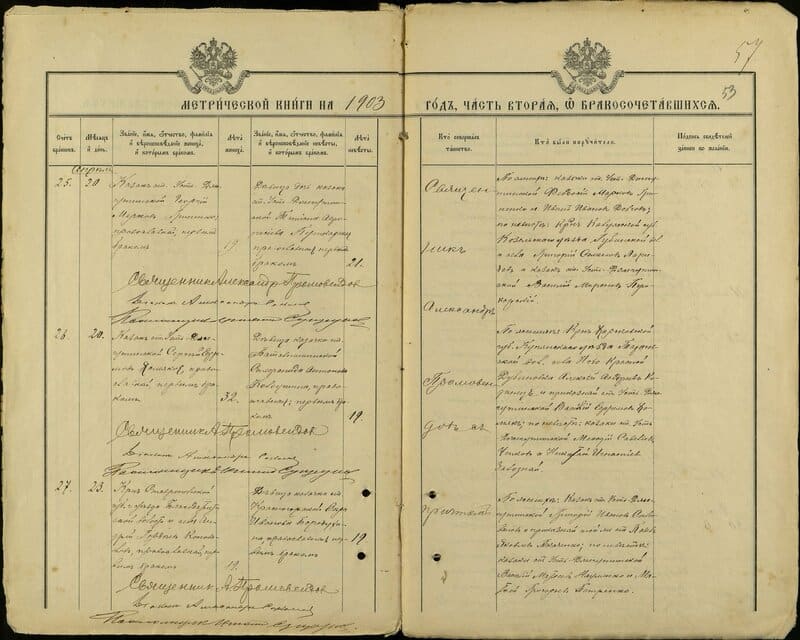
A bride from Batalpashinskaya is entered in a parish register of 1903 as “Стефанида Антонова Колоушина” (Stefanida Antonova Koloushina) [◆ S015, d. 18, scan 54, via S160]. The Red Army soldier Nikolay Sergeyevich Kalaushin [S001, No. 186], who died of wounds on 14 June 1943 and was buried at Myskhako, appears in the casualty report as “Калоушин” (Kaloushin) [◆ S022, f. 58, op. 18001, d. 1214, via S174, record 54432432]. And the branch that lived in Vladikavkaz — the descendants of Makar Grigoryevich (No. 46) and Nikolay Makarovich (No. 102) — is entered in the roster as “КОлОушины”, Koloushin [◈ S001, Nos. 46, 102].
Put all these records side by side and a pattern emerges. The stressed part of the name, “-у́шин” (-úshin), never changes; only the unstressed beginning moves about: “Ка-”, “Ко-”, “Ке-”, “-ла-”, “-ло-” (Ka-, Ko-, Ke-, -la-, -lo-). △ The clerks rendered the unstressed vowel as each of them heard it. That instability in itself suggests that the root of the name was not felt to be a familiar word; otherwise the spelling would have held on to that word, as the “Голо-” (Golo-) of the surname Goloushev does. It is curious, too, that the Ka-/Ko- wavering repeats pairs known to the dictionaries of Russian dialects: kalaush — koloush, kalaushka — koloushka (more on these below).
The name is stressed on the third syllable, on the u: Kalaúshin. This is how the family pronounces it [◇ S003], and it is also how Russian Wikipedia gives it [◈ S188, “Kalaushin”]. In none of the documents of the family that we have found and examined is it written with a “Г” (G).
Documents
◆ “No. 321. Trofim Pakhomov Kalaushin, 78. His wife Avdotya, 70. Their children: Ivan, 22; Aleksey, 16; Afanasy, 12; Andrey, 9; Anna, 19.” Revision tale of Stavropolskaya stanitsa of the Khoper Cossack Regiment, 18 November 1815 [◆ S007, no. 321, from a transcription on S181, topic 84017]
◆ “6th — formerly belonging to the retired Cossack Trofim Калоушин [Kaloushin].” Statement of the value of the establishments belonging to the Cossacks of the former Stavropolskaya stanitsa, July 1830, section “Orchards” [◆ S010, no. 155, from a transcription on S181, topic 39076]
◆ “For distinction in the battle of Dayar on 9 June. … To uryadniks: … 4th class. … to Yegor Колоушин [Koloushin]” (p. 231); “to Ilya Колоушин” (p. 232, among the prikazny). V.G. Tolstov, History of the Khoper Regiment of the Kuban Cossack Host. Appendices. Tiflis, 1901 [◆ S053, App. 74, pp. 231–232]
A bag on the back: kalaush, koloush, kalauz
The word that stands closest to the surname is one that Vladimir Dal recorded as belonging to Vologda and Siberia: “KALAUZ, kalaus, kalaush (masc.) … a pouch, pocket; a purse, bag, sack, drawstring pouch; a small case, knapsack, bundle of belongings”, and, figuratively, “capital, wealth, a purse” [◈ S190, s.v. “kalauz”]. Max Vasmer gives the same forms — kaláuz, kaláus, kaláush, “pocket; bag; small case” — and derives the word from Tatar kalauz, kalaɣuz, “knapsack” [◈ S202, s.v. “kalauz”].
The Dictionary of Russian Folk Dialects (SRNG) adds detail. Kalaush is a small travelling bag, a knapsack, a bundle, a pocket, a purse, and in Tomsk (1852) even “capital, wealth”; it was recorded in Veliky Ustyug, Vologda, Tobolsk and Irkutsk, and in Veliky Ustyug in 1902 the variant koloush was noted too; kalaushek is a bag or knapsack (Omsk, 1863) [◈ S198, no. 12, 1977, pp. 336–337]. Koloush is defined in the same dictionary as “a leather or cloth bag drawn shut with cords; a pouch” (Veliky Ustyug, 1898) [◈ S198, no. 14, 1978, p. 190]. In the Russian North a kalaush was a small linen bag carried over the shoulder or on the back; in one village of the Mezen district a speaker told the dialectologists: “There were no satchels in the old days — they sewed kalaushi out of scraps” [◈ S196, vol. 5, 2011, pp. 27–28]. The word even became a place name: there is a village called Kalauz in the Nikolsky district of Vologda Oblast [◈ S196, vol. 4, 2009, s.v. “zaklad”; ◈ S182, “Kalauz”].
V.S. Kuchko, the author of a special study of this family of words, follows A.E. Anikin in treating kalaush, “bag”, as a loanword from Turkic (Tatar qalauz ~ qalaγuz, “knapsack”) [◈ S116, p. 198]. The Dictionary of the Russian Language of the 11th–17th Centuries has no entries for kalauz, koloush or koloushnik: as a common noun, kalaush is known only from dialect records of the 19th and 20th centuries [◈ S199, no. 7, 1980, pp. 33, 253]. (The Kalaus River, discussed below, is mentioned as early as 1627.)
A hat with earflaps, and the koloushnik
A second set of words sounds almost the same but has a different origin. In Vologda Governorate a kalaushka was an earflap hat — “a hat of young reindeer fur with ear-pieces” (Totma, 1902) [◈ S198, no. 12, 1977, p. 337]. In the Babushkinsky and Nyuksensky districts of Vologda Oblast, kalaushka, koloushka and kaloushka have been recorded in the same sense, and the sewn-on ear-piece of a winter hat was called a kalaushechka or a koloushek [◈ S196, vol. 5, 2011, pp. 28, 38; ◈ S116, p. 188]. The form kaloushka is an exact parallel to the spelling “Kaloushin”.
The hat word has figurative meanings as well: a kalaushka is “a frivolous, forward person” or “a foolish, muddle-headed one”. Next to it stand kalaushnik, a chatterbox or fibber, and the verb kalaushit, to beat [◈ S116, pp. 188–189]. In Novgorod, Tver and Pskov governorates Dal recorded “KOLOUSHNIK … a gossip, tale-bearer, whisperer” and koloushnichat, to gossip [◈ S190, s.v. “koloushnik”].
Kuchko explains these words as native Russian formations: kolo (“around”) + ushi (“ears”) — a hat that sits “around the ears”; the gossiping koloushnik he derives from the same “around the ears”, and kalaushit, “to beat”, from ogloushit, “to stun” [◈ S116, pp. 190, 196, 201]. The whole group, he concludes, is heterogeneous: beneath the single outward form kalaush-/koloush- lie four series of words which seem to have arisen independently of one another and only later drawn together [◈ S116, p. 201]. His article does not mention the surname Kalaushin. And in Arkhangelsk Oblast even a fish — the gudgeon — was called a kalaus [◈ S196, vol. 5, 2011, p. 27].
The Kalaus River
The name also echoes a river. The Kalaus is a steppe river of the Stavropol region, a left tributary of the Western Manych, 436 km long [◈ S188, “Kalaus”]. Russians have known it since the 17th century. The Kniga Bolshomu chertezhu (“Book of the Great Map”, 1627) calls it both “Kulauz” and “Kalauz” in a single passage: “And from the other side the river Kulauz falls into the Manach; the course of the Kulauz river is 350 versts… And below the Kalauz river the Great Yegerlik falls into the Manach” [◆ S085, via Wikisource]. A record of questioning dated 8 May 1640, published among the Donskie dela (“Don Affairs”), mentions a place “at the mouth of the Kalauza river, eight days’ journey from Astrakhan and six from Azov” [◆ S103, bk 2 (RIB, vol. 24, 1906), no. 3, col. 25].
The origin of the river’s name is disputed. M.A. Bulgarova derives it from the Nogai Kylavyz: Kylavyz > Kulauz > Kalauz — Kalaus [◈ S114, after Bulgarova 1999]; other authors from Turkic kala, “town”, or kalaus, “border” [◈ S188, “Kalaus”, after Tvyordy 2008]. In 1858 I.D. Popko translated “Kalaus” as “guide”, but he was writing about a different body of water, the Kalaus channel in the Kuban delta [◈ S126, pt 1, p. 17, n.]. Turkish kılavuz and Hungarian kalauz do mean “guide” [◈ S183, “kılavuz”, “kalauz”], but in the Russian dictionaries — Dal, Vasmer, the SRNG — kalauz means a bag, pocket or sack, and never a guide [◈ S190, s.v. “kalauz”; ◈ S202, s.v. “kalauz”; ◈ S198, no. 12, 1977, p. 336].
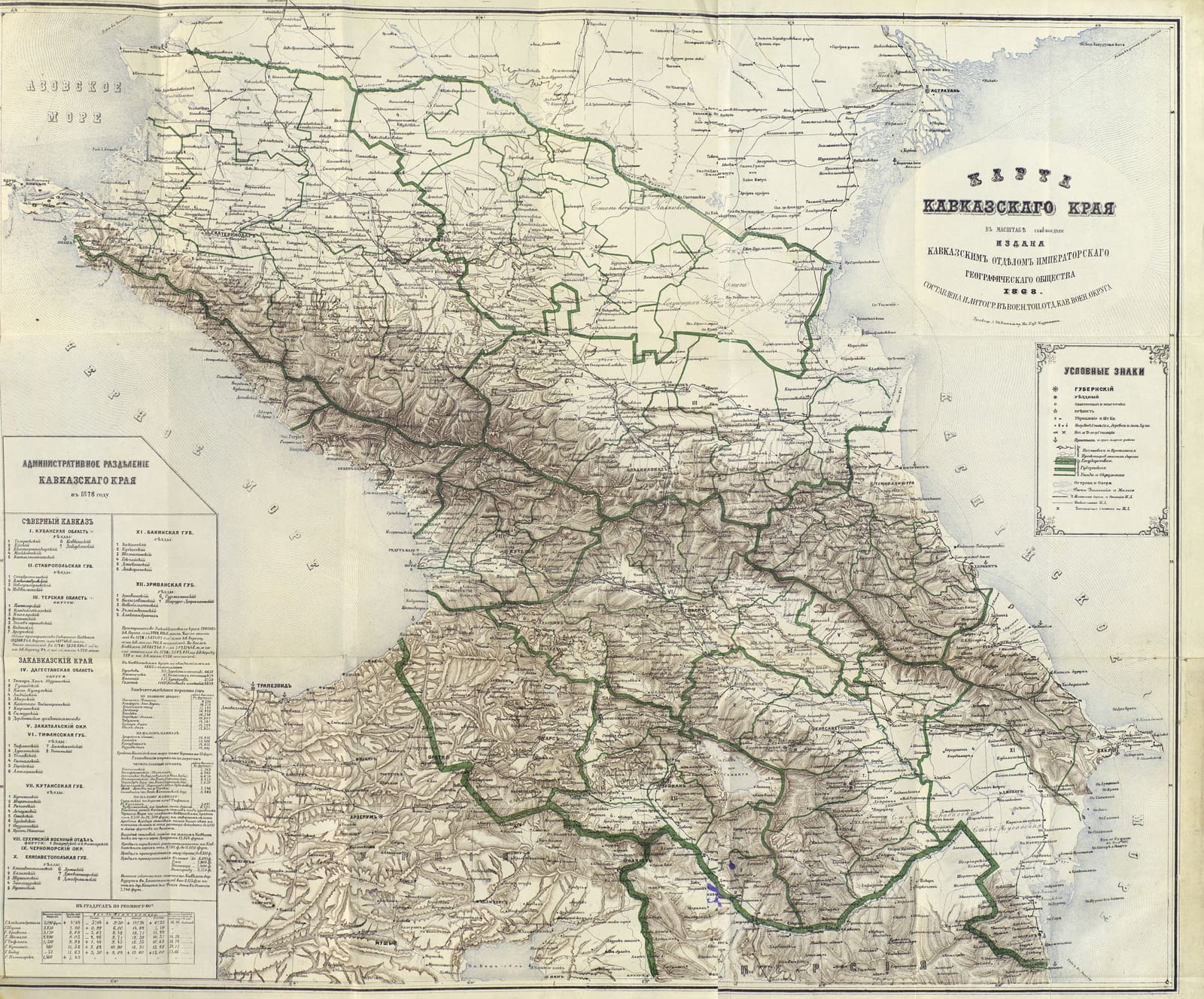
The Kalaus is firmly linked with the Khoper Cossacks. As V.G. Tolstov writes, after the Treaty of Küçük Kaynarca of 1774 “it was determined that our border in the Caucasus should be considered to be the rivers Kalaus and Yeya” [◆ S047, pt 1, ch. 2]. On 5 October 1777 the Vladimir Dragoon Regiment set out with the Khoper Cossacks towards “the Black Forest, to the tracts of Tashla and Kalaus” [◈ S124]. The future Stavropol — fortress No. 8, “at the head of the Yegorlyk, called the Tashla” — was planned to guard, together with its neighbour, “the passage between the heads of the Kalaus and the Black Forest”, and the Aleksandrovskaya (later Severnaya) fortress was built on a tributary of the Kalaus [◆ S047, pt 1, ch. 2; ◈ S124]. In this country — by the headwaters of the Kalaus and the upper Yegorlyk, on the Azov–Mozdok Line — the Khoper Cossacks lived from 1777 to 1825, until the regiment was moved to the Kuban and the Kuma [◆ S047, pt 1, ch. 2; ◈ S135]. And it was here, in Stavropolskaya stanitsa, that Trofim Pakhomovich Kalaushin was recorded in 1815.
The name of the river is echoed, too, by a phrase from the family’s own language — kalausskaya stal, “Kalaus steel”.
◇ family testimony · the story of Matvey Alekseyevich’s workshop The family recalls that Matvey Alekseyevich Kalaushin [S001, No. 71], to make his weapons, obtained Damascus steel through Suleymanov — the father of Lyubov Dzhelalovna Geychenko (née Suleymanova) — and re-tempered it, and that in the Caucasus “daggers of Kalaus steel were very highly prized”; in support the family cited the testimony of the Arabist historian Leonid Lavrov [◇ S001, No. 71].
△ hypothesis · “Kalaus steel” “Kalaus steel” is the family’s own name for the steel of the Kalaushin masters. Most likely it stands for kalaushinskaya, “the Kalaushins’ steel”: in the Caucasus, imported Damascus blade steel that a well-known master had re-forged and specially tempered was called after him — “Bazalay steel”, “Chilli buolat” [◈ S091, PDF p. 58]. In the sound of the word one also hears the Kalaus, by whose headwaters the Khoper Cossacks lived for almost half a century, from 1777 to 1825 [◆ S047, pt 1, ch. 2].
Yuliya Matveyevna and Sergey Goloushev
◇ family testimony · recorded by the compiler of the roster Yuliya Matveyevna Kalaushina [S001, No. 123], Matvey Alekseyevich’s daughter, was born in 1890 (or, by other accounts, in 1884), lived in Batalpashinsk, was a teacher, and died unmarried before 1944. The family history records that she “corresponded and met with S.S. Goloushev, the well-known artist (1855–1920)”, and that “many of the versions of the origin of the surname KALAUSHIN came from her and from him” [◇ S001, No. 123]. The roster does not say which versions Yuliya Matveyevna and her correspondent held.
Sergey Sergeyevich Goloushev (1855–1920), better known under the pen-name Sergey Glagol, was a physician, painter and graphic artist, an art and theatre critic and a notable figure in the artistic life of Moscow in the early 20th century; as a young man he studied at the gymnasiums of Stavropol and Orenburg [◈ S188, “Goloushev, Sergey Sergeyevich”]. △ The “S.S. Goloushev, the well-known artist” of the roster is evidently this same man: the initials and the dates agree. B.-O. Unbegaun explains that glagol is the Church Slavonic name of the letter G [◈ S201, p. 186] — the letter with which Sergey Sergeyevich’s real surname begins.
The likeness of the two names strikes one at once: Goloúshev and Kalaúshin share the same structure and the same stress. The dictionaries of surnames, however, derive them from different roots. Goloushin, according to Unbegaun, comes from Golovushin (compare golovushka, “little head”) [◈ S201, p. 128]; Goloushev, according to Yu.A. Fedosyuk, from goloushy — said of a man cropped so short that his hair did not touch his ears, or of one who went about bareheaded [◈ S203, s.v. “Goloushev”]. In Dal, goloukhy is a person whose ears are “bare, not overgrown, uncovered” [◈ S190, s.v. “goly”]. The dialect dictionaries also have golousha, a woman who goes about with her head uncovered [◈ S198, no. 6, s.v. “golousha”].
Which is most likely: the explanations in order
The surname Kalaushin is not in the dictionaries of V.A. Nikonov (1993), B.-O. Unbegaun (1989) or Yu.A. Fedosyuk (1972), in S.B. Veselovsky’s Onomastikon (1974) or in N.M. Tupikov’s dictionary of Old Russian personal names (1903); I.M. Ganzhina’s dictionary of modern Russian surnames (2001) has not yet been available to us [◈ S193; ◈ S201; ◈ S203; ◈ S186; ◈ S200]. Nor have we found in the Donskie dela, in Tupikov or in Veselovsky anyone surnamed Kalaushin or Koloushin, or nicknamed Kalauz, before 1740 [◈ S103, bks 1–4 (RIB, vols 18, 24, 26, 29), via OCR; ◈ S200; ◈ S186]. Everything that follows is therefore our own reasoning, arranged from the more to the less likely.
△ hypothesis · first explanation — the most likely, though not proven A nickname from a dialect word with the stem kalaush-/koloush-. It may be kalaush, a knapsack, in which case the nickname went to a man with a bag on his back — a wanderer, a pedlar, a man in service — just as kalita, a purse or pouch, gave the surname Kalitin, alongside Kotomkin, Sumin, Meshkov and Koshelev (all from words for bags and purses). Or it may be kalaushka or koloushnik — an earflap hat, a chatterbox, a gossip — in which case it was a nickname for a man’s character. In its favour: the stem matches exactly the words recorded by Dal and Vasmer, in the SRNG and SGRS and by Kuchko; the stress matches in many words of the group (koloúsh, kalaúshek, kalaúshka, koloúshnik — and Kalaúshin), although the “bag” word itself is more often recorded as kaláush [◈ S202, s.v. “kalauz”; ◈ S116, p. 198]; the Ka-/Ko- wavering in the documents repeats the pairs in the dictionaries; and the sequence -au-/-ou-, rare inside a Russian word, points either to a borrowing (kalauz) or to the seam of a compound (kolo + ushi) — and this group of words has both. Against it are geography and grammar. The words were recorded in the Russian North, in Siberia and in the north-west; they are absent from the Don dictionaries we consulted, from the dictionary of the dialect of the Kuban stanitsa of Otradnaya and from that of the Nekrasov Cossacks [◈ S185; ◈ S192; ◈ S197, vol. 2; ◈ S195; ◈ S194]. Surnames in -in are usually formed from words ending in -a/-ya (Borodin from boroda, “beard”; Ilyin from Ilya) [◈ S201, p. 26]: from the masculine kalaush one would rather expect Kalaushev, and from the feminine kalaushka Kalaushkin, while a form kalausha is unknown to the dictionaries. The objection is softened by the fact that the Don Cossacks were constantly joined by newcomers from many districts, the northern ones among them, so that a nickname could have come to the Don with the man who bore it.
△ hypothesis · second explanation — possible, but weak After the Kalaus River. A man might have been nicknamed after a river where he had been or served. For it: the river was known to Russians as early as 1627, it is mentioned in the Donskie dela in 1640, and in 1777 the Khoper Cossacks came precisely “to the tracts of Tashla and Kalaus”. Against it: in every source we have found the river’s name has z or s, while the surname has sh; in the common noun the forms kalauz, kalaus and kalaush live side by side, but for the river we have not met a form in sh; surnames from river names are usually formed in -sky or -ov; and Trofim Pakhomovich was born about 1737, forty years before the Khoper Cossacks reached the Kalaus, so the nickname would have had to arise earlier — on the Don, on campaigns in the steppe.
△ hypothesis · third explanation — unlikely Kalauz, “guide”. A Cossack who led the way across the steppe might have been called by the Turkic word kılavuz. But in Russian the word is not attested in the sense of “guide”: of the sources found, only I.D. Popko, in 1858, interpreted the name of the Kalaus channel that way; and the same difficulties remain — z against sh, and the suffix -in.
△ hypothesis · fourth explanation — unlikely as a direct origin From the surname Goloushin or Goloushev. The likeness of the two names naturally suggests a kinship. But the dictionaries derive Goloushin and Goloushev from a different root — golov- (“head”) or golo- (“bare”); a change of initial g to k is not regular in Russian; and in all the documents of the family that we have found and examined, the name is written with a K. None of this touches the family’s memory that Yuliya Matveyevna and S.S. Goloushev discussed the origins of the name.
△ hypothesis · fifth explanation — nothing to go on A pet name in -usha, or the verb kalaushit. Surnames in -ushin with the suffix -ush- do exist (Malushin, Radushin, Gorbushin, Khvastushin) [◈ S201, p. 128], but no suitable first name with the stem Kala-/Kolo- has been found: Kolusha (from Nikolay) would have given Kolushin. A nickname for a brawler from kalaushit, “to beat”, is a special case of the first explanation.
A rare name
According to forebears.io (2014 data), the Kalaushins are most numerous in Moscow Oblast, Karachay-Cherkessia and St Petersburg, and — for the feminine form — in Stavropol Krai; the form Koloushin is borne by about three people, and Goloushin by about 38 [◈ S148, 2014 data]. △ This distribution is consistent with almost all of today’s Kalaushins descending from a single Khoper Cossack family.
Namesakes did, however, live far from the Kuban. Parish registers of the 19th and early 20th centuries, machine-read by Yandex Archive Search, mention peasants named Kalaushin from Valuysky district of Voronezh Governorate living in Sergiyevskaya settlement in the Maykop department (1893, 1909), an Orenburg Cossack of the yedinoverie, the Old Rite in union with the Church (1870), a priest of the Vladimir diocese (1832), and a priest and a sexton in parishes of the Omsk consistory (1867–1877); an Omsk register of 1814–1815 mentions a “village of Kalaushina”. In Irkutsk Governorate and Yakutsk Oblast the form Kalaushev occurs repeatedly in the 19th and early 20th centuries [◈ S160, machine reading, 08.10.2026; originals not checked]. Nothing is known of any kinship between them and the Khoper Kalaushins. △ If these readings are confirmed, they will show that the stem kalaush- gave rise to surnames in the very regions where the dictionaries recorded the word kalaush — and in Siberia also with the suffix -ev that grammar would lead us to expect from the masculine kalaush.
Where the documents may be found
- GASK, f. 748, op. 1, d. 1 — the original revision tale of Stavropolskaya stanitsa, 1815 (household No. 321); the returns of the 5th (1795) and 6th (1811) revisions of the Khoper Regiment — where Trofim Pakhomovich came from, and whether his father Pakhom was still alive.
- GAAO, f. 599, op. 2, d. 3684 and 7148 — the confessional registers of Stavropol district, 1822–1825, and of Batalpashinskaya, 1827 (full-resolution scans).
- RGIA, f. 383, op. 30, d. 520 — the file on the allotment of pasture land to the town of Stavropol, with the statement of 1830.
- RGVIA, f. 14877, op. 1, d. 5159 — the confessional registers of Batalpashinskaya for 1828 (ff. 178–214) and 1830 (ff. 501–518); GARO, f. 226, op. 7, d. 271 — the household inventory of the stanitsa for 1831 (the full text, not only the list of surnames).
- RGADA, f. 23, op. 1, d. 19 — the original list of the first settlers of Stavropolskaya, 1782; lists of the stanitsas of Severnaya, Moskovskaya and Donskaya from the late 18th century; the census books of the Don and Khoper settlements and the returns of the early revisions; the Akty, otnosyashchiesya k istorii Voyska Donskogo (“Acts relating to the history of the Don Host”).
- The Caucasus Calendar for 1909, a complete copy (National Library of Russia, State Public Historical Library, National Electronic Library, Presidential Library) — the entry “Kelaushin the 1st”.
- Dictionaries and toponymic works we have not seen ourselves: I.M. Ganzhina, Slovar sovremennykh russkikh familiy (2001); M.A. Bulgarova, Nogayskaya toponimiya (Stavropol, 1999); A.V. Tvyordy, Kavkaz v imenakh, nazvaniyakh, legendakh (Krasnodar, 2008).
- The manuscript materials of A.B. Kalaushin (source [10] of the roster) and the papers of Matvey Alekseyevich’s descendants — on Yuliya Matveyevna and the “versions of the origin of the surname”; RGALI, f. 734 — the personal papers of S.S. Goloushev (Sergey Glagol), 1900–1920.
- The original parish and confessional registers with the forms Kalaushin and Kalaushev: State Archive of Irkutsk Oblast, f. 50; Historical Archive of Omsk Oblast, f. 16; National Archive of the Republic of Sakha (Yakutia), f. I-225, I-226; State Archive of Orenburg Oblast, f. 173; National Archive of the Republic of Adygea, f. 77; Central State Archive of Moscow, f. 229 (Vladimir diocese, 1832).
Documents and illustrations
Sources for this chapter
- S001 — A.B. Kalaushin’s roster Kalaushiny (philippov.spb.ru, version 03.02 of 13 July 2025)
- S003 — Family testimony: V.O. Kalaushin, 8–9 Oct 2026
- S006 — Name list of the Khoper Regiment at Stavropol fortress, 19.12.1782 (RGADA)
- S007 — Revision tale of Stavropolskaya stanitsa, 18.11.1815 (GASK, f. 748)
- S008 — Confessional registers of Stavropol district, 1822–1825 (GAAO, f. 599, d. 3684)
- S009 — Batalpashinskaya confessional register, 1827 (GAAO, f. 599, d. 7148)
- S010 — Valuation of the establishments of the Cossacks of the former Stavropolskaya stanitsa, July 1830 (RGIA, f. 383)
- S011 — Household inventory of Batalpashinskaya, 1831 (GARO, f. 226)
- S015 — Parish registers of Ust-Dzhegutinskaya stanitsa (GA KChR, f. 9, op. 1)
- S022 — TsAMO (via OBD Memorial and Podvig Naroda)
- S047 — V.G. Tolstov, Istoriya Khopyorskogo polka Kubanskogo kazachyego voyska, pt 1 (Tiflis, 1900)
- S053 — V.G. Tolstov, Istoriya Khopyorskogo polka…, pt 2; Appendices (Tiflis, 1901)
- S058 — Kavkazsky kalendar (Tiflis), 1910–1914
- S085 — Kniga Bolshomu chertezhu (1627)
- S091 — E.G. Astvatsaturyan, Oruzhiye narodov Kavkaza (1995)
- S102 — I.I. Dmitrenko, Sbornik istoricheskikh materialov po istorii Kubanskogo kazachyego voyska, vol. 1 (St Petersburg, 1896)
- S103 — Donskie dela, bks 1–4 (Russkaya istoricheskaya biblioteka, vols 18, 24, 26, 29)
- S114 — V.N. Koveshnikov, “Zagadki nazvaniy: Kalaly, Kalaus, Kalabatka” (viktor-dnk.ru, 2024)
- S116 — V.S. Kuchko, “K etimologizatsii dialektnykh omonimov: volog. kalaushka” (2016)
- S124 — Passport of the City of Stavropol (2026)
- S126 — I.D. Popko, Chernomorskie kazaki v ikh grazhdanskom i voennom bytu, pt 1 (St Petersburg, 1858)
- S135 — GASK Handbook 2008: Administrativno-territorialnoye ustroystvo Stavropolya… (Stavropol, 2008)
- S148 — forebears.io: surname distribution
- S160 — Yandex Archive Search (yandex.ru/archive)
- S174 — OBD Memorial (obd-memorial.ru)
- S181 — VGD genealogy forum (forum.vgd.ru)
- S182 — English Wikipedia — for general historical context
- S183 — Wiktionary
- S185 — Bolshoy tolkovy slovar donskogo kazachestva (2003)
- S186 — S.B. Veselovsky, Onomastikon (Moscow, 1974)
- S188 — Russian Wikipedia — for general historical context
- S190 — V.I. Dal, Tolkovy slovar zhivogo velikorusskogo yazyka
- S192 — A.V. Mirtov, Donskoy slovar
- S193 — V.A. Nikonov, Slovar russkikh familiy (Moscow, 1993)
- S194 — O.T. Serdyukova, Slovar govora kazakov-nekrasovtsev (2005)
- S195 — Slovar govora kazachyego naseleniya stanitsy Otradnoy (2013)
- S196 — Slovar govorov Russkogo Severa (SGRS), vols 4–5
- S197 — Slovar russkikh donskikh govorov, vol. 2
- S198 — Slovar russkikh narodnykh govorov (SRNG)
- S199 — Slovar russkogo yazyka XI–XVII vv., no. 7 (Moscow, 1980)
- S200 — N.M. Tupikov, Slovar drevnerusskikh lichnykh sobstvennykh imen (St Petersburg, 1903)
- S201 — B.-O. Unbegaun, Russkie familii (Moscow, 1989)
- S202 — M. Vasmer, Etimologichesky slovar russkogo yazyka
- S203 — Yu.A. Fedosyuk, Russkie familii: populyarny etimologichesky slovar (Moscow, 1972)
Illustrations
- ◆ Confessional registers of Stavropol district, 1822–1825: household No. 249 — “Трофимъ Калаушинъ” (Trofim Kalaushin), aged 85, his wife Yevdokiya, their sons Aleksey, Afanasy and Andrey. — State Archive of Astrakhan Oblast, f. 599, op. 2, d. 3684, scan 1287; scan: Yandex Archive Search; public domain, credit the archive and reference.
- ◆ Confessional register of Batalpashinskaya stanitsa, 1827: “the widow Yevdokiya Kalaushina” and her sons. — State Archive of Astrakhan Oblast, f. 599, op. 2, d. 7148, scan 161; scan: Yandex Archive Search; public domain, credit the archive and reference.
- ◆ Award list of the Khoper regiments for the battle of Dayar, 9 June 1877: “Егору Колоушину” (p. 231) and “Илье Колоушину” (p. 232). Tiflis, 1901. — Tolstov 1901, App. 74; scan: State Public Historical Library of Russia (elib.shpl.ru); public domain.
- ◆ Caucasus Calendar for 1910: “Есаулъ Аф. Георг. Калаушинъ”, “Ст. Георг. Калаушинъ”. Tiflis, 1909. — Pt 2, col. 497; scan: National Parliamentary Library of Georgia, Iverieli; public domain.
- ◆ Caucasus Calendar for 1914: “Подъес. Никита Ильичъ Колаушинъ” (Podyesaul Nikita Ilyich Kolaushin). Tiflis, 1913. — PDF p. 932; scan: National Parliamentary Library of Georgia, Iverieli; public domain.
- ◆ Parish register of Ust-Dzhegutinskaya stanitsa, 1903: “Стефанида Антонова Колоушина” (Stefanida Antonova Koloushina). — State Archive of Karachay-Cherkessia, f. 9, op. 1, d. 18, scan 54; scan: Yandex Archive Search; public domain, credit the archive and reference.
- Map of the Caucasus Region published by the Caucasian Branch of the Imperial Russian Geographical Society, 1868 — for a general view of the country where the Khoper Cossacks lived. — Wikimedia Commons; public domain.
This page uses material from the Kalaushin family roster published on the Philippov website: https://philippov.spb.ru/?q=Kalaushiny (version 03.02 of 13 July 2025).