Chapter 5 of 14 · 1853–1911
At Court
The Kalaushins in His Majesty’s Own Convoy, 1853–1911
In brief
For half a century Kalaushins from Batalpashinskaya served at the Imperial Court — from Andrey Ivanovich, chamber Cossack to the Tsesarevna in 1853, to the Convoy uryadniks Fedot, Mikhail and Aleksandr Alekseyevich and to Ivan Stepanovich, who came to the Convoy’s centenary in 1911. At the heart of the chapter is the family’s account, confirmed by relatives, of the saddle made in Fedot Alekseyevich’s workshop for the Shah of Persia, and its most consistent dating: spring to early summer 1900, for the visit of Mozaffar ad-Din Shah.
◆ documented◈ published source◇ family testimony△ hypothesisMore about the method
The thread· Quality· Exclusivity
For half a century the Kalaushins served at Court — from a chamber Cossack to the Tsesarevna (1853) to the Convoy’s centenary (1911), for which the Kuban Host chose presentable Cossacks holding the Insignia of the Military Order, “the more, the better” [◈ S001, No. 6; ◈ S132, pp. 104–105]. This is a chapter about exclusivity — about being chosen: men were chosen for the Convoy, and to be chosen was an honour for the whole stanitsa [◈ S097, pp. 142–144]; each departing man received “gracious words” and his badge from the Emperor’s own hand [◆ S036, no. 150, 10.06.1900, p. 3]. At its centre is the saddle for the Shah of Persia from Fedot Alekseyevich’s workshop: ◇ family testimony, confirmed by relatives [◇ S001, No. 73; ◇ S003].
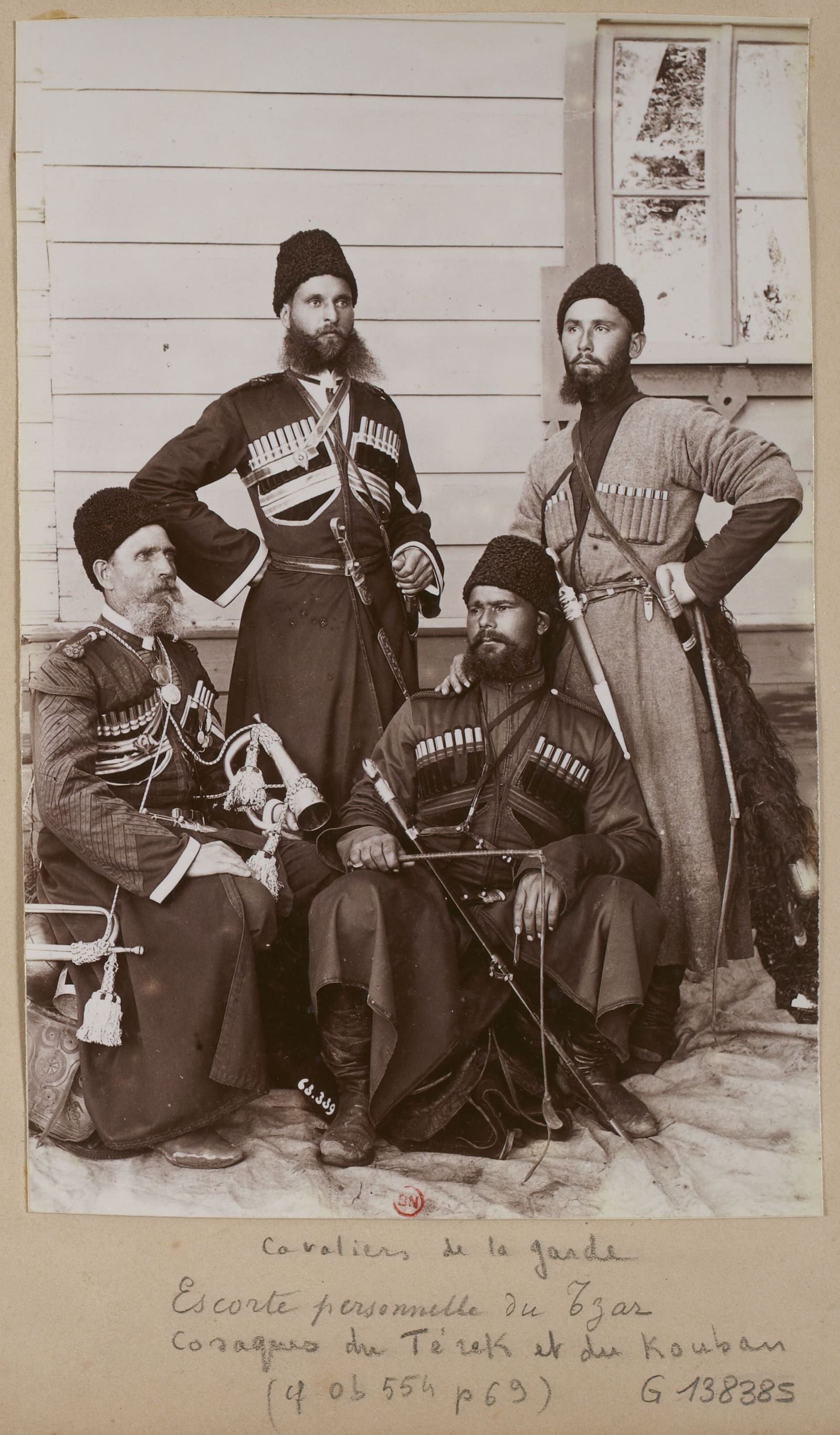
Aleksandr Borisovich Kalaushin, who compiled the family roster, called Uryadnik Andrey Kalaushin the first Cossack of the family to serve “in the Own Convoy that guarded the Imperial Family”, and its first — “perhaps its last” — chamber Cossack [◈ S001, No. 6]. The sources know of no other chamber Cossack in the family, but the road to court he had opened stayed open. From the 1850s until 1911 Kalaushins of Batalpashinskaya served at the Imperial Court: with the Tsesarevna in St Petersburg, as uryadniks (Cossack non-commissioned officers) at Gatchina, in St Petersburg and at Tsarskoye Selo; and when the Convoy celebrated its centenary, one of them came as a member of the Kuban Host’s delegation. This chapter is about them, and about the saddle which, as the family tells it, Fedot Alekseyevich made for the Shah of Persia.
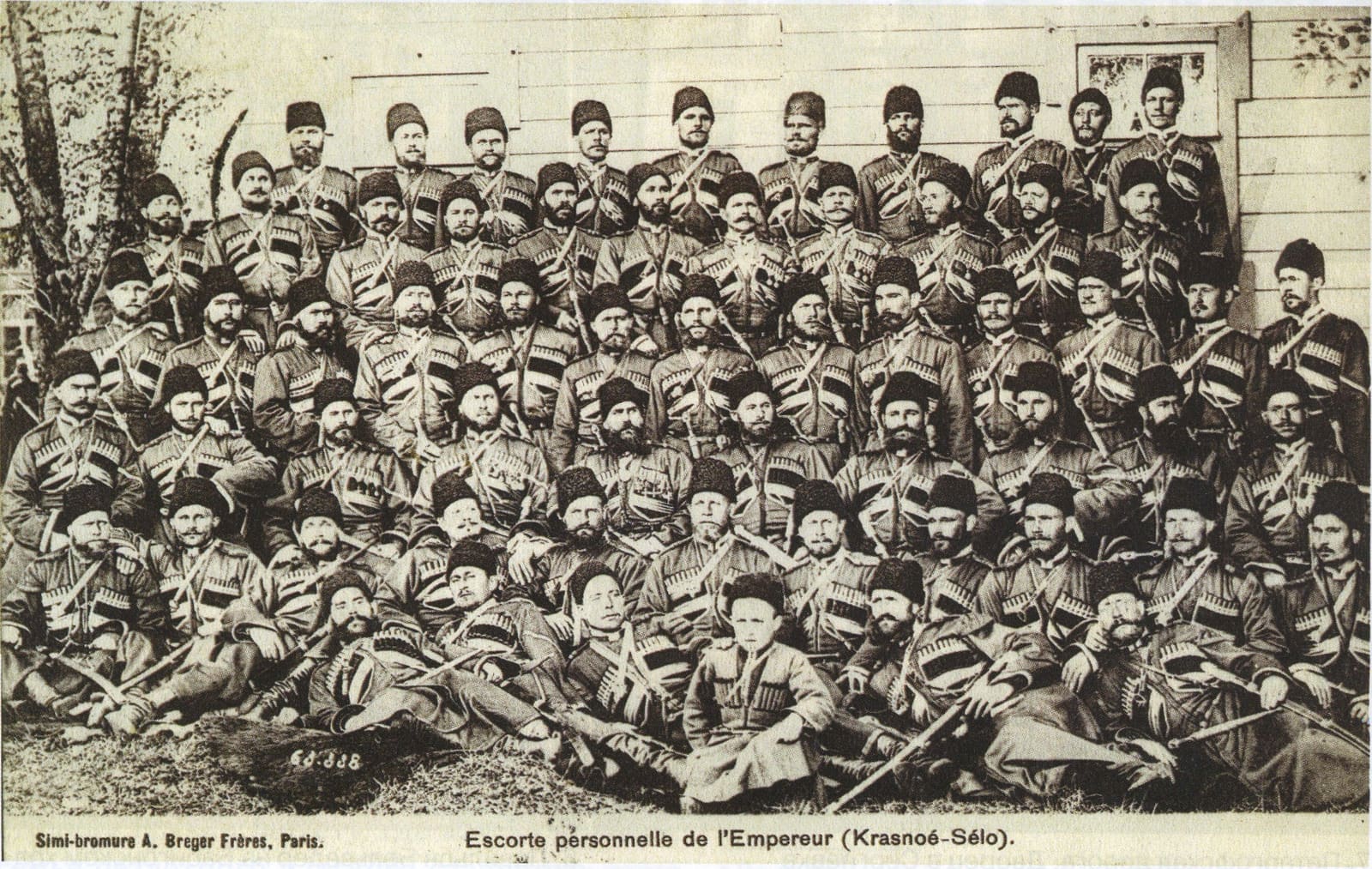
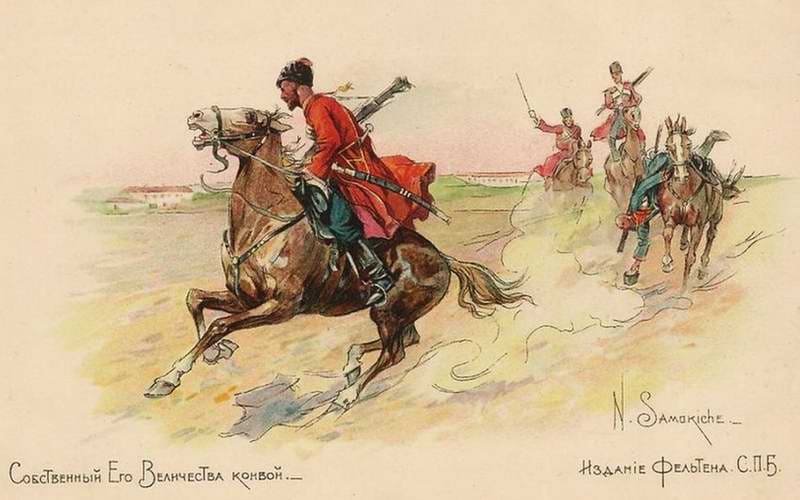
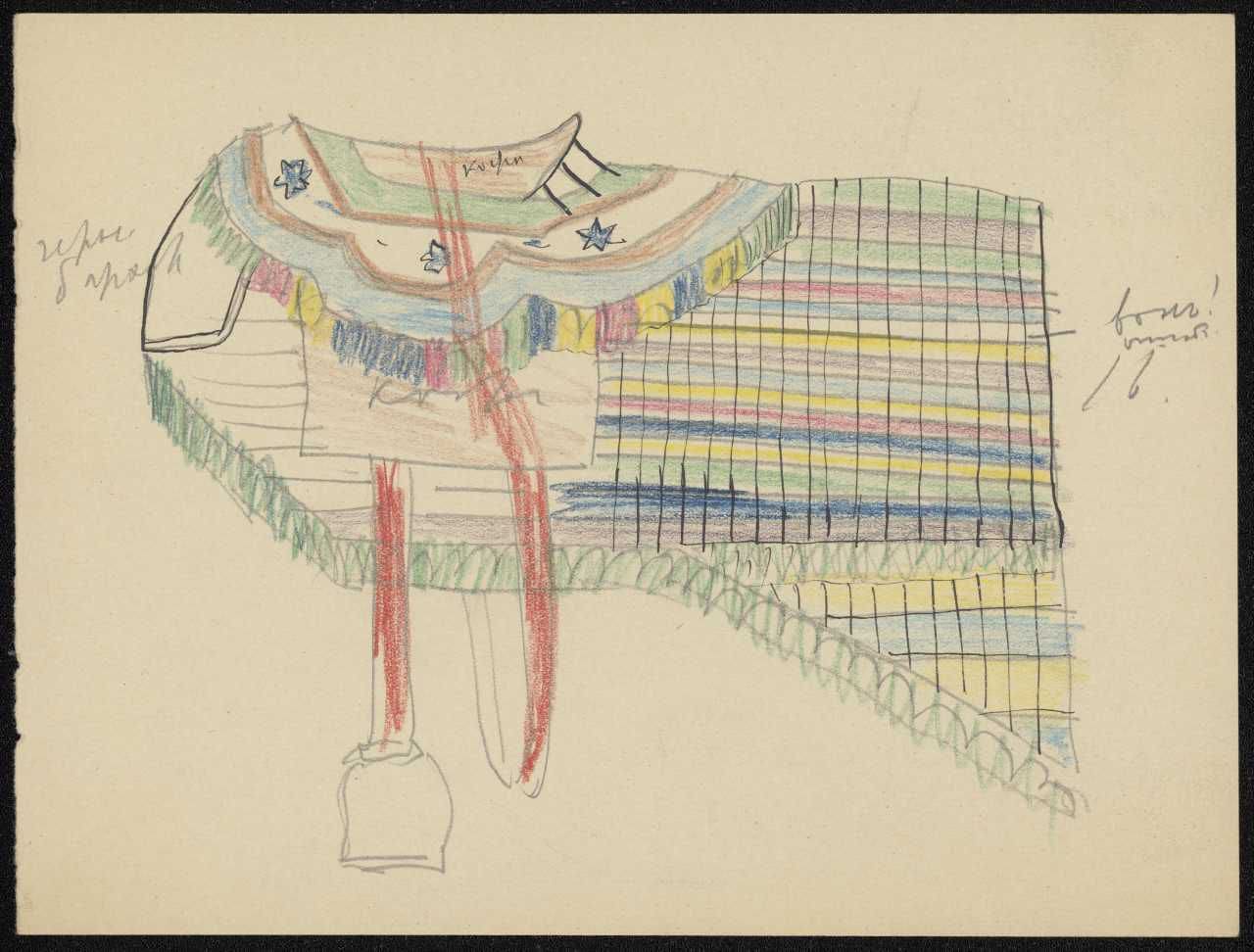
His Majesty’s Own Convoy (Sobstvenny Yego Imperatorskogo Velichestva Konvoy; hereafter the Convoy) was the Emperor’s Cossack bodyguard. It counted its seniority from 1811; from 1832 Cossacks of the Caucasus Line served in it, and later its core was formed by Kuban and Terek sotnias (squadrons) [◈ S109; ◈ S188, “Sobstvenny Yego Imperatorskogo Velichestva Konvoy”]. To be chosen was an honour for the whole stanitsa (Cossack village). The Convoy’s officers made their final choice of young Cossacks every May in Yekaterinodar. The stanitsa signed a formal pledge for each man it sent, vouching for him, and the Cossack himself bought, at his own expense and from the Host crafts school, a new Guards service saddle whose tree (lenchik) had its arches trimmed with fine white horn [◈ S097, pp. 142–144]. The officers’ saddles, writes the Convoy’s historian N.V. Galushkin, were supplied by “the Cossack Kalaushin of Batalpashinskaya, famous throughout the Caucasus for the work of his workshop” [◈ S097, p. 143, n. 24]. So the family was bound to the Convoy twice over: by service and by craft.
Chamber Cossack to the Tsesarevna
On 21 January 1853 a letter left the Chancellery of the Heir to the Throne in St Petersburg, addressed to the nakazny ataman (the appointed head) of the Caucasus Line Cossack Host, Major-General Prince G.R. Eristov (“Eristavi” in the letter). Colonel Count Adlerberg, head of the Chancellery, wrote that it was the wish of His Imperial Highness the Heir Tsesarevich that Uryadnik Andrey Kalaushin of the 2nd Khoper Regiment, who was serving in the Convoy and was then on leave in the Caucasus, should fill the vacant post of chamber Cossack to the Tsesarevna, transferring to the Court Department. He was to be sent to St Petersburg at once, “should he so wish, with his whole family”, given travel and subsistence money for the journey, and all written particulars about him were to be forwarded to the Chancellery [◈ S001, No. 6, from the file “On the appointment of Uryadnik Kalaushin as chamber Cossack”]. The Tsesarevna was then Maria Alexandrovna, wife of the Heir — the future Emperor Alexander II. In 1852 Count A.V. Adlerberg was temporarily managing the Heir’s household and acting as the Tsesarevna’s secretary; Prince Eristov had become nakazny ataman in 1852 [◈ S188, “Maria Alexandrovna (Empress)”, “Adlerberg, Alexander Vladimirovich”, “Eristov, Georgy Romanovich”].
From other sheets of the same file the roster’s compiler retells the details of the departure. The uryadnik’s family consisted of his wife and two daughters, Matryona and Fedosya; Fedosya was about ten. The Cossack authorities corresponded at length over whether the Kalaushins should travel by post horses or by peasant carts, and in the end sent them with two post horses. Travel money was paid for half the way, as far as Voronezh — 888¼ versts, 26 roubles 49¾ kopecks in silver — together with subsistence money from Stavropol to St Petersburg. Andrey Kalaushin was appointed chamber Cossack on 2 September 1853 [◈ S001, No. 6].
Chamber Cossacks (kamer-kazaki) were the part of the guard closest to the Imperial Family: they lived at the palace and, by virtue of their post, were constantly at the side of those they guarded. The custom of choosing them from the Convoy began in 1836 with Uryadnik Podsvirov; later the Emperor, the Heir, the Empress and the Dowager Empress each had two chamber Cossacks, who were on duty “week on, week off”. They were chosen for their height, good looks and full beards; their parade dress was scarlet, like that of the whole Convoy, and their everyday cherkeska (Circassian coat) blue. Under the establishment of 1851 there were four chamber Cossacks among the Imperial Family’s personal servants [◈ S109].
Note on the roster. The roster enters the chamber Cossack as Andrey Alekseyevich (No. 6), born in 1816, with a wife Feodosiya and nine children. The compiler himself noted that Andrey’s descent from Aleksey was “purely a speculative assumption” [◈ S001, note to No. 8]. The confessional register of Batalpashinskaya for 1848 names two Andrey Kalaushins. One is Andrey Trofimovich, aged 41, with his wife Feodosiya and six children, among them a son Fyodor. The other is Andrey, aged 30, son of Ivan, with his wife Mariya and daughters Matrona, 11, and Feodosiya, 7 [◆ S012, households nos. 275 and 92, via S180, topic 25557]. This is exactly the family named in the 1853 file — a wife and the daughters Matryona and Fedosya. In the stanitsa’s parish register for 1857 a godmother is entered as “the chamber Cossack’s daughter, maiden Fedosya Andreyevna Kalaushina” [◆ S013, ff. 178v–179v, from a transcription on S181]. The chamber Cossack was therefore Uryadnik Andrey Ivanovich Kalaushin (b. c. 1817–1819; the roster also lists him as No. 16), son of Ivan Trofimovich and brother of Nikolay Ivanovich, from whom, according to the roster, the author of this chronicle descends. △ The patronymic “Alekseyevich” in entry No. 6 most likely echoes the shift of generations that the roster inherited in its early part.
How long his service at court lasted is not known. Maria Alexandrovna became Empress on 18 February 1855 [◈ S188, “Maria Alexandrovna (Empress)”]. In 1857 the chamber Cossack’s daughter was in Batalpashinskaya, and the stanitsa’s confessional register for 1860 lists “Uryadnik Andrey Ivanov Kalaushin, 41” [◆ S014, from a transcription on S181]: the family, or at least part of it, was living in the Kuban again.
In the autumn of 1861 Alexander II was in the Caucasus, and on 18–19 September he visited the fortifications of the Laba Line and the stanitsa of Labinskaya [◈ S170, 2025]. At Labinskaya he received a deputation from six Line Cossack brigades — 60 officers and 240 veteran uryadniks and Cossacks. From some way off the Emperor recognised in the ranks an old uryadnik of his own Convoy, Potsvirov of Belomechetskaya, asked him how he was faring, answered the old man’s question about the Empress’s health, and then asked: “And do you remember Kalaushin?” An eyewitness, I.S. Kravtsov, who presented the deputies, explained in his memoirs: “Uryadnik Kalaushin of Batalpashinskaya stanitsa served as chamber Cossack to the late Empress and died of consumption.” “The poor fellow is ill all the time; a pity, he is a good man,” the Emperor said [◆ S034, pp. 40–41].
△ hypothesis · identification
Kravtsov was writing in 1886, so “the late Empress” for him was most likely Maria Alexandrovna (d. 1880) — the very Tsesarevna to whom Andrey Kalaushin had been appointed in 1853. “The late Empress” could in principle also be Nicholas I’s widow, Alexandra Feodorovna (d. 1860), but the sources say nothing of Kalaushin serving her. The sources know of no other chamber Cossack named Kalaushin, and it is natural to see Uryadnik Andrey Ivanovich in the man the Emperor asked about. That would also explain why the Emperor remembered him personally: the appointment of 1853 had been made at his own wish — “it is the wish of His Imperial Highness the Heir Tsesarevich”. The Emperor’s words “he too sends his greetings to all his old comrades” sound as if, even in 1861, the ailing Kalaushin was still somewhere near the court; how this fits with the 1860 entry in the stanitsa’s confessional register, the files of the Court Department may show.
Fyodor Andreyevich
According to the roster, Fyodor Andreyevich Kalaushin [S001, No. 23] also served in the Convoy. He entered service in 1857 and became an uryadnik in April 1873; by 1874 he held the silver medal for the Conquest of the Western Caucasus and the Cross “For Service in the Caucasus”, and the records for 1877 list him as an uryadnik of the 1st squadron of His Majesty’s Own Convoy [◈ S001, No. 23]. Here the compiler cites the 1877 list of uryadniks on internal service in the Batalpashinsk Department; the details of his Convoy service await a check against the original (see “Where the Documents May Be Found”).
Note on the roster. The roster makes Fyodor Andreyevich the chamber Cossack’s son, although the compiler allowed that Fyodor “was born earlier” and did not go to St Petersburg with his parents [◈ S001, No. 6]. In the 1848 confessional register the eleven-year-old Fyodor is the son of Andrey Trofimovich and Feodosiya (household no. 275) [◆ S012, via S180, topic 25557] — that is, a first cousin of the chamber Cossack.
The Alekseyevich brothers: Gatchina and St Petersburg
The sons of the master saddler Aleksey Nikolayevich [S001, No. 32] were the chamber Cossack’s great-nephews: their grandfather, Nikolay Ivanovich, was his brother [◆ S012, household no. 92, via S180, topic 25557]. Four of the five sons — Matvey, Mikhail, Fedot and Aleksandr — followed their father’s craft; the fifth, Savva (Savely), became a teacher [◈ S001, Nos. 32, 75]. Three of the four craftsmen brothers served in the Convoy. Matvey Alekseyevich, as the family remembers, served in a Cossack regiment at Labinskaya, “but not in the Convoy, because he was short” [◇ S001, No. 71]: the Convoy took tall men.
Mikhail Alekseyevich was born on 9 July 1870 in Batalpashinskaya. The name index to the orders of the Kuban Cossack Host (the Kuban Host) lists him as a Cossack of the 1st Khoper Regiment, then as a Cossack and an uryadnik of the Convoy [◈ S033, via S180, topic 855]; according to the roster, he served four years in the Convoy [◈ S001, No. 72].
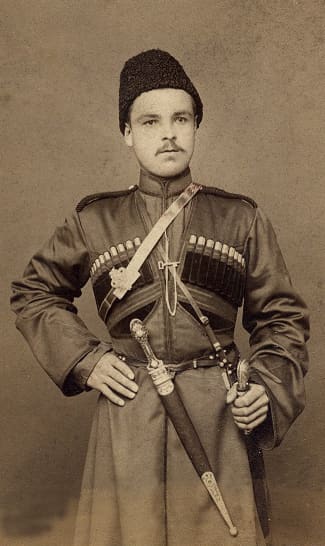
Fedot Alekseyevich Kalaushin [S001, No. 73] was born in 1871. The same index lists him as a “saddler”; he took the oath in 1891 [◈ S033, via S180, topic 855] and was enrolled in the Convoy by Kuban Host Order No. 156 of 7 June 1892 [◈ S156, comment by Andro, 01.06.2013]. In the roster’s words, he served “first at Gatchina, under Alexander III, and then in the capital, St Petersburg, under Nicholas II”, as an uryadnik of the Life Guards 2nd Kuban Sotnia [◈ S001, No. 73].
Under Alexander III the Convoy kept guard at the Gatchina Palace, inside and out. Its inner guard manned nine posts — in the “Chinese” gallery, by the dining room, outside the bedrooms of the Emperor and Empress and of the Imperial children, at the spiral staircase and at the private entrance — while ten outer posts ringed the deer park [◈ S097, p. 106]. After the death of Alexander III, in November 1894, the Court moved to Tsarskoye Selo, but the Life Guards 2nd Kuban Sotnia remained on duty at Gatchina [◈ S097, p. 127]. Under Nicholas II the Convoy was based mainly at Tsarskoye Selo; one sotnia at a time was sent to St Petersburg, and it also served the court of the Dowager Empress Maria Feodorovna at Gatchina and the Anichkov Palace. The Convoy’s St Petersburg barracks stood at No. 28 Shpalernaya Street, and attached to them were the Convoy’s own workshops — for arms, saddlery and tailoring [◈ S097, pp. 127–128, 131].
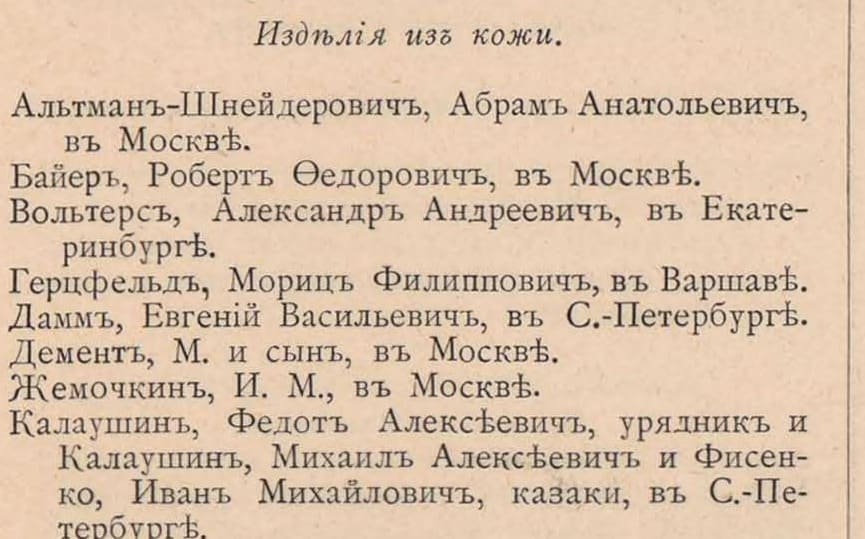
The brothers did not give up their craft while serving. At the All-Russian Exhibition of 1896 in Nizhny Novgorod a bronze medal for leather goods went to “Kalaushin, Fedot Alekseyevich, uryadnik, and Kalaushin, Mikhail Alekseyevich, and Fisenko, Ivan Mikhailovich, Cossacks, in St Petersburg” [◆ S044, no. 1, p. 33]. By 1896, then, Fedot Alekseyevich was already an uryadnik, and both brothers were living in the capital.
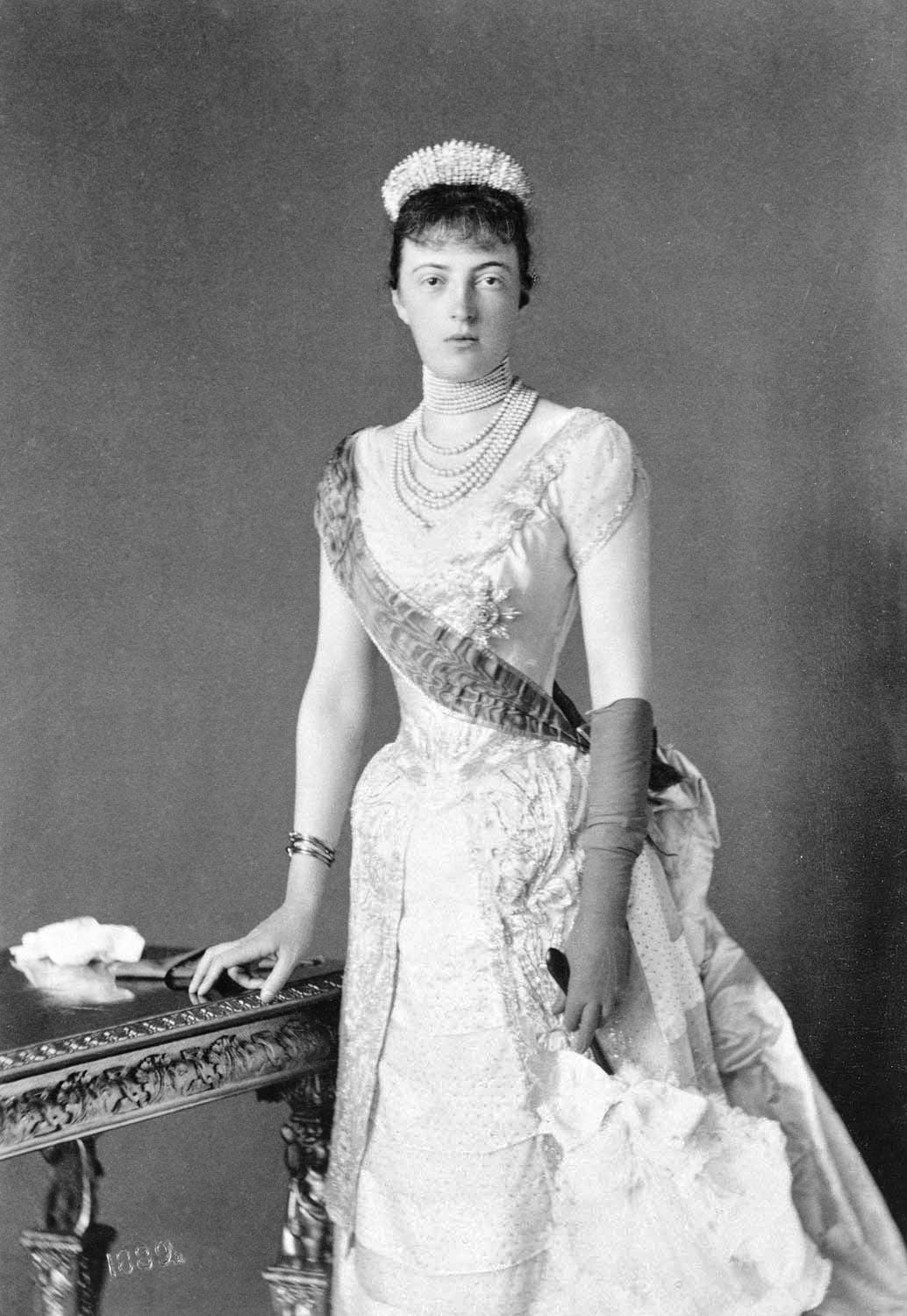
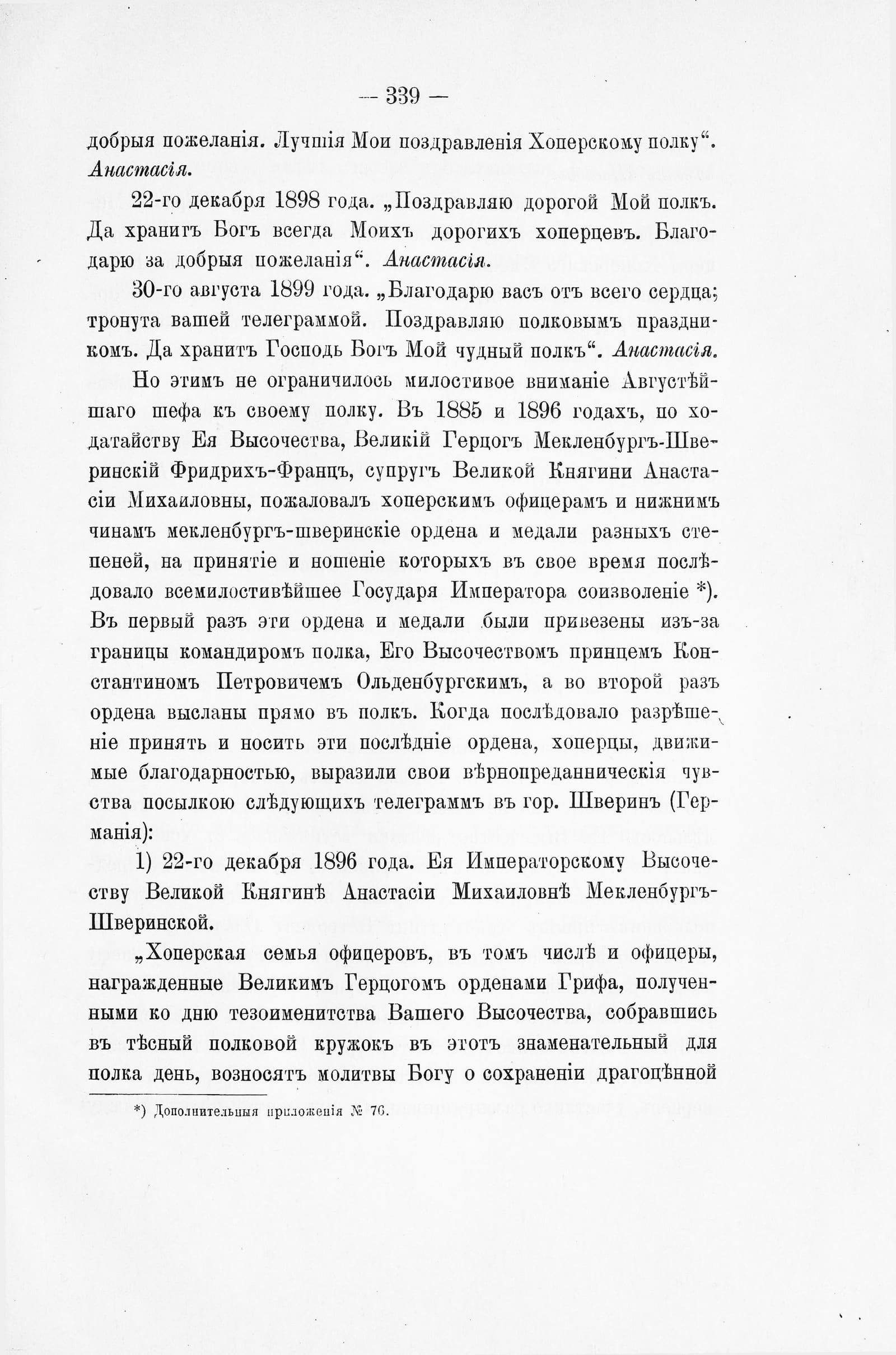
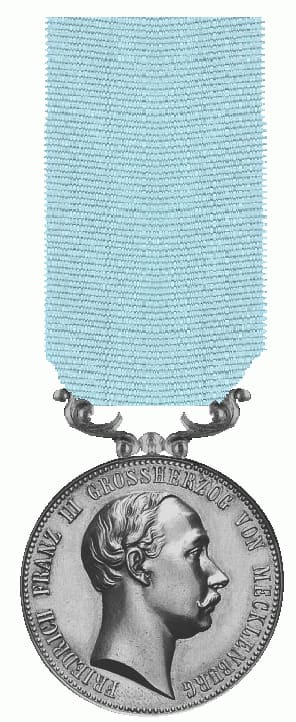
In January 1897 Kuban Host Order No. 5 recorded that Fedot Alekseyevich had been “graciously permitted to accept and wear the Mecklenburg-Schwerin silver medals of Grand Duke Friedrich Franz III” [◈ S001, No. 73]; the day of the month is unclear in the roster’s text, and a commentator on Kubanskaya genealogiya gives 13 January [◈ S156, comment by Andro, 01.06.2013]. Mecklenburg awards were nothing new to the Khoper Cossacks. From 1879 the honorary chief of the 1st Khoper Regiment was Grand Duchess Anastasia Mikhailovna, wife of Grand Duke Friedrich Franz III of Mecklenburg-Schwerin, and “in 1885 and 1896, at Her Highness’s request”, the Grand Duke conferred Mecklenburg orders and medals on Khoper officers and other ranks [◆ S053, pt 2, p. 339]. △ The Khoper-born Convoy uryadnik from Batalpashinskaya most likely received his medal by the same route, through the chief of his home regiment; it was probably Friedrich Franz III’s silver Medal for Merit. What exactly he was rewarded for is not yet known.
The farewell review
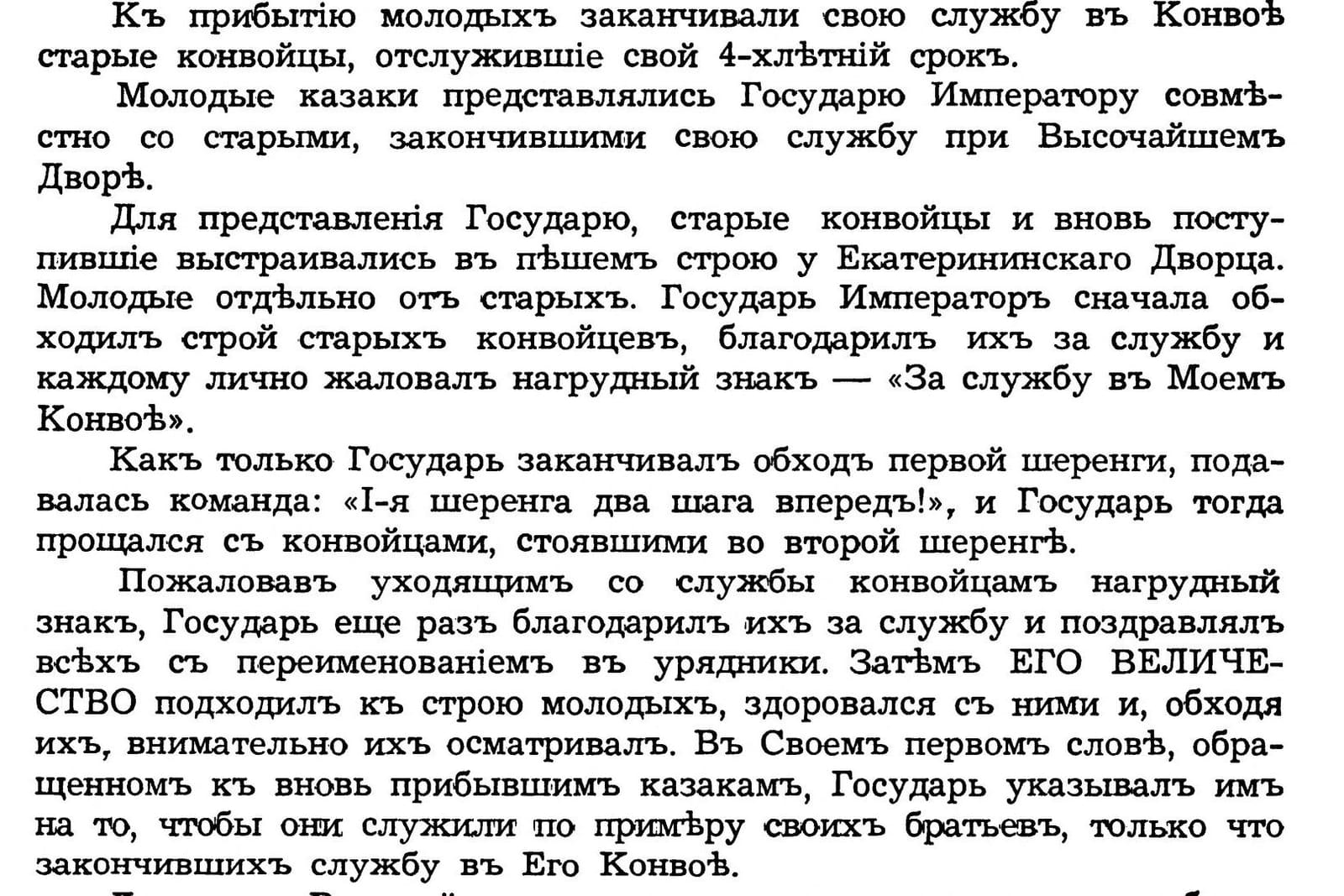
Active service in the Convoy lasted four years, and some of the long-serving men stayed on for extended service [◈ S097, pp. 114–116]; △ Fedot Alekseyevich, who served eight years, was probably one of them. Leaving the Convoy was a ceremony. At the end of May trainloads of young Cossacks from the Kuban and the Terek arrived at Tsarskoye Selo, and by then the old Convoy men had finished their service. Old and young were presented to the Emperor together, drawn up on foot. The Emperor walked along the ranks of the departing men, thanked them for their service, handed each of them in person the breast badge “For Service in My Convoy”, and congratulated them all on their promotion to uryadnik [◈ S097, pp. 144–145]. Galushkin calls it “the last presentation to His Majesty”. To discharge a Cossack without promotion and stripped of the Guards uniform brought shame on his stanitsa, and in the Convoy’s history such cases were very rare. At the border of the Host the nakazny ataman met the returning men and thanked them on behalf of the whole Host [◈ S097, p. 150].
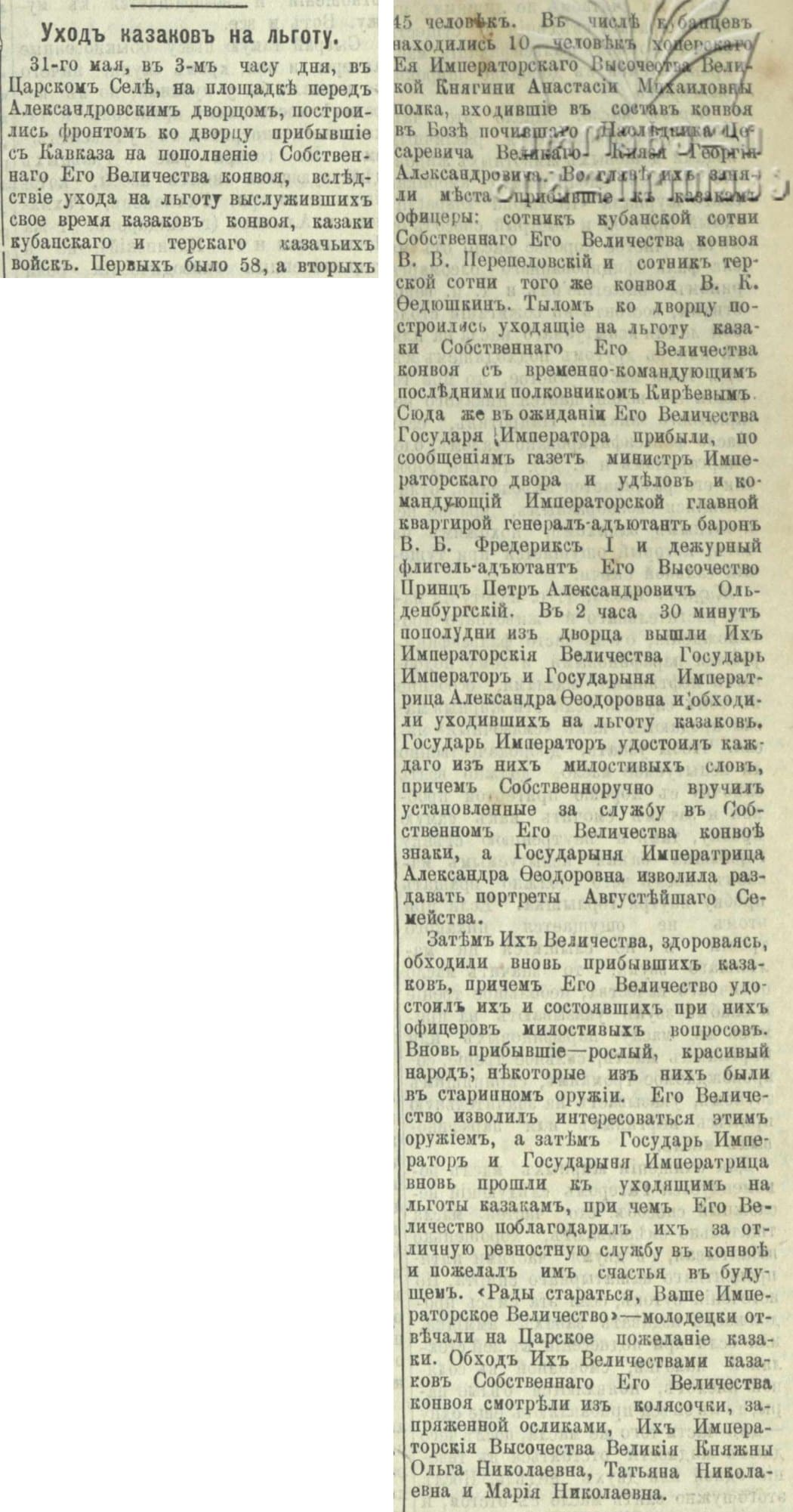
In 1900 the review took place on Wednesday, 31 May Old Style (13 June New Style), at half past two in the afternoon — not at the Catherine Palace, as Galushkin describes, but at the Alexander Palace, where the Imperial Family was then living. Facing the palace stood the young Cossacks who had come as replacements — 58 from the Kuban and 45 from the Terek; among the Kubans were ten Khoper Cossacks from the escort of the late Tsesarevich, Grand Duke George Alexandrovich. With their backs to the palace stood the men going home on lgota (into the reserve), led by the acting commander of the Convoy, Colonel Kireyev. The Emperor and Empress Alexandra Feodorovna walked along the ranks. Nicholas II spoke “gracious words” to each departing man, handed out the Convoy service badges with his own hand, thanked them for their “excellent and zealous service” and wished them “happiness in the future”; the Empress gave out portraits of the Imperial Family, and the little Grand Duchesses watched from a small carriage drawn by donkeys. Beside the Emperor stood the Minister of the Imperial Court, Baron V.B. Fredericks [◆ S036, no. 150, 10.06.1900, p. 3]. That day the Emperor wrote in his diary: “On the square in front of the palace the old Cossacks going home and the new ones who have arrived for service were presented” [◆ S037, 31.05.1900].
Seventeen days later, on 17 (30) June 1900, Kuban Host Order No. 60 discharged Fedot Alekseyevich “retaining the Guards uniform and awarded the badge for service in the Convoy” [◈ S001, No. 73; ◈ S156, comment by Andro, 01.06.2013].
Note on the roster. The same entry says that Fedot Alekseyevich served in the Convoy “from 1892 to 1911” and came home “after 19 years of service” [◈ S001, No. 73]. The number and date of the order are the firmest anchor in the entry, so his years in the Convoy are 1892–1900. △ “1911” and “19 years” probably refer to his whole Cossack service liability — under the regulations a Cossack was liable for about twenty years, cut to eighteen in 1909 [◈ S184, “Kazachestvo”] — or echo, in the family’s memory, the Convoy’s centenary of 1911.
The saddle for the Shah of Persia
◇ family testimony · confirmed by relatives
The saddle for the Shah of Persia (Iran) was made in Fedot Alekseyevich’s workshop on the order of Emperor Nicholas II; the work took two months. Fedot Alekseyevich took the saddle to St Petersburg himself. There, “at a review of the Guards, on the last day before going home (at the end of his service)”, Prince Trubetskoy reported to the Emperor that the saddle had arrived. Nicholas II examined it, said it was very well made, and there and then congratulated Kalaushin on the title of Purveyor to the Court of His Imperial Majesty; a gold watch was granted with the title. Talking with the master, the Emperor asked how long he had been in St Petersburg and, learning that Trubetskoy had put off presenting the saddle for so long, showed his displeasure. Once the Emperor had gone, Trubetskoy turned his anger on Fedot and sent him to the guardhouse for two days for an incautious answer. The promised gold watch never reached Fedot Alekseyevich. The family also remembers the signboard of his workshop in Batalpashinskaya, which said that the workshop belonged to a Purveyor to the Court of His Imperial Majesty — a title that, as the family tells it, was granted to him after the saddle for the Shah [◇ S001, No. 73]. Relatives confirm this account; it is recorded in the family history [◇ S003].
△ hypothesis · dating
The years point to 1900. Fedot Alekseyevich served in the Convoy from 1892 and was discharged by Kuban Host Order No. 60 of 17 June 1900 [◈ S001, No. 73]. The only state visit of a Persian shah to St Petersburg in those years was that of Mozaffar ad-Din Shah, 4–10 (17–23) July 1900 [◆ S037, 4–10.07.1900; ◆ S036, no. 181, 11.07.1900, p. 3; ◆ S052, 20.07.1900, p. 5].
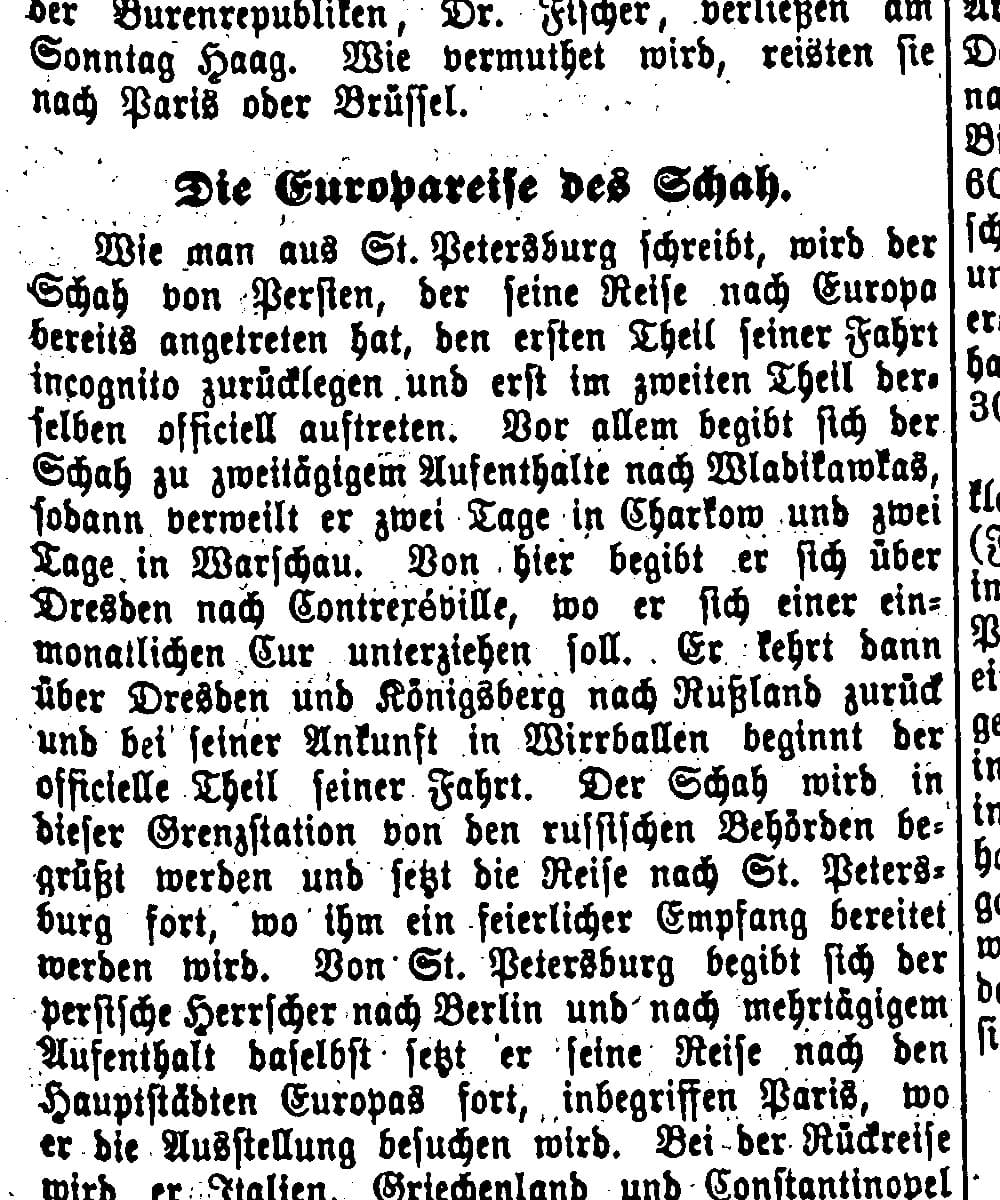
The visit was known well in advance. On 2 (15) February 1900 it was reported from St Petersburg that Nicholas II had invited the Shah on the occasion of his journey to Europe; at the end of February (early March New Style), that extensive preparations had been ordered for his reception; and the Shah was expected in St Petersburg at the end of May [◆ S048, 15.02.1900, p. 7; ◆ S049, 03.03.1900, p. 33; ◆ S050, 10.03.1900, p. 23]. In April the route was changed: the Shah crossed Russia incognito, and the official reception in St Petersburg was moved to his return journey [◆ S051, 25.04.1900, p. 3]. In May his cortège travelled the Georgian Military Road escorted by sotnias of the 1st Khoper Regiment [◆ S036, no. 184, 14.07.1900, p. 3]. A gift for such a visit would naturally have been ordered in February or March, and with two months’ work the saddle would have been ready by the end of May.
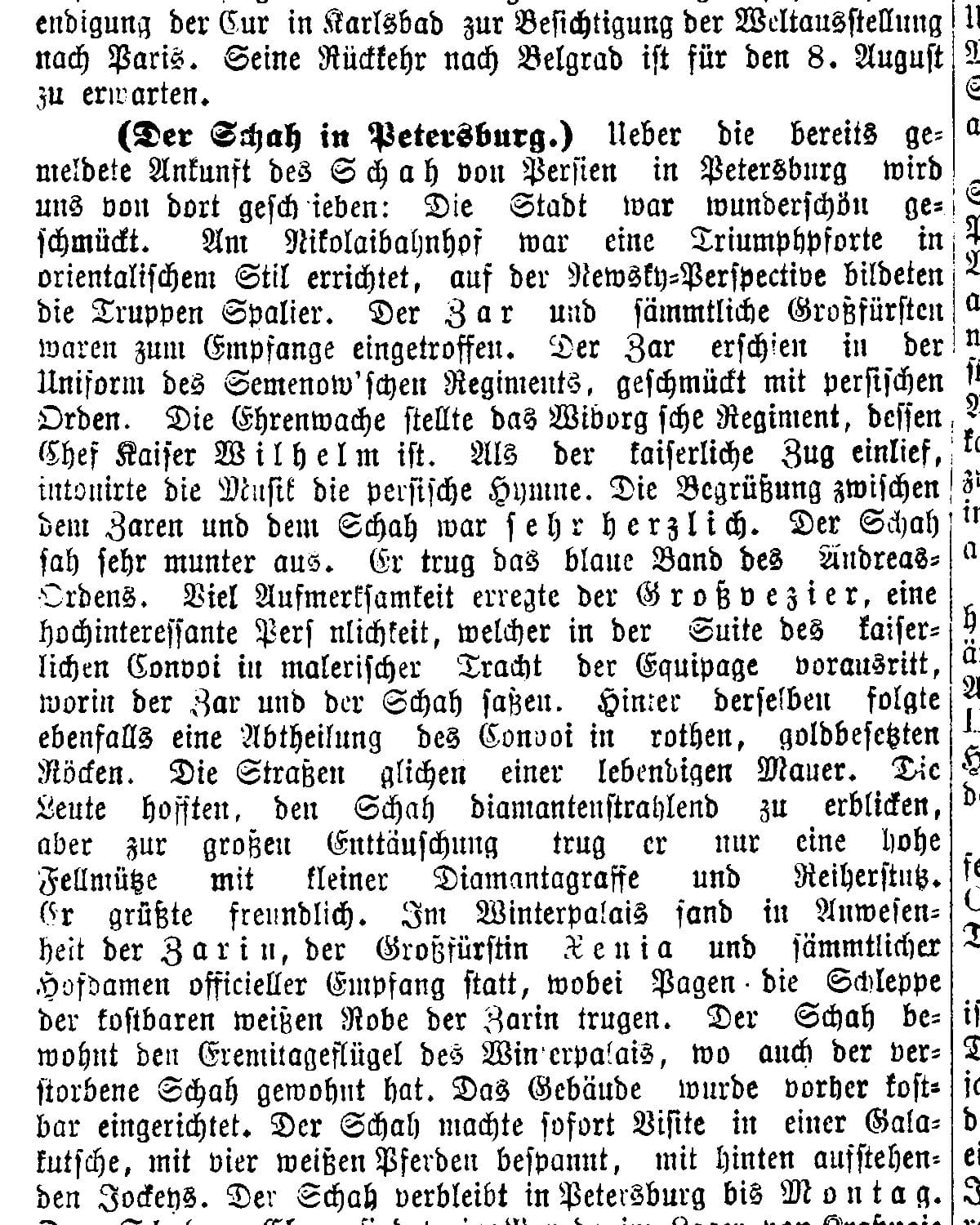
The end of May was exactly the time of the farewell review. The family’s “review of the Guards on the last day before going home” is most naturally placed on 31 May 1900: the Emperor’s diary for that year records no other presentation of departing Convoy men, on that day the Emperor spoke to every man who was leaving, and seventeen days later came the order discharging Fedot Alekseyevich — with the very badge for service in the Convoy that the Emperor had handed out with his own hand at the review. Two and a half weeks after that, on 4 July, the Shah arrived in St Petersburg. The Emperor met him at the Nikolayevsky Station and drove him to the Hermitage himself; two sotnias of the Convoy escorted the carriage, and in the Malachite Room of the Winter Palace Nicholas II presented the Shah with the Order of St Andrew [◆ S037, 04.07.1900; ◆ S036, no. 181, 11.07.1900, p. 3]. The Shah stayed until 10 July — Peterhof, a parade at Krasnoye Selo on 6 July, Tsarskoye Selo on 8 July — and at the farewell luncheon gave the Emperor “a beautiful old sabre and his portrait” [◆ S037, 4–10.07.1900]. The Emperor’s question about how long the master had been in town, and his displeasure at the delay, make sense if the saddle had been made for the original date — the end of May, when the Shah had at first been expected in the capital — while the reception in St Petersburg was meanwhile moved to July, and the finished saddle had to wait. The most consistent dating is spring to early summer 1900: the saddle was made in the spring (roughly March to May), the Emperor most probably saw it at the farewell review on 31 May, and it was intended for Mozaffar ad-Din Shah’s visit of 4–10 July 1900.
Other meetings between Russian emperors and shahs fit the family account less well. Naser al-Din Shah was in St Petersburg in May 1889, in the reign of Alexander III, before Fedot Alekseyevich had taken the oath [◈ S127]. Mozaffar ad-Din Shah met Nicholas II at the manoeuvres near Kursk in 1902 and at Peterhof in August 1905 [◆ S054, 19.09.1902, p. 2; ◆ S037, 20–24.08.1905], by which time Fedot Alekseyevich had left the Convoy. Mohammad Ali Shah never came to Russia as shah [◈ S182, “Mohammad Ali Shah Qajar”], and for Ahmad Shah’s coronation in Tehran in 1914 Russia sent a special envoy [◆ S049, 21.07.1914]: a gift would then have gone to Tehran, with no review in St Petersburg.
A note on names. In the family account it is “Prince Trubetskoy” who reports that the saddle has arrived. In 1900 the Convoy was commanded by Baron Alexander Meyendorff (1893–1906); on the day of the review, 31 May, the departing men were led by the acting commander, Colonel Kireyev, and the aide-de-camp on duty beside the Emperor was Prince Peter Alexandrovich of Oldenburg [◆ S036, no. 150, 10.06.1900, p. 3]. Prince Georgy (Yury) Ivanovich Trubetskoy, Meyendorff’s nephew, took over the Convoy from his uncle in 1906 and commanded it until 1914 [◈ S097, p. 170; ◈ S188, “Trubetskoy, Georgy Ivanovich”]. Under him, in 1906–1908, according to the family, Fedot’s younger brother Aleksandr Alekseyevich was still serving in the Convoy, and under him the Convoy celebrated its centenary. △ For Kuban families his was the best-remembered commander’s name of those years, and in the account it most likely took the place of his uncle’s; the title of the “prince” who stood beside the Emperor that day may have merged with it too. This is how names often travel in family memory; it does not contradict the account.
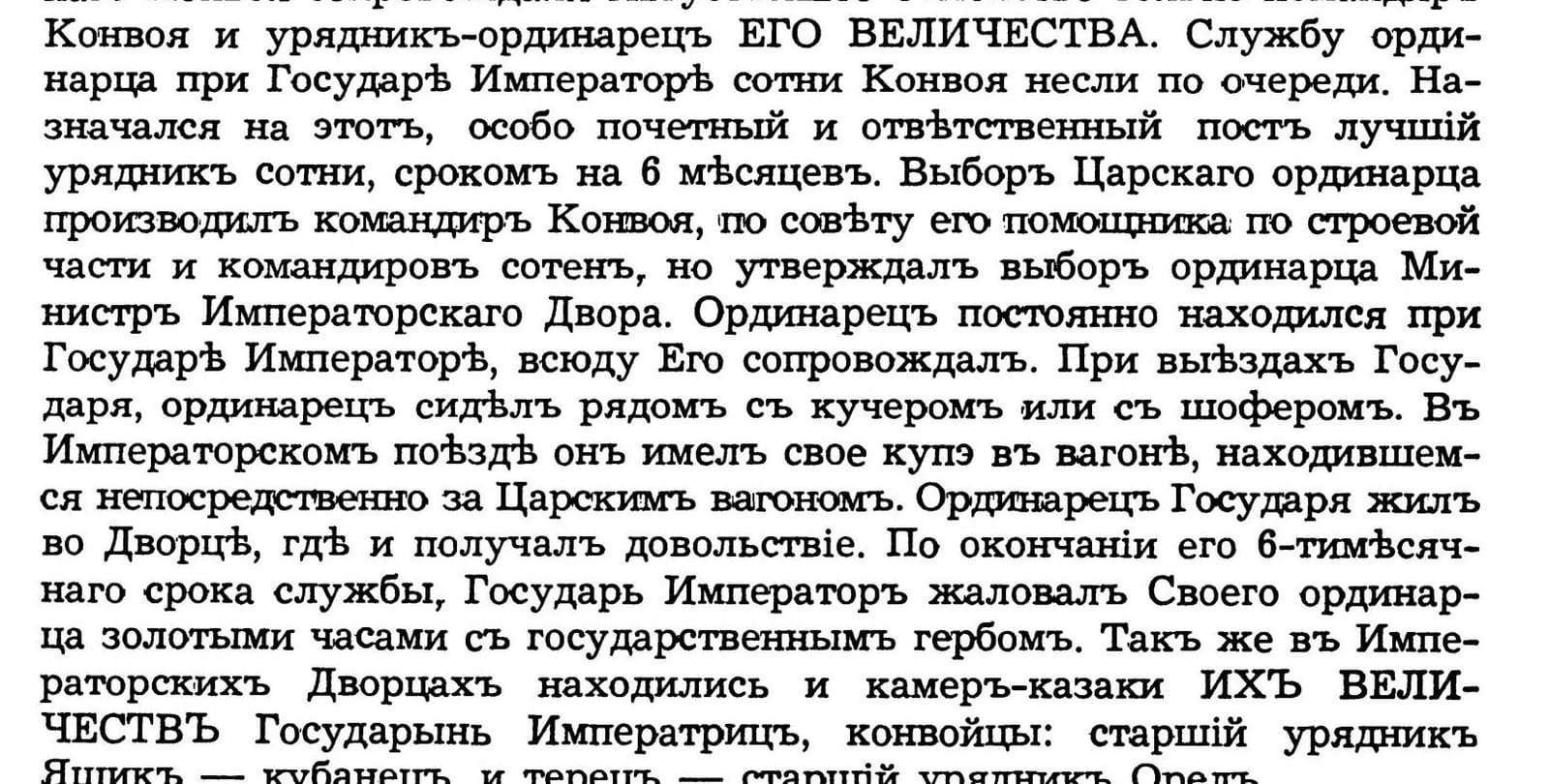
The title and the watch. The official List of Purveyors to the Imperial Court, compiled at the beginning of 1915, names “the saddle-maker Fedot Kalaushin of Batalpashinskaya stanitsa” [◈ S108]. The title was conferred by the Chancellery of the Ministry of the Imperial Court, and its file will show the date; △ it is worth noting that at the review of 31 May 1900 the Minister of the Court himself stood beside the Emperor. Watches were a customary imperial reward in the Convoy: the Emperor gave a gold watch bearing the State arms, for example, to his orderly uryadnik at the end of six months’ duty with him, while silver watches went to Cossacks who completed the Convoy’s training detachment and to the best marksmen [◈ S097, pp. 151–152].
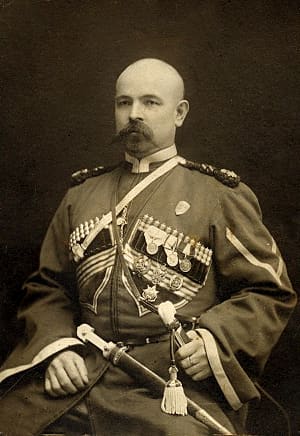
The portrait. On a later formal portrait of Fedot Alekseyevich (from the awards shown, no earlier than 1913) a researcher on the Druzhina forum identified the Convoy service badges, the badge of the Convoy’s centenary, and the coronation and commemorative medals; the lowest badge he could not identify, suggesting it was “possibly Persian” [◈ S179, topic “Sobstvenny Yego Imperatorskogo Velichestva Konvoy”, post no. 133, 22.01.2017]. △ If so, the badge may prove another thread leading to the story of the saddle; the original photograph, kept by the family’s descendants, may settle the question.
Where the documents on the saddle may be found. The Chamber-Fourier Journal (the daily court journal) for 1900: RGIA, f. 516, op. 1 (219/2728), d. 10 for the review of 31 May (around ff. 600–640v); d. 11 for the Shah’s visit of 4–10 July. The original diary of Nicholas II: GA RF, f. 601, op. 1. His Imperial Majesty’s Cabinet (RGIA, f. 468): gifts for the Shah’s visit of 1900; the Cabinet’s registers of items received and issued for 1900–1901 — receipt of a saddle from Uryadnik Kalaushin, a watch assigned to him. The Chancellery of the Ministry of the Imperial Court (RGIA, f. 472): the file on F.A. Kalaushin’s purveyor title. The Court Stables Office (RGIA; fond number to be confirmed): presentation saddles and horses. AVPRI, Persian Desk (fond number to be confirmed): the ceremonial of the 1900 visit and the exchange of gifts. Convoy orders for May–June 1900 (RGVIA; fond number to be confirmed): the list of men leaving on lgota. GAKK, Krasnodar: the text of Kuban Host Order No. 60 of 17.06.1900; Kubanskiye Oblastnye Vedomosti, summer 1900. The St Petersburg press: Pravitelstvenny Vestnik and Novoye Vremya for 1–3 June 1900, Russky Invalid for 5–12 July 1900. In Iran: the Safarnameh of the Shah’s first European journey (AH 1318), entries on St Petersburg (c. 19–25 Rabi‘ al-awwal 1318); the treasury and archive of the Golestan Palace.
The barracks on Shpalernaya Street
The youngest brother, Aleksandr Alekseyevich Kalaushin [S001, No. 74], was born in 1877 or 1878. He is called an uryadnik of the Convoy both in S.V. Volkov’s database and in a collector’s caption to a photograph of the 1910 graduating class of the Maykop Military Crafts School [◈ S162, via S180, topic 855; ◈ S153, P.N. Strelyanov, 30.12.2020].
◇ family testimony · as told by Emiliya Fyodorovna, Lyudmila Aleksandrovna and Mariya Aleksandrovna Kalaushina
According to Emiliya Fyodorovna, wife of Matvey Matveyevich Kalaushin, Aleksandr Alekseyevich served as an uryadnik of the Convoy in St Petersburg from 1904 to 1908. In the Convoy’s Cossack barracks at No. 28 Shpalernaya Street (in Soviet times Voinova Street), on 1 (14) May 1904, his son Boris was born — the first of the direct line of the Kalaushins to be born in St Petersburg [◇ S001, Nos. 74, 138]. His daughters remembered their father as a dashing horseman. Lyudmila Aleksandrovna said that he could vault over a horse from one side to the other; Mariya Aleksandrovna, that his bride, Yevdokiya Fyodorovna Semakina, set him a condition: to burst through the gates of her house at full gallop, standing upright in a britzka. The condition was met: the britzka braked sharply, and only then did he fall, but he was quickly on his feet again [◇ S001, No. 74]. “Since he had served in the Convoy, that is no wonder,” the roster’s compiler remarks.
The Convoy’s St Petersburg barracks on Shpalernaya Street was a two-storey building: upstairs were a church and the sotnia’s quarters, downstairs the training detachment, a gymnasium and the kitchen, and at ground level its own electric power plant; in the courtyard, on the Zakharyevskaya Street side, stood the stables, the barracks of the non-combatant detachment and the workshops [◈ S097, p. 131]. Many of the men on extended service had families and lived in quarters assigned to them [◈ S097, p. 149, n. 27]. △ That a son was born in the Convoy barracks on 1 May 1904 shows that by then Aleksandr Alekseyevich was already serving in the Convoy and living at the barracks with his family; as the young Cossacks arrived only at the end of May [◈ S097, p. 144], his service may have begun somewhat before 1904. After the Convoy he returned to Batalpashinskaya; the Kavkazsky kalendar for 1913 lists him as teacher of harness-making at the Maykop Military Crafts School [◆ S058, 1913, pp. 585–586]. The brothers’ workshops are the subject of the next chapter.
The Convoy’s centenary
18 May 1811 was regarded as the Convoy’s founding day, and in May 1911 it celebrated its centenary. The celebrations lasted from 17 to 21 May at Tsarskoye Selo. On 17 May, in the Alexander Palace, the cloth of a new jubilee standard was nailed to its staff, the Emperor driving the first nail; on 18 May, in front of the Catherine Palace, a service was held to consecrate the standard, followed by a parade of the Convoy. Up to a thousand former Convoy men came for the occasion [◈ S097, pp. 173–175].
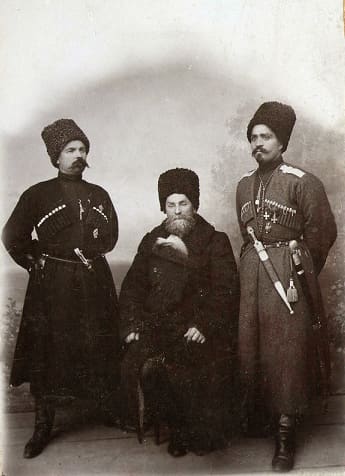
The Kuban Host sent a delegation. Its make-up had been fixed in advance — the nakazny ataman, the chief of the Host staff, one field officer and one subaltern, and six other ranks — and the department atamans were told to look for Cossacks, whether or not they had served in the Convoy, provided they held the Insignia of the Military Order — “the more, the better” — and made a good figure. On the morning of 9 May the ten-man delegation arrived in St Petersburg; among them was Podkhorunzhy (senior NCO) Ivan Stepanovich Kalaushin [◈ S132, pp. 104–105, from GAKK, f. 332, op. 1, d. 551; f. 396, op. 1, d. 10213, 10239]. The roster calls him a Convoy man, formerly an uryadnik of the Convoy [◈ S001, No. 77]; a Convoy uryadnik Ivan Kalaushin also appears in the index of Kuban Host orders for 1880–1899 [◈ S033, via S180, topic 855]. Ivan Stepanovich (b. 1860) was Fedot Alekseyevich’s first cousin; one photograph shows the two of them together with Fedot’s father-in-law, Mikhail Ivanovich Pushkarsky [◈ S156, photo 47-0-1073]. According to the roster, Ivan Stepanovich died in that same year, 1911 [◈ S001, No. 77].
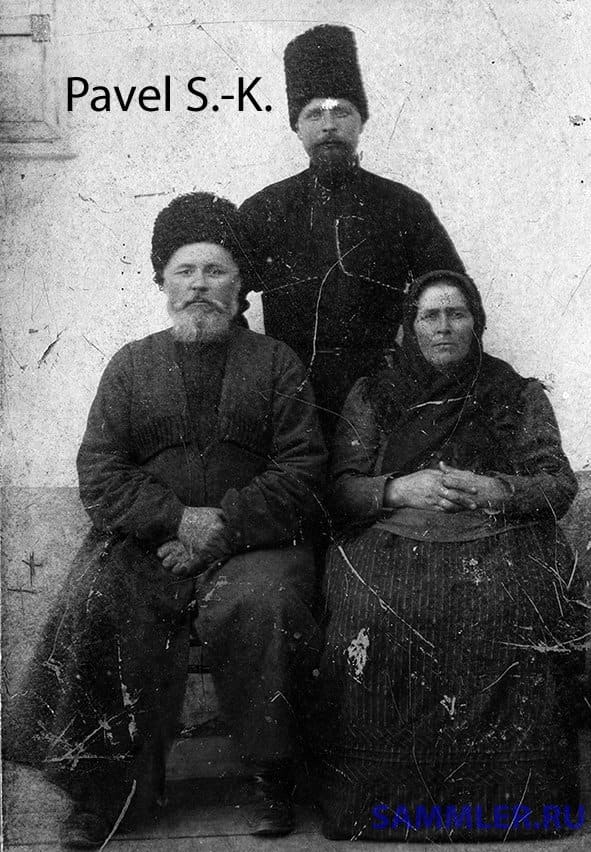
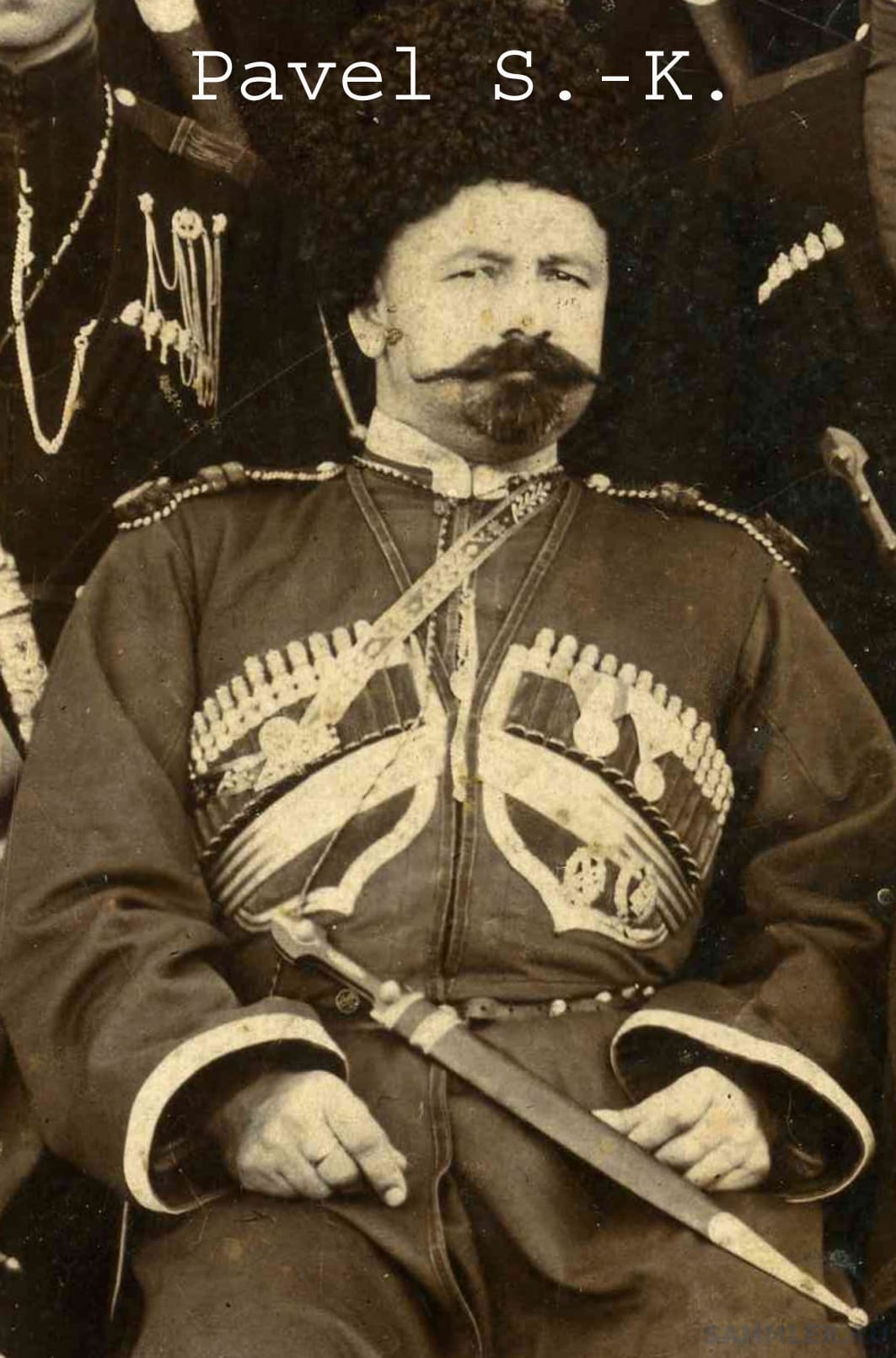
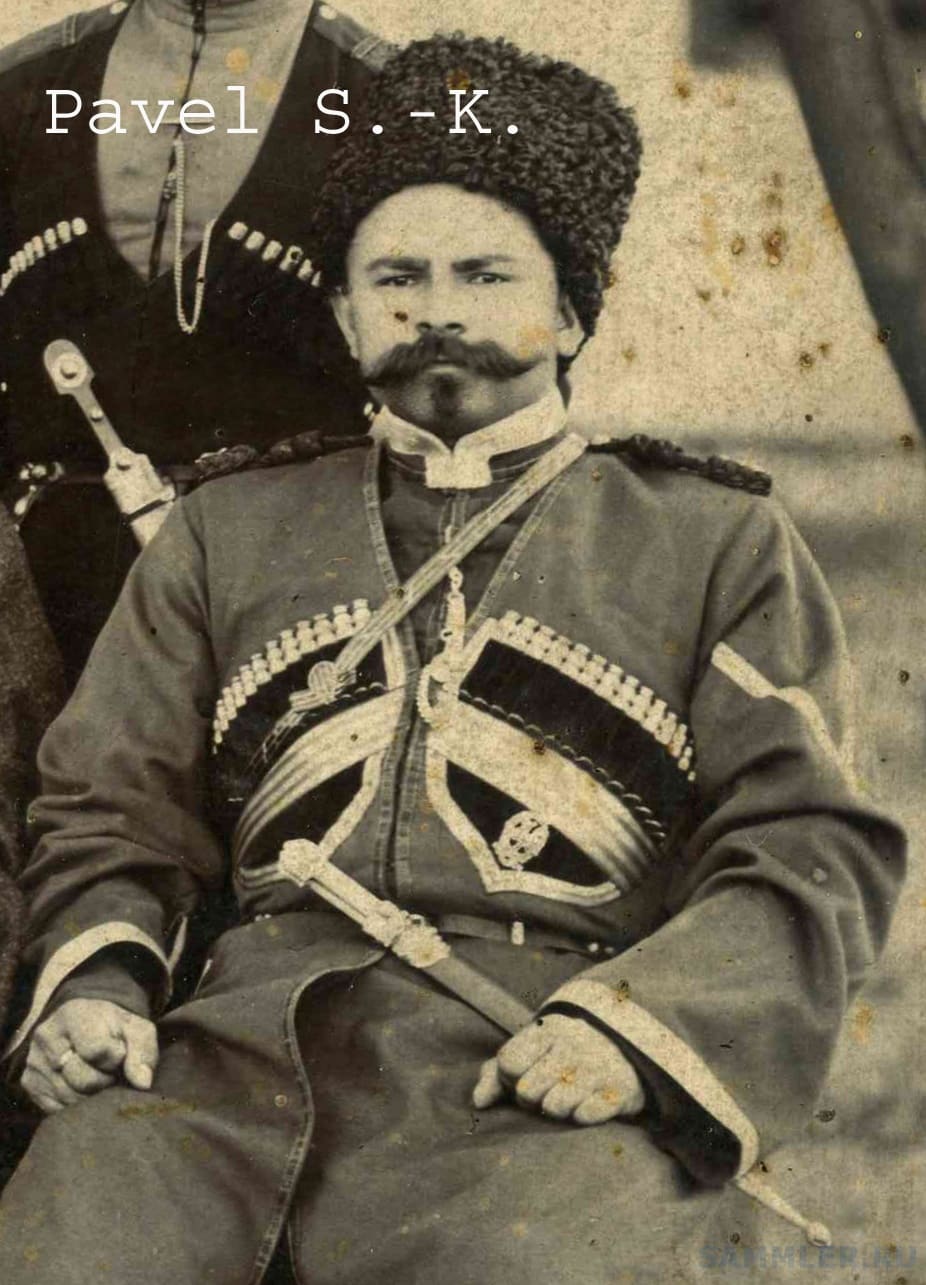
The badge of the Convoy’s centenary, according to the Druzhina forum researcher, also appears on the later portrait of Fedot Alekseyevich (see above). △ Whether he himself was among the veterans at the jubilee is not known — there is no list of them; but it seems no accident that the year 1911 is so firmly tied to the Convoy in the family’s memory. A photograph from a private collection, published on sammler.ru, shows yet another Convoy man at the centre of a “family of the Kalaushins, Cossacks of Batalpashinskaya stanitsa”: Sergey Stepanovich, “junior uryadnik of the Life Guards 2nd Kuban Sotnia”; his place in the roster remains to be established [◈ S153, topic “Vidy Batalpashintsev”, 24.12.2025].
In March 1917 the Convoy was renamed the Life Guards Caucasian Cossack Regiment and sent to the front, and in June of that year it was disbanded [◈ S001, No. 77]. With it passed into history the service at court to which the Kalaushins of Batalpashinskaya had given more than half a century.
Documents
From the letter of the Heir’s Chancellery to the nakazny ataman of the Caucasus Line Cossack Host, 21 January 1853. “It is the wish of His Imperial Highness the Heir Tsesarevich that the vacant post of chamber Cossack to Her Imperial Highness the Tsesarevna be filled, with transfer to the Court Department, by… Uryadnik Andrey Kalaushin of the 2nd Khoper Regiment, who is at present on leave in the Caucasus… That Uryadnik Kalaushin, on receipt of this, be sent at once to St Petersburg, should he so wish, with his whole family” [◈ S001, No. 6, the compiler’s transcription].
I.S. Kravtsov on Alexander II’s meeting with the Cossack deputation at Labinskaya, 1861. “‘And do you remember Kalaushin?’ the Emperor asked again. Uryadnik Kalaushin of Batalpashinskaya stanitsa served as chamber Cossack to the late Empress and died of consumption. ‘How could I not, Your Majesty,’ Potsvirov answered. ‘The poor fellow is ill all the time; a pity, he is a good man; he too sends his greetings to all his old comrades’” [◆ S034, pp. 40–41].
Kavkaz, no. 150, 10 June 1900, “The Cossacks go home on lgota” — on the review of 31 May 1900 at Tsarskoye Selo. “His Majesty the Emperor deigned to address gracious words to each of them, and with His own hand presented the badges established for service in His Majesty’s Own Convoy, while Her Majesty the Empress Alexandra Feodorovna graciously gave out portraits of the August Family” [◆ S036, no. 150, 10.06.1900, p. 3].
Where the documents may be found
- The chamber Cossack (1853–1861). The file “On the appointment of Uryadnik Kalaushin as chamber Cossack” — given in the roster as “TsGVIA f. 366, op. 1058, d. 2, vol. 1, 36 ff.”; archive and reference to be confirmed (RGVIA). Service records of chamber Cossacks and Court Department files for 1853–1860s (RGIA, fonds of the Ministry of the Imperial Court). Parish registers of St Petersburg churches, 1853–1857 (TsGIA SPb, f. 19). The Batalpashinskaya confessional registers for 1854, 1856, 1857 and 1860 (RGVIA, f. 14877, op. 1, d. 2050, 2470, 2717, 3501) — whether Andrey Ivanovich is entered as “absent”.
- Fyodor Andreyevich. The 1877 list of uryadniks on internal service in the Batalpashinsk Department (given in the roster as TsGVIA f. 330, op. 56, d. 452).
- The Alekseyevich brothers and Ivan Stepanovich. Kuban Host Orders No. 156 of 7.06.1892, No. 5 (January 1897) and No. 60 of 17.06.1900 (GAKK). Convoy orders and the annual lists of Convoy ranks — those kept on for extended service and those transferred to the reserve — which the commander submitted to the Minister of the Imperial Court [◈ S097, pp. 115–116]: the Convoy archive (RGVIA; fond number to be confirmed). Parish registers of St Petersburg churches for 1904, above all the church at the Convoy barracks on Shpalernaya Street — the baptism of Boris Aleksandrovich (TsGIA SPb, f. 19).
- The Mecklenburg medal. The Regierungsblatt für das Großherzogtum Mecklenburg-Schwerin for 1896–1897; the Landeshauptarchiv Schwerin — files on awards.
- The Convoy’s centenary. GAKK, f. 332, op. 1, d. 551; f. 396, op. 1, d. 10213, 10239 (after Slobodenyuk); Kubanskiye Oblastnye Vedomosti, May 1911.
- The saddle for the Shah — see the end of the section “The saddle for the Shah of Persia”.
Documents and illustrations

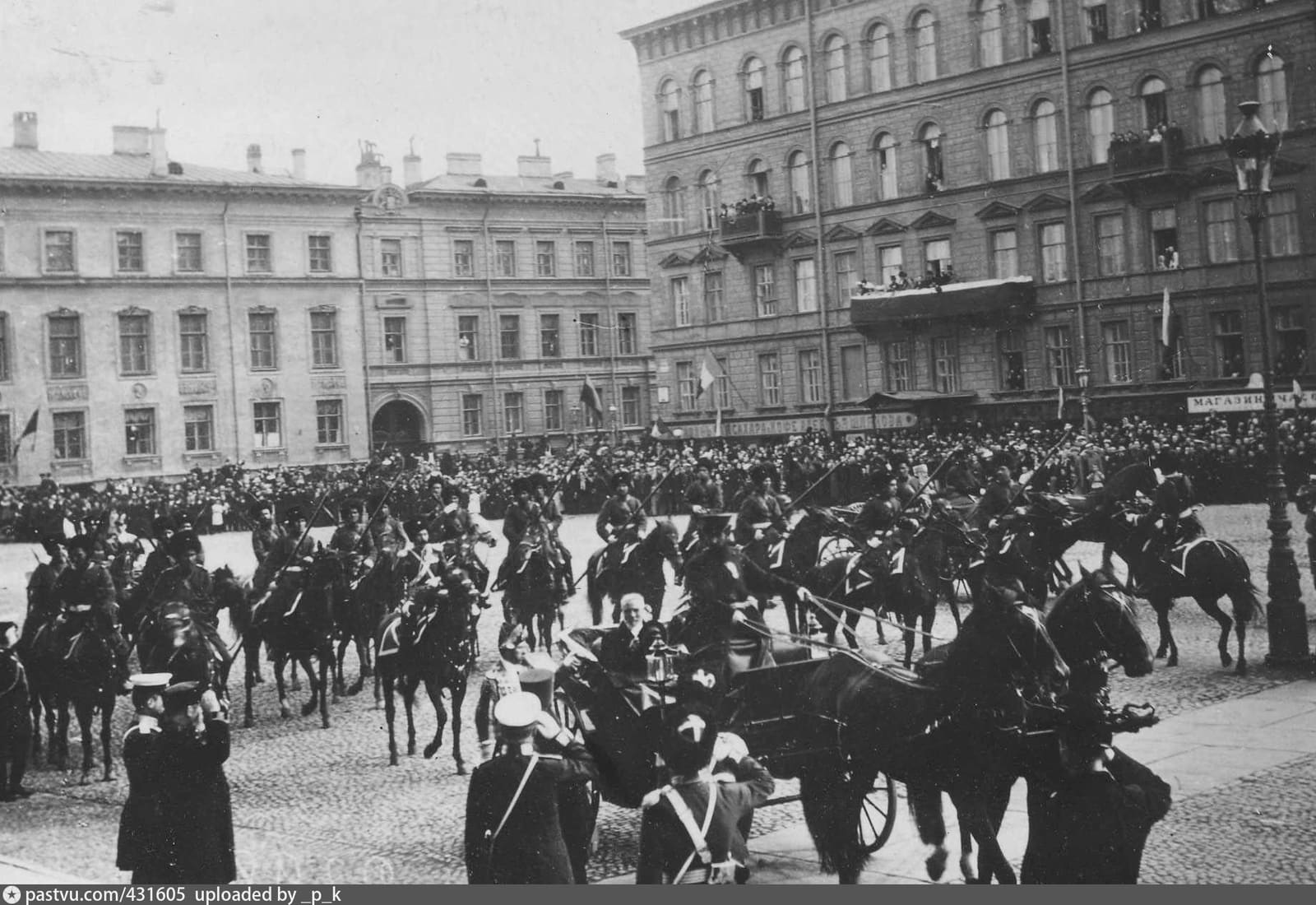
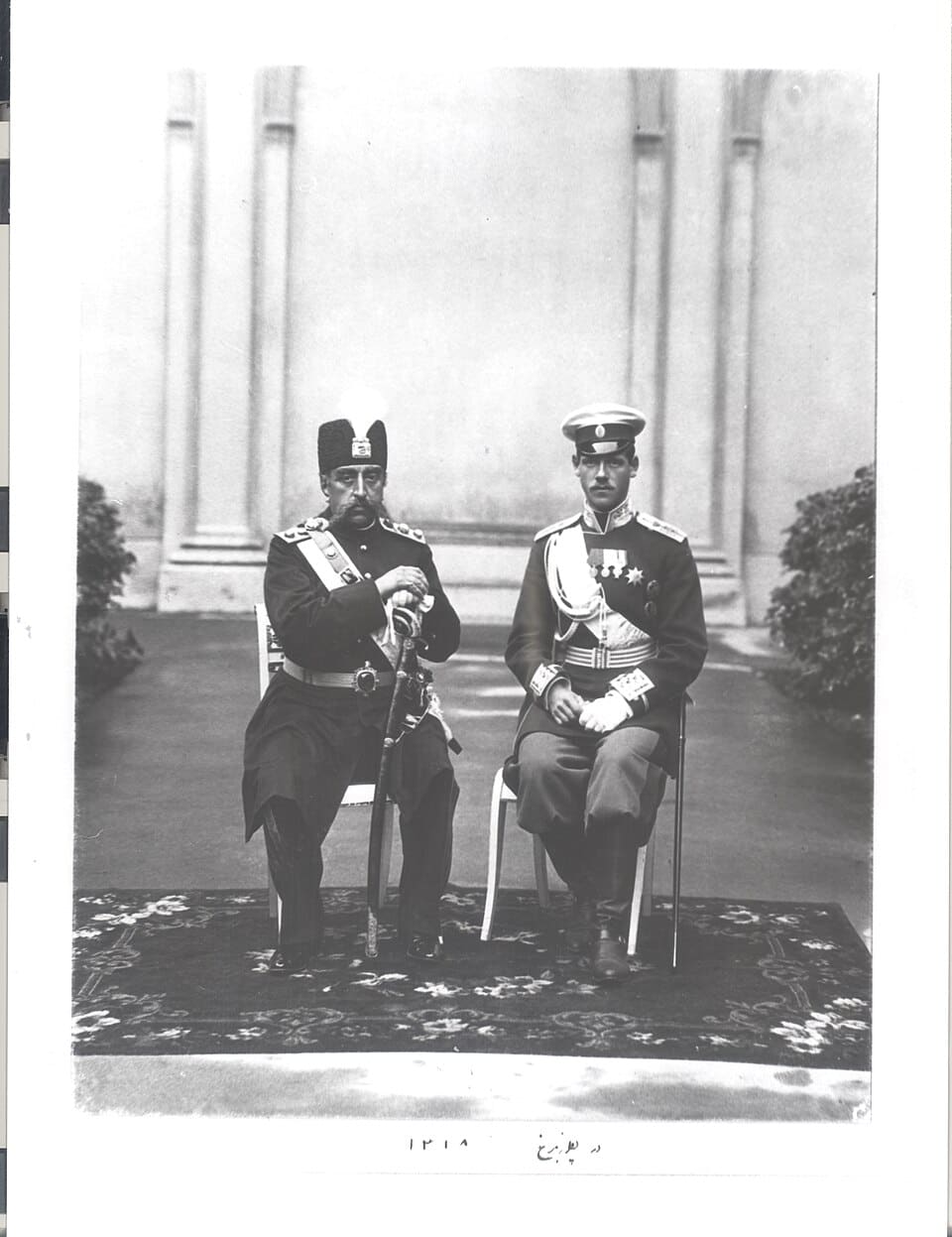
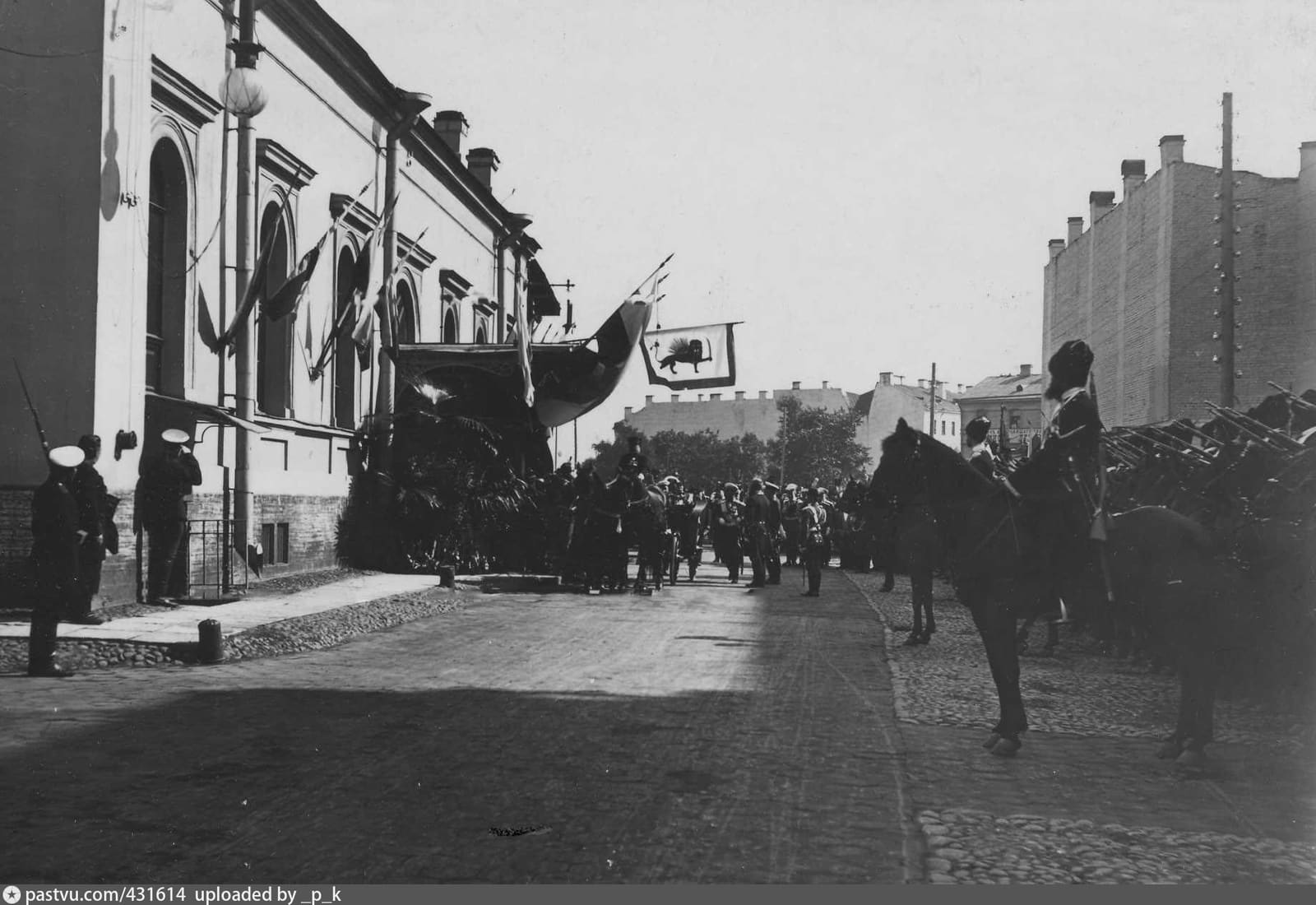
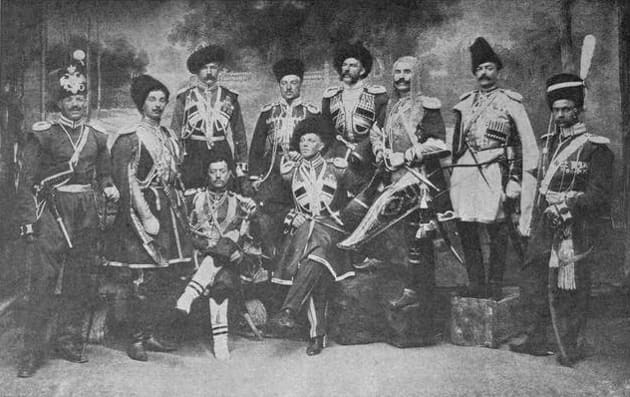
Sources for this chapter
- S001 — A.B. Kalaushin’s roster Kalaushiny (philippov.spb.ru, version 03.02 of 13 July 2025)
- S003 — Family testimony: V.O. Kalaushin, 8–9 Oct 2026
- S012 — Batalpashinskaya confessional register (family list), 1848 (GASK, f. 135, d. 806)
- S013 — Batalpashinskaya parish register, 1857 (RGVIA, f. 14877, d. 2716)
- S014 — Batalpashinskaya confessional register, 1860 (RGVIA, f. 14877, d. 3501)
- S033 — Name index to the Orders of the Kuban Host, 1880–1899
- S034 — I.S. Kravtsov, “Kavkaz i yego voenachalniki…” (Russkaya Starina, 1886)
- S036 — Kavkaz newspaper (Tiflis)
- S037 — Dnevniki imperatora Nikolaya II, vol. 1 (Moscow: ROSSPEN, 2011)
- S044 — Illyustrirovanny vestnik… progressa Rossii, no. 1 (1898)
- S048 — Wiener Zeitung, 1900 (ANNO)
- S049 — Prager Tagblatt, 1900, 1914 (ANNO)
- S050 — Neue Freie Presse, 1900 (ANNO)
- S051 — Vorarlberger Volksblatt, 1900 (ANNO)
- S052 — Neues Wiener Journal, 1900 (ANNO)
- S053 — V.G. Tolstov, Istoriya Khopyorskogo polka…, pt 2; Appendices (Tiflis, 1901)
- S054 — Ostdeutsche Rundschau, 1902 (ANNO)
- S058 — Kavkazsky kalendar (Tiflis), 1910–1914
- S097 — N.V. Galushkin, Sobstvenny Yego Imperatorskogo Velichestva Konvoy (San Francisco, 1961)
- S108 — I.V. Zimin et al., Yuvelirnye sokrovishcha Rossiyskogo imperatorskogo dvora (Moscow, 2013)
- S109 — I.V. Zimin, Detsky mir imperatorskikh rezidentsy (Moscow, 2010)
- S127 — Ye. Preobrazhenskaya, “Vizity shakha Persii v Rossiyu” (Naslediye Imperii)
- S132 — V.V. Slobodenyuk, “Prazdnovaniye stoletnego yubileya Kubanskoy kazachyey gvardii” (Krasnodar, 2011)
- S153 — sammler.ru: collectors’ forum (P.N. Strelyanov)
- S156 — Kubanskaya genealogiya (kubangenealogy.ucoz.ru)
- S162 — S.V. Volkov, database Uchastniki Belogo dvizheniya v Rossii, vol. “K”
- S170 — F.I. Moiseyenko Labinsk Museum of History and Local Lore (labinskiymuzey.ru)
- S179 — Druzhina forum: thread “Sobstvenny Yego Imperatorskogo Velichestva Konvoy”
- S180 — Kubanskiye kazaki forum (kubancossack.0pk.me)
- S181 — VGD genealogy forum (forum.vgd.ru)
- S182 — English Wikipedia — for general historical context
- S184 — Great Soviet Encyclopedia
- S188 — Russian Wikipedia — for general historical context
This page uses material from the Kalaushin family roster published on the Philippov website: https://philippov.spb.ru/?q=Kalaushiny (version 03.02 of 13 July 2025).