Chapter 3 of 14 · 1815–1860
The Caucasian Line
Trofim Kalaushin, his sons and the stanitsa of Batalpashinskaya (1815–1860)
In brief
The earliest Kalaushins named in the records are Trofim Pakhomovich, a Khoper Cossack of Stavropolskaya, and his sons Ivan, Aleksey, Afanasy and Andrey, who moved in 1826–1827 to the new stanitsa of Batalpashinskaya on the Kuban. The chapter follows their households through the lists of 1815, 1827, 1848 and 1860, tells the story of the chamber Cossack Andrey Ivanovich and the family’s first decorations, and gently refines A.B. Kalaushin’s family roster in the light of the documents.
◆ documented◈ published source◇ family testimony△ hypothesisMore about the method
The thread· Exclusivity
In 1853 Uryadnik Andrey Ivanovich was appointed chamber Cossack to the Tsesarevna — the first time the Court chose a member of the family [◈ S001, No. 6; ◆ S013, ff. 178v–179v]. The chapter also shows the chronicle’s method: the households of 1815, 1827, 1848 and 1860 are brought into one picture, and the roster is refined against the documents — as a note, with respect for its compiler.
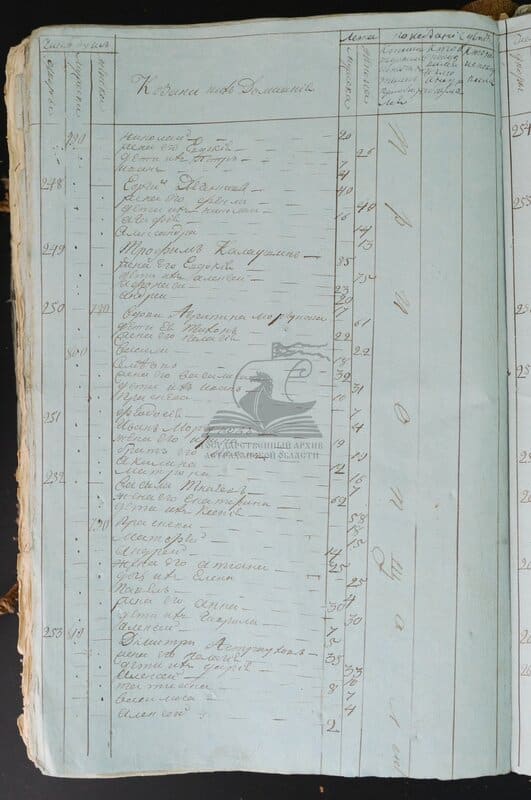
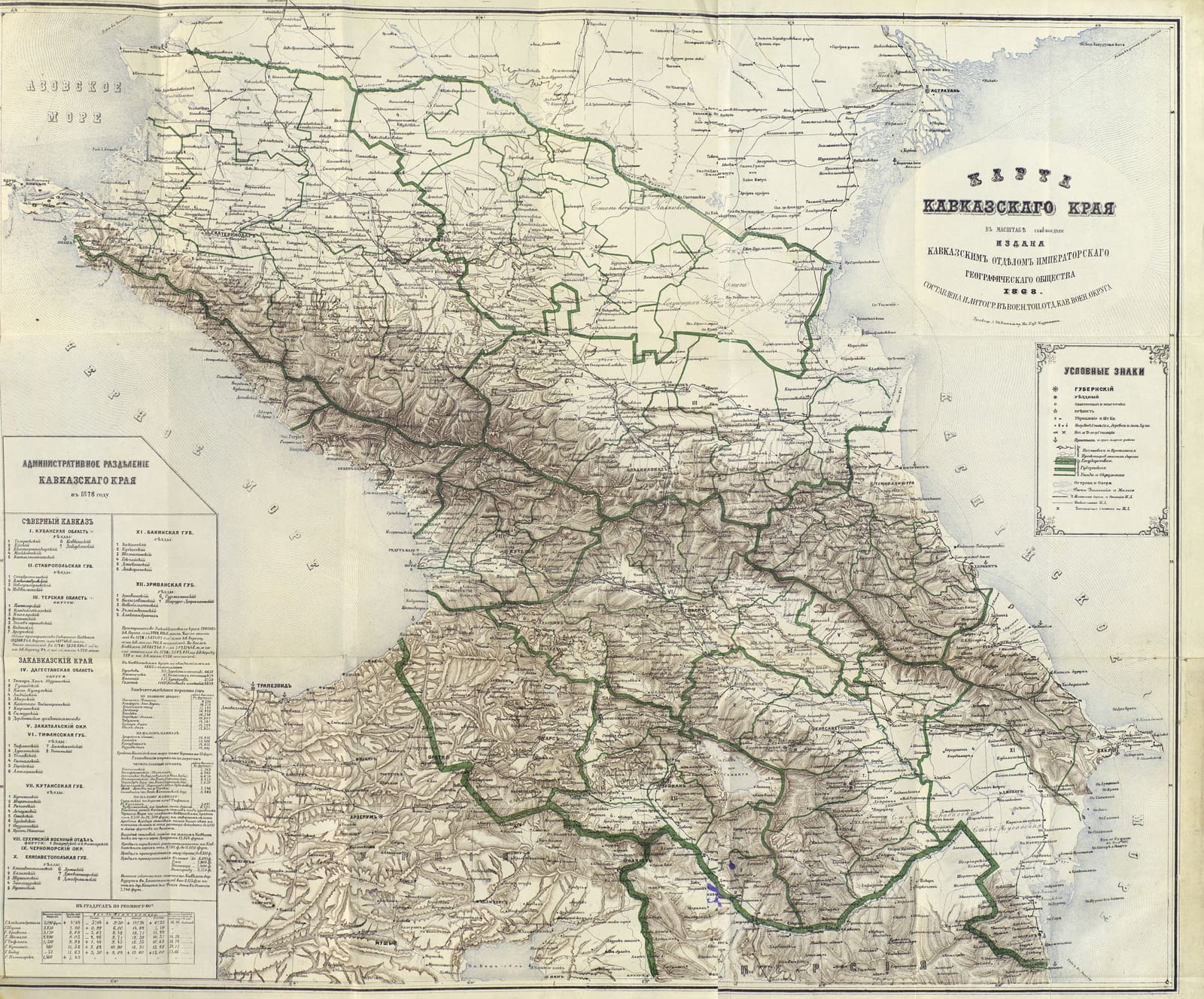
The first Kalaushins whom the records name were Khoper Cossacks of the Caucasus Line. In 1815 an old Cossack, Trofim Pakhomovich Kalaushin, was living with his family in the stanitsa (Cossack village) of Stavropolskaya; twelve years later his widow and sons were among the first settlers of the new stanitsa of Batalpashinskaya on the Kuban. All the branches of the family traced in this chronicle descend from his sons — Ivan, Aleksey, Afanasy and Andrey. The chapter takes the story to 1860, when the Line Cossacks became Kuban Cossacks.
Household No. 321 in Stavropolskaya
The Khoper Regiment came to the Azov–Mozdok Line in the autumn of 1777 and, together with dragoons, laid out the fortress from which Stavropol grew. Beside it, in 1778, the stanitsa of Stavropolskaya was settled; it served as the regiment’s headquarters stanitsa [◆ S047, pt 1, ch. II; ◈ S135, p. 611].
The revision list (revizskaya skazka, a household census of the Empire) drawn up for the stanitsa on 18 November 1815 records as No. 321 the household of “Trofim Pakhomov Kalaushin”, aged 78. With him were his wife Avdotya, 70, and their children: Ivan, 22; Anna, 19; Aleksey, 16; Afanasy, 12; and Andrey, 9 [◆ S007, household no. 321, via S181 transcription, topic 84017]. Trofim was therefore born around 1737. His patronymic names one more ancestor, his father Pakhom, whom we know only from that “Pakhomov”. Avdotya is the everyday form of the name Yevdokiya.
In the confessional registers (annual parish lists of parishioners) of Stavropol district for 1822–1825 Trofim is still alive: he is 85, and with him are his wife Yevdokiya and their sons Aleksey, Afanasy and Andrey. The eldest son, Ivan, now heads his own household, with his wife Yefrosinya and their children Nikolay, Andrey and Nastasya [◆ S008, scans 1287, 597]. The clerks put Yevdokiya’s age anywhere between 51 and 70; two of the four entries agree with the year given by the compiler of the roster — around 1770 [◆ S008, scan 2733; ◆ S009, no. 172, via S180, topic 25558; ◈ S001, No. 2].
Aleksandr Borisovich Kalaushin, who compiled the family roster, does not cite these documents, yet he judged the essentials correctly: the founder was born “about 1740” and had sons “Ivan and Aleksey” [◈ S001, No. 1]. The revision list gives the founder back his name. The compiler also suggested that the ancestor was “most likely a Don Cossack” [◈ S001, No. 1]; where Trofim came from before joining the Khoper Regiment may be shown by the regiment’s revision lists of 1795 and 1811.
The Stavropol fortress was meant “to guard the passage along the valley of the Kalaus River” [◈ S124, p. 1], and the Khoper Cossacks lived by the upper reaches of that river for half a century, from 1777 to 1825 [◆ S047, pt 1, ch. II; ◈ S135].
◇ family testimony
The family recalls that Matvey Alekseyevich Kalaushin, Ivan Trofimovich’s great-grandson, obtained Damascus steel — through Suleymanov, the father of Lyubov Dzhelalovna Geychenko — and re-tempered it himself, and that daggers “of Kalaus steel” were very highly prized in the Caucasus; in support, the family cited the words of the Arabist historian Leonid Lavrov [◇ S001, No. 71].
△ hypothesis · on the name
Kalausskaya stal, “Kalaus steel”, is the family’s own name for the steel of the Kalaushin masters — most likely kalaushinskaya, “the Kalaushins’ steel”: in the Caucasus, imported “Damascus” steel that a well-known master had re-forged and specially tempered was called by his name, as in “Bazalay steel” and “Chilli buolat” [◈ S091, PDF p. 58]. Yet the word also echoes the Kalaus, beside which Trofim and his sons had lived. The steel and the workshops are the subject of the chapter “The Workshop”.
The move to the Kuban (1825–1827)
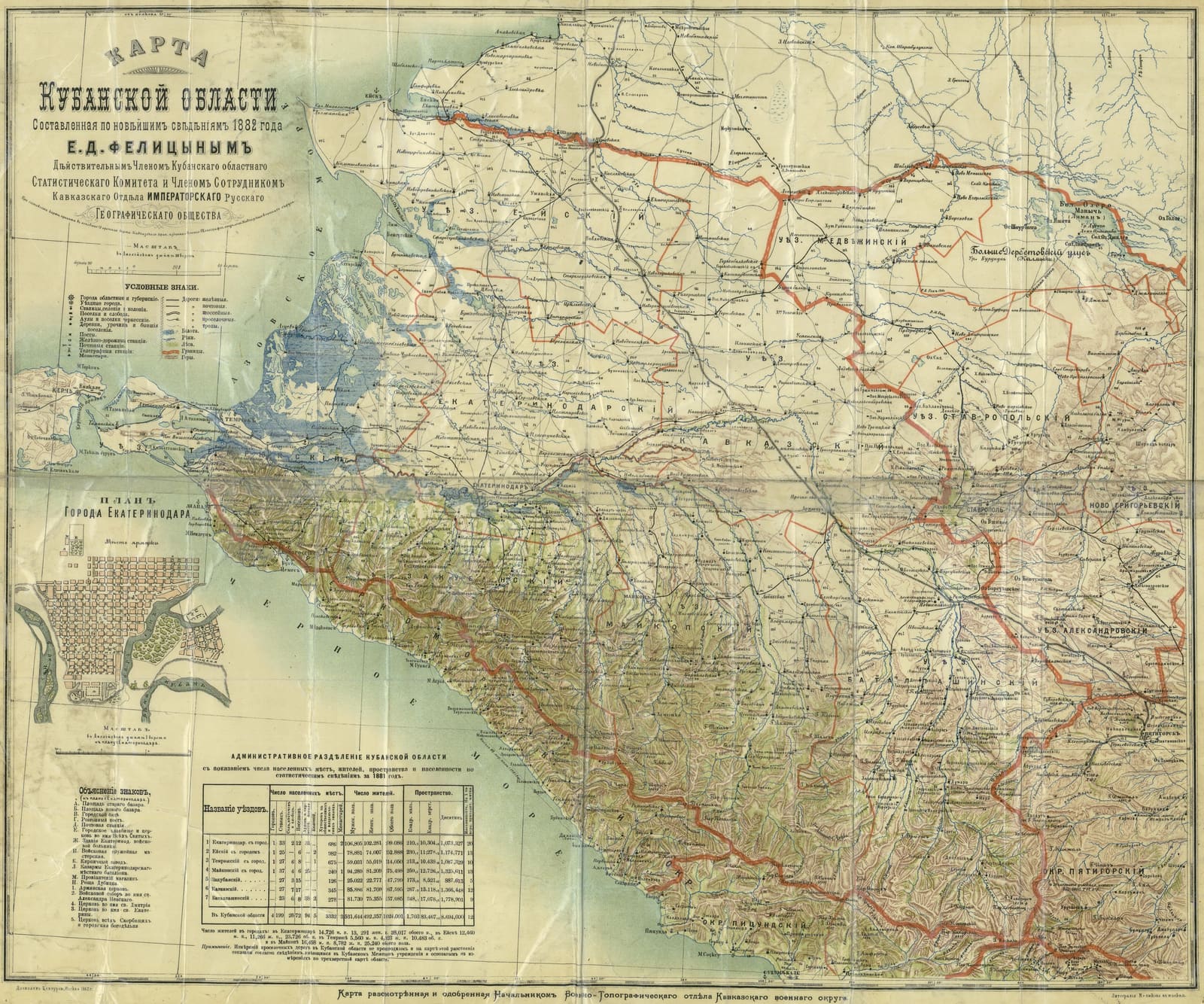
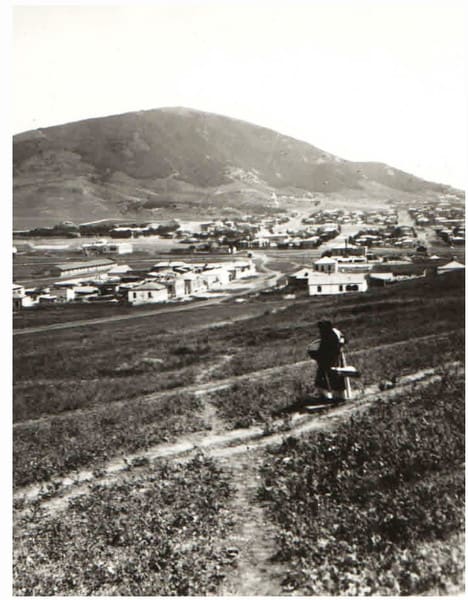
In 1824, at the request of General A.P. Yermolov, the government resolved to move the Khoper and Volga Cossack stanitsas “to the very border” with the mountain peoples [◆ S047, pt 1, p. 177]. Under the resettlement schedule the 441 households of Stavropolskaya were split in two: 300 were to go to the Karantinny post on the Kuma, and 141 “to Batalpashinsk, near the fortification” [◆ S047, pt 1, p. 178]. The stanitsa of Batalpashinskaya was founded on 1 October 1825 and named after the Batalpashinsk fortification; its northern part was settled by Cossacks from Vorovskolesskaya, its southern part and centre by people from Stavropolskaya [◈ S135, p. 535].
The regimental historian V.G. Tolstov writes that the Khoper Cossacks began moving in instalments in the autumn of 1825, “and however hard they tried to reach the new places quickly, it was only in the late autumn of 1827, after the harvest and the threshing, that they finally hauled their belongings over and settled in the new stanitsas on the Kuban” [◆ S047, pt 1, p. 179]. Land was allotted on the old basis, 30 desyatinas for every male soul, and the salt lakes went to Batalpashinskaya [◆ S047, pp. 179–180]. In 1831 the Stavropol Cossacks carried their old church “on their own shoulders” to Karantinnaya, ceding to those who had settled in Batalpashinskaya part of the money for a new one. So, in Tolstov’s words, after fifty years on the Azov–Mozdok Line the Khoper Cossacks “left the comfortable places they had made their own and, with all their ‘families and goods’, moved to a new home, on the forward frontier of the Caucasian line” [◆ S047, p. 180]. Life there was different: “now one had to keep one’s eyes open, both along the line and across the Kuban” [◆ S047, p. 181].
Trofim Pakhomovich himself never appears in the Batalpashinskaya registers: by 1827 Yevdokiya is entered as a widow. He died between the mid-1820s and 1827. In July 1830, when an official of the Caucasus Treasury Chamber was valuing the gardens left behind by the Cossacks of “the former Stavropolskaya stanitsa”, one of Colonel Yefimovich’s gardens was described as “formerly belonging to the retired Cossack Trofim Kaloushin” [◆ S010, no. 155, via S181 transcription, topic 39076].
1827: the widow Yevdokiya and Cossack Ivan
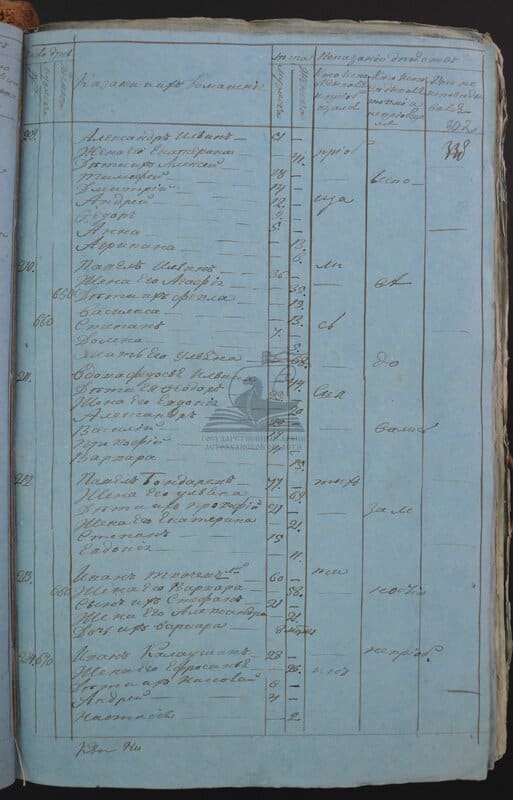
The confessional register of Batalpashinskaya for 1827 is an almost complete list of its first settlers: 181 households [◆ S009, ff. 864–885, via S180, topic 25558]. The Kalaushins come at the very end. No. 172 is “the widow Yevdokiya Kalaushina”, 58, with her sons Aleksey and Afanasy (both 27) and Andrey; with them are Aleksey’s wife Yevdokiya Semyonovna, 26, and their two-year-old son Stefan, and Afanasy’s wife Aleksandra, 20. No. 181 is “Cossack Ivan Kalaushin”, 38, with his wife Yefrosinya Pavlovna, 35, and their children Nikolay (11), Andrey (10), Irina (4) and Marina (3) [◆ S009, nos. 172, 181; ◆ S009, scans 161, 163]. Ivan’s daughter Nastasya is no longer listed; △ she probably died in childhood.
Andrey Trofimovich is given here as 12 — so the original itself reads [◆ S009, scan 161]. Every other list places his birth between 1801 and 1807; △ the figure seems to be a clerk’s slip.
The household inventory of 1831 also knows two households in the stanitsa, “Kalaushen” and “Kalaushin” [◈ S011, list of surnames on S181, topic 3165]. The spelling of the name had not yet settled in the paperwork of these years: “Kalaushin”, “Kaloushin” (1830), “Kalaushen” (1831) — as in the sources.
Who was whose son: notes on the roster
The family roster Kalaushiny is the work of Aleksandr Borisovich, “who for more than forty years gathered the facts grain by grain” [◈ S001, dedication]. In it the history of the family begins with “Aleksey Kalaushin (1791–1862)” and his sons: in the 1827 register the widow Yevdokiya is entered with her sons but without her husband’s name, and in the roster her husband became Aleksey. The revision list of 1815 and the registers of the 1820s name the husband — Trofim — and show Aleksey to be one of the sons. Hence the refinements below, which this chronicle follows throughout; we keep the roster’s numbering so that every entry can be checked.
Note on the roster.
| Roster No. | In the roster | In the documents |
|---|---|---|
| 1 | founder, name not preserved, c. 1740; sons Ivan and Aleksey | Trofim Pakhomovich, b. c. 1737, d. before 1827; wife Avdotya (Yevdokiya); children Ivan, Anna, Aleksey, Afanasy, Andrey |
| 2 | Aleksey, b. c. 1791, husband of Yevdokiya, father of seven sons | no separate generation: Yevdokiya’s husband is Trofim; Aleksey is her son (No. 4) |
| 3 and 5 | Ivan, b. 1793; Ivan Alekseyevich, b. 1811 | one person — Ivan Trofimovich, b. 1793 |
| 4 | Aleksey Alekseyevich, b. 1791 (1796 by source [6]) | Aleksey Trofimovich, b. c. 1796–1800 |
| 7 and 15 | Nikolay Alekseyevich and Nikolay Ivanovich, both b. 1817, wife Vasilisa | one person — Nikolay Ivanovich, b. c. 1816 |
| 6 | Andrey Alekseyevich, b. 1816, chamber Cossack; nine children | two men: Andrey Trofimovich (b. c. 1801–1807) and the chamber Cossack Andrey Ivanovich (b. c. 1817–1819, No. 16) |
| 8 | Afanasy Alekseyevich | Afanasy Trofimovich, b. c. 1800–1803 |
| 9 and 11 | Stepan Alekseyevich (b. 1826–1828) and Stefan Alekseyevich (b. 1825) | one person — Stefan, son of Aleksey Trofimovich, b. c. 1825 |
| 19 and 54 | Gavriil Ivanovich and Gavriil Andreyevich, both b. 1831 | one person — Gavriil Ivanovich |
| source [4] | “Confessional lists… for 1847” | the confessional register of 1827 (GAAO, f. 599, op. 2, d. 7148) |
| source [6] | “Name lists of the inhabitants… for 1828” | by its contents, the confessional register of 1848 (GASK, f. 135, op. 6, d. 806) |
Basis: [◆ S007; ◆ S008; ◆ S009; ◆ S012; ◆ S014; ◆ S013]; full references are given in the text of this chapter.
The compiler himself was careful to flag his doubts. Of Andrey’s and Afanasy’s descent from Aleksey he wrote: “A purely speculative assumption”; it rested on the premise that Ivan (b. 1793) had no children [◈ S001, No. 8, n. 2]. The documents resolve the doubt in their own way: Andrey and Afanasy were not Aleksey’s sons but his brothers, and Ivan had six children. The compiler also doubted that Ivan had begun his service “in Batalpashinskaya stanitsa” [◈ S001, No. 3] — rightly so, since the stanitsa came into being only in 1825.
For the line of Ivan Trofimovich, to which the author of this website belongs, the number of generations from the founder does not change: Trofim → Ivan → Nikolay Ivanovich → … For the descendants of Aleksey, Afanasy and Andrey Trofimovich, the roster’s generations move up by one.
Four households in 1848
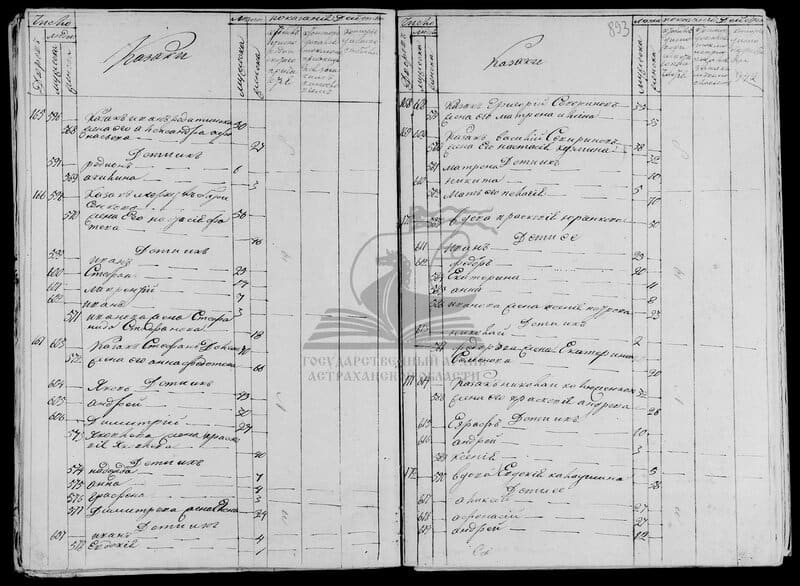
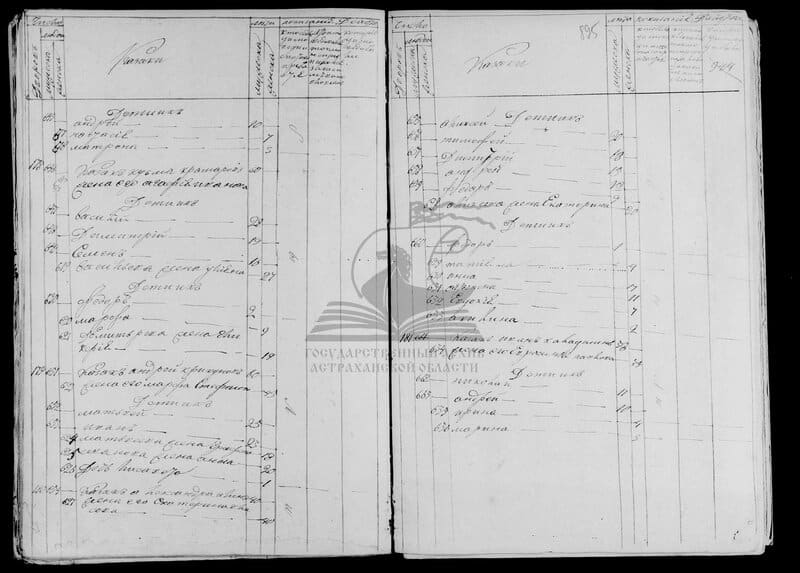
Twenty years on, the stanitsa had grown to 367 households. In the confessional register of the St Nicholas church of Batalpashinskaya for 1848 (published on the Kubanskiye kazaki forum as a “family list”) there are already four Kalaushin households [◆ S012, ff. 424–452v, via S180, topic 25557]:
- No. 92 — Ivan’s household. With him are his sons: Nikolay, 32, with his wife Vasilisa (29) and their children Stefan (13), Aleksey (9), Yelizaveta (7), Agafya (5) and Ilya (3); Andrey, 30, with his wife Mariya (29) and their daughters Matrona (11) and Feodosiya (7); and the youngest, Gavriil, 17.
- No. 219 — Aleksey, 52, with his wife Anna (34) and their children Stefan (23), Vasily (21), Yefim (14) and Nastasya (12).
- No. 274 — Afanasy, 46, with his wife Anna (46) and their children: Mikhail (21) and his wife Yevdokiya (17), Natalya (12), “Mikhail the second” (10), Tatyana (7) and Georgy (6).
- No. 275 — Andrey, 41, with his wife Feodosiya (36) and their children Anna (15), Yefimiya (13), Fyodor (11), Anna (8), Semion (5) and Yevdokiya (2).
In the entry for household No. 92 Ivan is given as 34 — with sons of 32 and 30 — and his wife as “Paraskeva, 49”. In 1827 Ivan’s wife is Yefrosinya Pavlovna, 35, and in 1860 the stanitsa lists a widow Yefrosinya, 68 — by her age the same woman. △ The 1848 entry appears to be damaged; whether a “Paraskeva” existed only the original can show.
Note on the roster. The roster assigns its information on children born in the 1830s and 1840s to “Name lists of the inhabitants of the stanitsa… for 1828” [◈ S001, source 6]. The years of birth derived from them (1834, 1836, 1840–1846) can come only from the 1848 list. A genuine confessional register of the stanitsa for 1828 does exist: it is held in RGVIA (f. 14877, op. 1, d. 5159, ff. 178–214) and is still waiting for a researcher.
Trofim’s sons and their branches
Ivan Trofimovich (b. 1793, d. before 1860)
According to the document cited in the roster, Ivan entered the Khoper Regiment in October 1810, aged seventeen, was “fully discharged” in January 1839, and in 1849, aged 56, “was listed in the documents as a retired Cossack” [◈ S001, No. 3, citing TsGVIA, f. 1058, op. 2, d. 143a]. Note on the roster. The roster says that he began his service “in Batalpashinskaya stanitsa in the 2nd Khoper Regiment, 5th Brigade”. In 1810 the family was living in Stavropolskaya; Batalpashinskaya appeared in 1825, and the 2nd Khoper Regiment and the brigades in 1845 [◈ S135, pp. 112, 535]. △ The 1849 document probably named his unit as it stood when it was drawn up.
In October 1857 the guarantors on the bride’s side at the wedding of Ivan’s niece, Tatyana Afanasyevna, were entered as “Ivan Kalaushin and Andrey Kalaushin” [◆ S013, ff. 213v–214, via S181 transcription, topic 20012]; △ the lists show no other adult Ivan Kalaushin in the stanitsa, so this was most likely Ivan Trofimovich himself. By 1860 his large household is headed by “the widow Yefrosinya Kalaushina”, 68, with seventeen souls [◆ S014, no. 101, via S181 transcription, topic 20012]. Ivan and Yefrosinya’s children were Nikolay, Andrey, Gavriil, Irina, Marina and Nastasya.
Nikolay Ivanovich — the line of the saddlers and of the author
Nikolay was born around 1816; his wife was Vasilisa (Vassa) Andreyevna. In July 1857 “Cossack Nikolay Ivanov Kalaushin and Vassa Andreyeva” brought their son Ilya, born on 13 July, to be baptised [◆ S013, f. 174v]. That same year his son Stepan and Stepan’s wife Feodosiya Fyodorovna baptised their son Aleksandr [◆ S013, f. 180v].
◇ family testimony
The family history records Nikolay as a master saddler [◇ S001, No. 7] — the craft for which his grandsons would later become known. Boris Matveyevich Kalaushin recalled that Nikolay had two sons called Ilya, the second known as “Ilya the second, Lagaga”. According to Nikolay Fedotovich and Olga Savvichna, Nikolay’s brothers were Ivan and Georgy [◇ S001, Nos. 7, 37].
Context. The documents, too, know two Ilyas: Ilya, aged three in 1848 (b. c. 1845), and Ilya baptised in July 1857. In the lists of 1827 and 1848 Ivan is Nikolay’s father and his brothers are Andrey and Gavriil; Georgy (Yegor, b. c. 1842) is the son of Afanasy Trofimovich and so Nikolay’s first cousin. The compiler himself thought that Georgy was to Nikolay “perhaps… only a nephew” [◈ S001, No. 7].
According to the roster, Nikolay’s sons also included Aleksandr Nikolayevich (b. 1837), an uryadnik (Cossack non-commissioned officer) from 1855 and the father of Pavel Aleksandrovich [◈ S001, No. 31]. Through them runs the direct line of the author of this website, Vyacheslav Olegovich Kalaushin. Note on the roster. Pavel is entered as No. 70.30, that is, as a son of Stefan Nikolayevich; his patronymic and the entry for Aleksandr Nikolayevich (“He has a son Pavel”) show that his father is No. 31 [◈ S001, Nos. 31, 70]. In the 1848 register Aleksandr does not appear in Nikolay’s household, though he would have been about eleven; △ the boy may have been entered in another household, or the year 1837 may be imprecise. The family’s own lists of Nikolay’s sons differ as well: Aleksandr Borisovich named Aleksandr among them, while Boris Matveyevich named a second Ilya and Anton but did not mention Aleksandr [◇ S001, No. 7]. The stanitsa’s registers for 1854–1860 should settle the question (see “Where the documents may be found”). Another of Nikolay’s sons, Aleksey (b. c. 1839), was the father of the saddler brothers Matvey, Mikhail, Fedot and Aleksandr, of the teacher Savva and of their sister Anna, whose stories follow in later chapters [◈ S001, No. 32]. Note on the roster. The entries for these brothers and their sister are marked “.31” in the roster, that is, as children of Aleksandr Nikolayevich; their patronymics and the list of children under Aleksey Nikolayevich show that their father is No. 32 [◈ S001, Nos. 32, 71–76]. △ The parent numbers in this part of the roster appear to have shifted when the manuscript was retyped — just as with Pavel Aleksandrovich.
Gavriil Ivanovich
Ivan’s youngest son, Gavriil, was born around 1831. According to the roster he took the oath in 1851, joined the 2nd Khoper Regiment as a Cossack in 1854, was promoted uryadnik in 1858, and held the bronze medal in memory of the War of 1853–1856 [◈ S001, No. 19]. In 1857 “Cossack Gavriil Ivanov Kalaushin and Yekaterina Antipova” had their daughter Nataliya baptised [◆ S013, f. 180v]. From him descends the Gavrilovich line; of the saddler Pyotr Gavrilovich the family remembered: “He was a master famous throughout the Caucasus for making saddles, horse collars and yokes” [◇ S001, No. 60].
Aleksey Trofimovich
Aleksey was born around 1796–1800. His first wife was Yevdokiya Semyonovna (b. c. 1801), his second Anna (b. c. 1814); his children were Stefan (b. c. 1825), Vasily (b. c. 1827), Yefim (b. c. 1834) and Nastasya (b. c. 1836) [◆ S009, no. 172; ◆ S012, no. 219]. By 1860 the household seems to be headed by Vasily: “Cossack Vasily Kalaushin, 33”, with seven souls [◆ S014, no. 244]. The year of Aleksey’s death, 1862, appears in the introduction to the roster without a source; △ it may have come from the family manuscript. Stefan Alekseyevich’s story is told below, with the cordon service.
Afanasy Trofimovich
Afanasy was born around 1800–1803; choosing between 1801–1802 and 1824, the compiler rightly preferred the former [◈ S001, No. 8]. His first wife was Aleksandra (b. c. 1807), his second Anna (b. c. 1802); his children were Mikhail, Natalya, “Mikhail the second”, Tatyana and Georgy (Yegor).
◇ family testimony
According to Olga Savvichna, Afanasy was known as Lagaga. The compiler noted that relatives gave the same nickname to others as well — to Yegor and to Ilya Nikolayevich the second [◇ S001, No. 8].
Note on the roster. The roster lists Afanasy’s service as uryadnik, then podkhorunzhy, khorunzhy and sotnik of the 1st Khoper Regiment [◈ S001, No. 8]. Yet in October 1857 his daughter Tatyana was married as a “KDD” — a Cossack’s unmarried daughter [◆ S013, ff. 213v–214], and in 1860 every Kalaushin in the stanitsa is entered as a Cossack, an uryadnik or a widow. △ The officer ranks most probably belong to Afanasy’s grandson, Afanasy Georgiyevich (Yegorovich), an officer from 1891 [◈ S001, Nos. 47, 92]. In 1860 Afanasy’s household is headed by eighteen-year-old “Cossack Yegor Kalaushin” [◆ S014, no. 44]; △ Afanasy himself had probably died. From Yegor descend the officers Afanasy and Stepan Georgiyevich [◈ S001, Nos. 42, 92, 93].
The roster derives the Vladikavkaz “KOlOushins” from Grigory Alekseyevich (b. 1830), father of Makar and Fyodor [◈ S001, Nos. 10, 46]; Grigory appears neither in the households of 1848 nor among the heads of household of 1860, and his place in the family has not yet been established. △ The Terek branch may descend from Mikhail Afanasyevich: in 1894 the Sunzhenskaya stanitsa administration was seeking “Mikhail Afanasyev Kalaushin, aged 71” [◆ S038, 1894, no. 113, 28.09.1894, p. 5], and Vladikavkaz parish registers of 1899–1900 name Makary and Fyodor Mikhailovich Kalaushin, Cossacks of Sunzhenskaya [◆ S016, d. 96, scan 153; d. 97, scan 72].
Andrey Trofimovich
Trofim’s youngest son, Andrey, was born around 1801–1807. His wife was Feodosiya (36 in 1848); △ she is probably the “KZh [Cossack’s wife] Feodosiya Lavrentyeva Kalaushina” entered as a godparent in 1857 [◆ S013, f. 163v]. His children in 1848 were Anna, Yefimiya, Fyodor, Anna the second, Semion and Yevdokiya [◆ S012, no. 275]. In 1860 “Cossack Andrey Kalaushin” is 59, with nine souls [◆ S014, no. 188]. According to the roster, his son Fyodor (b. c. 1837) was an uryadnik of the 1st squadron of His Majesty’s Own Convoy (hereafter the Convoy), the Cossack bodyguard of the Emperor, in 1877 [◈ S001, No. 23]. Matrona and Feodosiya, whom the roster also lists under this Andrey, were the daughters of Andrey Ivanovich [◆ S012, no. 92].
One more name — Uryadnik Seleverst Ivanovich (b. 1848) [◈ S001, No. 20] — has yet to find its place: he could not have been a son of Yefrosinya Pavlovna (b. c. 1792), and there was no other adult Ivan in the stanitsa in 1848. The stanitsa’s parish register for 1848 may hold the answer.
Uryadnik Andrey Ivanovich, chamber Cossack to the Tsesarevna
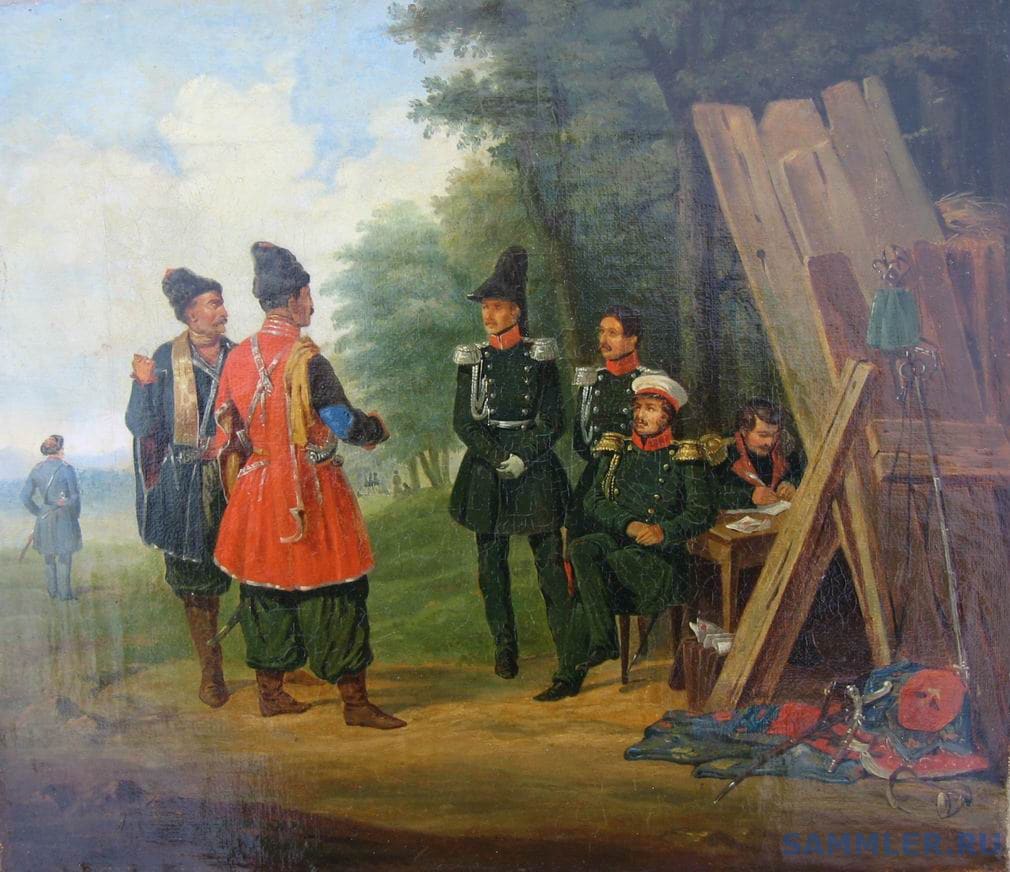
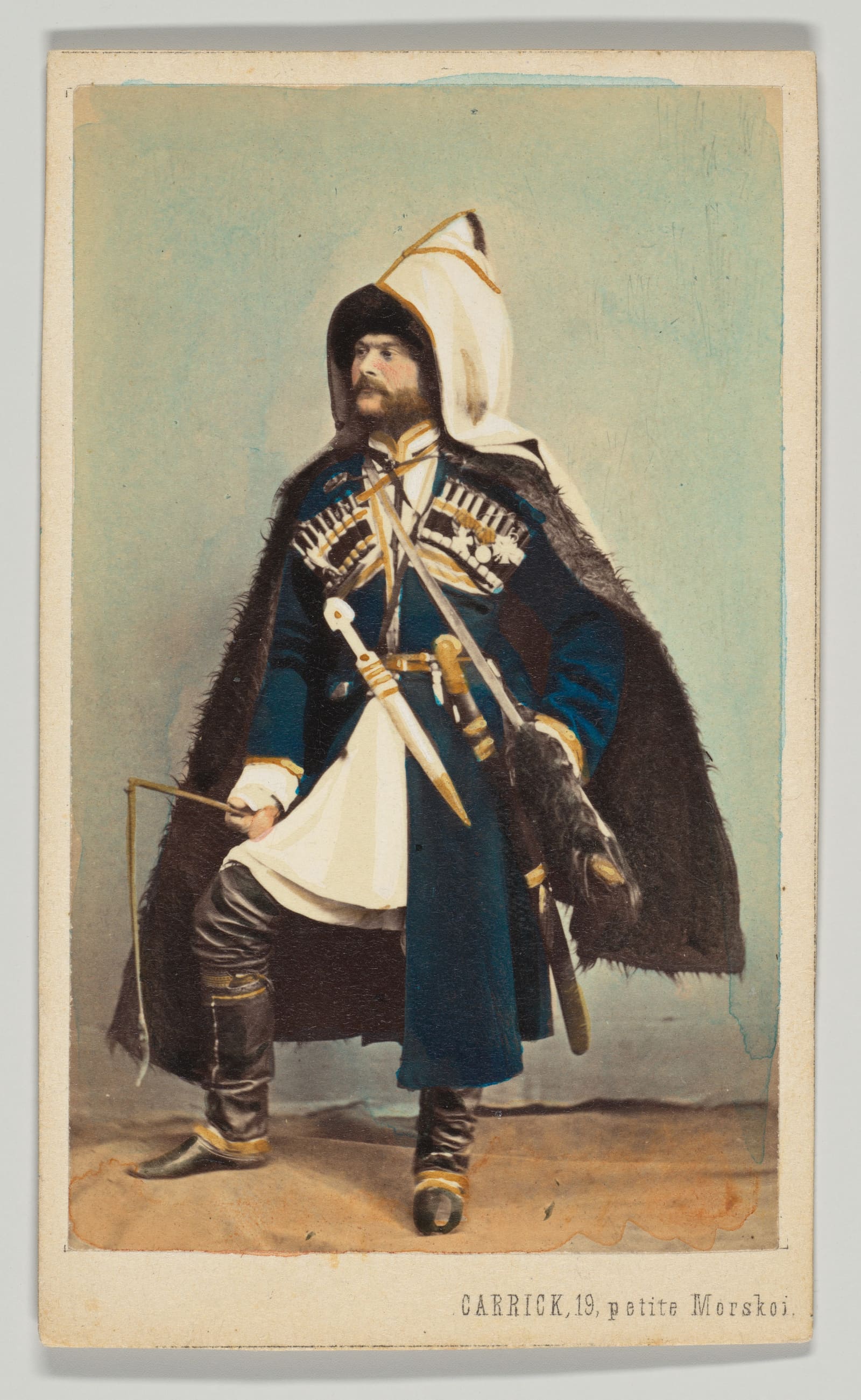
In 1832 a detachment of Caucasus Line Cossacks was formed within the Convoy, and from the mid-1830s chamber Cossacks (kamer-kazaki) — Cossacks in constant personal attendance on members of the imperial family — began to be chosen from its men. Under the establishment of 1851 there were only four of them among the 215 personal servants of the imperial family; tall, handsome men were chosen, and they wore a scarlet full-dress uniform and a blue everyday cherkeska (Circassian coat) [◈ S109].
On 21 January 1853 Colonel Count Adlerberg, head of the chancellery of the Tsesarevich (the heir to the throne), informed Prince Eristov, nakazny (appointed) ataman of the Caucasus Line Cossack Host, that “Uryadnik of the 2nd Khoper Regiment Andrey Kalaushin”, then serving “in His Highness’s Own Convoy” and on leave in the Caucasus, was to fill the vacant post of chamber Cossack to the Tsesarevna. He was to be “sent without delay to St Petersburg, with his whole family if he so wishes”, and provided with travel and subsistence money; a copy of the letter went “to the 5th Brigade of the C.L.C.H. (Batalpashinsk stanitsa)” [◈ S001, No. 6, from the file “On the appointment of Uryadnik Kalaushin as chamber Cossack”]. The Tsesarevna at the time was Maria Alexandrovna, Empress from 1855 [◈ S188, “Maria Alexandrovna (Empress)”]. According to the roster, Andrey was appointed chamber Cossack to the Tsesarevna on 2 September 1853 and transferred to the Court department. The family — his wife and two daughters, Matryona and ten-year-old Fedosya — travelled to St Petersburg with two post horses; travel money was allowed for half the journey, as far as Voronezh, 888¼ versts [◈ S001, No. 6]. The compiler regarded Andrey as “the first Cossack of the family” to serve in the Convoy, and “the first and perhaps the last” of the family to serve as a chamber Cossack [◈ S001, No. 6].
Note on the roster. The roster enters the chamber Cossack as Andrey Alekseyevich, b. 1816 [◈ S001, No. 6]; the 1853 letter itself gives no patronymic. The documents name him as Andrey Ivanovich, son of Ivan Trofimovich and brother of Nikolay. His family in 1848 — his wife Mariya and daughters Matrona and Feodosiya — is the very family that left for St Petersburg [◆ S012, no. 92]. The database of service records compiled from GAKK materials lists, from a service record of 1854: “Kalaushin Andrey Ivanov”, Batalpashinskaya, chamber Cossack, aged 36 [◈ S156, database of service records of Kuban and Terek Cossacks from GAKK materials]. In the stanitsa’s parish register for 1857 his daughter is entered as a godparent in August as “Chamber Cossack’s DD [unmarried daughter] Fedosya Andreyeva Kalaushina”, and in early September as “UDD [uryadnik’s unmarried daughter] Feodosiya Andreyeva Kalaushina” [◆ S013, ff. 178v–179v, 180v]. In 1860 the stanitsa lists “Uryadnik Andrey Ivanov Kalaushin”, aged 41 [◆ S014, no. 102]. By 1857–1860, then, the family — at least in part — was back on the Kuban; how long his service at court lasted is not yet known. In 1861, receiving a deputation of Line Cossacks at Labinskaya, Alexander II asked Potsvirov, an old uryadnik of his own Convoy, “And do you remember Kalaushin?” — and, on hearing “How could I not, Your Majesty”, said: “The poor fellow is ill all the time; a pity, he is a good man.” An eyewitness explained that “Uryadnik Kalaushin of Batalpashinskaya stanitsa served as chamber Cossack to the late Empress” [◆ S034, pp. 40–41]; △ the sources know of no other chamber Cossack named Kalaushin, and it is natural to see Andrey Ivanovich here. The meeting is described in the chapter “At Court”.
On the cordon (1828–1859)
In the new places the organisation of the host itself was changing. In 1828, among the Line Cossacks, “the title desyatnik was replaced by the word uryadnik” [◆ S047, pt 1, p. 84, n.]. In 1832 all the Caucasian Cossack regiments except the Black Sea Host were united “into one whole host under the name of the Caucasus Line Cossack Host”, headed by an appointed ataman, while the regimental and stanitsa administrations remained as before [◆ S047, pt 1, p. 230]. Under the Statute of 14 February 1845 the single Khoper Regiment became two. The 2nd Khoper Regiment had its headquarters at Batalpashinskaya; the stanitsa counted 1,218 male souls, and the regiment’s cordon ran for 85 versts along the Kuban and partly through the mountains [◈ S135, pp. 112, 116]. In the papers of these years the Khoper Brigade is the 5th: the 1848 register lists in the stanitsa a “staff physician of the hospital of the 5th Brigade” [◆ S012, no. 366], and the copy of the chamber-Cossack letter went to the 5th Brigade. A notice of the Host administration of 1849 announced that “the Regimental Administration of the 5th Brigade has reported” that “the Cossacks of Batalpashinskaya stanitsa Mikhailo Kalaushin and Osip Kucherov, on 10 April of this year, near the Solenoozersky post, found three horses” [◆ S030, 1849, no. 35, 10.09.1849, p. 3; ◆ S031, 1849, no. 44, 29.10.1849]. △ The only adult Mikhail in the stanitsa in the 1848 list is Mikhail Afanasyevich.
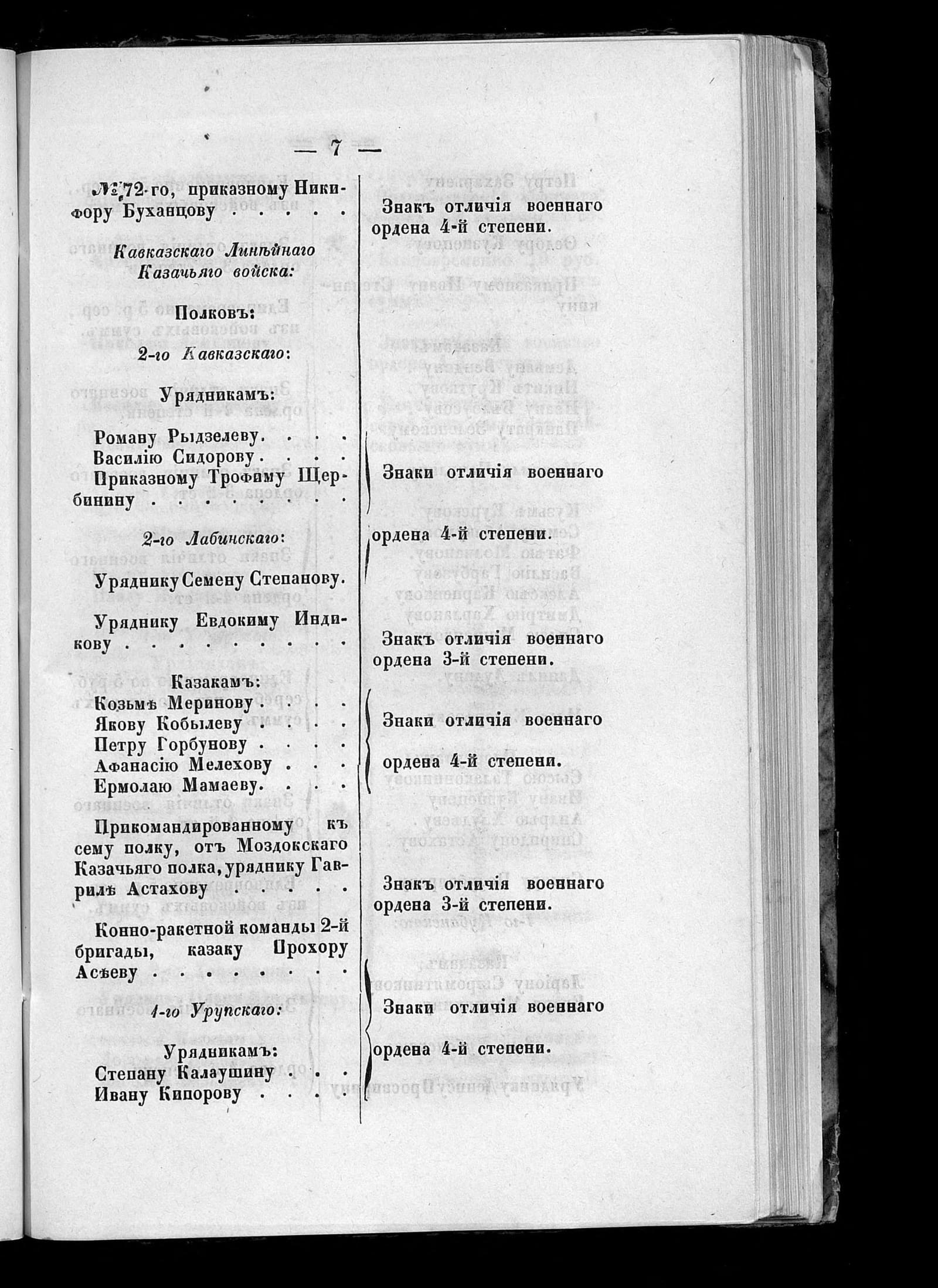
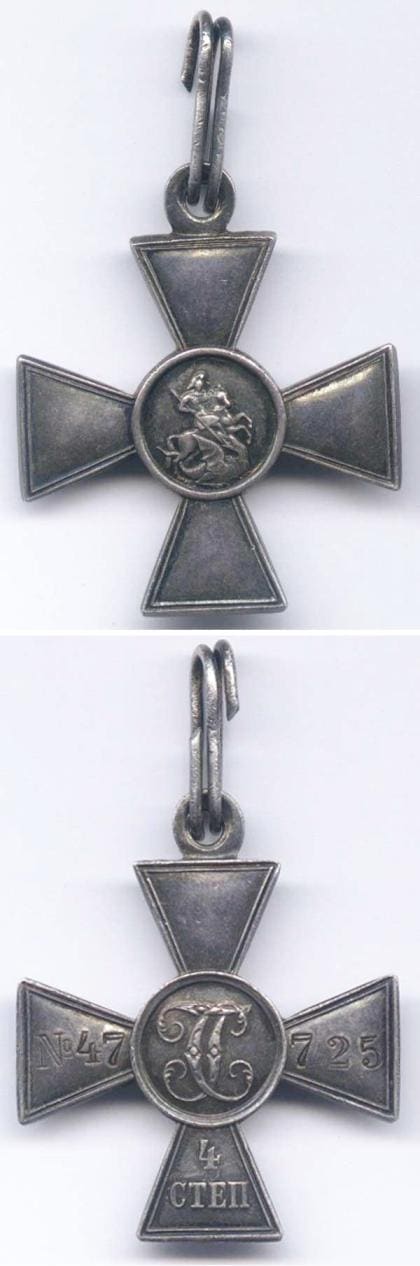
These years also bring the family’s first known battle honours. Stefan (Stepan) Alekseyevich, son of Aleksey Trofimovich, is an uryadnik aged 28 in his service record of 1854 [◈ S156, database of service records from GAKK materials]. By the War Minister’s order of 22 June 1859, for actions “during the first half of 1858, on the Right Flank of the Caucasus Line”, the Insignia of the Military Order, 4th class, was awarded to the uryadniks of the 1st Urup Regiment Stepan Kalaushin and Ivan Kiporov [◆ S032, p. 7]. That this was Stepan Alekseyevich is confirmed by the database of settlers compiled from RGVIA documents: “Kalaushin Stepan Alekseyev” was moved from the 2nd Khoper Regiment to the 1st Urup (document of 1859) [◈ S161]. According to the roster, in September 1857 Stepan was transferred to the 3rd Laba Regiment and then to the 1st Urup, and won insignia No. 6451 for repelling a party of mountaineers that attacked a Cossack detachment near the stanitsa of Ispravnaya on 17 May 1858. His service record says of him: “cannot read or write Russian”; married, with a daughter, Praskovya. “He died young,” the compiler ends the entry [◈ S001, No. 9].
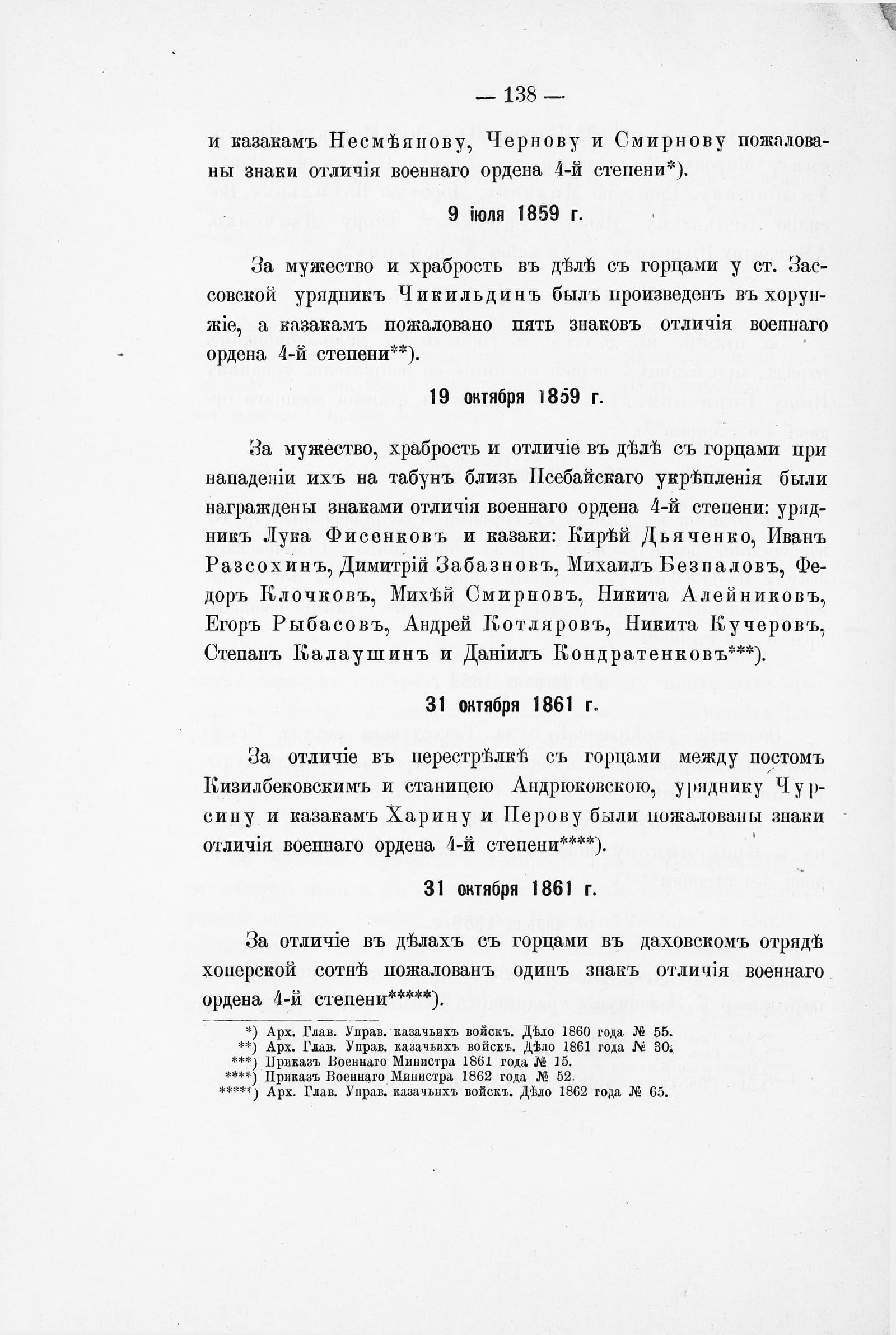
For the action of 19 October 1859 — for “courage, bravery and distinction in an action with the mountaineers when they attacked a herd near the Psebay fortification” — the Insignia of the Military Order, 4th class, also went to Cossack Stepan Kalaushin; the award was announced by the War Minister’s order No. 15 of 1861 [◆ S053, App. 65, p. 138]. Note on the roster. The roster attributes this award to Stefan Nikolayevich, b. 26 April 1847 [◈ S001, No. 30] — but a boy of twelve could not have been decorated. △ Most likely this was Stepan (Stefan) Nikolayevich, son of Nikolay Ivanovich, b. c. 1835 (13 in 1848; also No. 48 in the roster), while the officer career in the same entry and the birthday of 26 April belong to Stepan Georgiyevich: the index to the Orders of the Kuban Host lists Cossack Stefan Kalaushin of Batalpashinskaya, b. 26.04.1868 [◈ S033, via S180, topic 855]. That there were two Stepans among the cross-holders — an uryadnik and a Cossack — is also clear from the database of holders compiled from the Chapter of Orders fund [◈ S156, database of holders of the Insignia of the Military Order from the Chapter of Orders fund, RGIA].
1860: Line Cossacks become Kuban Cossacks
On 19 November 1860 the Caucasus Line and Black Sea Cossack Hosts were abolished and the Kuban and Terek Hosts formed in their place. The Kuban Host received the first six brigades of the Line Host [◈ S135, pp. 270–271], the Khoper Brigade — the 6th since 1858 — among them [◈ S188, “1st Khoper Cossack Regiment”]. A rescript of Alexander II of 24 June 1861 explained that the hosts took their names “from the names of rivers made famous by the age-old deeds of the Cossacks” [◈ S135, p. 270].
The confessional register of Batalpashinskaya for 1860 lists five Kalaushin households: the widow Yefrosinya (68, with seventeen souls), Uryadnik Andrey Ivanovich (41, with two), Cossack Andrey Trofimovich (59, nine souls), Cossack Vasily Alekseyevich (33, seven souls) and Cossack Yegor Afanasyevich (18, three) [◆ S014, nos. 44, 101, 102, 188, 244]; only Andrey Ivanovich’s patronymic is given in the register, and we have restored the others by age. △ The widow Yefrosinya’s large household probably included the families of her sons Nikolay and Gavriil. And so — as sons, grandsons and already great-grandsons of Trofim Pakhomovich — the Kalaushins entered the Kuban Cossack Host (the Kuban Host).
The stanitsa of Labinskaya, which also belongs to the family’s story, was founded at the Makhoshevskoye fortification in 1841–1842; in 1845 it was a stanitsa of the 2nd Laba Regiment, with 1,031 male souls [◈ S135, pp. 114, 570; ◈ S188, “Labinsk”]. Note on the roster. A note to Ivan’s entry says that the sons of A. Kalaushin “settled in two stanitsas of the Caucasus Line, Batalpashinskaya and Labinskaya, only at the beginning of the 19th century” [◈ S001, No. 3]. According to the documents, the family came to Batalpashinskaya from Stavropolskaya in 1826–1827, while Labinskaya enters the family’s history later, with the generation of Matvey Alekseyevich: in 1910 he was chairman of the Second Mutual Credit Society of Labinskaya [◆ S058, 1910, pt 2, col. 525].
From Ivan Trofimovich’s household, too, came the craftsmen who made the family name known.
◇ family testimony · confirmed by relatives
Ivan’s great-grandson Fedot Alekseyevich served in the Convoy. The family history records that, on the order of Emperor Nicholas II, his workshop spent two months making a saddle for the Shah of Persia. Fedot Alekseyevich took the saddle to St Petersburg himself. There, “at a review of the Guards, on the last day before going home (at the end of his service)”, Prince Trubetskoy reported to the Emperor that the saddle had arrived. Nicholas II examined it, said it was very well made, and there and then congratulated Kalaushin on the title of Purveyor to the Court of His Imperial Majesty; a gold watch was granted with the title. The Emperor asked the master how long he had been in St Petersburg and, learning how long the presentation of the saddle had been delayed, showed his displeasure; after he left, Trubetskoy sent Fedot to the guardhouse for two days for an incautious answer. The promised gold watch never reached Fedot Alekseyevich [◇ S001, No. 73]. Relatives confirm the account [◇ S003].
△ hypothesis · dating
The years point to 1900. Fedot Alekseyevich served in the Convoy from 1892 and was discharged by Kuban Host Order No. 60 of 17 June 1900, “retaining the Guards uniform and awarded the badge for service in the Convoy” [◈ S001, No. 73]. During his service a Persian shah came to St Petersburg on a state visit only once: Mozaffar ad-Din Shah, on 4–10 July 1900 Old Style (17–23 July New Style) [◆ S052, 20.07.1900, p. 5]. The visit was prepared well in advance: in February 1900 the press reported the invitation Nicholas II had sent to the Shah, and in April the route of his journey [◆ S048, 15.02.1900, p. 7; ◆ S051, 25.04.1900, p. 3]. Two months’ work on the saddle therefore falls in the spring of 1900. And the documents allow us to name the day of the “review on the last day before going home”: on 31 May (13 June) 1900, in front of the Alexander Palace at Tsarskoye Selo, the Emperor walked along the ranks of the Convoy Cossacks leaving for the reserve, “honoured each of them with gracious words” and handed them the badges for service in the Convoy with his own hand [◆ S036, no. 150, 10.06.1900, p. 3]. Seventeen days later came the order discharging Fedot Alekseyevich — with that very badge; thirty-four days later the Shah arrived in St Petersburg. The most consistent dating is spring to early summer 1900: the saddle was being prepared for Mozaffar ad-Din Shah’s visit.
Other meetings between Russian emperors and shahs fit the family account less well. Naser al-Din Shah was in St Petersburg in 1889, before Fedot Alekseyevich’s service began; Nicholas II met Mozaffar ad-Din Shah at the manoeuvres near Kursk in 1902 and at Peterhof in 1905, by which time Fedot Alekseyevich had left the Convoy; and for Ahmad Shah’s coronation in Tehran in 1914 Russia sent a special envoy [◈ S127; ◆ S054, 19.09.1902, p. 2; ◆ S037, 20–24.08.1905; ◆ S049, 21.07.1914]. The purveyor’s title is confirmed by the official list of 1915, in which I.V. Zimin names “the saddle-maker Fedot Kalaushin of Batalpashinskaya stanitsa” [◈ S108].
A note on names. In 1900 the Convoy was commanded by Baron Alexander Meyendorff; his nephew, Prince Georgy (Yury) Ivanovich Trubetskoy, took command in 1906 and held it until 1914 [◈ S097, pp. 119, 170; ◈ S188, “Trubetskoy, Georgy Ivanovich”]. △ It seems that in the family’s memory the name of the later, better-remembered commander took the place of his uncle’s — all the more naturally since Fedot’s younger brother, Aleksandr Alekseyevich, also served in the Convoy under Trubetskoy [◇ S001, No. 74]. The full story is told in the chapters “At Court” and “The Workshop”.
Documents (translated from the Russian)
1815. Revision list of the stanitsa of Stavropolskaya, Khoper Cossack Regiment, 18 November 1815: “321. Trofim Pakhomov Kalaushin, 78. His wife Avdotya, 70. Their children: Ivan, 22; Aleksey, 16; Afanasy, 12; Andrey, 9; Anna, 19.” [◆ S007, via S181 transcription, topic 84017]
1827. Confessional register of the stanitsa of Batalpashinskaya: “172. The widow Yevdokiya Kalaushina, 58. Her children: Aleksey, 27; Afanasy, 27; Andrey, 12. Aleksey’s wife Yevdokiya Semyonova, 26; son Stefan, 2. Afanasy’s wife Aleksandra, 20… 181. Cossack Ivan Kalaushin, 38. His wife Yefrosinya Pavlova, 35. Their children: Nikolay, 11; Andrey, 10; Irina, 4; Marina, 3.” [◆ S009, via S180, topic 25558]
1853. From the letter of the chancellery of the Tsesarevich to the appointed ataman of the Caucasus Line Cossack Host, St Petersburg, 21 January 1853: “It is the wish of the Sovereign Heir Tsesarevich that the vacancy of chamber Cossack to Her Imperial Highness the Tsesarevna be filled, with transfer to the Court department, by Uryadnik of the 2nd Khoper Regiment Andrey Kalaushin, of the Caucasus Line Cossack Host, serving in His Highness’s Own Convoy, who is at present on leave in the Caucasus…” [◈ S001, No. 6, from the file “On the appointment of Uryadnik Kalaushin as chamber Cossack”]
Where the documents may be found
- GASK (State Archive of Stavropol Krai), f. 748, op. 1, d. 1: the original of the 1815 revision list of Stavropolskaya (household No. 321) — Avdotya’s age, any note on origin; also the Khoper Regiment’s revision lists of 1795 and 1811 — where Trofim came from and whether Pakhom was still alive.
- GAAO (State Archive of Astrakhan Oblast), f. 599: parish registers of the Kazan church of Stavropolskaya for 1800–1812 (births of Afanasy and Andrey) and the stanitsa’s confessional registers before 1825.
- RGVIA, f. 14877, op. 1, d. 5159: confessional registers of Batalpashinskaya for 1828 (ff. 178–214) and 1830 (ff. 501–518) — the families in the first years after the move, including Andrey Trofimovich’s age; d. 2050 (1854), d. 2470 (1856), d. 2717 (1857), d. 3501, vol. 3 (1860) — full family composition, Aleksandr Nikolayevich, the chamber Cossack entered as “absent”.
- GARO (State Archive of Rostov Oblast), f. 226, op. 7, d. 271: household inventory of Batalpashinskaya, 1831.
- GASK, f. 135, op. 6, d. 806: the 1848 confessional register (the entry for household No. 92); d. 809: the 1848 parish register (birth of Seleverst).
- TsGVIA/RGVIA, f. 1058, op. 2, d. 143a: the document cited in the roster (apparently a service record of 1849; Ivan, Afanasy); reference to be verified.
- The file “On the appointment of Uryadnik Kalaushin as chamber Cossack” (given in the roster as TsGVIA, f. 366, op. 1058, d. 2, vol. 1; reference to be verified); the Ministry of the Imperial Court fonds in RGIA — service records of chamber Cossacks; St Petersburg parish registers for 1853–1857 (TsGIA SPb, f. 19).
- GAKK (State Archive of Krasnodar Krai): service records of 1854 (Andrey Ivanovich, Stefan Alekseyevich).
- RGVIA, f. 330, op. 56, d. 452: list of uryadniks on internal service in the Batalpashinsk Department (given in the roster as for 1877 and for 1887; Aleksandr Nikolayevich, Fyodor Andreyevich).
- TsGA RSO-A (Central State Archive of North Ossetia–Alania, Vladikavkaz), f. 296: confessional registers of Sunzhenskaya, 1870s–1890s (the Terek branch).
- The saddle for the Shah: the Chamber-Fourier Journal for 1900 (RGIA, f. 516) and the diary of Nicholas II (GA RF, f. 601) — the review of 31 May and the Shah’s visit of 4–10 July; His Imperial Majesty’s Cabinet (RGIA, f. 468) — gifts to the Shah, a watch for Uryadnik Kalaushin; the Chancellery of the Ministry of the Imperial Court (RGIA, f. 472) — the file on F.A. Kalaushin’s purveyor title; GAKK — the text of Kuban Host Order No. 60 of 17.06.1900. A fuller list is given in the chapter “At Court”.
Documents and illustrations
Sources for this chapter
- S001 — A.B. Kalaushin’s roster Kalaushiny (philippov.spb.ru, version 03.02 of 13 July 2025)
- S003 — Family testimony: V.O. Kalaushin, 8–9 Oct 2026
- S007 — Revision tale of Stavropolskaya stanitsa, 18.11.1815 (GASK, f. 748)
- S008 — Confessional registers of Stavropol district, 1822–1825 (GAAO, f. 599, d. 3684)
- S009 — Batalpashinskaya confessional register, 1827 (GAAO, f. 599, d. 7148)
- S010 — Valuation of the establishments of the Cossacks of the former Stavropolskaya stanitsa, July 1830 (RGIA, f. 383)
- S011 — Household inventory of Batalpashinskaya, 1831 (GARO, f. 226)
- S012 — Batalpashinskaya confessional register (family list), 1848 (GASK, f. 135, d. 806)
- S013 — Batalpashinskaya parish register, 1857 (RGVIA, f. 14877, d. 2716)
- S014 — Batalpashinskaya confessional register, 1860 (RGVIA, f. 14877, d. 3501)
- S016 — TsGA RSO-A, f. 296, op. 1
- S030 — Saratovskiye Gubernskiye Vedomosti, 1849
- S031 — Voronezhskiye Gubernskiye Vedomosti, 1849
- S032 — Order of the War Minister on the irregular forces, No. 32 of 22.06.1859
- S033 — Name index to the Orders of the Kuban Host, 1880–1899
- S034 — I.S. Kravtsov, “Kavkaz i yego voenachalniki…” (Russkaya Starina, 1886)
- S036 — Kavkaz newspaper (Tiflis)
- S037 — Dnevniki imperatora Nikolaya II, vol. 1 (Moscow: ROSSPEN, 2011)
- S038 — Terskiye Vedomosti, 1894
- S047 — V.G. Tolstov, Istoriya Khopyorskogo polka Kubanskogo kazachyego voyska, pt 1 (Tiflis, 1900)
- S048 — Wiener Zeitung, 1900 (ANNO)
- S049 — Prager Tagblatt, 1900, 1914 (ANNO)
- S051 — Vorarlberger Volksblatt, 1900 (ANNO)
- S052 — Neues Wiener Journal, 1900 (ANNO)
- S053 — V.G. Tolstov, Istoriya Khopyorskogo polka…, pt 2; Appendices (Tiflis, 1901)
- S054 — Ostdeutsche Rundschau, 1902 (ANNO)
- S058 — Kavkazsky kalendar (Tiflis), 1910–1914
- S091 — E.G. Astvatsaturyan, Oruzhiye narodov Kavkaza (1995)
- S097 — N.V. Galushkin, Sobstvenny Yego Imperatorskogo Velichestva Konvoy (San Francisco, 1961)
- S108 — I.V. Zimin et al., Yuvelirnye sokrovishcha Rossiyskogo imperatorskogo dvora (Moscow, 2013)
- S109 — I.V. Zimin, Detsky mir imperatorskikh rezidentsy (Moscow, 2010)
- S124 — Passport of the City of Stavropol (2026)
- S127 — Ye. Preobrazhenskaya, “Vizity shakha Persii v Rossiyu” (Naslediye Imperii)
- S135 — GASK Handbook 2008: Administrativno-territorialnoye ustroystvo Stavropolya… (Stavropol, 2008)
- S156 — Kubanskaya genealogiya (kubangenealogy.ucoz.ru)
- S160 — Yandex Archive Search (yandex.ru/archive)
- S161 — Database of settlers in the North Caucasus and the Kuban (VGD forum, 2022)
- S180 — Kubanskiye kazaki forum (kubancossack.0pk.me)
- S181 — VGD genealogy forum (forum.vgd.ru)
- S188 — Russian Wikipedia — for general historical context
This page uses databases from the Kubanskaya Genealogiya website: http://kubangenealogy.ucoz.ru/.
This page uses material from the Kalaushin family roster published on the Philippov website: https://philippov.spb.ru/?q=Kalaushiny (version 03.02 of 13 July 2025).