Chapter 9 of 14 · 1941–1945
The Great Patriotic War
The Kalaushins at the front, in besieged Leningrad and on the home front, 1941–1945
In brief
Between 1941 and 1945 Kalaushins from Cherkessk, Bekeshevskaya, Zelenchukskaya, Vladikavkaz and Leningrad served as drivers, carters, sappers, anti-aircraft gunners and officers, from Novgorod and Myskhako to Berlin and the Far East, and the Book of Memory of Karachay-Cherkessia alone lists nine men of the name killed or missing. This chapter follows them through casualty reports, award sheets and the family roster, and also tells of besieged Leningrad, where Matvey Matveyevich Kalaushin served as acting commandant of Pushkin House, and of the spring of 1945 in ruined Mikhailovskoye.
◆ documented◈ published source◇ family testimony△ hypothesisMore about the method
The thread
This chapter is about those who fought and those who did not come back; the traits of the house step aside for remembrance, and the chronicle does not mark them here. From besieged Leningrad, two lines only: Matvey Matveyevich acted as commandant of Pushkin House, and D.S. Likhachev counted him among the four people who “saved the Institute until 1945” [◈ S129; ◈ S118, p. 19]; between the ages of twelve and fourteen his son Boris made more than a hundred and fifty hand-written booklets [◈ S163; ◈ S115].
By the summer of 1941 the grandsons and great-grandsons of the Khoper Cossacks no longer lived only in Cherkessk, as the former stanitsa (Cossack village) of Batalpashinskaya had been called since 1939. They were in Leningrad and Terijoki, in Vladikavkaz and Nalchik, in Kustanay and Sukhumi, in the stanitsas of Bekeshevskaya and Zelenchukskaya. The war entered their names in records of a different kind from the old regimental lists: reports of irrecoverable losses, award sheets, award card indexes and Books of Memory. The surname is spelled in several ways — Kalaushin, Kaloushin, Koloushin, Kolaushin — sometimes in the same document [◆ S022, f. 33, op. 687572, d. 240, via S175]. This chapter tells only what the records, published sources and the family roster contain. Many of the people named in the records do not appear in the roster; where their kinship with the family is suggested, it is marked as a hypothesis.
The first weeks: Boris Aleksandrovich
Boris Aleksandrovich Kalaushin [S001, No. 138] was born in St Petersburg on 1 May 1904 Old Style (14 May New Style), in the barracks of His Majesty’s Own Convoy — the Cossack bodyguard of the Emperor — at 28 Shpalernaya Street, where his father, Aleksandr Alekseyevich, was serving as an uryadnik, a Cossack non-commissioned officer [◇ S001, Nos. 74, 138]. He worked as a cinema projectionist, first in Labinskaya and later at Lenfilm; in June 1940 he was transferred as a technician to the cinema administration at Terijoki (now Zelenogorsk) [◈ S001, No. 138, from his work record book].
◇ family testimony · as told by his son, Aleksandr Borisovich Kalaushin, compiler of the roster
On the evening of 22 June 1941 the men of the house gathered on the veranda, and Boris said that he would rather die than be taken prisoner, and would fight to the end; his eight-year-old son heard it from outside. Father and son said goodbye by the well. The boy’s mother was at work, but she ran to the station in time to catch the troop train, and there, under the lime trees, his parents parted for the last time [◇ S001, No. 138].
The final entry in his work record book bears the same date: “discharged on mobilisation into the Red Army”. At the front he became the cinema and radio technician of the political department of the 128th Rifle Division, with the rank of voyentekhnik (military technician) 2nd rank [◈ S001, No. 138]. On 30 July 1941 he wrote to his wife from near Novgorod; the family kept the letter:
“We are 30 km from the front; in Novgorod the air-raid alarms never stop… War is terrible, and whoever survives it will be a happy man. I am writing in the cab of a lorry… Wait for me, if I live, not before a year and a half, or even two; be patient” [◈ letter of B.A. Kalaushin to his wife, 30.07.1941, via S001, No. 138].
In the 128th Division’s casualty report and in the order striking him off the strength, Boris Aleksandrovich — “cinema and radio technician of the political department, 128th Rifle Division” — is listed as missing in action on 15 August 1941 [◆ S022, f. 58, op. 818883, d. 4; f. 56, op. 12220, d. 48, via S174].
◇ family testimony · Aleksandr Borisovich’s enquiries
His son traced four men who had served with his father. They told him that the division had fallen back from Novgorod by two roads and that the staff and the political department had taken the Leningrad highway. One of them, who recognised Boris Aleksandrovich from a photograph, wrote that as they fought their way back they had “not counted even half” of their men [◇ S001, No. 138].
The Siege: Pushkin House
Boris Aleksandrovich’s cousin, Matvey Matveyevich Kalaushin [S001, No. 127], was head of the museum of Pushkin House — the Institute of Russian Literature of the USSR Academy of Sciences — when the war began. Only a fortnight earlier, on 8 June 1941, he had been at the Pushkin festival in Mikhailovskoye [◈ S106, pp. 252–253].
In the Siege winter of 1941–1942 Matvey Matveyevich acted as commandant of Pushkin House. According to the recollections of a member of the Institute’s staff, N.N. Fonyakova, he was responsible for the building and everything kept in it, and for the people: their ration cards, visits to the sick, the burial of the dead [◈ S129]. The main manuscript collections had gone to Novosibirsk on a special train as early as the summer of 1941, but much had to be left in the building; after the bombardments those who remained at the Institute mended the roof themselves, boarded up the windows with plywood and put out incendiary bombs [◈ S129]. In July 1942 Matvey Matveyevich was sent to Tashkent, accompanying a train with the most valuable museum material [◈ S129]. His correspondence with V.A. Manuylov — in 1942–1944 the Academy Presidium’s plenipotentiary for the Institute and custodian of its unevacuated holdings — survives in the Central State Archive of Literature and Art in St Petersburg (TsGALI SPb); both men, as the researcher notes, were directly involved in the safekeeping and transport of the museum’s treasures [◈ S128, p. 202]. His Medal “For Valiant Labour in the Great Patriotic War 1941–1945” was shown in 2010 at the exhibition A Quiet Feat at the All-Russian Pushkin Museum [◈ S129].
Matvey Matveyevich’s family spent the first years of the Siege in Leningrad [◈ S163]. His son, Boris Matveyevich [S001, No. 213], was twelve. In the besieged city, and later in evacuation in Tashkent [◈ S001, No. 213], he wrote, illustrated and stitched together tiny booklets — more than a hundred and fifty of them in 1941–1942 [◈ S142, pp. 29–30]. The cover of one of them, Two Notebooks, carries the mark of his childhood “publishing house”, “Literature and Children”, and the date MCMXLI [◈ S142, p. 30, fig. 3]. Copies of the booklets have been given to the People’s Museum “And the Muses Were Not Silent…” in St Petersburg [◈ S142, p. 29].
◇ family testimony
The family history records that the boy did all this at the age of twelve to fourteen, “having barely crawled out of death by starvation” [◇ S001, No. 213].
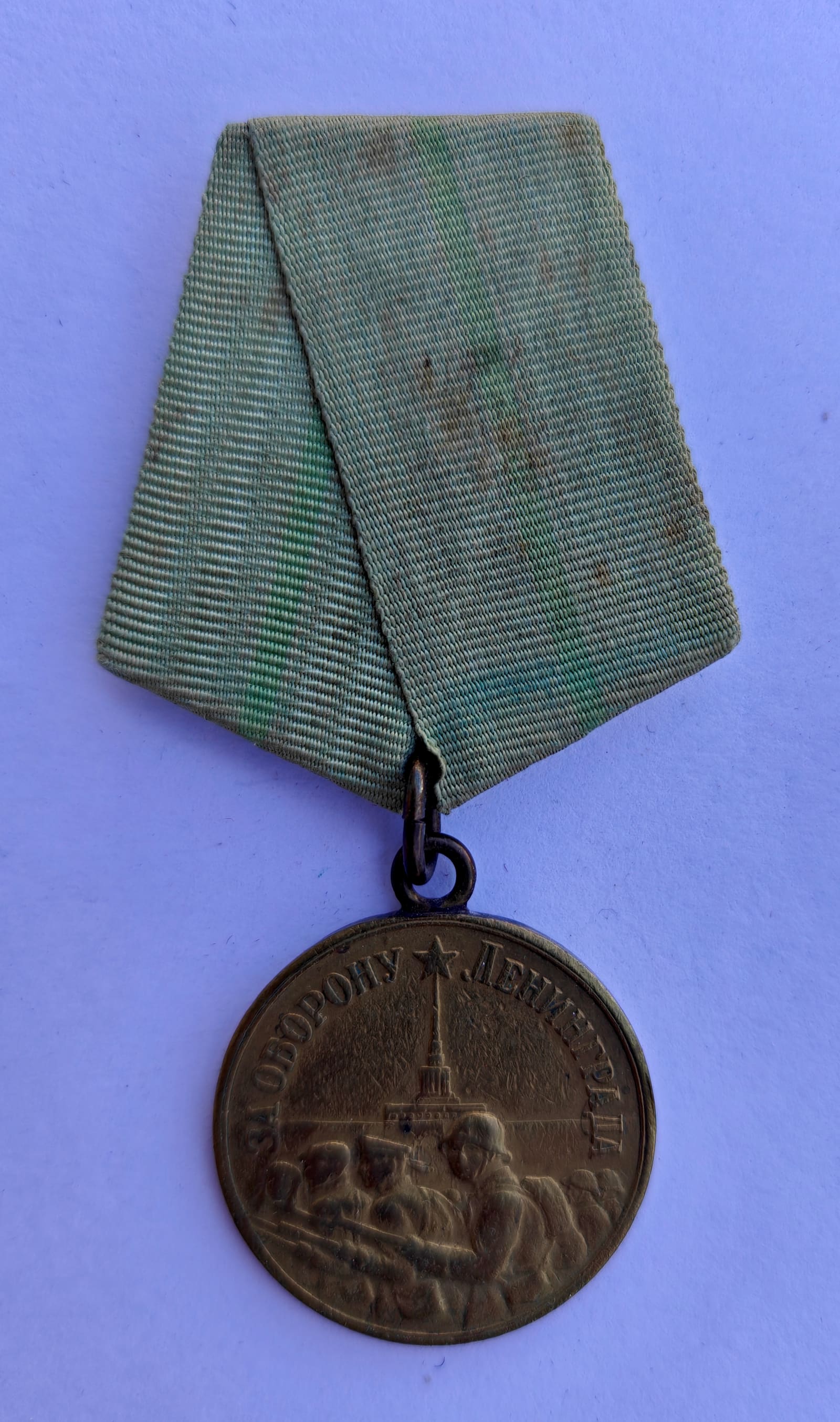
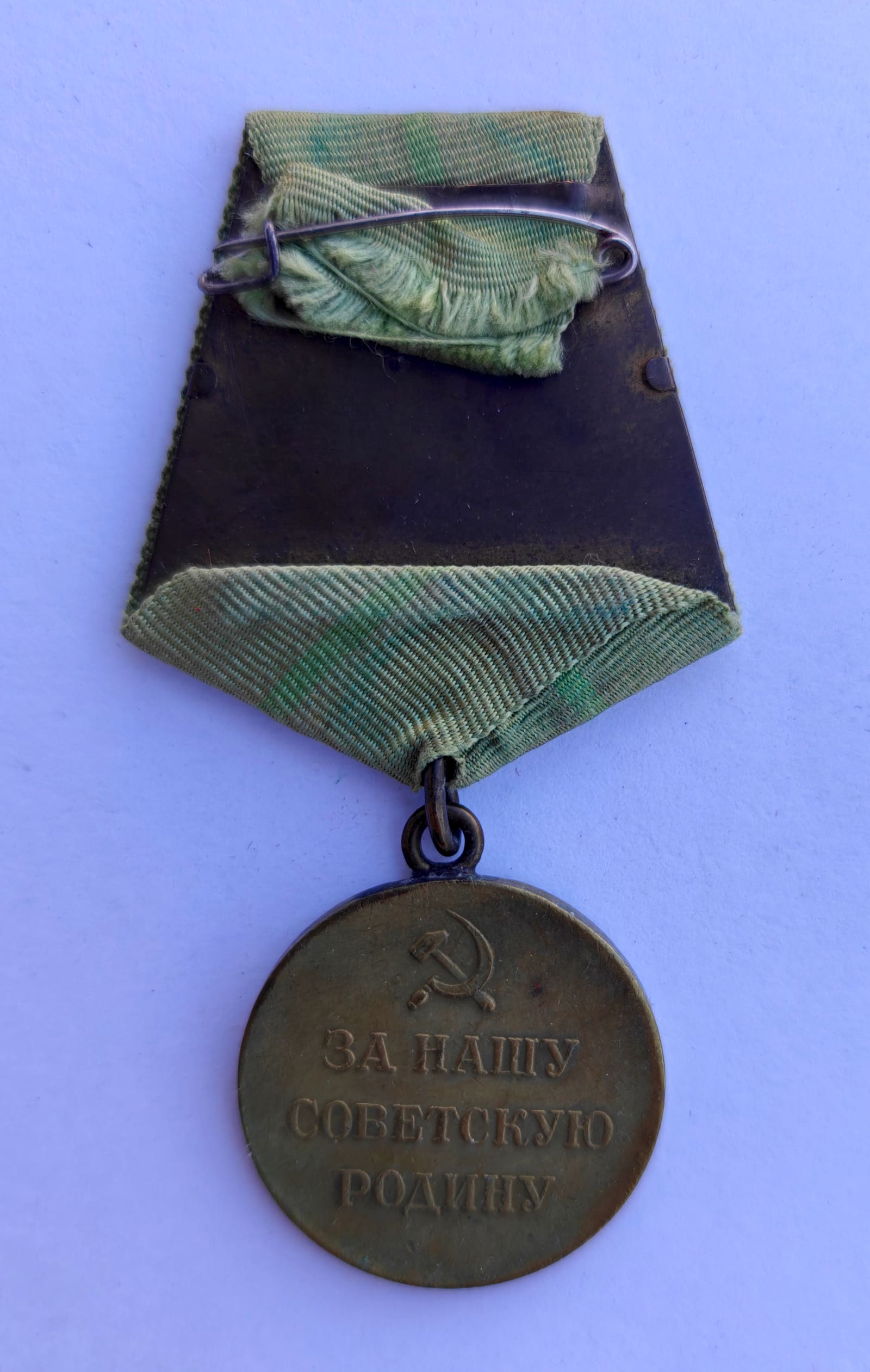
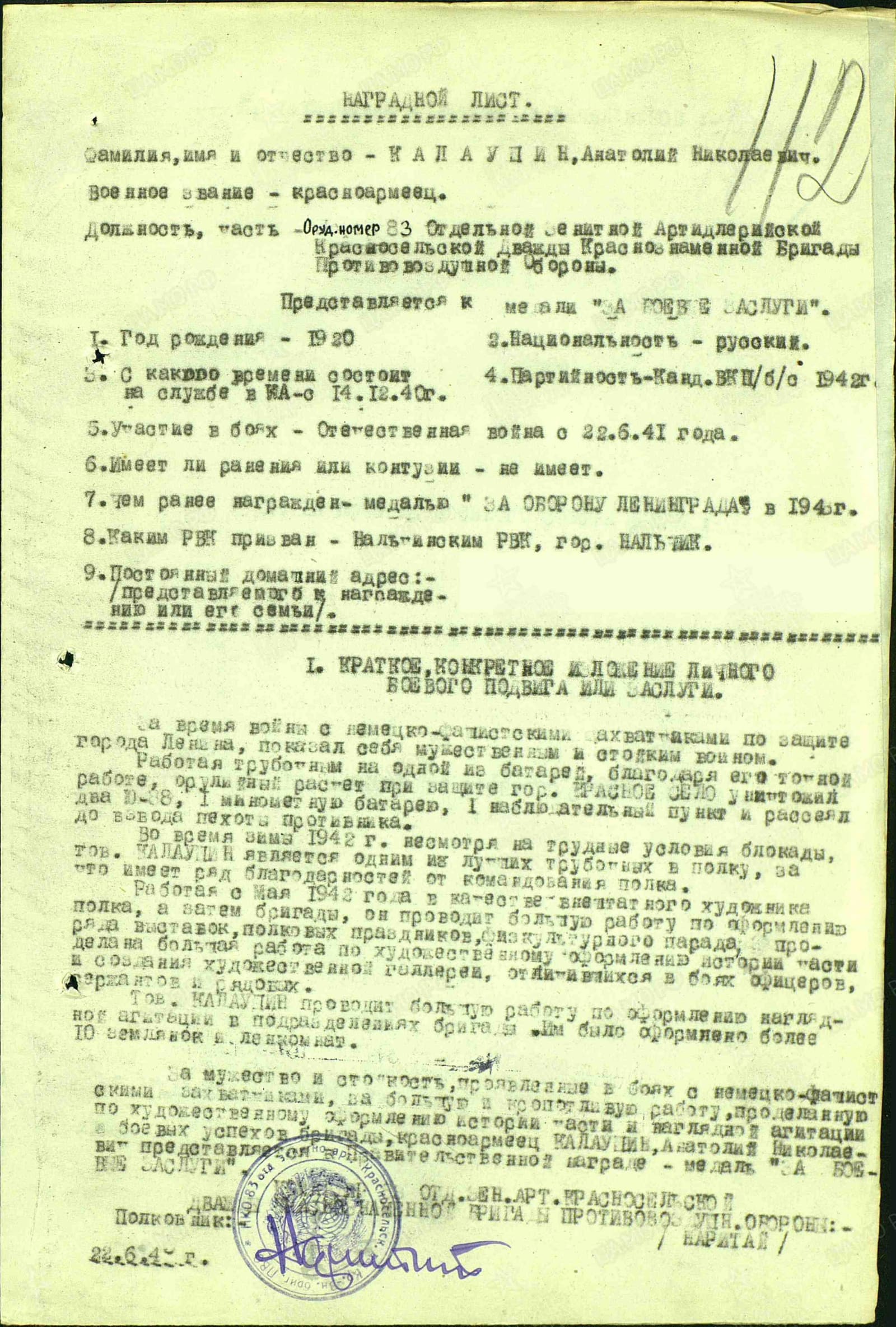
In the same Siege winters Leningrad was defended by Red Army man Anatoly Nikolayevich Kalaushin, born in 1920 and called up in December 1940 by the Nalchik city military commissariat. He served as a fuse-setter in the 83rd Separate Anti-Aircraft Artillery Brigade of the Leningrad Air Defence Army. His award sheet of 1945 records that his gun crew brought down two Ju-88s in the defence of Krasnoye Selo; that in the winter of 1942, “despite the hard conditions of the blockade”, he was one of the best fuse-setters in the regiment; and that from May 1942 he also served as the regiment’s, and later the brigade’s, unofficial artist, designing exhibitions and festivities. He had been awarded the Medal “For the Defence of Leningrad”, and in June 1945 he received the Medal “For Combat Service” [◆ S022, f. 33, op. 686196, d. 2311, via S175]. △ He may be the Anatoly Nikolayevich of the roster (1920–1971), son of the émigré Nikolay Matveyevich, who, the family recorded, left his wife and their children Taisiya and Anatoly behind in Russia [◇ S001, Nos. 125, 211] — that is, a nephew of Matvey Matveyevich.
Cherkessk: nine names in the Book of Memory
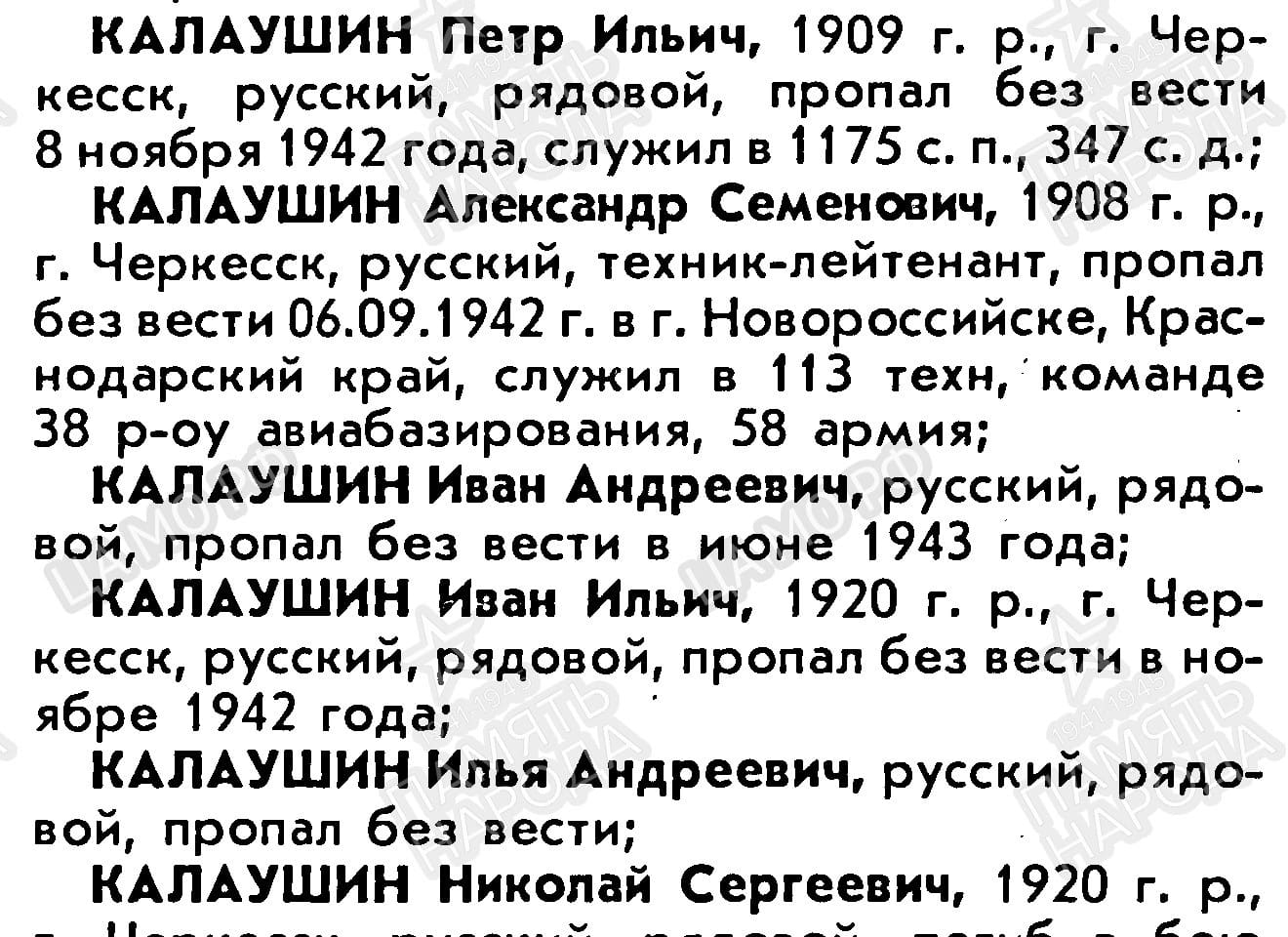
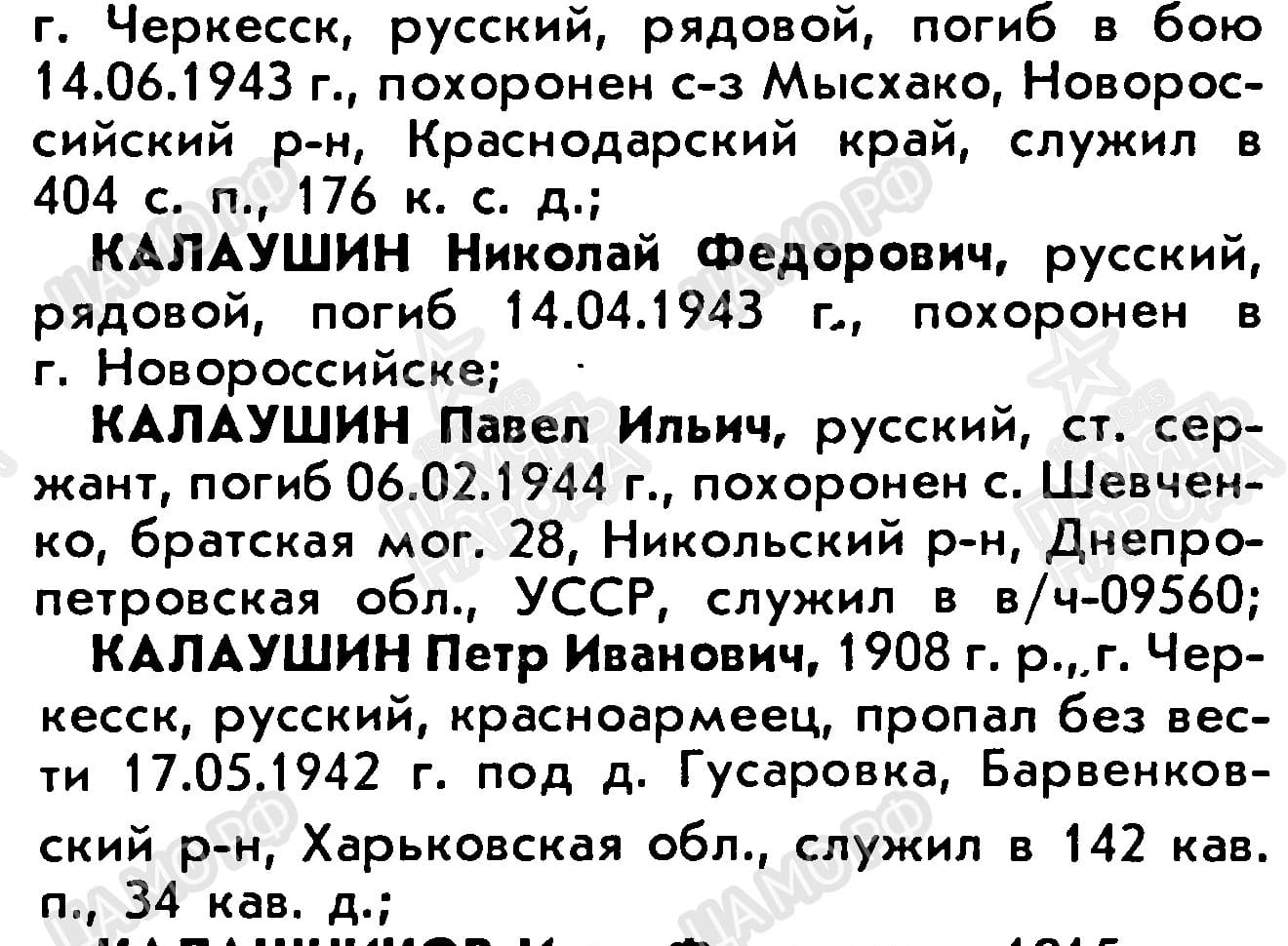
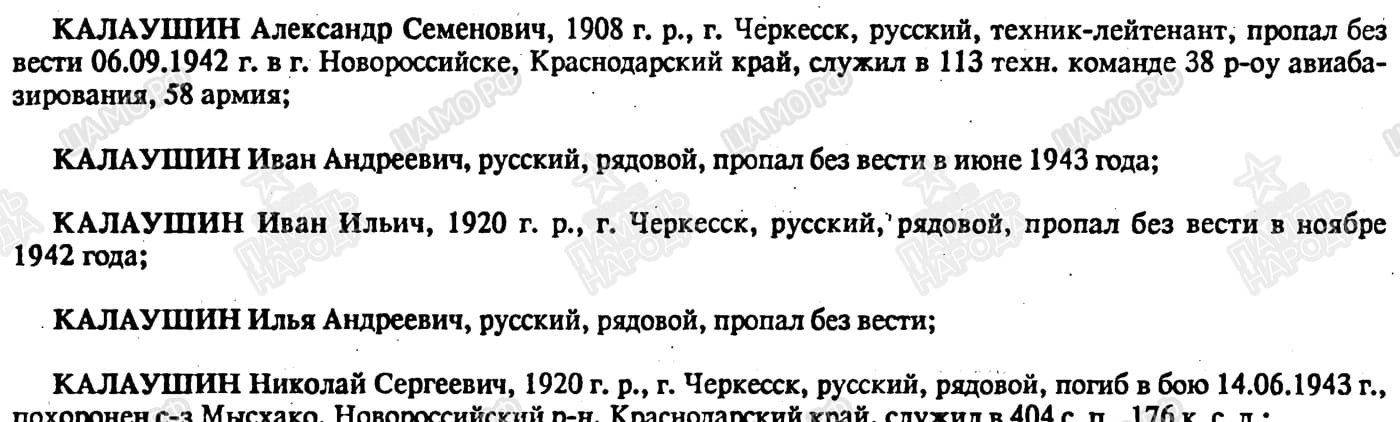
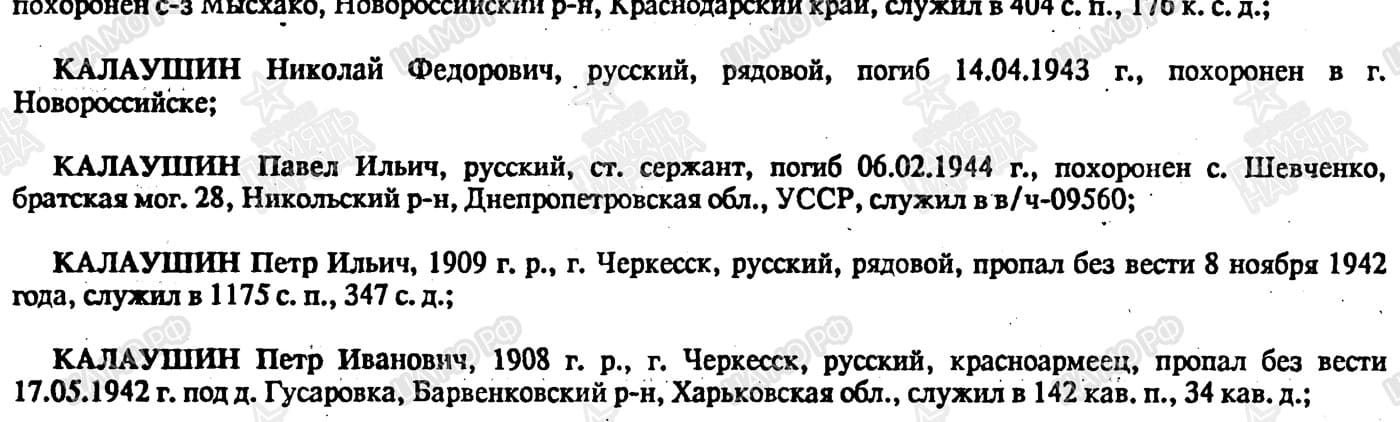
Cherkessk is the home town the military records name most often for the Kalaushins. The Book of Memory of the Karachay-Cherkess Republic lists nine men under this surname: Pyotr Ilyich, Aleksandr Semyonovich, Ivan Andreyevich, Ivan Ilyich, Ilya Andreyevich, Nikolay Sergeyevich, Nikolay Fyodorovich, Pavel Ilyich and Pyotr Ivanovich [◈ S110, p. 59; S110, “Cherkessk” volume, p. 101, via S174]. Three of them appear in the roster.
The brothers Ilya and Ivan Andreyevich [S001, Nos. 188, 189] were the sons of Andrey Timofeyevich and Anastasiya Vasilyevna [◈ S001, No. 106]. Ilya, wounded in the head, died of his wounds on 11 December 1941 in the 424th Medical Battalion; he is buried in the Rostov region — in the cemetery of the village of Abramovka according to the casualty report, in the village cemetery of the farmstead of Nekrasovka according to the burial lists [◆ S022, f. 58, op. 818883, d. 1199; ◈ S176, via S174]. Ivan, called up in August 1941, went missing in May–June 1943; the report on him names his mother, Anastasiya Vasilyevna [◆ S022, f. 58, op. 977520, d. 716, via S174].
Note on the roster. The roster gives Ilya Andreyevich’s year of birth as 1913; the casualty report gives 1915. The same report names his next of kin as “father, Kalaushin Andrey”, whereas in the roster Andrey Timofeyevich was killed in the First World War [◆ S022, f. 58, op. 818883, d. 899, 1199; ◈ S001, Nos. 106, 188]. We give both versions.
Nikolay Sergeyevich [S001, No. 186], born in 1920 and a schoolteacher before the war [◈ S001, No. 186], was a submachine-gunner in the 404th Rifle Regiment of the 176th Rifle Division. On 13 June 1943 he was brought to the divisional medical battalion with a shrapnel wound to the head, and he died the next day; he is buried in a mass grave at the Myskhako state farm near Novorossiysk [◆ S022, f. 58, op. 18001, d. 1214, via S174]. In the same 176th Division, in its 188th Separate Anti-Tank Battalion, served Junior Sergeant Vladimir Alekseyevich Kalaushin, born in 1924; he was killed near Myskhako on 24 April 1943 [◆ S022, f. 58, op. 18001, d. 178, via S174]. Vladimir is not in the roster, but the report names his father: Aleksey Dmitriyevich [S001, No. 160], the same man who in December 1930 had been deprived of his vote and banished from the North Caucasus Territory [◆ S020, via S157]. In this way a casualty report adds a new name to the family tree.
Private Nikolay Fyodorovich was killed on 14 April 1943 and is buried in Novorossiysk [◈ S110]. Near Novorossiysk, too, on 6 September 1942, Technician-Lieutenant Aleksandr Semyonovich Kalaushin, head of the 113th Technical Team of the 38th Air Base District of the 5th Air Army, went missing while his team was on its way to the town [◆ S022, f. 58, op. 818883, d. 1624, via S174]. Pyotr Ivanovich, born in Batalpashinskaya in 1908, was called up in Ashkhabad, served in the 142nd Cavalry Regiment of the 34th Cavalry Division and went missing on 17 May 1942 near the village of Gusarovka in the Barvenkovo district of the Kharkov region [◆ S022, f. 58, op. 818883, d. 236, via S174]. △ He may be the “Kalaushin Pyotr”, born on 29 May 1908, whose name appears in the prisoner-of-war records of Mauthausen concentration camp under camp number 137939; the database reads his birthplace as “Cherkassk” [◆ S023, NARA, RG 242, A3355, roll 155, via S174]. The rare surname, the first name and the year of birth all match, but the German record gives no patronymic. Private Pyotr Ilyich, born in 1909, of the 1175th Rifle Regiment of the 347th Division, went missing on 8 November 1942 [◈ S110].
Ivan and Pavel Ilyich
Ivan and Pavel Ilyich are not in the roster. Both were born in Batalpashinskaya, and their memory is kept by a relative who maintains their pages on the Immortal Regiment website [◈ S154, pages of I.I. and P.I. Kalaushin]. △ They seem to have been brothers, the sons of one Ilya; Pyotr Ilyich, and Vasily Ilyich, who was deprived of his vote in Batalpashinsk in December 1930, may have belonged to the same family [◆ S020, via S157]. Who their father was remains to be established.
Ivan Ilyich, born in 1920 and a driver by trade, was called up as early as September 1940 and served as a Red Navy man in the transport section of the Black Sea Fleet’s rear services. Naval reports and the Book of Memory of Sevastopol list him as missing in Sevastopol on 3 July 1942 [◆ S029, f. 1250, op. 2, d. 415, 416, via S174; ◈ S113, vol. 3]; the military commissariat’s report and the Book of Memory of Karachay-Cherkessia give November 1942 [◆ S022, f. 58, op. 977520, d. 417]. The report names his mother, Anna Gavrilovna, who lived in Cherkessk [◆ S022, f. 58, op. 977520, d. 417].
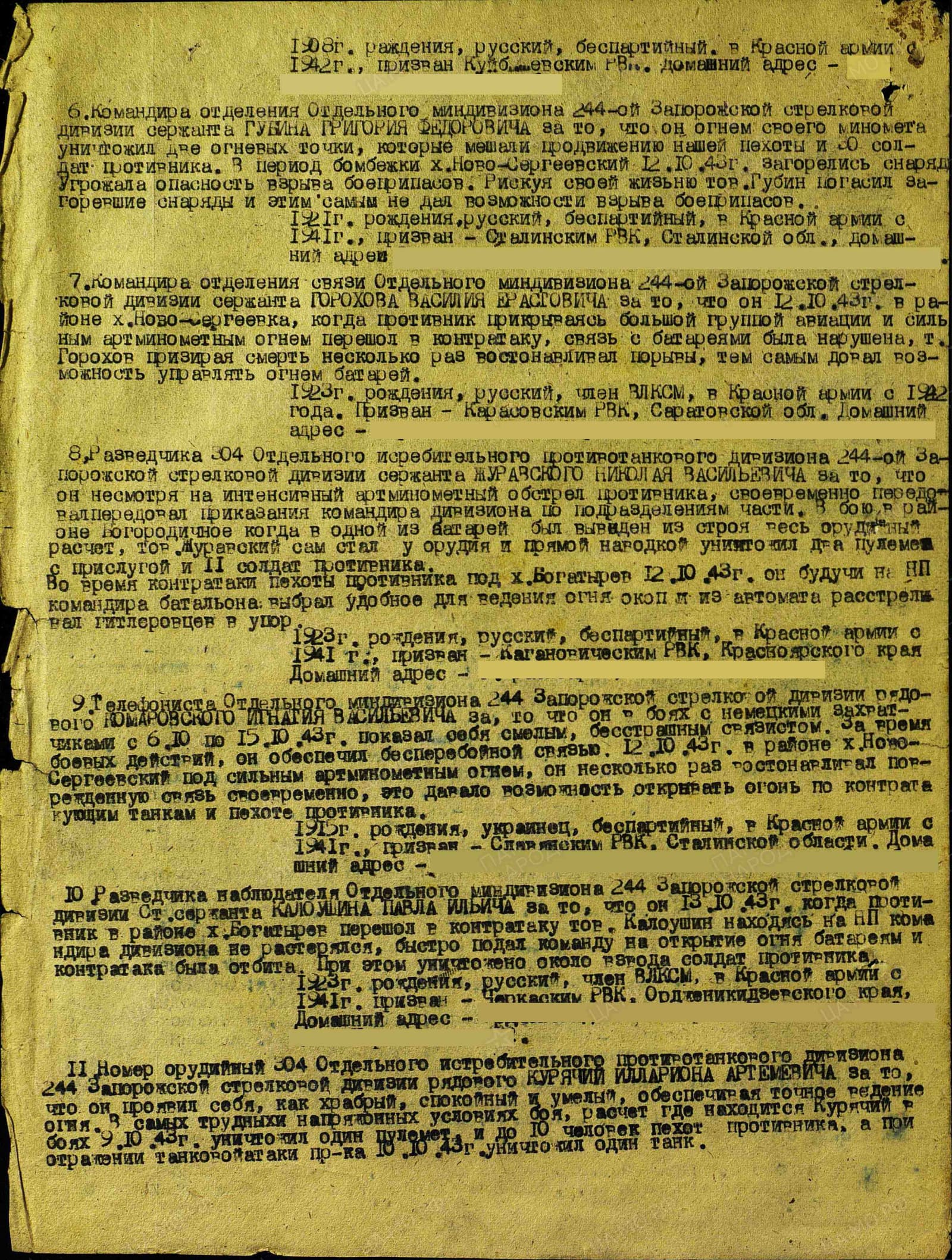
Pavel Ilyich, born in 1923 and a member of the Komsomol, joined the army in 1941. On 13 October 1943, near the farmstead of Bogatyrev, Senior Sergeant Kaloushin (as the order spells his name), reconnaissance observer of the separate mortar battalion of the 244th Zaporozhye Rifle Division, was at the battalion commander’s observation post when the enemy counter-attacked; he quickly gave the batteries the order to open fire, and the counter-attack was beaten off. For this he was awarded the Medal “For Courage” [◆ S022, f. 33, op. 686044, d. 1806; S175, record 18851024]. Pavel Ilyich was killed on 6 February 1944 and is buried in mass grave No. 28 in the village of Shevchenko, Nikolsky district, Dnepropetrovsk region [◈ S110].
Bekeshevskaya: a Cossack and his horses
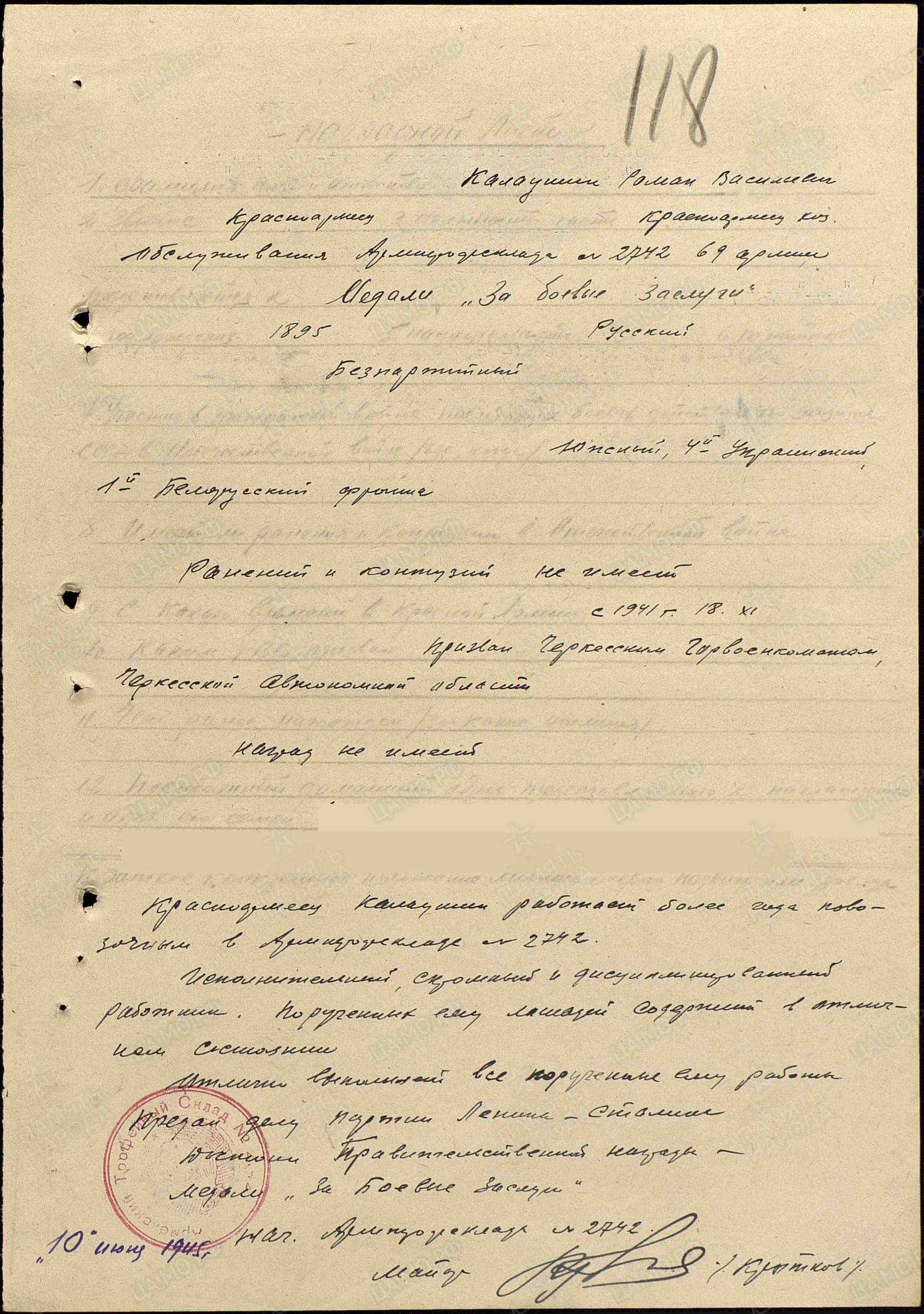
Roman Vasilyevich Kalaushin [S001, No. 100] was born on 14 October 1895 in the stanitsa of Bekeshevskaya and served in the 3rd Khoper Regiment in the First World War [◇ S001, No. 100]. In November 1941, at forty-six, he was called up by the Cherkessk city military commissariat. He went through the Southern, 4th Ukrainian and 1st Belorussian Fronts and ended the war in Germany as a private at Army Trophy Depot No. 2742 of the 69th Army. On 10 June 1945 the head of the depot wrote in his award sheet that Red Army man Kalaushin had worked as a carter for more than a year and “keeps the horses entrusted to him in excellent condition”. He received the Medal “For Combat Service” by Order No. 45/n of the Commander-in-Chief of the Group of Soviet Occupation Forces in Germany, signed in Berlin on 21 July 1945 [◆ S022, f. 33, op. 690306, d. 2689; S175, record 42654515]. The former Khoper Cossack spent this war, too, looking after horses. His son, Yury Romanovich (b. 1937), became the family chronicler [◈ S001, No. 182].
Note on the roster. The roster has Roman Vasilyevich taking part in the war in 1943–1945 and ending it “in Berlin, in the 1st Belorussian Front” [◈ S001, No. 100]; according to the award sheet he had been in the Red Army since 18 November 1941 [◆ S022, f. 33, op. 690306, d. 2689].
From the same stanitsa came Ilya Petrovich [S001, No. 168] (1913–1999), son of Pyotr Vasilyevich, who received the Order of the Patriotic War, 2nd class, awarded to veterans for the fortieth anniversary of Victory [◈ TsAMO jubilee card index, Order of the USSR Minister of Defence No. 87 of 06.04.1985, via S175]. Ivan Petrovich, born in 1899, is not in the roster. A sapper of the 1131st Rifle Regiment of the 337th Division, he was awarded the Medal “For Combat Service” for clearing mines from the approaches to a river line near Chupakhovka under enemy fire [◆ S022, f. 33, op. 686044, d. 2217], and he was killed on 20 September 1943; he is buried in the village of Zhernoklevy in the Drabov district of the Poltava region, and his family lived in Bekeshevskaya [◆ S022, f. 58, op. 18001, d. 1226, via S174]. △ He was probably a son of Pyotr Vasilyevich and a brother of Ilya Petrovich. Bekeshevskaya also gave Guards Yefreytor (lance corporal) Vasily Ivanovich, born in 1920, a driver in the 174th Guards Artillery and Mortar Regiment, who on 30 November 1943 brought up shells under mortar fire, just in time for a battery that then beat off a tank attack [◆ S022, f. 33, op. 717037, d. 653]; and Private Ivan Ivanovich, born in 1913, who died of wounds in 1943 [◈ S112, vol. 9].
Drivers
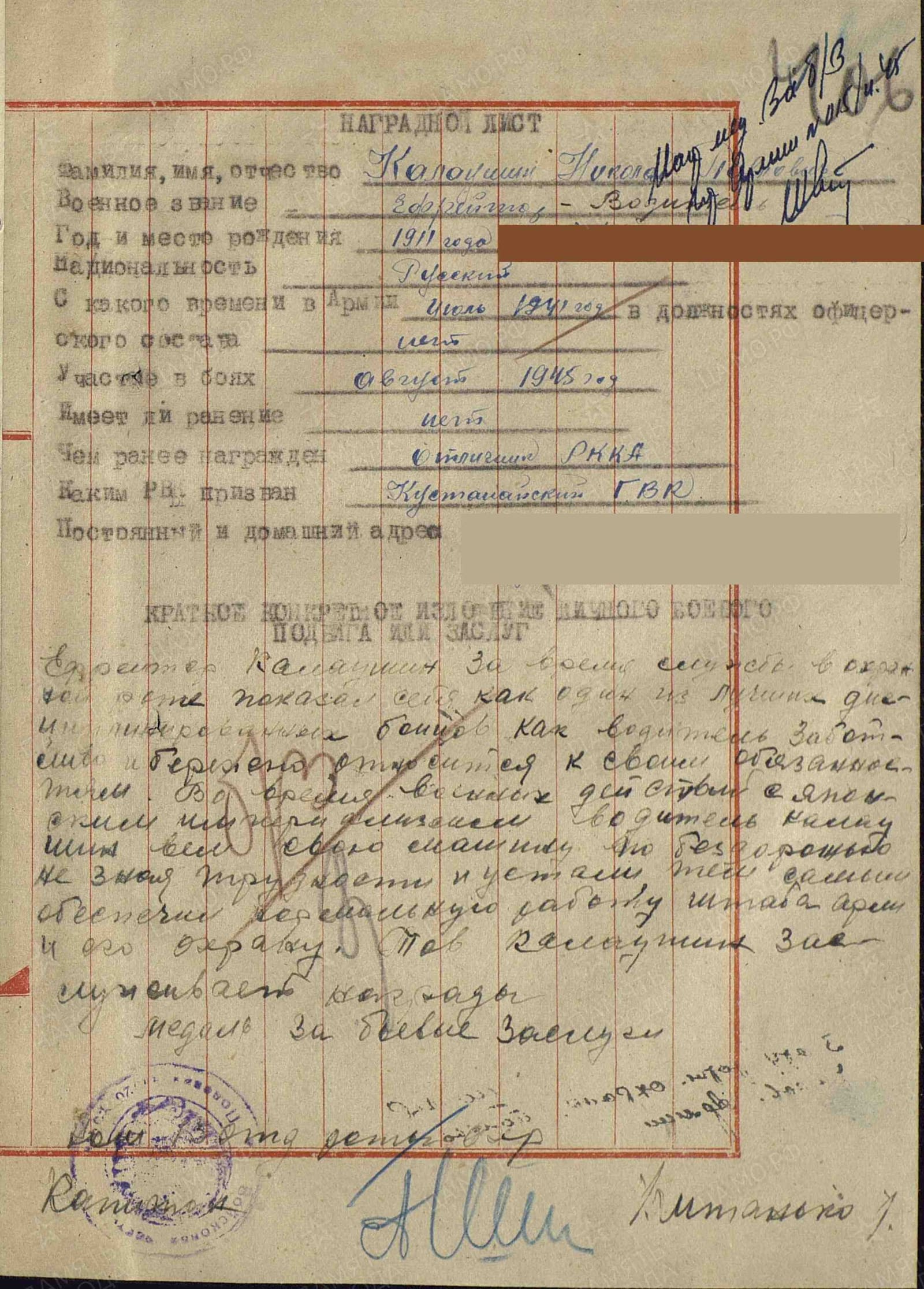
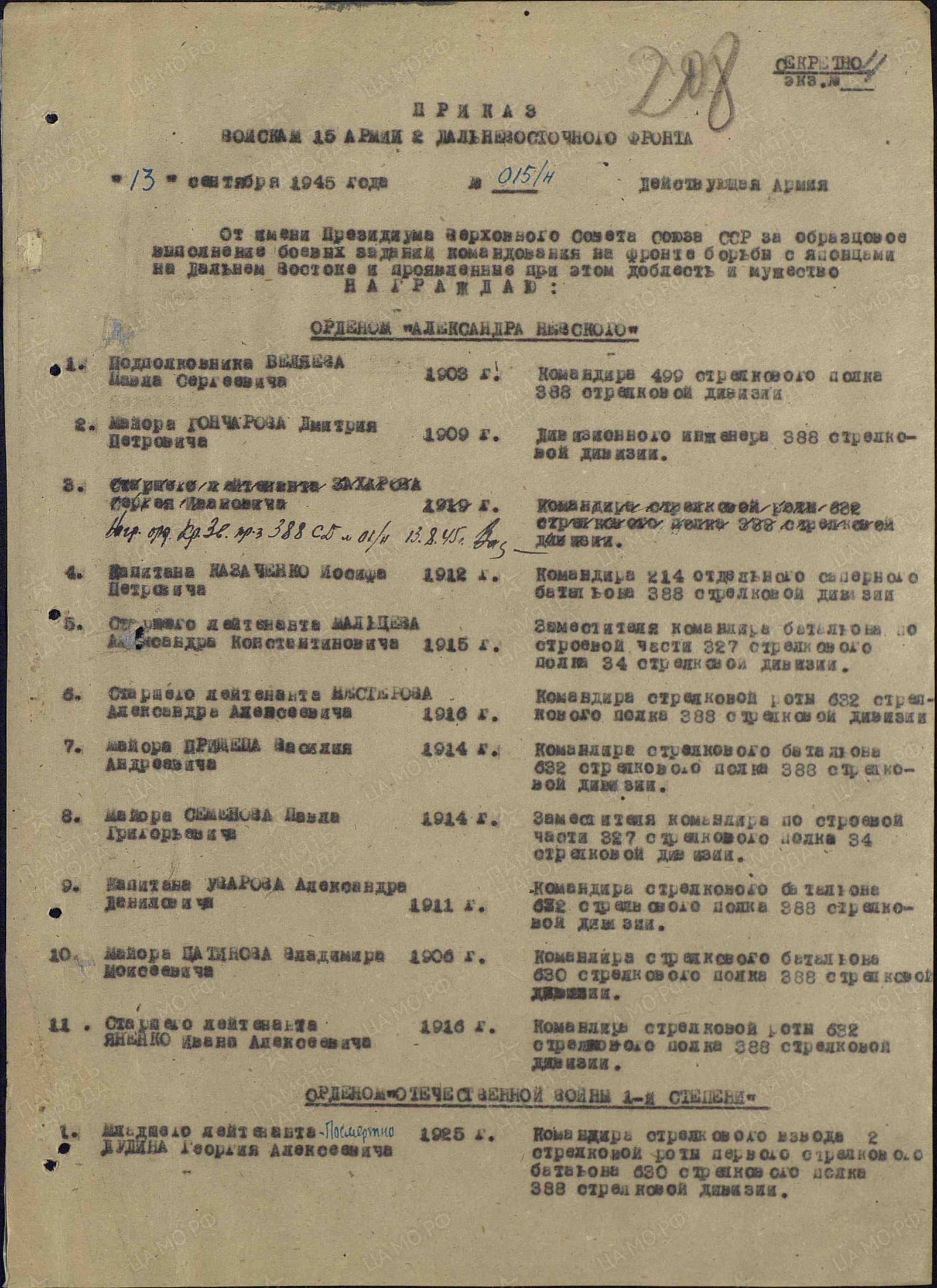
Nikolay Pavlovich Kalaushin [S001, No. 118] was the brother of Mikhail Pavlovich [S001, No. 117], great-grandfather of the author of this chronicle. He was born in 1911 in Batalpashinskaya (now Cherkessk), the son of Pavel Aleksandrovich, who was killed in the years of the Revolution [◇ S001, Nos. 70, 118]. By trade Nikolay Pavlovich was a driver, and he was called up not in Cherkessk but in Kustanay [◈ S001, No. 118], joining the army in July 1941. A yefreytor and driver in the 13th Separate Guard Company protecting the headquarters of the 15th Army, 2nd Far Eastern Front, he had earlier been awarded the badge “Excellent Soldier of the Red Army”; according to his award sheet, he saw combat in August 1945. His company commander wrote that “during the military operations against the Japanese imperialists, driver Kalaushin drove his vehicle over roadless country, knowing neither hardship nor fatigue”. He received the Medal “For Combat Service” by an order to the troops of the 15th Army, No. 015/n of 13 September 1945 [◆ S022, f. 33, op. 686196, d. 6291; S175, record 29982103]. In 1986 he was awarded the jubilee Order of the Patriotic War, 1st class [◈ TsAMO jubilee card index, Order of the USSR Minister of Defence No. 53 of 01.08.1986, via S175]. Nikolay Pavlovich died in 1987 [◈ S001, No. 118].
The roster says nothing of Mikhail Pavlovich’s own war years (he lived from 1908 to 1980). In 1943 his son Vyacheslav was born — the grandfather of the author of this website [◈ S001, Nos. 117, 202].
Aleksey Fedotovich [S001, No. 135], son of the Convoy Cossack and master saddler Fedot Alekseyevich [S001, No. 73], lived in Sukhumi and was also a driver. He was called up by the Sukhumi city military commissariat; as a Red Army man he served in the 32nd Motor Transport Battalion (recorded as “32 avtob.”), was later sent to an evacuation hospital (SEG No. 1600), and from 11 February 1946 was on the strength of military unit 31874 [◈ S001, No. 135, from Pamyat Naroda]. He died in Sukhumi in 1968 [◇ S001, No. 135].
The Vladikavkaz branch: the Koloushin brothers
◇ family testimony · from a letter of Nikolay Nikolayevich Koloushin, 1983
The line of Grigory Kalaushin, which lived in Vladikavkaz and spelled the name with an “o” — Koloushin — was, in the roster’s words, cut off from the rest of the family by the Revolution, the Civil War, de-Cossackisation, prisons and the war of 1941–1945 [◇ S001, No. 184]. In 1983 Nikolay Nikolayevich wrote to relatives: “Our childhood was very hard; we were cut off from our relations and so we know little of our distant kin” [◇ S001, No. 184].
Two of the sons of Nikolay Makarovich Koloushin [S001, No. 102], Ivan and Nikolay, can be traced clearly in the military records.
Ivan Nikolayevich [S001, No. 183] was born on 10 November 1913 — in Batalpashinsk according to the roster, in the stanitsa of Sunzhenskaya in the Prigorodny district of the North Ossetian ASSR according to the award card index (which writes “s. Sunzhenskaya”); he worked for fifteen years in Rostov-on-Don and was called up in 1939 in Ordzhonikidze (Vladikavkaz) [◈ S001, No. 183; ◈ TsAMO award card index, via S175, record 1371138347]. According to the roster, he served in the 269th Guards Rifle Regiment, was shell-shocked, took part in the defence of Leningrad and in the capture of Berlin, and was awarded the Medals “For the Capture of Berlin” and “For Victory over Germany” [◈ S001, No. 183]. His Immortal Regiment page lists the breaking of the Siege of Leningrad among his battles [◈ S154, page of I.N. Kalaushin]. △ At Leningrad he probably fought in another unit: the 269th Regiment belonged to the 88th Guards Rifle Division, formed in the spring of 1943 from a division that had fought at Stalingrad; in 1945 that division stormed Berlin and on the last day of the fighting reached the Brandenburg Gate [◈ S188, “88th Guards Rifle Division” (Russian)]. In 1968 he was awarded the Order of Glory, 3rd class, by decree of the Presidium of the USSR Supreme Soviet [◈ TsAMO award card index, decree of 12.06.1968, via S175]. Ivan Nikolayevich died on 3 October 1991 [◈ S154].
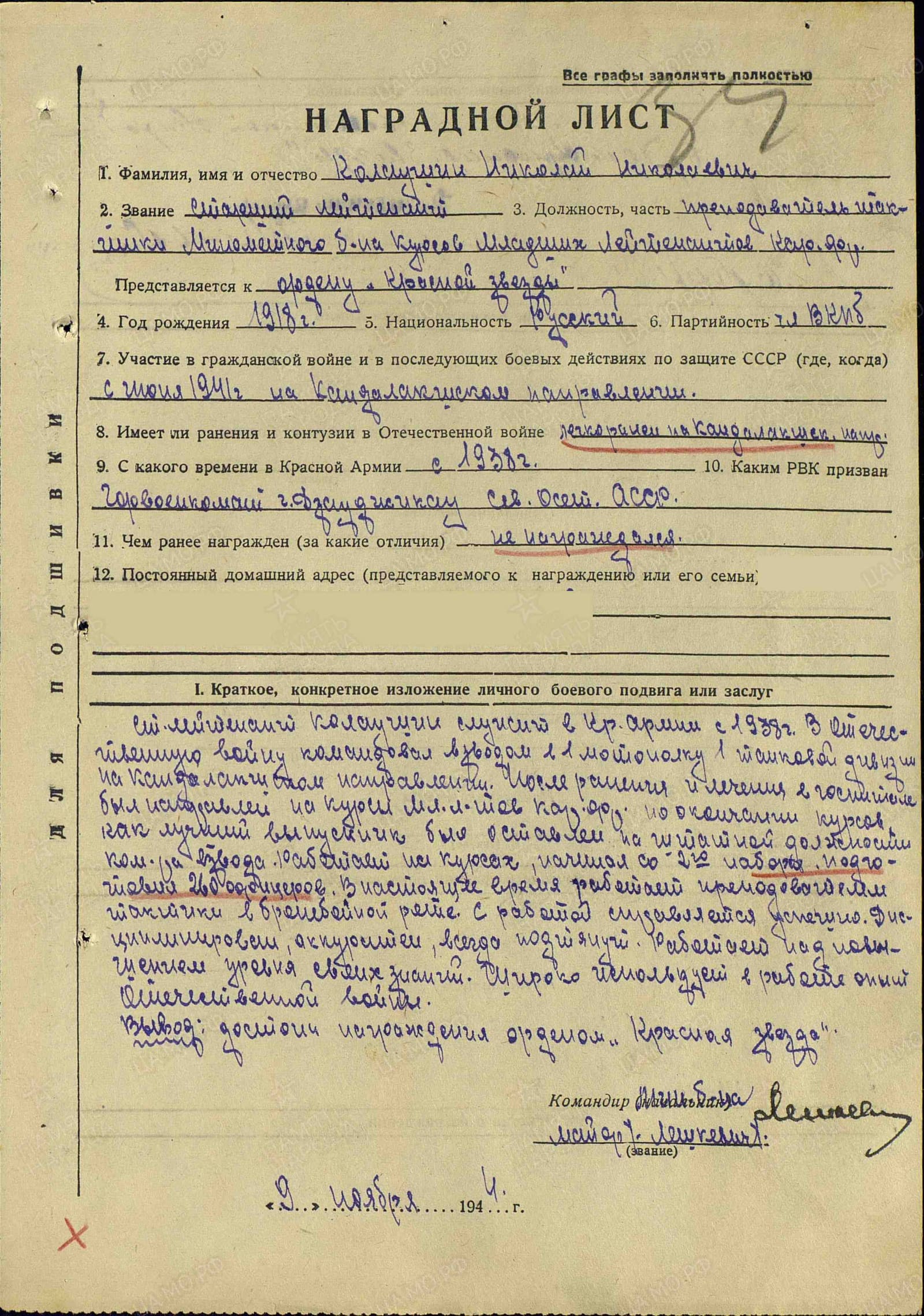
His brother, Nikolay Nikolayevich [S001, No. 184], born in 1918, was called up in 1938 in Ordzhonikidze (Vladikavkaz). From June 1941 he commanded a platoon of the 1st Motorised Regiment of the 1st Tank Division on the Kandalaksha axis, and was wounded. After hospital he was sent to the junior lieutenants’ courses of the Karelian Front and, as the best graduate of his intake, was kept on there as a platoon commander. By November 1944 he had trained 26 officers, and he was awarded the Order of the Red Star [◆ S022, f. 33, op. 690155, d. 7630; S175, record 44298728]. In 1945 Captain Kaloushin received the Medal “For the Defence of the Soviet Arctic” [◆ S022, f. 234, op. 3231, d. 42, vol. 2a]. According to the roster, he spent his life in Vladikavkaz and kept a garden [◇ S001, No. 184].
Officers and sailors
Vyacheslav (Vladislav) Savelyevich [S001, No. 150] was the son of Savva Alekseyevich, a teacher in Cossack schools [◈ S001, No. 75], and thus a first cousin of Matvey Matveyevich and Boris Aleksandrovich. He was born on 8 April 1918 in the stanitsa of Zelenchukskaya and was called up as early as September 1936. The award card index lists him as a senior lieutenant of the administrative service (the roster also names the medical service); his place of service is recorded as a unit of the Red Army’s Main Armoured Directorate, GBTU KA (“ARZ 1, Kiev, KV”) [◈ S001, No. 150; ◈ TsAMO award card index, via S175, record 1371138333]. He was awarded the Medal “For Victory over Germany” [◈ S001, No. 150], the Medal “For Combat Service” by a decree of 1947 and, in 1986, the jubilee Order of the Patriotic War, 2nd class [◈ TsAMO card indexes, via S175, records 1371138333, 1522855014]. △ Post-war decrees awarding the Medal “For Combat Service” probably marked long service.
Aleksey Yefimovich [S001, No. 215] was the son of Colonel Yefim Mikhailovich [S001, No. 131], who, the family recorded, went missing in the Civil War, in 1920 [◇ S001, No. 131; ◈ S162, vol. “K”]. He was born on 28 October 1910 in the village of Karakurt in the Kars region, graduated from an infantry school, was called up in 1942 and took part as a lieutenant in the liberation of Ukraine; wounded in 1943, he left hospital an invalid [◈ S001, No. 215]. He received the Order of the Patriotic War, 1st class, for the fortieth anniversary of Victory [◈ TsAMO jubilee card index, Order of the USSR Minister of Defence No. 78 of 06.04.1985, via S175].
The roster says little about the two sons of Semyon Ilyich; the records add detail. Lieutenant Mikhail Semyonovich [S001, No. 162], born in 1907 in the Ust-Labinsk district, had served in the Red Army since 1929; senior adjutant of a battalion of the 884th Rifle Regiment, 196th Division, he went missing in June 1941, in the very first days of the war [◆ S022, f. 33, op. 563783, d. 10, via S174]. His mother, Varvara Vasilyevna, was then living in Yessentuki [◆ S022, f. 33, op. 563783, d. 10, via S174]. Nikolay Semyonovich [S001, No. 165], born on 18 January 1913 in the stanitsa of Gubskaya, served as a Red Navy man in the Black Sea Fleet; he was awarded the Medals “For the Defence of the Caucasus” and “For Victory over Germany” and the Order of the Patriotic War, 2nd class, by a fleet order of 19 January 1946 [◈ TsAMO and TsVMA award card indexes, via S175, record 1371138367; ◈ S001, No. 165].
Note on the roster. The roster lists both brothers as children of Semyon Ilyich, No. 87. Their birthplaces — the Ust-Labinsk district and Gubskaya — point rather to the other Semyon Ilyich, the schoolteacher (No. 91): from 1903 to 1911 he taught at the Novolabinskaya school (the stanitsa of Novolabinskaya lies in the Ust-Labinsk district), and from 1912 to 1914 he was head of the school at Gubskaya [◈ S001, No. 91, from the Kavkazsky kalendar]. △ Mikhail and Nikolay Semyonovich were probably his sons.
The same name: deeds from the award sheets
The roster does not know the men in these award sheets; their place in the family has yet to be found.
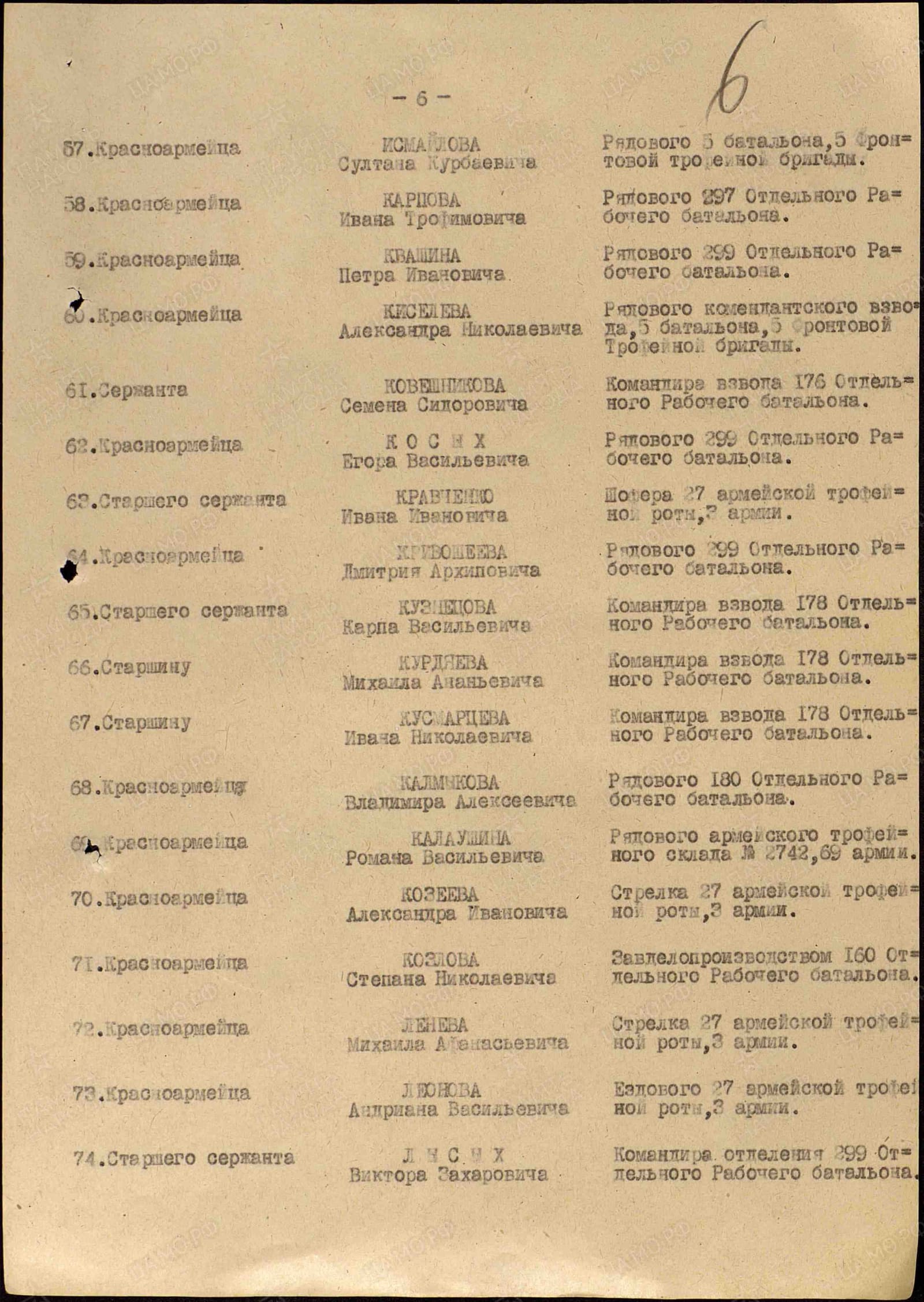
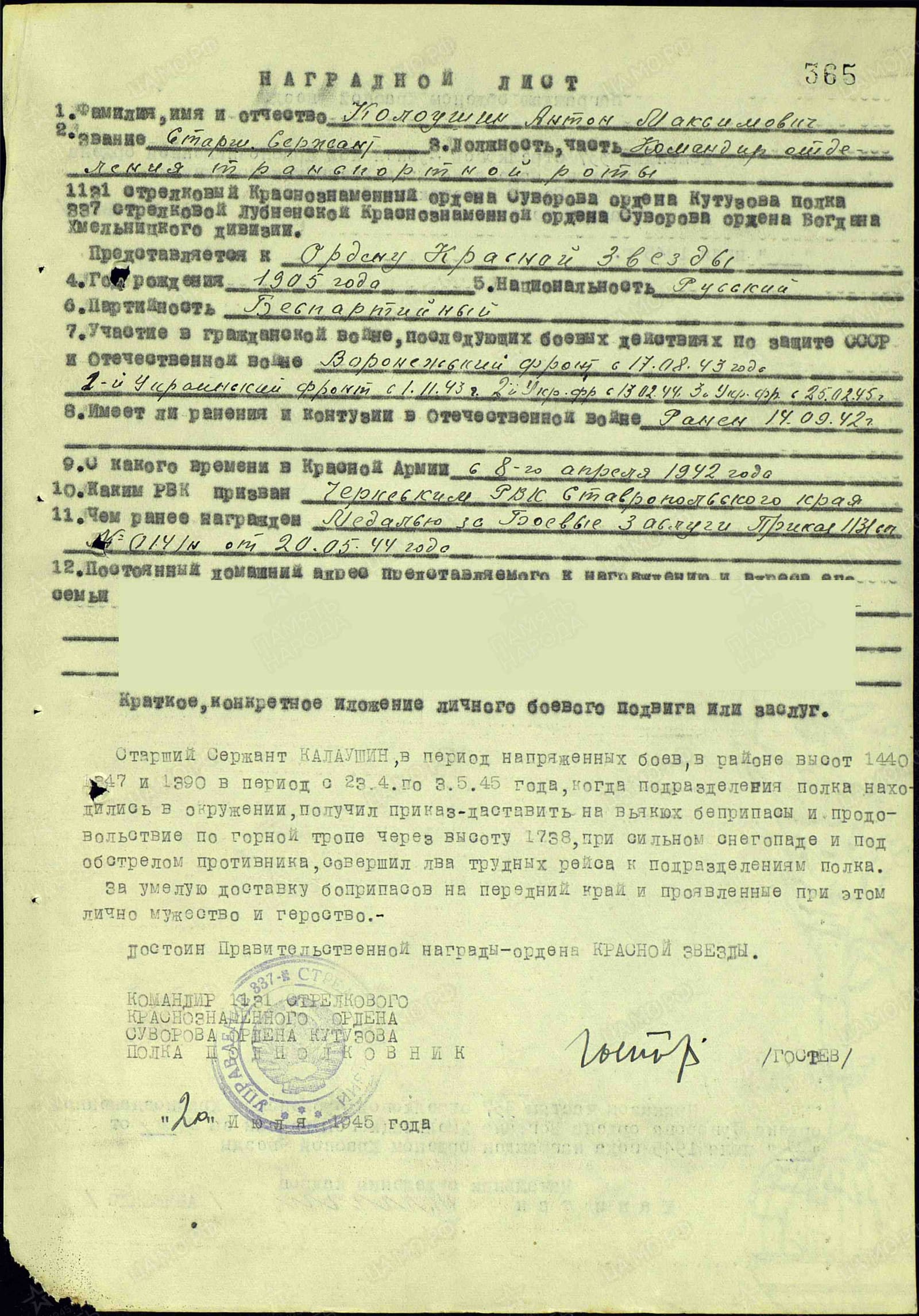
Anton Maksimovich Koloushin, born in 1905 and called up in Cherkessk in April 1942, was a horse driver in the transport company of the 1131st Rifle Regiment — the same regiment in which the sapper Ivan Petrovich of Bekeshevskaya served. On 28 April 1944, taking ammunition up to the firing positions, he came under air attack; one of his horses was put out of action, but he delivered the ammunition “to its destination and on time”, and received the Medal “For Combat Service” [◆ S022, f. 33, op. 690155, d. 6059]. A year later, between 23 April and 3 May 1945, now a senior sergeant, he twice led pack-horses carrying ammunition and food to encircled units of his regiment — along a mountain path over Height 1738, in heavy snow and under fire — and was awarded the Order of the Red Star [◆ S022, f. 33, op. 687572, d. 240]. The heading of this award sheet calls him “Koloushin”; the citation, “Kalaushin”.
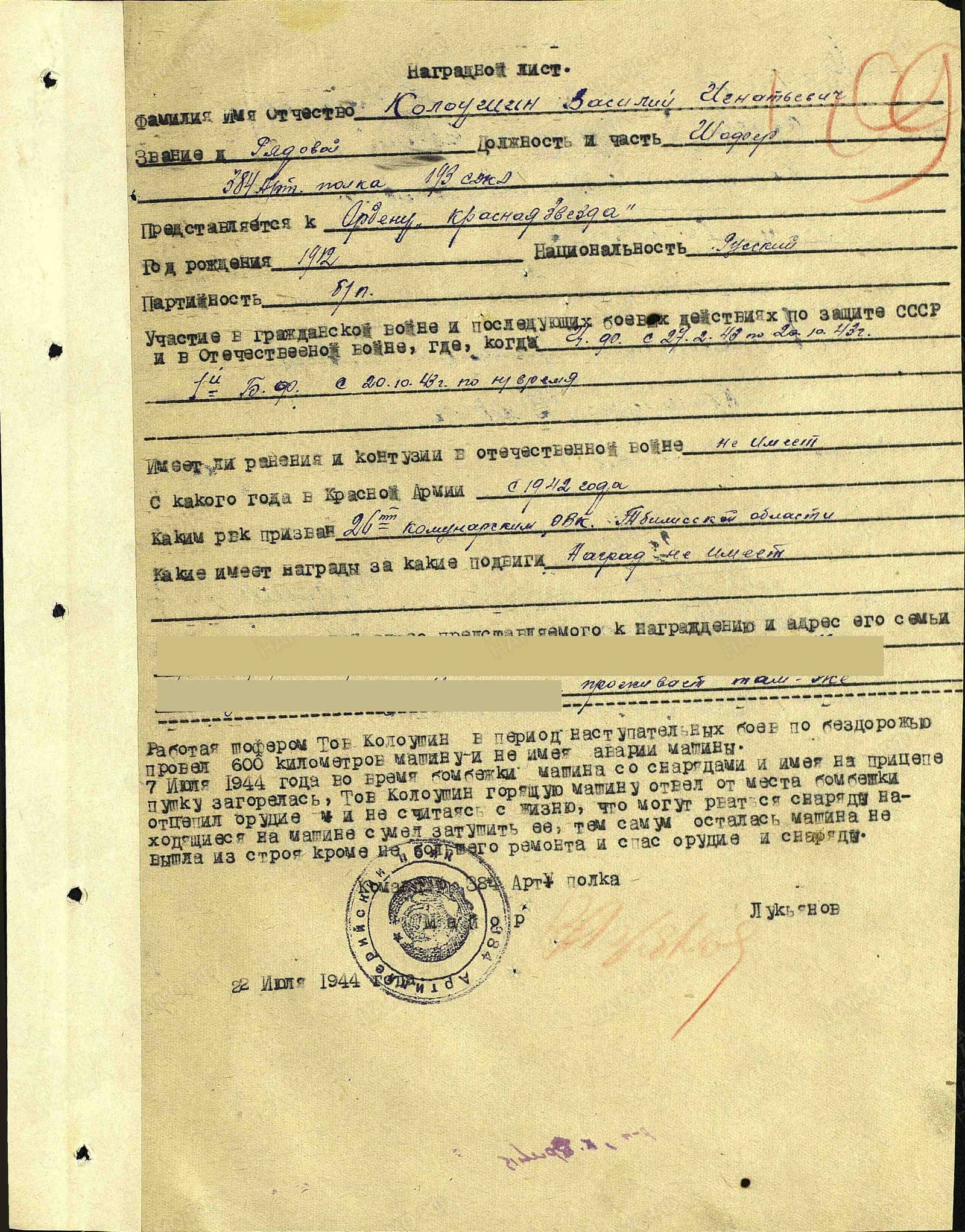
Vasily Ignatyevich, born in 1912 in the stanitsa of Otradnaya, a driver in the 384th Artillery Regiment of the 193rd Rifle Division, drove his lorry 600 km over roadless country without a single accident; and on 7 July 1944, during an air raid, when his lorry, loaded with shells and towing a gun, caught fire, he drove it clear of the bombing, uncoupled the gun and put out the fire; for this he was awarded the Order of the Red Star [◆ S022, f. 33, op. 690155, d. 923]. For the fighting for the bridgehead on the left bank of the Vistula in February 1945 he received a second Order of the Red Star [◆ S022, f. 33, op. 687572, d. 1506]. Yefim Ignatyevich, also of Otradnaya, born in 1906, went missing near Nizhny Akbash in September 1942, was taken prisoner and was later freed [◆ S022, f. 58, op. 818883, d. 1514; op. 18001, d. 1582]. In April 1945, as horse driver of a mortar battery of the 1675th Artillery and Mortar Regiment, 30th Cavalry Division, he brought up ammunition under a hurricane of fire; and on 29 April, when the enemy threatened the firing position, he galloped up to the mortar and, with the horses alone, pulled it out to safety [◆ S022, f. 33, op. 690306, d. 663, 2614]. Akim Yefimovich of the same stanitsa, born in 1925, was reported missing in 1943 but survived: in May 1945, twice wounded, this gun-crew member of the 1311th Light Artillery Regiment received the Medal “For Combat Service” [◆ S022, f. 58, op. 18001, d. 796; f. 33, op. 686196, d. 5804].
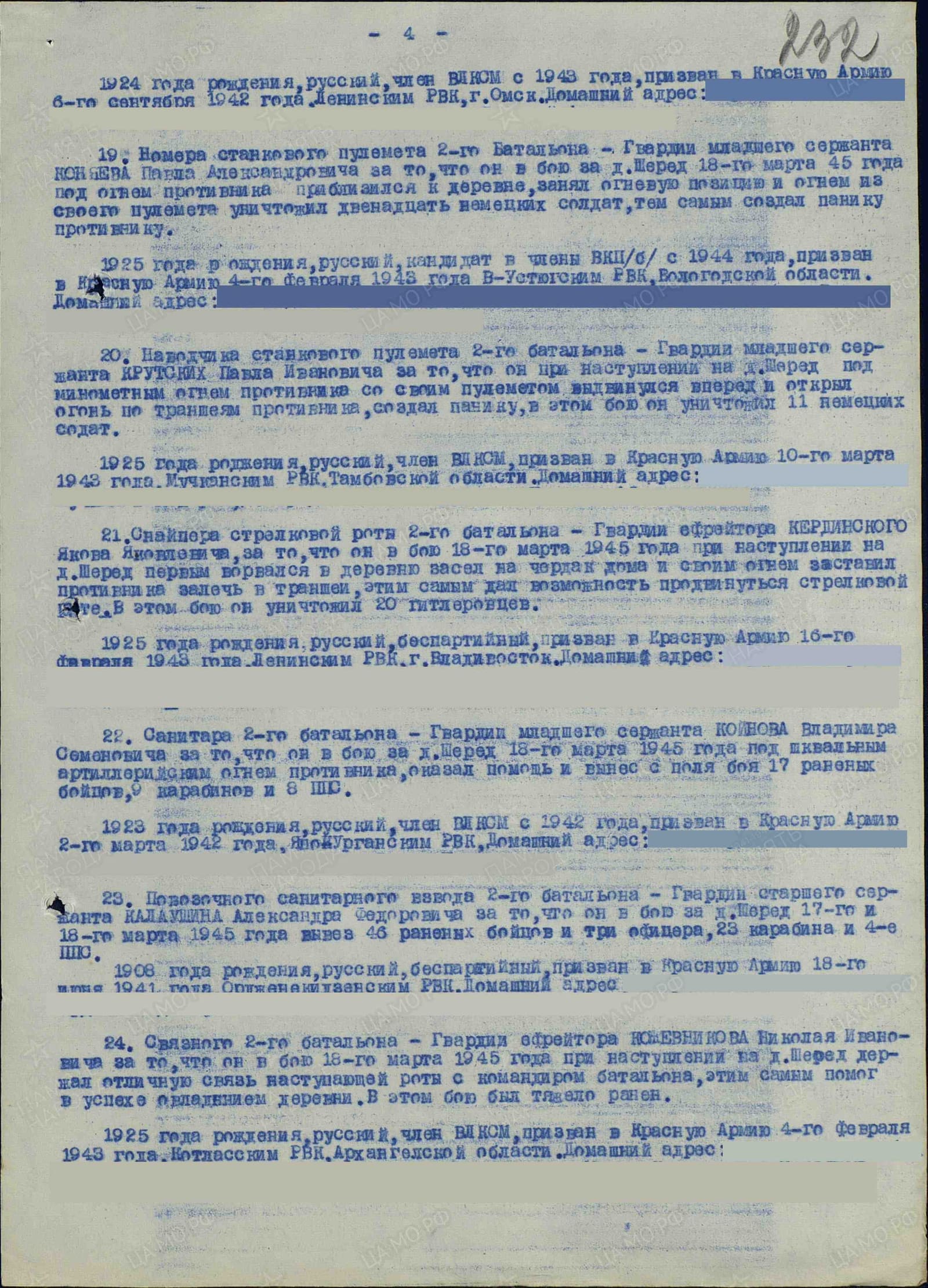
Guards Senior Sergeant Aleksandr Fyodorovich Kalaushin, born in 1908 and called up in Ordzhonikidze on 18 June 1941, was a carter in the medical platoon of the 332nd Guards Rifle Regiment. In the battle for the village of Shered on 17–18 March 1945 he carried out 46 wounded soldiers and three officers, together with 23 carbines and four PPSh submachine guns [◆ S022, f. 33, op. 690306, d. 3417]. Yefreytor Grigory Sergeyevich, born in 1905 and called up in Mikoyan-Shakhar, a gun commander in the 1404th Anti-Aircraft Artillery Regiment, shot down two enemy aircraft on 29 and 31 March 1944 [◆ S022, f. 33, op. 717037, d. 2262]; at the end of December 1944 he was killed or died of wounds, and he is buried in the Polish town of Baranów [◆ S022, f. 58, op. 18003, d. 32, 68, via S174].
Private Vasily Vasilyevich of the village of Petropavlovskoye in the Arzgir district, born in 1920, a rifleman of the 979th Rifle Regiment, had been at the front since 7 January 1945. On 19 January, on reconnaissance, he killed two German soldiers in hand-to-hand fighting and brought back a prisoner for interrogation. The recommendation for the Order of Glory, 3rd class, was signed on 10 February and the order issued on 16 February 1945 [◆ S022, f. 33, op. 690306, d. 1146]; according to the casualty report, he had been killed near Glogau on 9 February [◆ S022, f. 58, op. 18003, d. 334]. △ The award, it seems, never reached him.
Those of whom less is known
Nikolay Ivanovich [S001, No. 103], a schoolteacher who before the Revolution had headed the school at Nevinnomysskaya, was killed in the war, according to the roster [◈ S001, No. 103]. The youngest of the roster’s Kalaushins whose name appears in the military card indexes is Nikolay Lvovich, born in 1927 [◈ S001, No. 192; ◈ TsVMA card index, via S175].
◇ family testimony
Fyodor Panteleimonovich [S001, No. 190], the family remembers, was killed young in Hungary [◇ S001, No. 190].
Private Aleksandr Karpovich of Vladikavkaz went missing in February–March 1943 [◆ S022, f. 58, op. 977520, d. 70]. Under the name Ivan Fyodorovich the databases hold two or three records that seem to concern different men: a Red Army man of the 2nd Guards Rifle Division from the stanitsa of Pavlodolskaya, missing in the Rostov region on 27 March 1942, and a prisoner of war born in 1905, captured in the Crimea on 8 May 1942, who passed through Stalags 315, II A and II E [◆ S022, f. 58, op. 818883, d. 1097; ◆ S023, via S174]. Mikhail Dmitriyevich, born in 1911, of Cherkessk, a private in a construction battalion of the 1st Ukrainian Front: in the casualty report the entry against his name reads “1.2.1944 sentenced to be SHOT”; the report gives no details of the case [◆ S022, f. 58, op. 18002, d. 1637, via S174]. △ He may have been a son of Dmitry Stepanovich [S001, No. 80] and a brother of Aleksey Dmitriyevich.
The award card indexes also include women of the name: Aleksandra Dmitriyevna, born in 1923, of Moscow, who received the Order of the Patriotic War, 1st class (1985), and Praskovya Ivanovna, a cleaner at the Caspian Higher Naval School, awarded the Medal “For Victory over Germany” [◈ TsAMO card indexes, via S175; ◆ S029, f. 682, op. 1, d. 2]. Their kinship with the family has not been established.
Mikhailovskoye, 1944–1945
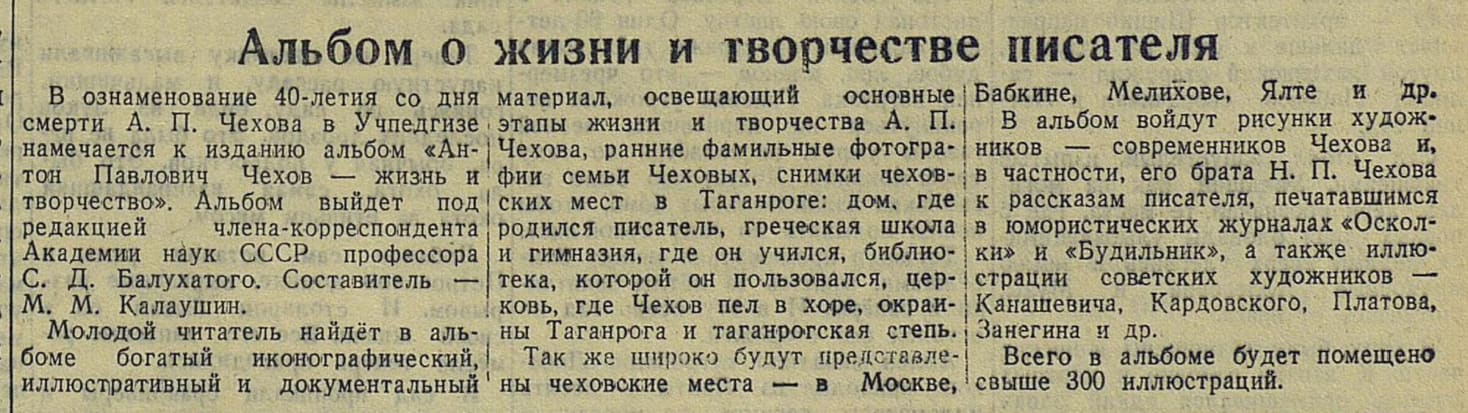
In the spring of 1944 Matvey Matveyevich was searching the hospitals for his old friend S.S. Geychenko. On 16 April he wrote to him at the evacuation hospital in Gorky, inviting him to come and work at Peterhof; on 15 May, having had no answer, he wrote again: “I am chasing you all over the Soviet Union” [◈ S090, pp. 179–180]. That summer Leningradskaya Pravda reported that an album on Chekhov’s life and work was being prepared for the fortieth anniversary of his death: “Compiler — M.M. Kalaushin” [◆ S074, no. 168, 15.07.1944, p. 3]. △ This is most likely the album that appeared only in 1957 as A.P. Chekhov v portretakh, illyustratsiyakh, dokumentakh, compiled by Matvey Matveyevich and edited by V.A. Manuylov [◈ S177, 01006288314].
From 1934 Matvey Matveyevich had been the curator of the Pushkin Reserve on behalf of Pushkin House [◈ S134, p. 196]. In late autumn 1944 he came to the liberated Mikhailovskoye, looked everything over, paid the staff of the Pushkin Reserve their wages for all the months gone by and took them back to Leningrad for the winter [◈ S144, no. 5 (8), 2014, p. 12]. While the traces were still fresh he drew up plans of the German defences of 1943–1944 in the village of Savkino and the central part of Mikhailovskoye; they are kept in the Reserve’s research archive [◈ S094, p. 33].
By Order No. 59 of the Institute of Russian Literature, dated 15 April 1945, S.S. Geychenko was appointed director of the Pushkin Reserve [◈ S136, p. 204]. In his own words, no one pressed for it harder than Matvey Matveyevich, and the appointment was confirmed “in the first days of April” [◈ S100, pp. 176–177]. On the morning of 12 April Geychenko left Leningrad for Pskov together with L.N. Nazarova of Pushkin House and the fifteen-year-old Boris Kalaushin, the future artist, who was going to sketch the ruined Pushkin sites; the journey to Pskov took more than two days [◈ S100, p. 179]. In May 1945, at Geychenko’s request, Boris Matveyevich drew a plan of the park at Petrovskoye showing the German defences of 1943–1944 — the minefield, dugouts, trenches, shell craters and destroyed trees; the draft is dated 16 May and is kept in the Reserve’s archive [◈ S086, no. 83, p. 177, citing the Archive of the Pushkin Reserve, PZ-KP-250]. In the same year he made a pencil drawing of Nanny’s Cottage and signed the sheet “BKalaushin 45” [◈ S087, 2015, no. 2 (13), p. 3].
The war ended for the Kalaushins in different corners of the country and beyond it: for Ivan Nikolayevich in Berlin; for Roman Vasilyevich in Germany, at an army trophy depot with his horses; for Nikolay Pavlovich in the Far East; for Nikolay Nikolayevich at the junior lieutenants’ courses of the Karelian Front; and for Boris Matveyevich over the plan of a ruined park at Petrovskoye.
Where the documents may be found
- Central Archive of the Russian Ministry of Defence (TsAMO), Podolsk: reports of irrecoverable losses (f. 58); the award card index (cabinet 41a, box 24) and the jubilee award card index (cabinet 23, box 11); records of the 128th, 176th and 244th Rifle Divisions and of the 269th Guards Rifle Regiment.
- Central Naval Archive (TsVMA), Gatchina: Black Sea Fleet records (f. 1250, f. 864), for Ivan Ilyich and Nikolay Semyonovich.
- The Pamyat Naroda portal: the records the roster cites for Nikolay Ivanovich, Aleksey Fedotovich and Vyacheslav Savelyevich; it is also the place to look for Fyodor Panteleimonovich, for Ivan Nikolayevich’s earlier unit (before the 269th Guards Regiment) and for Roman Vasilyevich’s service before 1945.
- TsGALI SPb: M.M. Kalaushin’s personal correspondence with V.A. Manuylov (fond number to be established).
- Archive of the All-Russian Pushkin Museum: op. 3, d. 70, 71, 73 — on the evacuation to Tashkent and Tomsk of the collection of the State Pushkin Museum in Moscow, the predecessor of the All-Russian Pushkin Museum; general background to the evacuation of the Pushkin collections.
- Research archive of the Pushkin Reserve: PZ-KP-250 (plan of the Petrovskoye park, 1945); Pl/ch, d. 14 (plan of the central part of Mikhailovskoye, redrawn by V.Ya. Shpinyov in 1946).
- People’s Museum “And the Muses Were Not Silent…”, St Petersburg: copies of Boris Kalaushin’s Siege booklets; see also O.G. Prutt, “Bukovki i bukvitsy Borisa Kalaushina”, Bibliofily Rossii, vol. 10 (Moscow, 2013), pp. 499–524.
- Prisoner-of-war records (via OBD Memorial): NARA, RG 242, A3355, roll 155, for the “Kalaushin Pyotr” of Mauthausen (his personal card is worth requesting from the Arolsen Archives); FSB Archive for Stavropol Territory, d. 6222-9736-9740, for Ivan Fyodorovich.
Documents
The texts are given as in the documents, uncorrected; English translations ours.
1943. “Reconnaissance observer of the Separate Mortar Battalion of the 244th Zaporozhye Rifle Division Senior Sergeant KALOUSHIN PAVEL ILYICH, for this: on 13.10.43, when the enemy counter-attacked near the farmstead of Bogatyrev, Comrade Kaloushin, being at the battalion commander’s observation post, did not lose his head, quickly gave the batteries the command to open fire, and the counter-attack was beaten off. In this, about a platoon of enemy soldiers was destroyed.” — Order of the artillery commander of the 244th Zaporozhye Rifle Division, No. 06/n of 20.10.1943 [◆ S022, f. 33, op. 686044, d. 1806, via S175]
1945. “Red Army man Kalaushin has worked for more than a year as a carter at Army Trophy Depot No. 2742. A diligent, modest and disciplined worker. Keeps the horses entrusted to him in excellent condition…” — Award sheet of R.V. Kalaushin, 10.06.1945 [◆ S022, f. 33, op. 690306, d. 2689, via S175]
1945. “During the military operations against the Japanese imperialists, driver Kalaushin drove his vehicle over roadless country, knowing neither hardship nor fatigue, and thereby ensured the normal work of the army staff and its protection.” — Award sheet of N.P. Kalaushin, 13th Separate Guard Company, 15th Army [◆ S022, f. 33, op. 686196, d. 6291, via S175]
Documents and illustrations
Images held by rights holders
- Image held by the rights holder — permission requested
Photograph · 1941–1944 ◇ family testimony
Pavel Ilyich Kalaushin (1923–1944), senior sergeant
Pavel Ilyich Kalaushin (1923–1944), senior sergeant, awarded the medal "For Courage" (1943); killed on 6 February 1944 and buried in Dnipropetrovsk region. Brother of Ivan Ilyich. Photograph from the Immortal Regiment page kept by his relative. His place in the roster is not established [moypolk.ru; OBD Memorial].
Семья (страница «Бессмертного полка»)
© the soldier's family; Immortal Regiment page (moypolk.ru)
- Image held by the rights holder — permission requested
Photograph · 1938–1942 ◇ family testimony
Ivan Ilyich Kalaushin (1920–1942), Red Navy sailor
Ivan Ilyich Kalaushin (1920–1942), a driver from Cherkessk, a sailor in the Black Sea Fleet rear services; missing in Sevastopol on 3 July 1942. Photograph from the Immortal Regiment page kept by his relative. His place in the roster is not established [moypolk.ru; OBD Memorial].
Семья (страница «Бессмертного полка»)
© the soldier's family; Immortal Regiment page (moypolk.ru)
- Image held by the rights holder — permission requested
Photograph ◇ family testimony
Ivan Nikolaevich Kalaushin (Koloushin) (1913–1991)
Ivan Nikolaevich Kalaushin (Koloushin) (10 Nov 1913 – 3 Oct 1991), a front-line soldier of the 269th Guards Rifle Regiment who took part in the capture of Berlin. Photograph from the Immortal Regiment page kept by his family [moypolk.ru; Roster of A. B. Kalaushin, no. 183].
Семья (страница «Бессмертного полка»)
© the soldier's family; Immortal Regiment page (moypolk.ru)
- Image held by the rights holder — permission requested
Award · 1945–1946 ◆ documented
Certificate of I. N. Kalaushin's medal "For Victory over Germany"
Certificate of the medal "For Victory over Germany in the Great Patriotic War 1941–1945" made out to Ivan Nikolaevich Kalaushin; photograph of the opened booklet from the Immortal Regiment page [moypolk.ru; Roster of A. B. Kalaushin, no. 183].
Семья (страница «Бессмертного полка»)
© the soldier's family; Immortal Regiment page (moypolk.ru)
- Image held by the rights holder — permission requested
Award · 1946 ◆ documented
Certificate of I. N. Kalaushin's medal "For the Capture of Berlin", A No. 420423
Certificate of the medal "For the Capture of Berlin", A No. 420423: "To Red Army man [of the reserve?] Kalaushin Ivan Nikolaevich" — by decree of the Presidium of the Supreme Soviet of 9 June 1945; the medal was presented in 1946. The roster gives the number as 420424 [moypolk.ru; Roster of A. B. Kalaushin, no. 183].
Семья (страница «Бессмертного полка»)
© the soldier's family; Immortal Regiment page (moypolk.ru)
- Image held by the rights holder — permission requested
Award · 1985 ◆ documented
Certificate of I. N. Kalaushin's jubilee medal "Forty Years of Victory", 1985
Certificate of the jubilee medal "Forty Years of Victory in the Great Patriotic War 1941–1945" ("To a war veteran") made out to Ivan Nikolaevich Kalaushin; presented in May 1985 [moypolk.ru; Roster of A. B. Kalaushin, no. 183].
Семья (страница «Бессмертного полка»)
© the soldier's family; Immortal Regiment page (moypolk.ru)
- Image held by the rights holder — permission requested
Work of art · 1941 ◈ published source
Boris Kalaushin's home-made booklet "Two Notebooks", 1941
A home-made booklet Boris Kalaushin made as a boy: "The Green Lamp Library. Chant-Tulle. Two Notebooks", with the imprint "Literature and Children", MCMXLI (1941); on the left, the mark of his childhood "publishing house", "LI". Copies of Boris's home-made books from the years of the Siege and the evacuation were given to the People's Museum "And the Muses Were Not Silent…" [Khukhrina 2022, p. 30, fig. 3].
Семья Б.М. Калаушина (оригинал, по-видимому); копии — Народный музей «А музы не молчали…», СПб.
Family archive; published in O. V. Khukhrina, Kulturnaya zhizn Yuga Rossii, 2022, no. 3
- Image held by the rights holder — permission requested
Work of art · 1945 ◈ published source
B. M. Kalaushin, "Nanny's Cottage", Mikhailovskoye, 1945
Boris Matveevich Kalaushin's pencil drawing "Nanny's Cottage", 1945: Mikhailovskoye soon after its liberation; the artist was 15 or 16, and the sheet is signed "BKalaushin 45". Published in the Pushkin Reserve's newspaper for the 70th anniversary of Victory [Pushkinsky Ugolok, 2015, No. 2 (13), p. 3].
Место хранения оригинала не указано (вероятно, ГМЗ «Михайловское»)
© heirs of B. M. Kalaushin; published by the Mikhailovskoye Museum Reserve
- Image held by the rights holder — permission requested
Photograph · 1940–1960 ◈ published source
Matvei Matveevich Kalaushin (1904–1968), portrait
Matvei Matveevich Kalaushin (1904–1968) — staff member and director of the Literary Museum of Pushkin House, curator of the Pushkin Reserve on behalf of the Institute of Literature; on his recommendation S. S. Geichenko was appointed director of the Reserve in 1945; in 1949 he opened the All-Union A. S. Pushkin Museum in the Alexander Palace. Portrait from the centenary exhibition [museum.ru, N20942; Mikhailovskaya Pushkiniana, issues 19, 26, 51].
Семейный архив / ГМЗ «Михайловское» (выставка 2005, museum.ru)
"Museums of Russia" (museum.ru), Mikhailovskoye Museum exhibition, 2005
Sources for this chapter
- S001 — A.B. Kalaushin’s roster Kalaushiny (philippov.spb.ru, version 03.02 of 13 July 2025)
- S020 — Archive of the Karachay-Cherkess Republic: decisions on disenfranchisement (1930–1932)
- S022 — TsAMO (via OBD Memorial and Podvig Naroda)
- S023 — Prisoner-of-war records (via OBD Memorial)
- S029 — TsVMA (via OBD Memorial and Podvig Naroda)
- S074 — Leningradskaya Pravda, 1944
- S086 — Mikhailovskaya Pushkiniana, the Mikhailovskoye Museum Reserve series
- S087 — Pushkinsky Ugolok, newspaper of the Pushkin Reserve
- S090 — L. Ageyeva, “Uroki Semyona Geychenko” (Mikhailovskaya Pushkiniana 71, 2018)
- S094 — A. Vasilyev, “Razminirovaniye territorii Pushkinskogo zapovednika (1944–1949)” (Mikhailovskaya Pushkiniana 64)
- S100 — S.S. Geychenko, U Lukomorya (Leningrad, 1986)
- S106 — I. Yefimova, “Pushkinsky prazdnik poezii v Mikhailovskom. 1940–1950-e” (Mikhailovskaya Pushkiniana 87)
- S110 — Book of Memory of the Karachay-Cherkess Republic
- S112 — Book of Memory of Stavropol Territory, vol. 9
- S113 — Book of Memory: Hero City of Sevastopol, vol. 3
- S128 — A. Pukova, “Arkhivnye materialy po istorii evakuatsii…” (Mikhailovskaya Pushkiniana 96)
- S129 — A.G. Rabinyants, “Tikhy podvig” (All-Russian Pushkin Museum library website)
- S134 — L.M. Soldatova, “Iz istorii Pushkinskogo zapovednika 30-kh godov XX veka” (Mikhailovskaya Pushkiniana 19)
- S136 — T.V. Stepanova, “Pervye poslevoyennye gody (1944–1950)…” (Mikhailovskaya Pushkiniana 19)
- S142 — O.V. Khukhrina, “Risunki leningradskikh detey 1930-kh – 1940-kh godov v kontekste voyny” (2022)
- S144 — M.A. Shpinyova, “Vsya nasha semya zapovedniku sluzhila” (1994; repr. 2014)
- S154 — Immortal Regiment (moypolk.ru)
- S157 — Open List (Otkryty Spisok, ru.openlist.wiki)
- S162 — S.V. Volkov, database Uchastniki Belogo dvizheniya v Rossii, vol. “K”
- S163 — All-Russian Pushkin Museum: exhibition “Boris Kalaushin: From the Academy to Abstraction” (2015)
- S174 — OBD Memorial (obd-memorial.ru)
- S175 — Podvig Naroda database (podvignaroda.ru)
- S176 — Burial lists (via OBD Memorial)
- S177 — Russian State Library (RSL), online catalogue
- S188 — Russian Wikipedia — for general historical context
This page uses material from the Kalaushin family roster published on the Philippov website: https://philippov.spb.ru/?q=Kalaushiny (version 03.02 of 13 July 2025).