Chapter 14 of 14 · 1737–2026
Sources and Further Research
How the chronicle was put together, where the documents on the Kalaushins are kept, and how relatives can help
In brief
The Kalaushin chronicle rests on three layers — family memory as recorded in A.B. Kalaushin’s family roster, the documents of each period, and the work of historians; this chapter explains how they were brought together, how to search for the family name in old records, and which archives, from Stavropol, Krasnodar and St Petersburg to Vienna and Tehran, hold or may hold papers on the family. It also sets out where to look for papers on the two accounts that relatives confirm — the saddle for the Shah of Persia (most consistently dated to spring and early summer 1900) and the commission for Archduke Franz Ferdinand — lists the enquiries prepared for museums, and invites relatives to add their photographs, documents and stories.
◆ documented◈ published source◇ family testimony△ hypothesisMore about the method
The thread
The chronicle’s own system lies in its sources: four classes, a marker on every fact, and, for the family accounts, notes on where the documents may be found. The family’s memory comes first, in its own words; the documents follow — as a complement, not a test. This is the chronicle’s method, not a trait of the family, so the chapter carries no trait marks.
A family chronicle is never finished. Everything told on these pages rests on three supports: the family’s memory, which Aleksandr Borisovich Kalaushin [S001, No. 221] “for more than 40 years gathered, crumb by crumb” into the family roster [◈ S001, dedication]; the documents of each period — revision tales and confessional registers, orders, newspapers, calendars, award lists; and the work of historians. The chapter “The Chroniclers” is about the people who kept and wrote down the family’s memory. This chapter is about the papers: how we searched for them, where those already found are kept, where those not yet found may be, and how anyone with something about the Kalaushins in a family album, a folder of old letters or a trunk can help.
The three layers of the chronicle
The roster. The chronicle is built on the family roster Kalaushiny, published on the genealogical website Philippov (version 03.02 of 13 July 2025). It has 265 entries, and, as its introduction says, the story “is told in the voice of Aleksandr Borisovich Kalaushin” [◈ S001, introduction]. Its list of sources has 35 items: Aleksandr Borisovich’s own handwritten roster, extracts from files of the Central State Military History Archive, V.G. Tolstov’s History of the Khoper Regiment, the Caucasus and Kuban calendars, a family photograph from his archive, and websites and databases [◈ S001, list of sources]. We keep the roster’s numbering: the number in square brackets at a person’s first mention points to his or her entry. Where the documents say something different we give notes on the roster — with gratitude to its compiler, whose own reservations often showed us where to look.
Family memory. These are the accounts recorded in the roster from Boris Matveyevich, Olga Savvichna, Yevdokiya Fyodorovna, Emiliya Fyodorovna and other relatives, and the information given on 8 October 2026 by the author of this website, Vyacheslav Olegovich Kalaushin. Two accounts — of the saddle for the Shah of Persia and of the parade commission for Archduke Franz Ferdinand — are confirmed by relatives and recorded in the family history [◇ S003].
Documents and published sources. In 2026 we searched for these by every route open to us. Revision tales, confessional registers and parish registers we read in researchers’ transcriptions on the VGD and Kubanskiye kazaki (kubancossack) forums, and in scans on Yandex Archive Search, where a search for the surname and its variants gave 309 hits. Newspapers: the Tiflis Kavkaz from the National Parliamentary Library of Georgia, Kubanskiye Oblastnye Vedomosti (the Kuban regional gazette), Russky Invalid, and Austrian papers from the ANNO collection of the Austrian National Library. The Caucasus and Kuban calendars, Imperial Orders, exhibition award lists; the books of V.G. Tolstov and N.V. Galushkin; the TsAMO databases Podvig Naroda and OBD Memorial, the Open List, S.V. Volkov’s database of participants in the White movement, the databases of the Kubanskaya genealogiya website; the State Catalogue of the Museum Fund of Russia and the online catalogues of museums in some forty countries. In all, more than 120 collections of sources — page copies, scans, recognised texts — and about 450 images were gathered.
How to read the markers. Every reference carries the mark of its source class: ◆ documented — a primary source of the period that we have seen in a scan or in a verbatim transcription with its archival reference; ◈ published source — a book, article or database, and also the roster where it passes on archival information; ◇ family testimony — relatives’ accounts and confirmations; △ hypothesis — our own inference. The family’s account always comes first, in its own words; the documents follow as an addition, not as a test.
Searching for the name
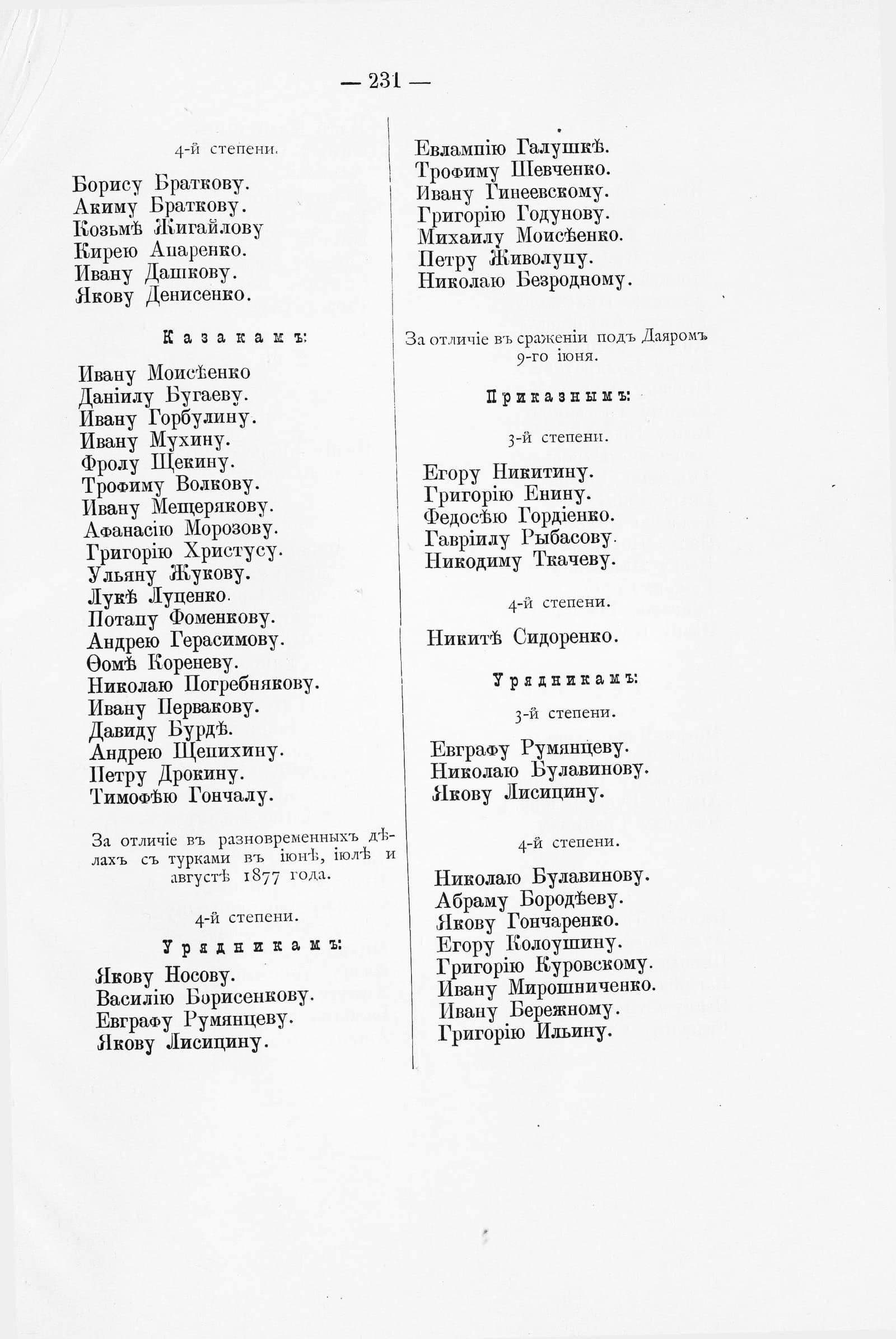
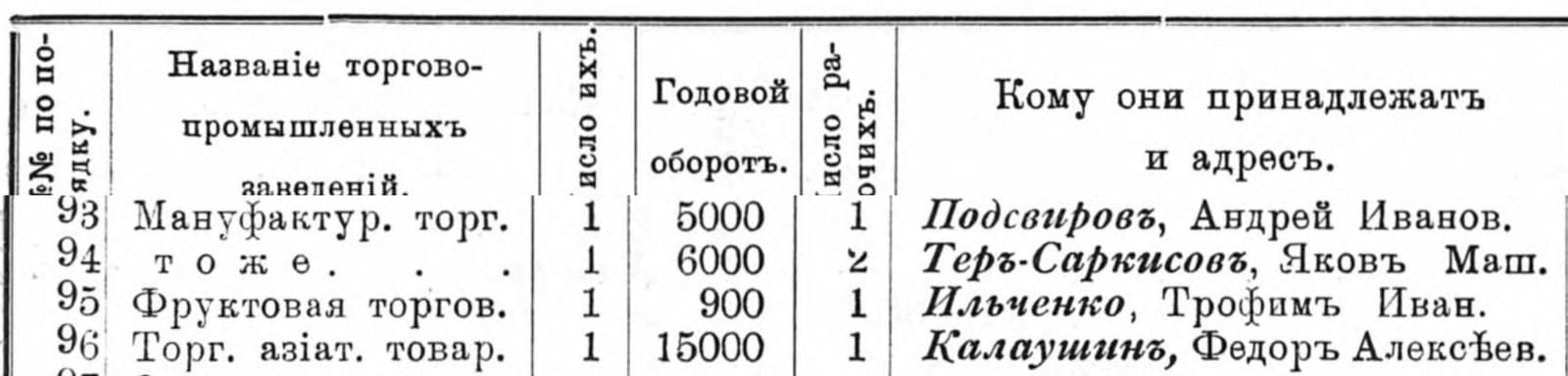
Clerks and typesetters wrote the name in many ways. In the History of the Khoper Regiment the uryadnik (Cossack non-commissioned officer) who distinguished himself at Dayar in 1877 is “Yegor Koloushin” [◆ S053, App. 74, p. 231]; in a list of gardens of 1830 the founder of the family appears as “Trofim Kaloushin” [◆ S010, no. 155, via S181]; the Podvig Naroda database has “Koloushin”, “Kaloushin” and “Kolaushin” [◈ S175, search of 8 Oct 2026]. Even the first name can change: among the traders of Batalpashinskaya the Kuban Calendar for 1914 prints “Kalaushin, Fyodor Alekseyev.” [◆ S060, 1914, p. 442] — △ in all likelihood Fedot Alekseyevich [S001, No. 73]. It pays to search under every form, and also by first name and patronymic, stanitsa (Cossack village) and regiment.
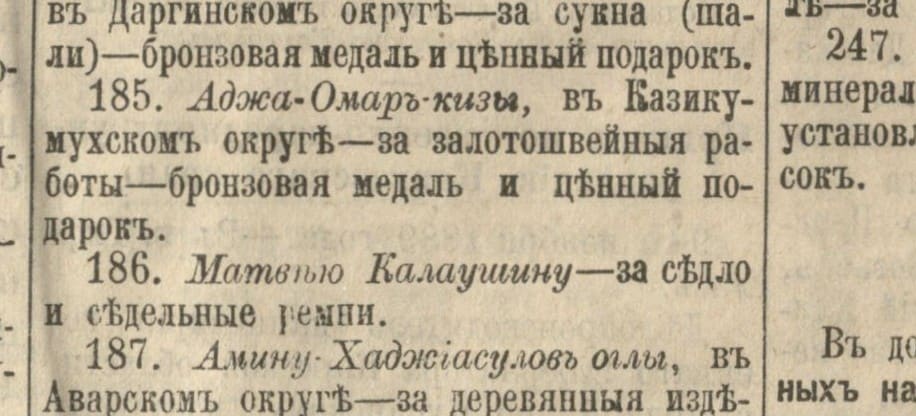
Machine reading of old typefaces makes mistakes. The line recording the award to Matvey Alekseyevich Kalaushin [S001, No. 71] at the Caucasus Exhibition of 1889 was read by the software as “Matviyo Kalauishnu”, and a text search could not see it: the line was found by reading the page with one’s own eyes. Only afterwards did a second, fuzzy search through all the issues carrying award lists, nos. 302–312, show that the name appears nowhere else in them [◆ S036, no. 305, 17.11.1889, p. 2]. If an online search finds nothing, the page is worth reading with one’s own eyes.
Russian records before 1 (14) February 1918 are dated Old Style, foreign newspapers New Style; in 1900 the difference was 13 days. In matching Russian and Austrian reports of the Shah’s visit we converted every date.
A guide to the archives
Below are the archives where papers on the Kalaushins are, or may be, held. References are given as we know them; where a fond number has not been established, we say so. Many files we have seen only in transcription, or know from references in publications; in such cases a copy of the original is worth ordering.
Stavropol and Astrakhan: the first generations
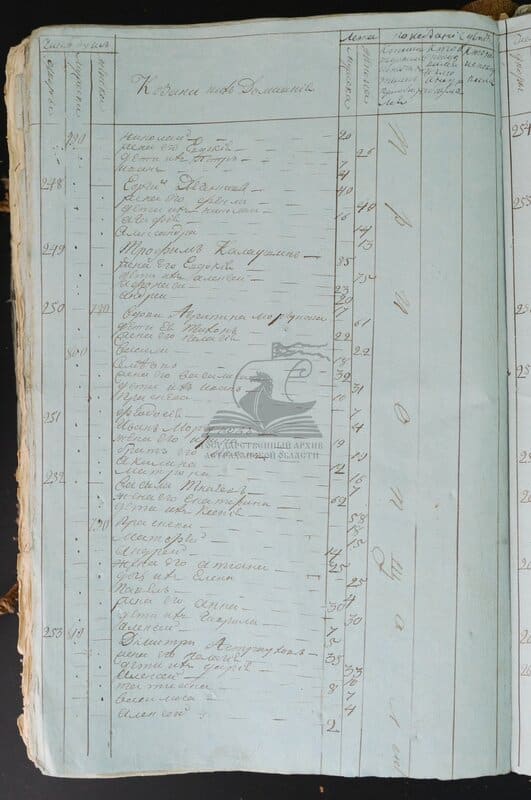
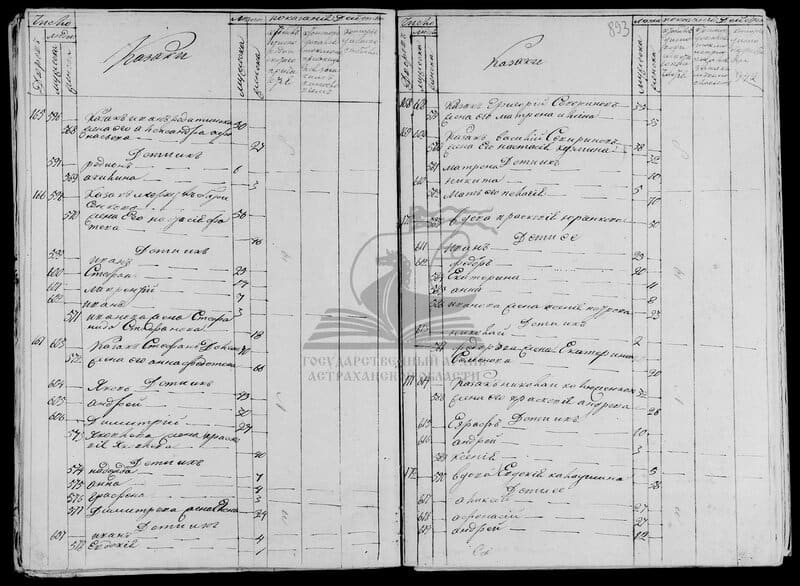
- State Archive of Stavropol Krai (GASK). F. 748, op. 1, d. 1 — the revision tale (census return) of Stavropolskaya stanitsa of 18 November 1815: household no. 321 records the founder of the family, Trofim Pakhomovich [S001, No. 1; in the roster an unnamed founder “born about 1740”], with his wife Avdotya and their children [◆ S007, household no. 321, via S181, topic 84017]. We read it in transcription; the original should be checked for Avdotya’s age and for any note on the family’s origin, and the tales of the 1795 and 1811 revisions looked for alongside it. F. 135, op. 6, d. 806 — the confessional register of Batalpashinskaya for 1848 (called a family list on the forum) [◆ via S180, topic 25557]; d. 809 of the same fond — the parish register for 1848. F. 1300, op. 1, d. 413 (ff. 7v–8) — on the founding of Batalpashinskaya on 1 October 1825 by Khoper Cossacks moved from Stavropolskaya and Vorovskolesskaya [◈ S135, p. 535].
- State Archive of Astrakhan Oblast (GAAO), f. 599, op. 2. D. 3684 — confessional registers of Stavropol district, 1822–1825: Trofim Kalaushin is 85, living with his wife and his sons Aleksey, Afanasy and Andrey, while his eldest son, Ivan, heads a household of his own [◆ S008, scans 1287, 597, via S160]. D. 7148 — the confessional register of Batalpashinskaya for 1827: Yevdokiya is now a widow and the family is in its new home [◆ S009, scan 161]. The same fond holds the parish registers of the Kazan church of Stavropolskaya from the early 19th century, which may record the births of Afanasy and Andrey Trofimovich.
Moscow
- Russian State Military History Archive (RGVIA, formerly TsGVIA). F. 14877, op. 1 — church registers of Batalpashinskaya from the mid-19th century. D. 2716 is the parish register for 1857. In July “Cossack Nikolay Ivanov Kalaushin and Vassa Andreyeva” [S001, No. 7; entered in the roster as Nikolay Alekseyevich] have a son named Ilya baptised — the second Ilya in the family: the elder was already three in the confessional register of 1848, and the roster remembers an “Ilya the second” [◇ S001, No. 7]. In August, at another baptism, the godmother is recorded as “the chamber Cossack’s daughter, the maiden” Fedosya Andreyeva Kalaushina [◆ S013, ff. 174v, 178v–179v, via S181, topic 20012]. Still unread are d. 5159 — the stanitsa’s confessional registers of 1828 and 1830 (ff. 178–214 and 501–518) — and the full household lists in the confessional registers of 1854–1860 (d. 2050, 2470, 2717, 3501; of the 1860 register only a list of household heads has been published). These are the places to look for Aleksandr Nikolayevich [S001, No. 31], of the direct line of the author of this website: he does not appear in Nikolay Ivanovich’s household in the 1848 register [◆ S012, household no. 92, via S180, topic 25557], and these registers should show where he belongs in the family. Note on the roster. The information that the roster attributes to “confessional lists of 1847” and “name lists of 1828” matches the confessional registers of 1827 and 1848 [◈ S001, sources 4, 6; ◆ S009; ◆ S012]; a confessional register of 1828 does exist — it is in d. 5159 and is still to be read.
- The roster’s RGVIA references. F. 1058, op. 2, d. 143a — information of 1849 on Ivan and Afanasy Trofimovich [S001, Nos. 3, 8]; f. 330, op. 55, d. 37 (service list of the uryadniks of the 3rd Brigade of the Caucasus Line Host, 1859) and d. 2147; f. 330, op. 56, d. 452 (lists of internal-service uryadniks of the Batalpashinsk Department, 1877 and 1887) and d. 455; f. 330, op. 60, d. 1271 — alphabetical list of the officers of the Kuban Host; f. 400 — a service record of 1913 [◈ S001, list of sources]. The roster places the 1853 file on the appointment of Uryadnik Kalaushin as a chamber Cossack in “TsGVIA f. 366, op. 1058, d. 2, vol. 1”; the fond number needs to be confirmed. According to the documents, the chamber Cossack was Uryadnik Andrey Ivanovich [S001, No. 16; the roster gives this information under No. 6, Andrey Alekseyevich]: a service list of 1854 records “Kalaushin Andrey Ivanov, Batalpashinskaya, chamber Cossack, aged 36”, and in 1857 his daughter is called “the chamber Cossack’s daughter” [◈ S156, database of service records; ◆ S013, f. 178v].
- Regimental lists and service records. F. 408, op. 1, d. 498 and 15097 — officer lists of the 2nd Khoper Regiment as of 1 January 1914 and 10 March 1915; scans of these and of the officer list of the 3rd Khoper Regiment as of 14 June 1917 are on the portal Pamyati geroyev Velikoy voyny 1914–1918 (In Memory of the Heroes of the Great War) [◈ S158]. Ff. 409 and 400 — officers’ service records: Afanasy and Stepan Yegorovich (Georgiyevich) [S001, Nos. 92, 93], Yefim Mikhailovich [S001, No. 131], Nikita Ilyich [S001, No. 85]. The archive of His Majesty’s Own Convoy — the Cossack bodyguard of the Emperor (fond number to be confirmed): Convoy orders for May–June 1900 and the lists of men leaving for the reserve.
- State Archive of the Russian Federation (GA RF). F. 601, op. 1, d. 217–266 — the original diaries of Nicholas II; we read them in the 2011 edition [◆ S037]. F. R-5982 — the Main Information Bureau in Constantinople: Nikita Ilyich in the “Name list of refugees to be sent on the steamer Kherson”, 18 December 1920 [◈ S082, no. 3, 2022, p. 21].
- Russian State Archive of Literature and Art (RGALI) holds letters of the St Petersburg branch: a letter of 1968 from Emiliya Fyodorovna, wife of Matvey Matveyevich [S001, No. 127], to Yu.G. Oksman (f. 2567, op. 1, item 541); Matvey Matveyevich’s letters of 1956 and 1959 to T.G. Tsyavlovskaya (f. 2558, op. 2, item 1254) and his correspondence of 1957 with K.L. Zelinsky (f. 1604, op. 1, items 270, 611); a letter of 1958 from Boris Matveyevich [S001, No. 213] (f. 2732, op. 1, item 1485) and his personal file of 1956 in the Union of Artists of the RSFSR (f. 2940, op. 7, item 653) [◈ S028].
- Archive of the Foreign Policy of the Russian Empire (AVPRI), Persian Desk (fond number to be confirmed): the ceremonial of the Shah’s visit in 1900 and the exchange of gifts.
St Petersburg, Pskov, Mikhailovskoye
- Russian State Historical Archive (RGIA). F. 468 (His Imperial Majesty’s Cabinet) — gifts to foreign guests and presentations to the Court; f. 472 (Chancellery of the Ministry of the Imperial Court) — files on purveyors’ titles; f. 516 — the Chamber-Fourier Journals (the daily court journals); the fond of the Court Stables Office (number to be confirmed) — presentation saddles and horses. What exactly to look for in them is set out below, in the section on the two accounts. F. 383, op. 30, d. 520 — the list of 1830 of gardens in the former Stavropolskaya stanitsa, which includes Trofim’s garden (see “Documents”).
- Central State Historical Archive of St Petersburg (TsGIA SPb), f. 19. Op. 128 — parish registers of the first-line regiments of the Kuban Host and of its plastun (Cossack infantry) battalions, 1886–1913; the list of surnames from these registers includes Kalaushins [◈ S181, topic 51744]. They may record the Cossack of the 1st Khoper Regiment Pavel Kalaushin, lightly wounded in Kutais on 16 May 1906 when bombs were thrown at General Alikhanov’s carriage [◆ S056, 1906, no. 147, 07.07.1906, p. 6]; △ most likely this is Pavel Aleksandrovich [S001, No. 70]. The registers of St Petersburg churches for 1853–1857 are the place to look for the chamber Cossack’s family, and those for 1904 for the baptism of Boris Aleksandrovich, who, the family says, was born in the Convoy barracks on Shpalernaya Street [◇ S001, No. 138].
- Central State Archive of St Petersburg (TsGA SPb), f. R-7240 (Leningrad University): △ probably the student file of B.A. Kalaushin, 1926–1929, which the roster cites as “GIA SPb, op. 10” [◈ S001, source 34]; the file of Matvey Matveyevich, who studied at the university in 1923–1926, may also be here.
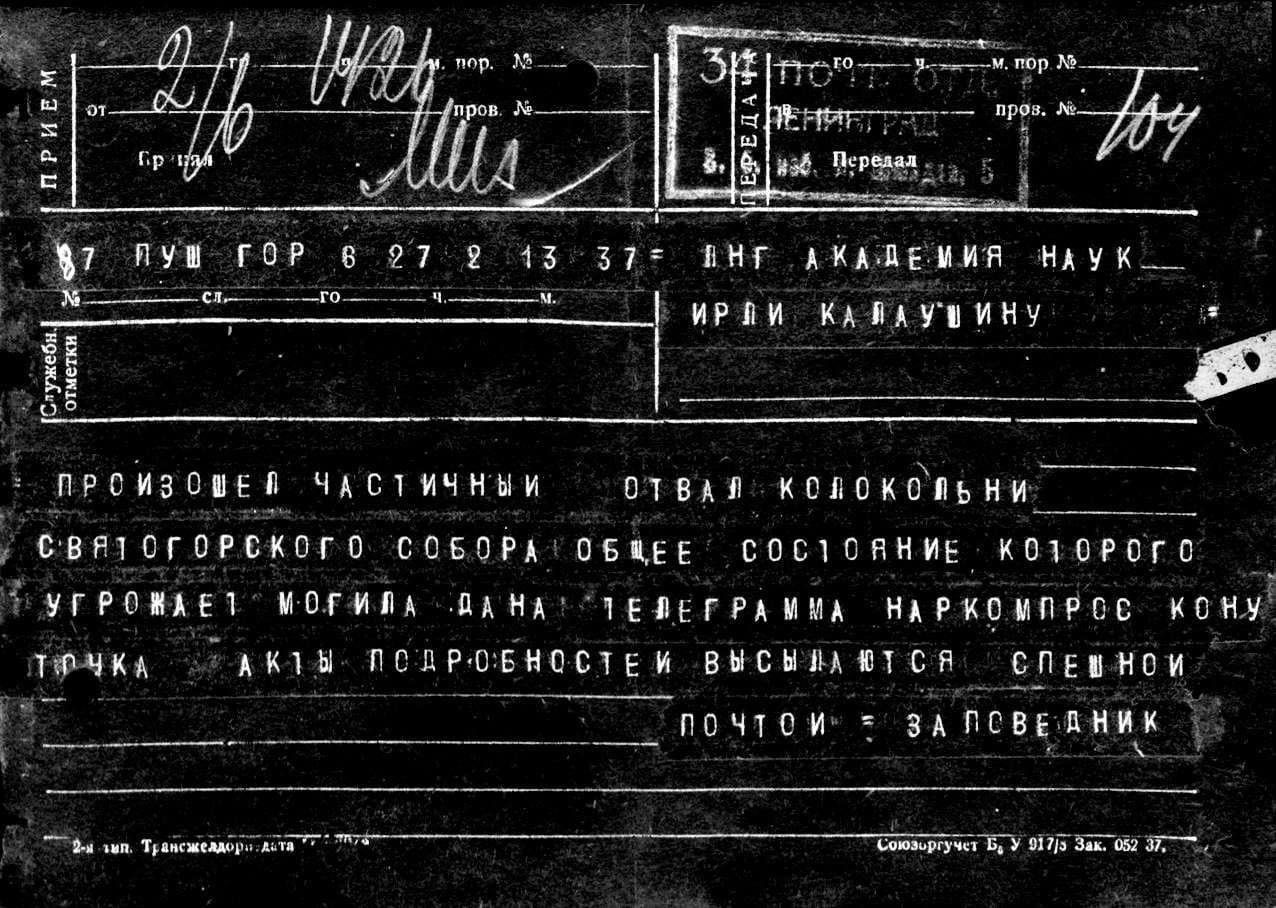
- St Petersburg branch of the Archive of the Russian Academy of Sciences, f. 150 (Institute of Russian Literature): the place to look for M.M. Kalaushin’s personal file (1931–1953); here too is the correspondence on the Pushkin Reserve, including a telegram of summer 1934 addressed “IRLI Kalaushin” about the collapse of the bell tower of the Svyatogorsky Monastery cathedral [◆ S021, op. 1 (1933), d. 24, f. 104; publ.: S086, no. 112]. TsGALI SPb — the fond of V.A. Manuylov, with Matvey Matveyevich’s wartime letters (fond number to be confirmed).
- Research archive of the Pushkin Reserve — Order No. 59 of the Institute of Russian Literature of 15 April 1945 appointing S.S. Geychenko; the plan of the German fortifications of 1943–1944 at Mikhailovskoye and Savkino drawn up by M.M. Kalaushin and redrawn in 1946 (Pl/ch, d. 14); and the 1945 plan of the Petrovsky park that Mikhailovskaya Pushkiniana attributes to B.M. Kalaushin (PZ-KP-250) [◈ S086, no. 19, p. 204; no. 64, p. 33; no. 83, p. 177]. ODNILS GAPO (Pskov), f. 1219, op. 1, d. 352 — correspondence of Pushkin House and the Reserve with the regional Party committee, 1945–1946.
The south of Russia
- State Archive of Krasnodar Krai (GAKK). The texts of the Kuban Host orders that we know so far only from the roster and from the Kubanskaya genealogiya databases: No. 156 of 7 June 1892, enrolling Fedot Alekseyevich [S001, No. 73] in the Convoy; No. 5 of 13 January 1897, on his Mecklenburg medals; No. 60 of 17 June 1900, discharging him from the Convoy [◈ S001, No. 73; ◈ S156, comment on photo 47-0-1071]. From GAKK service records Kubanskaya genealogiya has already extracted a line of 1854: “Kalaushin Andrey Ivanov, Batalpashinskaya, chamber Cossack, aged 36” [◈ S156, database of service records]. F. 332, op. 1, d. 551 and f. 396, op. 1, d. 10213, 10239 — the Kuban delegation to the Convoy’s centenary in May 1911, which included Ivan Stepanovich, then a podkhorunzhy (senior Cossack non-commissioned officer) [S001, No. 77; ◈ S132, pp. 104–105]. Ff. R-158 and R-102 — papers of 1920 on Batalpashinskaya. The parish registers of Labinskaya for 1912 — the deaths of Matvey and Mikhail Alekseyevich. Kubanskiye Oblastnye Vedomosti for 1897 and for summer 1900 — the texts of Orders No. 5 and No. 60. The supplement to no. 16 of 1888, which names “A. Kalaushin” as the saddle-master of the crafts department of the Batalpashinsk town school, has already been found [◆ S035, 1888, suppl. to no. 16, 16.04.1888, p. 3]. Note on the roster. The roster takes these words to refer to Aleksey Nikolayevich [◈ S001, No. 32]; the department’s report for 1890 names the saddle-master in full — Anton Kalaushin [◆ S035, 1891, no. 20, 18.05.1891, p. 2]; △ most likely Anton Nikolayevich (No. 33), Aleksey Nikolayevich’s younger brother.
- State Archive of the Karachay-Cherkess Republic (GA KChR), Cherkessk. F. 9, op. 1 — parish registers of the stanitsas of the former Batalpashinsk Department: in the register of Ust-Dzhegutinskaya for 1898–1899, for example, a witness at a wedding is “Stefan Georgiyev Kalaushin, khorunzhy of the 2nd Khoper Regiment” (a khorunzhy was the lowest Cossack officer rank, roughly a cornet) [◆ S015, d. 14, scan 149]. The minutes of 1930–1934 on disenfranchisement [◈ S001, source 21]; the papers of the Batalpashinsk Department revolutionary committee and executive committee, 1920–1921; the file of the newspaper Batalpashinskaya Pravda for 1920, whose no. 27 the roster cites in telling of Fedot Alekseyevich’s death [◈ S001, No. 73].
- National Archive of the Republic of Adygea (NA RA), Maykop, f. 77 — parish registers of Maykop: in 1903 “uryadnik of Batalpashinskaya stanitsa, Kuban Oblast, Mikhail Alekseyev” [S001, No. 72] stands godfather at a baptism [◆ S018, d. 50, scan 137]. Central State Archive of the Republic of North Ossetia–Alania (TsGA RSO-A), f. 296 — parish registers of Vladikavkaz with entries on the Kalaushins of Sunzhenskaya.
Khabarovsk
- State Archive of Khabarovsk Krai (GAKhK), f. R-830, op. 3, d. 18923 appears in the roster’s list of sources [◈ S001, source 29]. Fond R-830 is the Bureau of Russian Émigrés in Manchuria (BREM); △ this is probably the questionnaire of Aleksey Matveyevich [S001, No. 122], who lived in emigration in Manchuria.
Abroad
- Vienna. The Haus-, Hof- und Staatsarchiv and the Kriegsarchiv of the Austrian State Archives: the papers of Archduke Franz Ferdinand (details below).
- Czech Republic. The National Heritage Institute (NPÚ) and Konopiště Castle — the inventories of the arms collection; Czech archives (Národní archiv, SOA Praha) — the records of the Konopiště estate and of the Habsburg-Este family archive; the Military History Institute (VHÚ) in Prague.
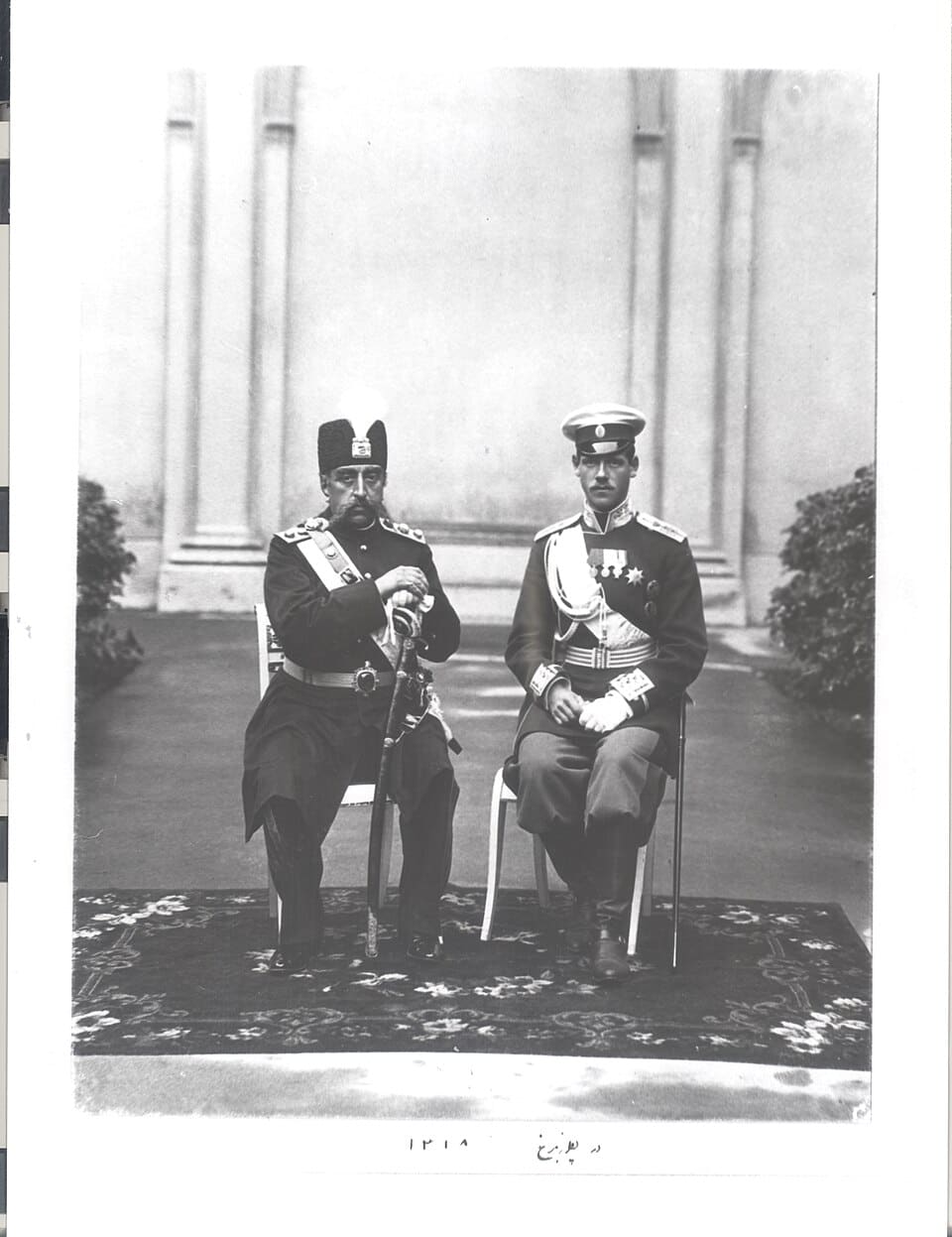
- Iran. The Golestan Palace in Tehran — the treasury of gifts, the former saddle store and the photographic archive; album no. 1421 of the palace library holds a photograph of the Shah with Tsesarevich Mikhail Alexandrovich captioned “In Petersburg, 1318”, that is, 1900 [◆ S017, no. 1421-6]. The Military Museum of the Saadabad complex, which keeps Russian imperial gifts to the Qajars — for example, a shashka (Caucasian sabre) given by Nicholas I to Fath-Ali Shah in 1829 [◈ S146].
- Emigration. GA RF — the lists of the Russian All-Military Union as of autumn 1925: △ apparently the source of the entry on Nikolay Matveyevich [S001, No. 125], a sotnik — Cossack lieutenant — in the 1st Combined Kuban Regiment in Yugoslavia [◈ S162, vol. “K”]; the Hoover Institution (Stanford) — the records of the Kuban Cossack Association (2020C39); the Bakhmeteff Archive, Columbia University — the papers of Ye.V. Maslovsky; the Archives of Yugoslavia (Belgrade) — the card index of the State Commission for Russian Refugees; in France, the OFPRA archives on Russian refugees.
- Schwerin. The Regierungsblatt für das Großherzogtum Mecklenburg-Schwerin for 1896–1897 (available in HathiTrust) — announcements of Mecklenburg awards; the files on them are to be sought in the Landeshauptarchiv Schwerin.
The two accounts confirmed by relatives: where to look for the papers
The task the family set was not to test these accounts but to match the years and to name the places where papers about them may be kept. Both accounts are told in full in the chapters “At Court” and “The Workshop”.
The saddle for the Shah of Persia
◇ family testimony · confirmed by relatives
The saddle for the Shah of Persia was made in Fedot Alekseyevich Kalaushin’s workshop on the order of Emperor Nicholas II; the work took two months. Fedot Alekseyevich took the saddle to St Petersburg himself. There, at a review of the Guards on his last day before going home at the end of his service, Prince Trubetskoy reported to the Emperor that the saddle had arrived. Nicholas II examined it, said it was very well made, and there and then congratulated Kalaushin on the title of Purveyor to the Court of His Imperial Majesty; a gold watch was granted with the title. The Emperor asked the master how long he had been in St Petersburg and, learning how long the presentation had been delayed, showed his displeasure; after he left, Trubetskoy sent Fedot to the guardhouse for two days for an incautious answer. The promised gold watch never reached Fedot Alekseyevich [◇ S001, No. 73; ◇ S003].
△ hypothesis · dating
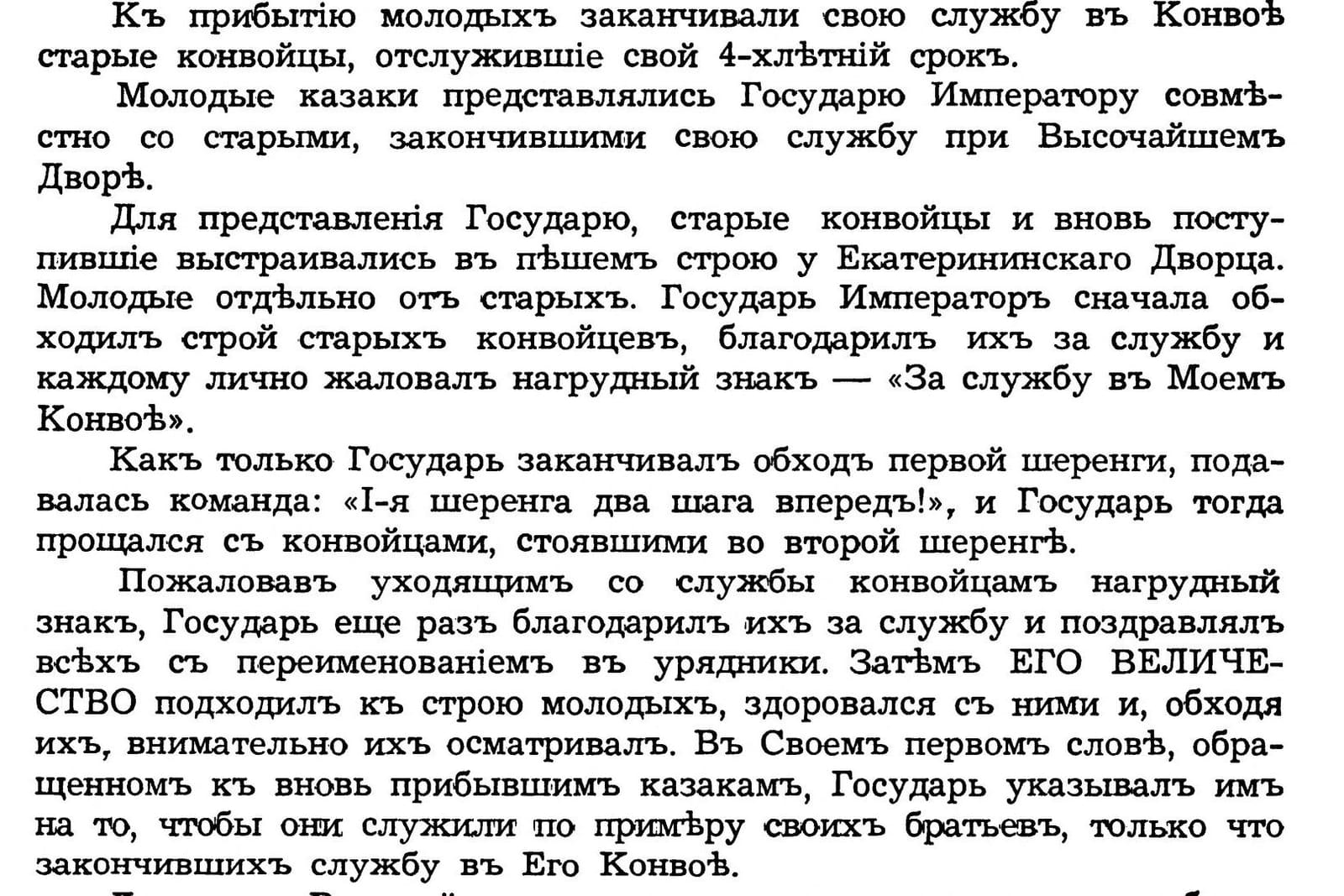
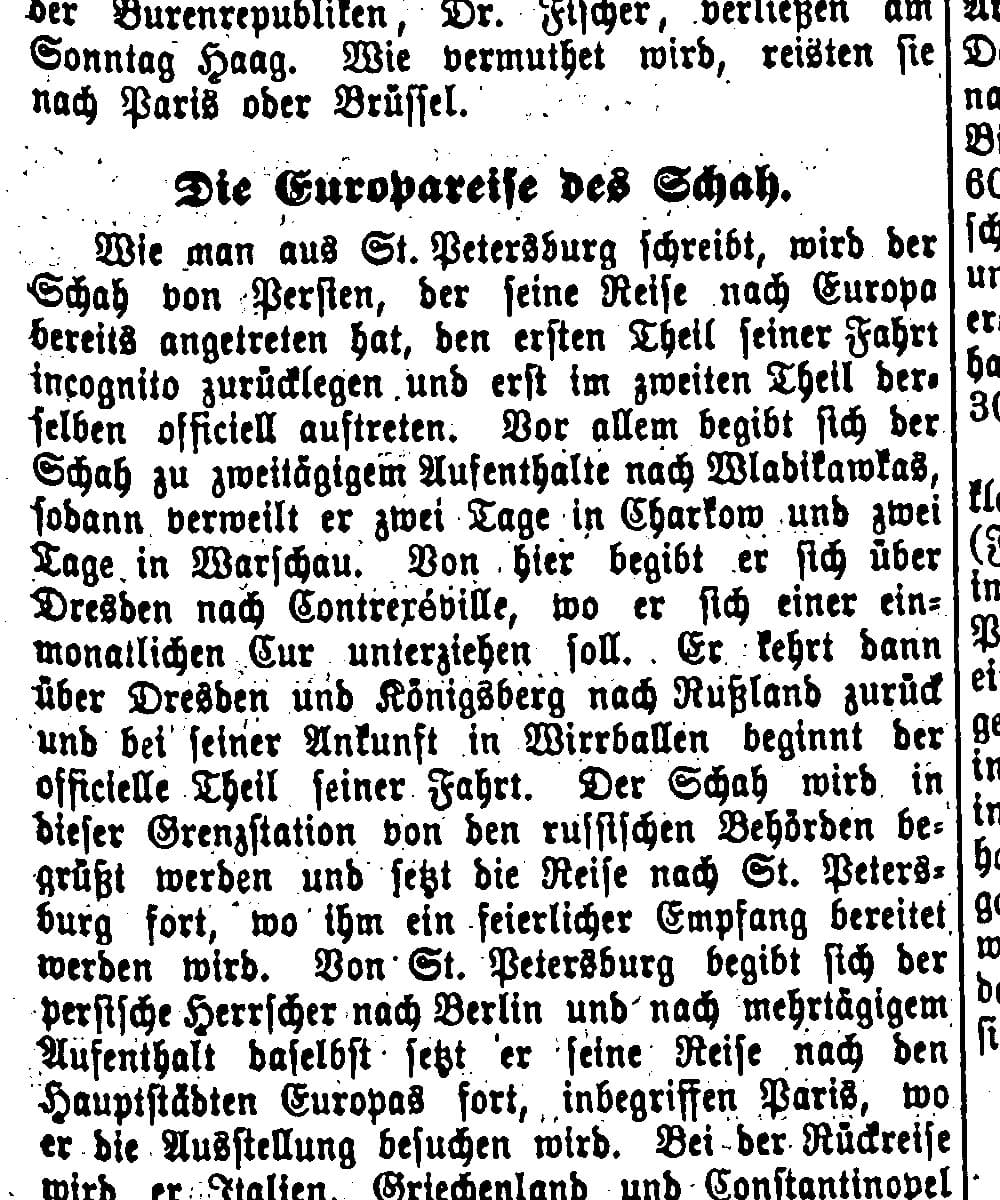
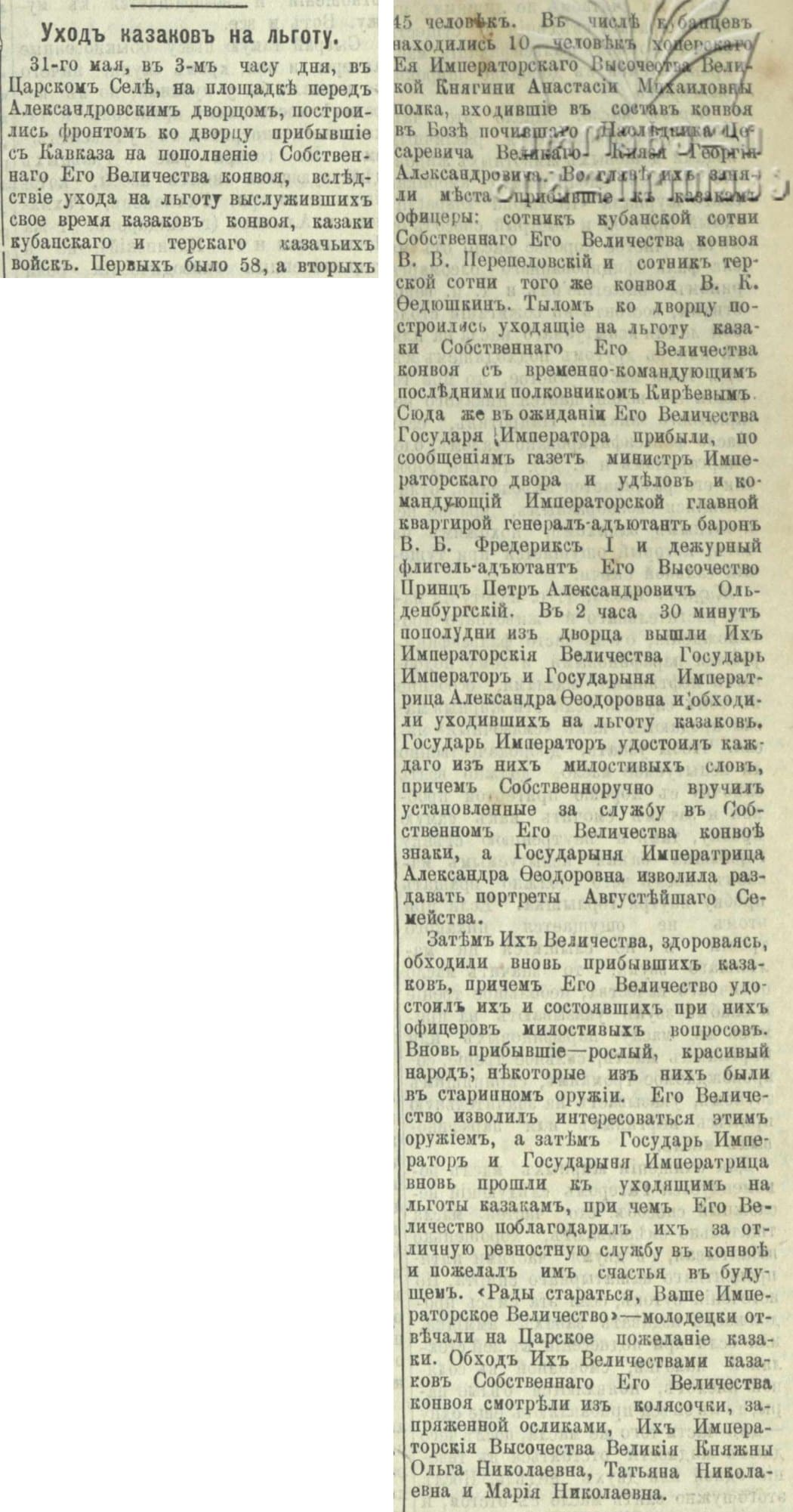
The years point to 1900. Fedot Alekseyevich served in His Majesty’s Own Convoy (hereafter the Convoy) from 1892 and was discharged by Order No. 60 of the Kuban Cossack Host of 17 June 1900 with the badge for service in the Convoy [◈ S001, No. 73]. The only state visit of a Persian shah to St Petersburg during his service was that of Mozaffar ad-Din Shah, 4–10 July 1900 Old Style (17–23 July New Style) [◆ S036, no. 181, 11.07.1900, p. 3; ◆ S037, 4–10.07.1900]. It was known well in advance: in February 1900 St Petersburg reported the invitation Nicholas II had sent to the Shah; in March came news of extensive preparations for his reception and, citing Novoye Vremya, that the Shah was expected in St Petersburg at the end of May; in April, that the route had changed: the Shah would cross Russia incognito, and the state reception in St Petersburg would come on his return journey (it took place in July) [◆ S048, 15.02.1900, p. 7; ◆ S049, 03.03.1900, p. 33; ◆ S050, 10.03.1900, p. 23; ◆ S051, 25.04.1900, p. 3]. Two months’ work on the saddle therefore falls roughly in March–May 1900. The “review on the last day before going home” is in all likelihood the farewell presentation of Convoy Cossacks leaving for the reserve. Galushkin describes the yearly custom: at the end of May the departing Convoy men presented themselves to the Emperor for the last time, and he handed each of them the Convoy service badge in person [◈ S097, pp. 144–145]. In 1900 there was one such presentation: on 31 May (13 June), outside the Alexander Palace at Tsarskoye Selo, the Emperor spoke “gracious words” to every departing man and handed each the badge with his own hand [◆ S036, no. 150, 10.06.1900, p. 3; ◆ S037, 31.05.1900]. Seventeen days later Order No. 60 was issued. From then on the documents show Fedot Alekseyevich living in the Kuban: in 1902 he won a silver medal at the Kuban exhibition in Yekaterinodar, and in 1907–1909 he was ataman (elected head) of Batalpashinskaya stanitsa [◆ S035, 1902, no. 255, 28.11.1902, p. 1; ◈ S156, database of stanitsa atamans; ◆ S035, 1909, no. 256, 03.12.1909, p. 1]. Note on the roster. The roster gives his years in the Convoy as 1892–1911; Order No. 60, quoted in the same entry, and these documents place his departure from the Convoy in 1900 [◈ S001, No. 73]. The most consistent dating is spring to early summer 1900: the saddle was being prepared for Mozaffar ad-Din Shah’s visit. Other meetings between Russian emperors and shahs fit the family account less well: Naser al-Din Shah was in St Petersburg in 1889, under Alexander III and before Fedot Alekseyevich had taken the oath (1891); in 1902 Mozaffar ad-Din Shah met Nicholas II at the manoeuvres near Kursk, and in 1905 at Peterhof, by which time Fedot Alekseyevich had left the Convoy; for Ahmad Shah’s coronation in 1914 Russia sent a special envoy to Tehran [◈ S127; ◈ S033, via S180, topic 855; ◆ S054, 19.09.1902, p. 2; ◆ S037, 20–24.08.1905; ◆ S049, 21.07.1914].
A note on names. In 1900 the Convoy was commanded by Baron Alexander Meyendorff (1893–1906), and on the day of the review the departing men were led by the acting commander, Colonel Kireyev; Prince Georgy (Yury) Ivanovich Trubetskoy, Meyendorff’s nephew, commanded the Convoy in 1906–1914, and Fedot’s younger brother Aleksandr Alekseyevich served under him [◈ S097, p. 170; ◆ S036, no. 150, 10.06.1900, p. 3; ◈ S188, “Trubetskoy, Georgy Ivanovich”; ◇ S001, No. 74]. △ The family most likely kept the name of the later, better-remembered commander. The title. The official List of Purveyors to the Imperial Court, compiled at the beginning of 1915, names “the saddle-maker Fedot Kalaushin of Batalpashinskaya stanitsa” [◈ S108].
Where the documents may be found. The Emperor’s diary hardly ever lists the gifts he himself gave to guests: even the Order of St Andrew presented to the Shah on 4 July is not mentioned there [◆ S036, no. 181, 11.07.1900, p. 3; ◆ S037, 4.07.1900]. It does show, however, the way Caucasian saddles reached the Emperor: on 11 December 1900, “Meyendorff came with a Caucasian dress saddle and a shashka — an offering from some good Dagestani!” [◆ S037, 11.12.1900]. The main places to look are therefore these:
- His Imperial Majesty’s Cabinet (RGIA, f. 468): the file on gifts to the Shah for the visit of 4–10 July 1900; the Cabinet’s registers of items received and issued for 1900–1901, which may record the receipt of a saddle from Uryadnik Kalaushin and the gold watch assigned to him.
- The Chamber-Fourier Journal for 1900 (RGIA, f. 516, op. 1 (219/2728)): d. 10 — the first half of the year, including the review of 31 May (by our reckoning around ff. 600–640); the Shah’s visit — △ probably near the start of d. 11 (or at the end of d. 10) [◈ S037, 2011 edition, notes].
- The Chancellery of the Ministry of the Imperial Court (RGIA, f. 472): the file on F.A. Kalaushin’s purveyor title — the date of the grant and the report behind it. The Minister of the Court himself, Baron V.B. Fredericks, was present at the review of 31 May [◆ S036, no. 150, 10.06.1900, p. 3].
- The Court Stables Office (RGIA; fond number to be confirmed); AVPRI, Persian Desk; Convoy orders for May–June 1900; GAKK — the text of Order No. 60 and Kubanskiye Oblastnye Vedomosti for summer 1900; Pravitelstvenny Vestnik and Novoye Vremya for 1–3 June 1900.
- On the Persian side: the Safarnameh, the Shah’s account of his first European journey (AH 1318), with its entries on St Petersburg around 19–25 Rabi‘ al-awwal 1318 (17–23 July 1900 N.S.), where the words to look for are zin (زین, saddle) and pishkesh (پیشکش, presentation gift); the treasury and photographic archive of the Golestan Palace.
The commission for Archduke Franz Ferdinand
◇ family testimony · confirmed by relatives
The family remembers the last commission that Matvey Alekseyevich Kalaushin [S001, No. 71] carried out together with Fedot Alekseyevich as a complete set of parade equipment for Archduke Franz Ferdinand: parade harness, saddles, sabres and kinzhals (Caucasian daggers). The family history records that it was a “political” commission, meant to help improve relations with Austria-Hungary; war came all the same in 1914, after the Archduke’s assassination [◇ S001, No. 71]. Relatives confirm that the commission was completed [◇ S003].
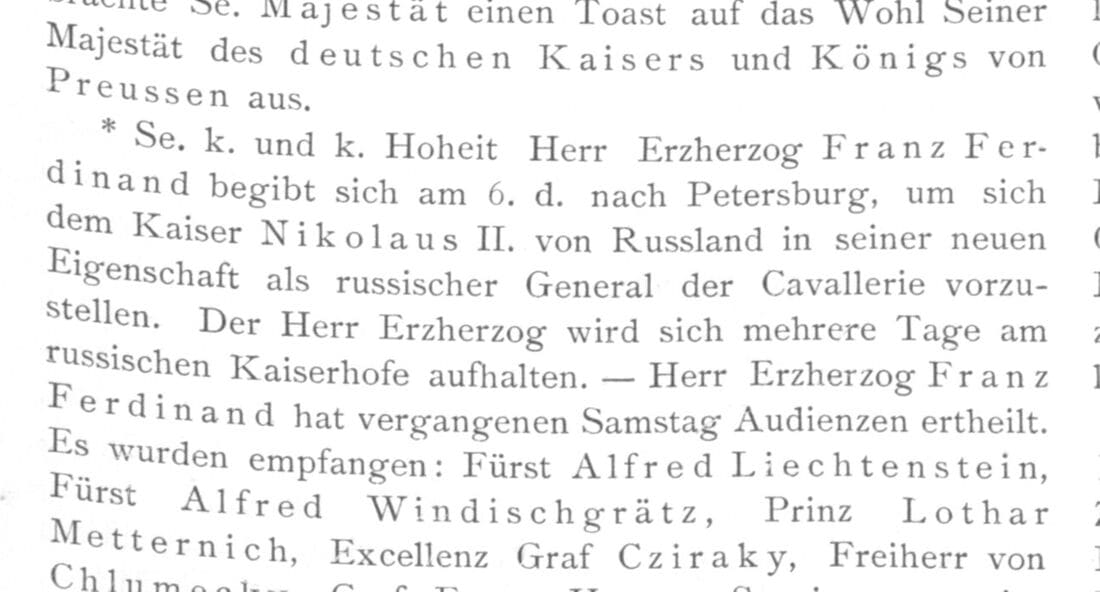
Matvey Alekseyevich died in 1912 [◇ S001, No. 71], so the work was finished before then. From 1891 the Archduke was honorary chief of the Russian 26th Bug Dragoon Regiment, and in February 1902 he came to St Petersburg to present himself to Nicholas II as a General of Cavalry of the Russian army [◈ S189, “Bugsky 9th Uhlan…”; ◆ S055, 01.02.1902, p. 3 — announcement of the coming journey].
Where the documents may be found. The inventory of the Konopiště arms collection and the files on gifts to the Archduke have not been published online; they have to be read in the reading rooms or ordered as copies.
- Haus-, Hof- und Staatsarchiv, Vienna: HA OMaA 505, the inventory of the Konopiště arms collection drawn up in 1915 in the probate of the Archduke’s estate; alongside it, inventories 504 (Konopiště furniture), 499 (Artstetten) and 501 (Belvedere). Franz Ferdinand’s papers, cartons 35–40 “Ehrenpreise und Geschenke” (Honorary Prizes and Gifts, 1892–1914), especially 39 (1910–1911) and 40 (1912–1914). MdÄ AR F1-69-78 — the Archduke’s journey to St Petersburg in 1902 [◈ S145].
- Kriegsarchiv, Vienna — the Archduke’s military chancellery, heading “Geschenke” (gifts), 1908–1914.
- NPÚ and Konopiště Castle — the inventories of 1914 and 1921 and the armoury; VHÚ, Prague.
- RGIA, f. 468 — gifts to the Archduke in February 1902 and in 1910–1912.
Other family accounts and where to follow them
◇ family testimony · the medals of Paris and London
The family remembered that the workshop’s work had more than once won prizes and gold medals at world exhibitions in Paris and London [◇ S001, Nos. 71, 72; ◇ S004].
Context. The award lists found so far record prizes for the Kalaushin masters at four exhibitions: Tiflis, 1889 (Matvey, “for a saddle and saddle straps”); Nizhny Novgorod, 1896 (a bronze medal to Fedot and Mikhail Alekseyevich with I.M. Fisenko, and an honourable mention to Matvey Alekseyevich); the Voznesenskaya exhibition, 1899 (a large silver medal for a Cossack saddle); and Yekaterinodar, 1902 (silver medals to Mikhail and Fedot) [◆ S036, no. 305, 17.11.1889, p. 2; ◆ S044, no. 1, pp. 33, 36; ◆ S035, 1899, no. 203, 24.09.1899, p. 2; ◆ S035, 1902, no. 255, 28.11.1902, p. 1]. At the Paris Exposition Universelle of 1900 the Cossack equipment was shown by the Main Directorate of Cossack Hosts; the catalogue does not name the makers [◆ S046]. Where to look: the jury reports of the Paris exhibition of 1900 (Group XVIII, Class 116); the Russian sections of the London exhibitions of 1862 and 1909; diplomas and medals that may survive with descendants.
◇ family testimony · kalausskaya stal, “Kalaus steel”
The family told how Matvey Alekseyevich obtained Damascus steel — through Suleymanov, the father of Lyubov Dzhelalovna Geychenko — and re-tempered it himself, and how kinzhals “with Kalaus steel” were very highly prized in the Caucasus; in support the family cited the words of the Arabist historian Leonid Lavrov [◇ S001, No. 71].
△ “Kalaus steel” is most likely kalaushinskaya, “the Kalaushins’ steel”: in the Caucasus steel was named after the master who re-tempered an imported blade — “Bazalay steel”, “Chilli buolat” [◈ S091, PDF p. 58]; and the word also echoes the Kalaus River, near whose upper reaches the Khoper Cossacks lived in 1777–1825 [◆ S047, pt 1, ch. 2; ◈ S135]. Context. In 1903 Kubanskiye Oblastnye Vedomosti, listing unclaimed railway consignments, names one “from the Zlatoust state works, to Kalaushin — blades” [◆ S035, 1903, no. 213, 30.09.1903, p. 3]. Where to look: L.I. Lavrov’s field materials (Etnografiya Kavkaza, 1982) and his papers, to be sought in the Museum of Anthropology and Ethnography of the Russian Academy of Sciences (the Kunstkamera) and in the archive of the Institute of Ethnology and Anthropology; blades and scabbards that survive in families, whose marks and inscriptions can be read.
◇ family testimony · the burning barn
During the Revolution Pavel Aleksandrovich Kalaushin was killed with pitchforks in Batalpashinskaya. His wife, Pelageya Alekseyevna, and their three small children were locked in a barn with other hostages and the barn was set on fire; they escaped only by a miracle [◇ S001, No. 70]. Where to look: GA KChR — the papers of the Batalpashinsk Department revolutionary committee and executive committee, 1920–1921, the orders of the special plenipotentiary of the Revolutionary Military Council of the 9th Army, and the lists of hostages; GA RF, f. R-470 (the Special Commission for the Investigation of Bolshevik Atrocities), if the fire took place in 1918; GAKK, f. R-158, op. 1, d. 32 and adjacent files; TsDODP KChR (the former Party archive), f. R-364; RGVA, f. 192 (Headquarters of the 9th Kuban Army); the newspapers of 1920, Batalpashinskaya Pravda and Krasnye Gory.
◇ family testimony · Anna Nikitichna
The family called Aleksey Nikolayevich’s [S001, No. 32] wife, Anna Nikitichna, Annushka-cherkeshenka — “Annushka the Circassian”. She was remembered in different ways. Boris Matveyevich, on his father’s word, said she was a Circassian: the brothers, on one of their journeys for Damascus steel, carried her off from a well in a Circassian aul (mountain village), and in church she was recorded as a Gypsy’s daughter. Yevdokiya Fyodorovna, Aleksandr Alekseyevich’s wife, said that Anna Nikitichna was the daughter of a Gypsy named Belavin; Aleksandr Borisovich believed she was an Adyghe [◇ S001, No. 32]. Context. The roster enters her as née Bulavina [◈ S001, No. 32]; Cossacks named Bulavinov lived in Batalpashinskaya from the stanitsa’s first years [◆ S009, no. 176, via S180, topic 25558]. A record of her marriage, or family photographs, if descendants have kept them, would help to tell more about her.
Enquiries to museums
No saddle or dagger bearing the Kalaushin mark has yet turned up in the online catalogues available to us, although the workshop’s work is known from the documents: Matvey’s saddle and saddle straps at the exhibition of 1889, the brothers’ leather goods at the exhibition of 1896, a Cossack saddle at the Voznesenskaya exhibition of 1899, Mikhail’s and Fedot’s saddlery at the Kuban exhibition of 1902, and the saddles that “the Cossack of Batalpashinskaya stanitsa Kalaushin, famous throughout the Caucasus for the work of his workshop” supplied to the officers of the Convoy [◆ S036, no. 305, 17.11.1889, p. 2; ◆ S044, no. 1, p. 33; ◆ S035, 1899, no. 203, 24.09.1899, p. 2; ◆ S035, 1902, no. 255, 28.11.1902, p. 1; ◈ S097, p. 143, n. 24]. Most museums publish only part of their holdings, and we were able to search only about 40 per cent of the State Catalogue of the Museum Fund from our network. More than thirty letters have therefore been prepared, grouped by priority.
- Where a piece from the workshop, or a photograph of it, may be kept. The F.I. Moiseyenko Museum of History and Local Lore in Labinsk: we ask about a harness ring (LM KP 30/305), the photograph albums of 1905 and 1911 (LM KP 542, 541) and any photographs of the house at 6 Krasnaya Street [◈ S165]. The Ye.D. Felitsyn Museum-Reserve in Krasnodar: the “Cossack saddle with harness” and the kinzhals “bearing a maker’s mark” shown in the exhibition Blesk stali (The Gleam of Steel, 2020–2021), and the photograph of the pavilion of the Uman and Labinskaya workshops at the Kuban exhibition of 1902 (KM 7033/7) [◈ S169; ◈ S165]. The Tsarskoye Selo Museum-Reserve: the Circassian saddle the museum acquired in 2021 [◈ S164], and the presents to Tsesarevich Aleksey — in May 1909, from Kuban Oblast and the Armavir–Tuapse Railway Company, “a Cossack saddle and a burka” (felt cloak); on 17 May 1911, from the Kuban and Terek delegations, a little horse with a saddle [◆ S036, 1909, no. 106; ◆ S037, 17.05.1911]. The Karachay-Cherkess Republican Museum in Cherkessk. Konopiště Castle and the Austrian State Archives (see above).
- Images and publication rights for the works of Boris Matveyevich and Matvey Matveyevich — the State Russian Museum (The Flower Fairy, 1968, GRM KP-180715), the museums of Karelia, Yaroslavl and Taganrog, the Leo Tolstoy Museum, the Cinema Museum, the Tsarskoye Selo Collection museum, the Pushkin Reserve, the All-Russian Pushkin Museum and others [◈ S165] (more in the chapter “The Artist”).
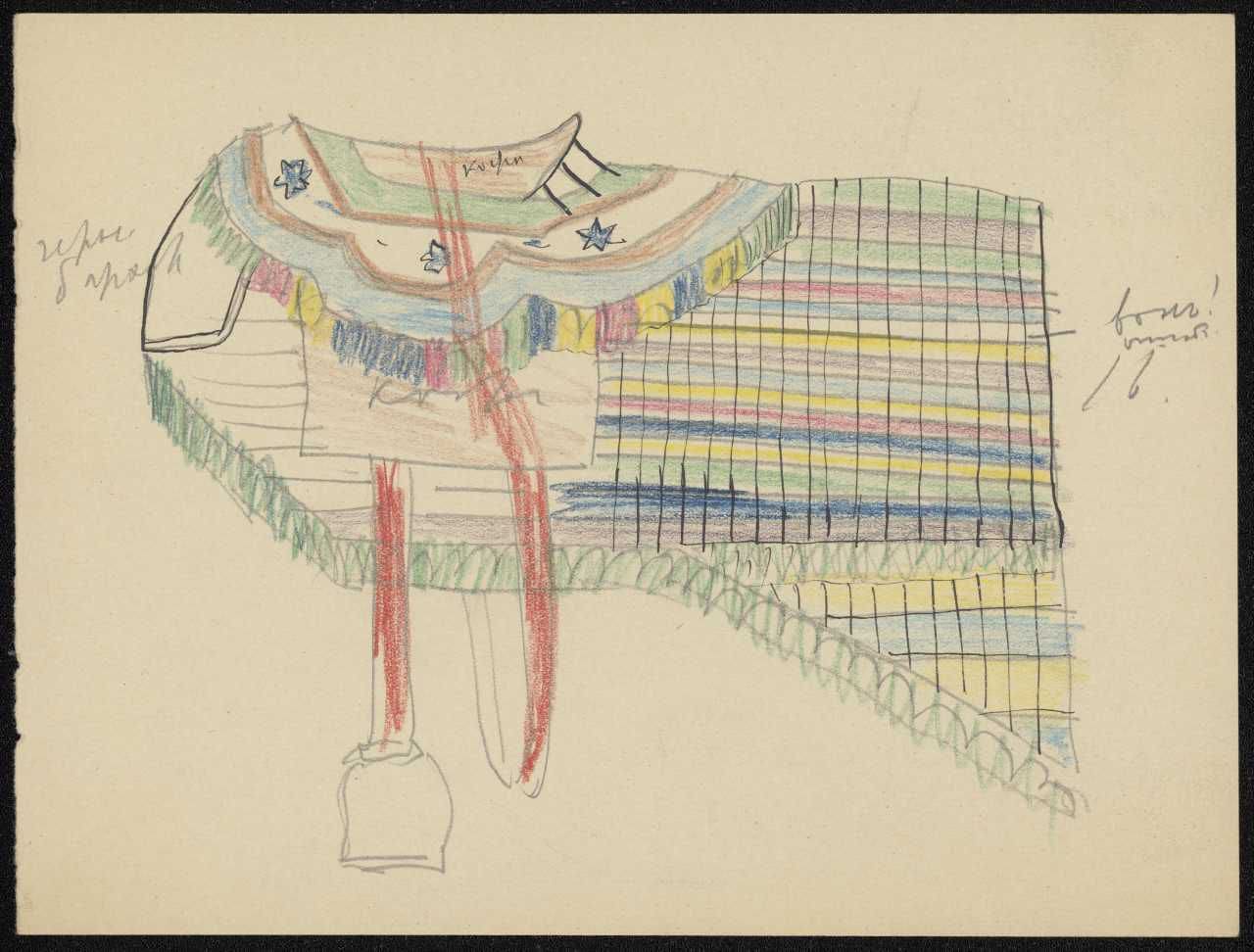
- Collections abroad. The Golestan Palace and the Military Museum of the Saadabad complex in Tehran — we ask whether the imperial gifts of 1900–1913 include Russian Cossack saddles; the National Museum of Denmark — the coloured drawing of a Convoy saddle and saddle-cloth from the Gudim-Levkovich collection (THM-12978); we ask whether this émigré collection holds Convoy or Kuban Host objects bearing makers’ marks; the National Museum in Prague — Karel Chotek’s negatives of 1908 showing the market of Labinskaya (OAE_n2134) [◈ S147]; the Georgian National Museum (the holdings of the former Caucasian Military History Museum in Tiflis), the Kutaisi Historical Museum and the Abkhaz State Museum in Sukhum — in Tiflis Matvey won the earliest of the family’s exhibition awards found so far, Aleksey Matveyevich was born in Kutais, and the families of Fedot and Aleksandr Alekseyevich lived in Sukhum [◆ S036, no. 305, 17.11.1889, p. 2; ◈ S001, Nos. 73, 74, 122]; émigré collections — the Hoover Institution, the Museum of Russian History at Jordanville, the Kuban museums in New Jersey, the Military Museum in Belgrade; Saumur, the Musée de l’Armée in Paris, the Livrustkammaren in Stockholm.
How to recognise a Kalaushin piece. A mark or inscription “Калаушинъ”; “Поставщикъ Двора Е.И.В.” (Purveyor to the Court of His Imperial Majesty) with the State arms — in the 1915 List the purveyor’s title is recorded for Fedot Alekseyevich [◈ S108]; “ст. Баталпашинская” or “ст. Лабинская”. A Convoy officer’s saddle can be recognised by its saddle-cloth: for officers it was “edged with Caucasian galloon” [◈ S097, p. 143, n. 24]. A Convoy saddle without a mark or a document, however, remains only a piece of the same kind.
What can be done from Russia
Some resources would not open from our network and are easy to check on the spot. Pamyat Naroda (pamyat-naroda.ru) requires a manual “I am not a robot” check — it may hold award documents that Podvig Naroda lacks. The State Catalogue of the Museum Fund (goskatalog.ru) responds only to Russian addresses: search for “Калаушин”, “Калаушинъ”, “Колоушин”, and for saddles and harness in the collections of the Labinsk museum, the Felitsyn Museum, Mikhailovskoye and the All-Russian Pushkin Museum. The page “Kalaushin Yury Romanovich” in the encyclopaedia Istorichesky Cherkessk (cherkessk.su) — one of the roster’s sources [◈ S001, source 1] and, △ most likely, the original record of the account of the saddle for the Shah — opens blank from our network, and there is no copy of it in the web archive; the site’s photograph albums of old Batalpashinskaya are worth searching too. △ The Chamber-Fourier Journal for 1900 may be available on the portal of the Presidential Library (prlib.ru); for us the portal stopped at a browser check. Issues of Kubanskiye Oblastnye Vedomosti for 1897 and summer 1900, if they are not on Yandex Archive Search, should be sought in the A.S. Pushkin Krasnodar Regional Universal Research Library and in the National Electronic Library.
An invitation to relatives
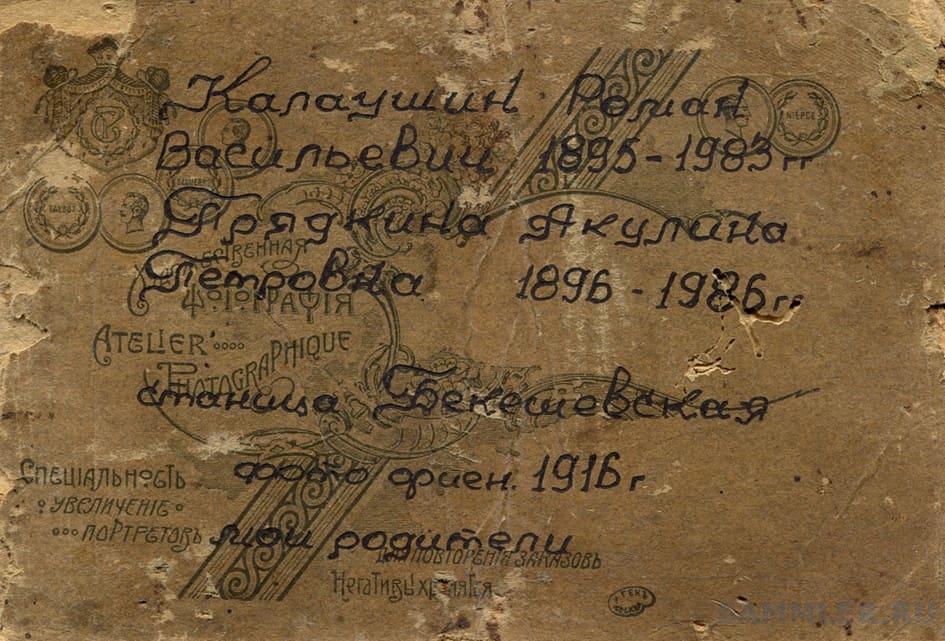
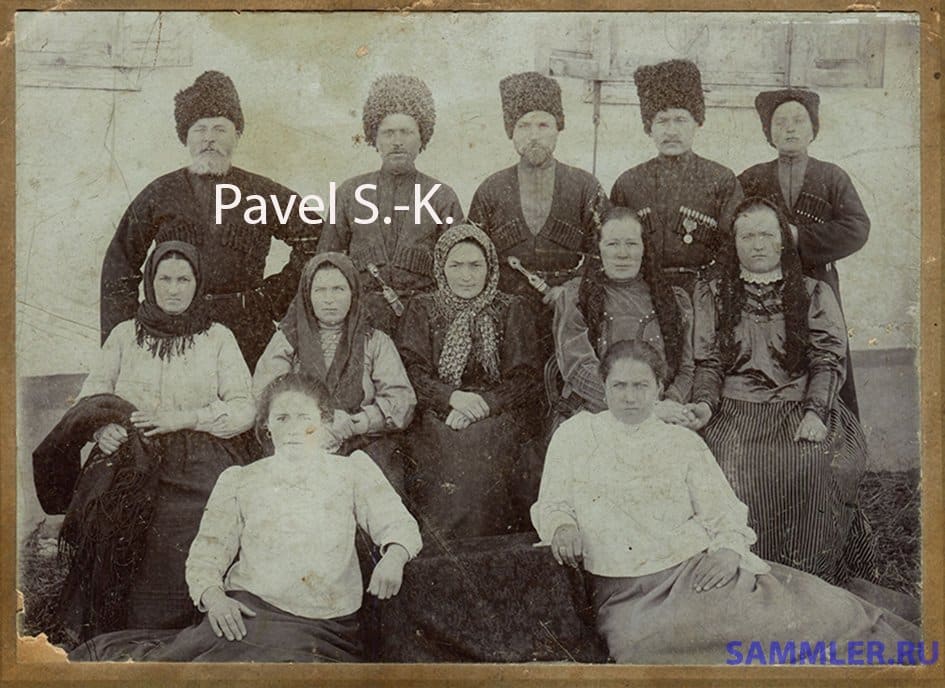
The most important papers on the Kalaushins may be kept not in archives but at home. The back of one photograph — “Kalaushin Roman Vasilyevich 1895–1983 / Pryadkina Akulina Petrovna 1896–1986 / Bekeshevskaya stanitsa / photo taken 1916 / my parents” — told more about Roman Vasilyevich’s [S001, No. 100] family than many a reference book [◆ inscription on the back of a photograph, S153, 09.10.2021]. A deed of sale of 1902, which Mariya Aleksandrovna [S001, No. 140] passed to the compiler of the roster, preserved Aleksey Nikolayevich’s words about his wife [◈ S001, No. 32]. If you have something of this kind, please share it — it will carry the chronicle forward.
We would be especially grateful for the following.
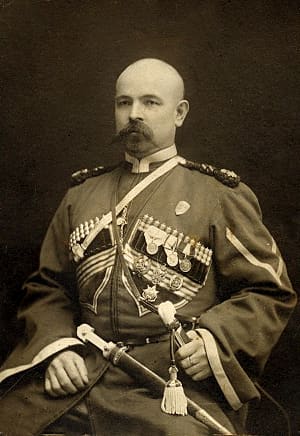
- Photographs with their backs. Scans of both sides at good resolution, and the names of the people pictured, if they are remembered. A particular request goes to the keepers of the original formal portrait of Fedot Alekseyevich: judging by the awards (among them the medal for the tercentenary of the House of Romanov) it was taken no earlier than 1913, and the lowest badge could not be identified by the moderator of the Druzhiny forum — “something oriental, possibly Persian” [◈ S179, thread “His Imperial Majesty’s Own Convoy”]. △ If it is a Persian award, it could tell a great deal about 1900.
- Documents. A certificate of the title of Purveyor to the Court; diplomas and medals from the exhibitions of 1889–1902 (in Tiflis a third-class diploma equal in rank to the bronze medal might be given instead [◆ S036, no. 302, 14.11.1889]); the badge for service in the Convoy; service papers, orders, letters; deeds of sale for houses in Batalpashinskaya and Labinskaya; rehabilitation papers; work-record books and school certificates.
- Objects. Saddles, harness, saddle trees, kinzhals, shashkas, scabbards — especially with marks and inscriptions.
- Stories. The written accounts of relatives in whose families the stories of the saddle for the Shah and the commission for the Archduke are kept — so that their words can be preserved in full, with the names of those who told them. Anything remembered about “Kalaus steel”, about Anna Nikitichna, about “Kalaushin Lane” and the garden in Labinskaya, about Paris and London, about the years of the Revolution.
- Aleksandr Borisovich’s family archive. The handwritten roster, the relatives’ letters quoted in it, the deeds of sale, the photograph of Vasily Afanasyevich’s family of 1904–1905 [◈ S001, sources 10, 17] — please tell us where they are kept now.
Every account will be given as family testimony, in the teller’s words and, if he or she wishes, with the teller’s name. Of relatives born in 1940 or later the chronicle gives only the name and the relationship; photographs of living people are published only with their consent; addresses and telephone numbers are never published. Please write to the author of the website, Vyacheslav Olegovich Kalaushin, through kalaushin.com.
Documents
1830. “No. 6 — formerly the property of the retired Cossack Trofim Kaloushin.” — List of gardens in the former Stavropolskaya stanitsa, July 1830: the sixth of Colonel Yefimovich’s gardens [◆ S010, no. 155, from a transcription on S181]
1889. “186. To Matvey Kalaushin — for a saddle and saddle straps.” — Award list of the Caucasus Exhibition: “Bronze medals or honorary diplomas of the third class”, Department IX, cottage-industry section [◆ S036, no. 305, 17.11.1889, p. 2]. The machine read this line as “Matviyo Kalauishnu”.
1900. “His Majesty the Emperor honoured each of them with gracious words, and with His own hand presented the badges established for service in His Majesty’s Own Convoy.” — “Cossacks leaving on reserve”, the farewell review of 31 May 1900 outside the Alexander Palace at Tsarskoye Selo [◆ S036, no. 150, 10.06.1900, p. 3]
Documents and illustrations

Sources for this chapter
- S001 — A.B. Kalaushin’s roster Kalaushiny (philippov.spb.ru, version 03.02 of 13 July 2025)
- S003 — Family testimony: V.O. Kalaushin, 8–9 Oct 2026
- S004 — N.G. Firtich, “Matvey Matveyevich Kalaushin: on the centenary of his birth” (museum.ru, N20942, 2005)
- S007 — Revision tale of Stavropolskaya stanitsa, 18.11.1815 (GASK, f. 748)
- S008 — Confessional registers of Stavropol district, 1822–1825 (GAAO, f. 599, d. 3684)
- S009 — Batalpashinskaya confessional register, 1827 (GAAO, f. 599, d. 7148)
- S010 — Valuation of the establishments of the Cossacks of the former Stavropolskaya stanitsa, July 1830 (RGIA, f. 383)
- S012 — Batalpashinskaya confessional register (family list), 1848 (GASK, f. 135, d. 806)
- S013 — Batalpashinskaya parish register, 1857 (RGVIA, f. 14877, d. 2716)
- S015 — Parish registers of Ust-Dzhegutinskaya stanitsa (GA KChR, f. 9, op. 1)
- S017 — Golestan Palace album, no. 1421-6
- S018 — Maykop parish registers (NA RA, f. 77, op. 1-l)
- S021 — SPbF ARAN, f. 150 (Pushkin Commission)
- S028 — RGALI (online catalogue and inventories)
- S033 — Name index to the Orders of the Kuban Host, 1880–1899
- S035 — Kubanskiye Oblastnye Vedomosti (KOV)
- S036 — Kavkaz newspaper (Tiflis)
- S037 — Dnevniki imperatora Nikolaya II, vol. 1 (Moscow: ROSSPEN, 2011)
- S044 — Illyustrirovanny vestnik… progressa Rossii, no. 1 (1898)
- S046 — Catalogue général de la section russe. Exposition universelle de 1900
- S047 — V.G. Tolstov, Istoriya Khopyorskogo polka Kubanskogo kazachyego voyska, pt 1 (Tiflis, 1900)
- S048 — Wiener Zeitung, 1900 (ANNO)
- S049 — Prager Tagblatt, 1900, 1914 (ANNO)
- S050 — Neue Freie Presse, 1900 (ANNO)
- S051 — Vorarlberger Volksblatt, 1900 (ANNO)
- S053 — V.G. Tolstov, Istoriya Khopyorskogo polka…, pt 2; Appendices (Tiflis, 1901)
- S054 — Ostdeutsche Rundschau, 1902 (ANNO)
- S055 — Sport und Salon, 1902 (ANNO)
- S056 — Russky Invalid, 1906
- S060 — Kubansky kalendar for 1913 and 1914
- S082 — Glavnoye spravochnoye byuro v Konstantinopole, 1920–1922 gg., no. 3 (Moscow, 2022)
- S086 — Mikhailovskaya Pushkiniana, the Mikhailovskoye Museum Reserve series
- S091 — E.G. Astvatsaturyan, Oruzhiye narodov Kavkaza (1995)
- S097 — N.V. Galushkin, Sobstvenny Yego Imperatorskogo Velichestva Konvoy (San Francisco, 1961)
- S108 — I.V. Zimin et al., Yuvelirnye sokrovishcha Rossiyskogo imperatorskogo dvora (Moscow, 2013)
- S127 — Ye. Preobrazhenskaya, “Vizity shakha Persii v Rossiyu” (Naslediye Imperii)
- S132 — V.V. Slobodenyuk, “Prazdnovaniye stoletnego yubileya Kubanskoy kazachyey gvardii” (Krasnodar, 2011)
- S135 — GASK Handbook 2008: Administrativno-territorialnoye ustroystvo Stavropolya… (Stavropol, 2008)
- S145 — Archivinformationssystem of the Austrian State Archives
- S146 — beytoote.com (after hamshahrionline): the Military Museum at Saadabad
- S147 — eSbírky (Národní muzeum, Prague): K. Chotek’s negative OAE_n2134
- S153 — sammler.ru: collectors’ forum (P.N. Strelyanov)
- S156 — Kubanskaya genealogiya (kubangenealogy.ucoz.ru)
- S158 — Pamyati geroyev Velikoy voyny 1914–1918 (gwar.mil.ru)
- S160 — Yandex Archive Search (yandex.ru/archive)
- S162 — S.V. Volkov, database Uchastniki Belogo dvizheniya v Rossii, vol. “K”
- S164 — Tsarskoye Selo Museum-Reserve: news of 28.07.2021
- S165 — State Catalogue of the Museum Fund of the Russian Federation (Goskatalog)
- S169 — Ye.D. Felitsyn Krasnodar Museum-Reserve (felicina.ru)
- S175 — Podvig Naroda database (podvignaroda.ru)
- S179 — Druzhina forum: thread “Sobstvenny Yego Imperatorskogo Velichestva Konvoy”
- S180 — Kubanskiye kazaki forum (kubancossack.0pk.me)
- S181 — VGD genealogy forum (forum.vgd.ru)
- S188 — Russian Wikipedia — for general historical context
- S189 — Voennaya entsiklopediya, vol. 5 (St Petersburg: I.D. Sytin, 1911)
This page uses material from the Kalaushin family roster published on the Philippov website: https://philippov.spb.ru/?q=Kalaushiny (version 03.02 of 13 July 2025).
This page uses databases from the Kubanskaya genealogiya website: http://kubangenealogy.ucoz.ru/.